
Best Table Saws for Hobbyists: 5 Picks Worth Buying in 2026
Compare the best table saws for hobbyists in 2026, from affordable portable models to serious hybrid saws for furniture, joinery, and long-term woodworking.
In this article
- What “Hobbyist” Actually Means for a Table Saw
- Hobbyist Table Saws at a Glance
- The One Spec That Predicts Long-Term Accuracy
- The Saws Worth Buying
- Dado Work: A Real Dividing Line for Hobbyists
- Planning for the Saw You’ll Want in Three Years
- Common Mistakes Hobbyists Make
- Frequently Asked Questions
- Bottom Line
What “Hobbyist” Actually Means for a Table Saw
A hobbyist isn’t quite a beginner and isn’t quite a professional, and that in-between spot is exactly where a lot of buying guides give bad advice. A true beginner just needs something that cuts safely and reliably. A working contractor needs speed and portability above almost everything else. A hobbyist, someone who’s committed to woodworking as an ongoing craft, cares about something different: whether the saw’s accuracy holds up over years of regular use, and whether it can grow with projects that get more demanding over time.

This guide is built around that specific concern. Every saw below is capable of clean cuts on day one. What actually separates them is what happens after a hundred, or a thousand, cuts.
Hobbyist Table Saws at a Glance
| Saw | Best For | Trunnions | Price | Dado Ready |
| DeWalt DWE7491RS | Best all-around hobbyist saw | Table-mounted | ~$649 | With extra insert |
| Grizzly G0715P | Serious hobbyists ready to upgrade | Cabinet-mounted | ~$859-999 | Yes |
| Shop Fox W1837 | Same hybrid tier, standard household power | Cabinet-mounted | ~$900-1000 | Yes |
| SKIL TS6307-00 | Testing the hobby without big spend | Table-mounted | ~$230-300 | No |
| SawStop CTS | Hobbyists working solo | Table-mounted | $899 | No |
The One Spec That Predicts Long-Term Accuracy

Where a saw’s trunnions mount matters more for a hobbyist than almost any other spec. Trunnions are the brackets holding the blade and motor assembly, and they mount either to the saw’s table or to its cabinet. Table-mounted trunnions are cheaper to build and work fine when new, but they’re more prone to drifting out of alignment over years of blade changes, bevel adjustments, and normal wear. Cabinet-mounted trunnions, the design cabinet saws use, hold their alignment far longer, since the table itself can flex slightly without throwing off the blade’s relationship to the miter slots.
Two saws in this guide, the Grizzly and the Shop Fox, use cabinet-mounted trunnions. The other three use table-mounted designs, which is completely fine for the first few years of ownership but is worth knowing about if you’re planning to keep a saw for a decade of serious use.
The Saws Worth Buying
DeWalt DWE7491RS — Best All-Around Hobbyist Saw

For most hobbyists, this remains the safest starting point, and it’s popular for good reason. It balances real rip capacity, a fence with a strong long-term accuracy track record, and a 3-year warranty, all without asking you to commit to hybrid-saw money or a 220V circuit.
Strengths: 32.5-inch rip capacity that handles full plywood sheets for furniture carcasses and cabinet work, a rack-and-pinion fence real owners describe as holding its setting well over years, and a 3-year warranty that reflects genuine confidence in the build.
Limitations: Table-mounted trunnions mean it won’t hold precision quite as long as a hybrid saw under heavy, sustained use, and dado work needs a separate throat plate purchase.
Best for: Hobbyists building furniture, cabinets, and varied projects who want one saw that won’t box them into a narrow project type. Our full DeWalt DWE7491RS Table Saw Review covers this saw in more depth.
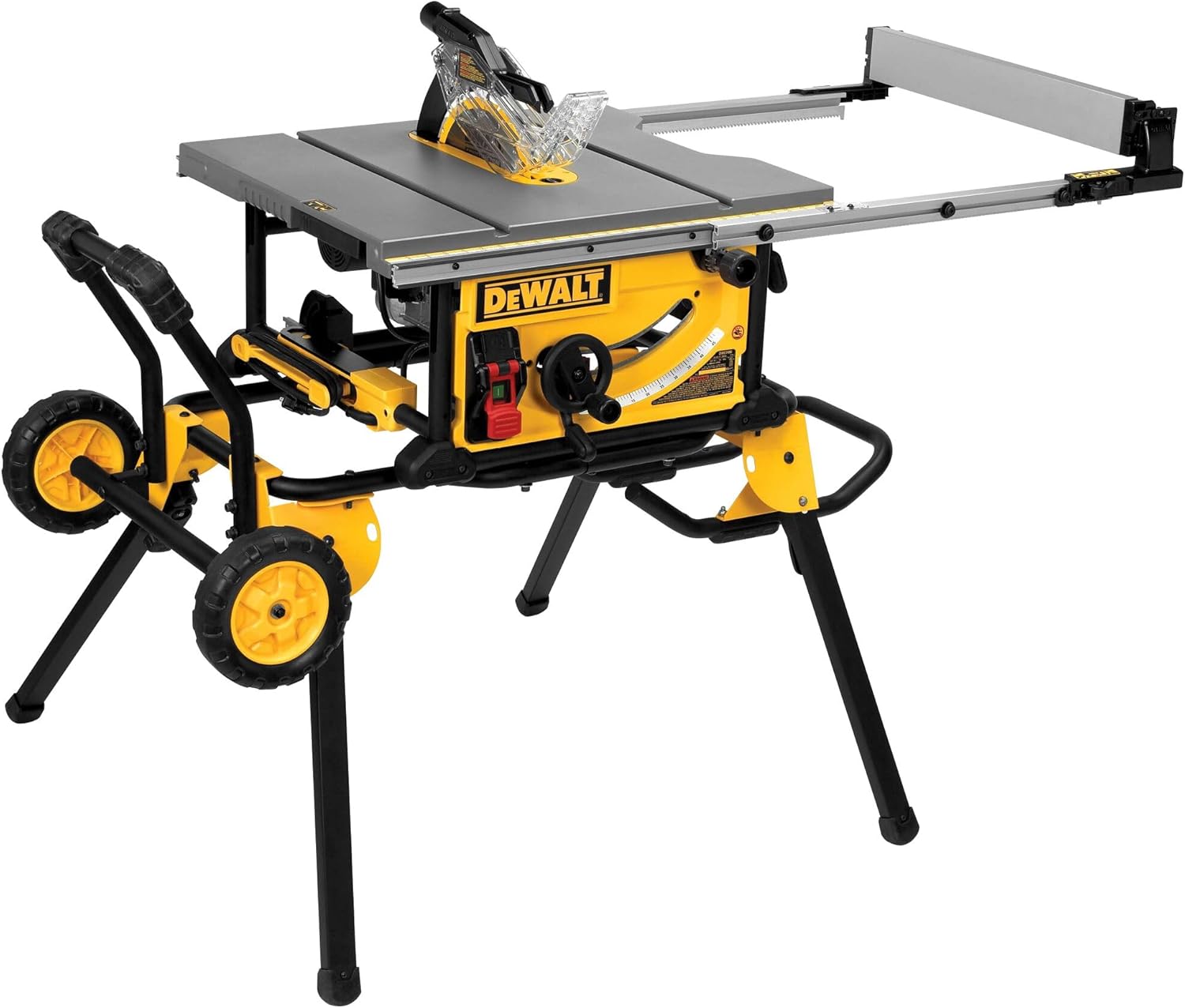
DEWALT DWE7491RS 10-Inch Table Saw with Rolling Stand
A powerful 10-inch jobsite table saw with a 15-amp motor, 32-1/2-inch rip capacity, rack-and-pinion telescoping fence, and folding rolling stand. It is built for larger workpieces while remaining portable enough for jobsites and workshops.
Check Price on Amazon (opens Amazon in a new tab)Grizzly G0715P — Best for Serious Hobbyists Ready to Commit

This is where a hobbyist stops thinking about a table saw as a tool and starts thinking about it as shop infrastructure. It’s a genuine hybrid saw, with cabinet-mounted trunnions doing the same job they do on a full cabinet saw, just in a lighter, less expensive package. Fine Woodworking’s own hands-on testing measured arbor runout under 0.001 inches, a tolerance that portable saws in this guide simply can’t promise to hold years down the road.
Strengths: Independently verified precision, a cast-iron top that resists flex under real pressure, and full dado stack compatibility without extra parts.
Limitations: Ships prewired for 220V, meaning you’ll need that circuit or an electrician before it’s usable. The same testing flagged the miter gauge as having too much play, and more than one owner has upgraded the stock fence not long after buying.
Best for: Hobbyists doing joinery-heavy work, fine furniture, or anyone who’s decided woodworking is a long-term craft rather than an occasional weekend activity.
Shop Fox W1837 — Best Hybrid Alternative

This covers the same hybrid ground as the Grizzly, cabinet-mounted cast-iron trunnions, a precision-ground table, dado capability, but solves the power problem the Grizzly creates. It’s prewired for a standard 120V, 20-amp household circuit, which most garages already have, removing the rewiring step entirely.
Strengths: The same hybrid-tier accuracy as the Grizzly without needing 220V, a fully enclosed steel base with genuinely effective dust collection, and a Biesemeyer-style T-fence that’s well regarded out of the box.
Limitations: At 260 to 300 pounds, it’s the heaviest saw in this guide, and it’s priced similarly to the Grizzly despite the power convenience.
Best for: Hobbyists who want hybrid-level precision but don’t have or don’t want to arrange 220V power. Our Best Hybrid Table Saws Under $1,000 guide compares this saw against the Grizzly in more detail.

Shop Fox W1837 10-Inch 2 HP Open-Stand Hybrid Table Saw
A 10-inch hybrid table saw that combines cabinet-style features with an open stand. The W1837 uses a 2 HP single-phase motor, cabinet-mounted cast-iron trunnions, a precision-ground cast-iron table, 30-inch right-side rip capacity, and a built-in mobile base for easier shop positioning.
Check Price on Amazon (opens Amazon in a new tab)SKIL TS6307-00 — Best for Testing the Hobby

Not every hobbyist knows yet how serious the hobby will become, and there’s nothing wrong with finding out before spending hybrid-saw money. This saw delivers a full 10-inch blade and genuine rack-and-pinion fence accuracy at a price that won’t sting if woodworking turns out to be a passing interest.
Strengths: Independent testing confirmed 30 rip cuts through plywood with no misalignment and consistent bevel cuts up to 45 degrees. Real cutting capability without a big financial commitment.
Limitations: One experienced reviewer noted the stock fence can flex slightly under real pressure, and it won’t hold precision as long as a hybrid saw under years of heavy joinery work.
Best for: New hobbyists who want to build skill and confidence before deciding whether to invest further.

SKIL TS6307-00 15 Amp 10-Inch Portable Jobsite Table Saw
A portable 10-inch jobsite table saw with a 15-amp motor, integrated folding stand, rack-and-pinion fence, and 25-1/2-inch rip capacity. It also offers 4×4 cutting capacity at 90 degrees, 0-to-45-degree bevel adjustment, and convenient onboard storage for essential accessories.
Check Price on Amazon (opens Amazon in a new tab)SawStop CTS — Best for Hobbyists Working Solo

A lot of hobbyist woodworking happens alone in a garage, with no one else around if something goes wrong. That’s exactly the scenario where SawStop’s flesh-detection technology earns its price premium, detecting blade-to-skin contact and stopping the blade in under 5 milliseconds.
Strengths: Genuinely rigorous independent testing confirmed strong out-of-box accuracy, and the safety system is unmatched at this price point.
Limitations: The direct-drive motor cannot accept a dado stack under any circumstances, and it has the smallest rip capacity in this guide at 24.5 inches.
Best for: Hobbyists who weigh solo-shop safety heavily enough to accept less rip capacity and no dado support in exchange.

SawStop CTS-120A60 Compact Table Saw
A compact and portable 10-inch table saw with a 15-amp direct-drive motor, rack-and-pinion fence, quick-tilt bevel adjustment, and SawStop’s patented safety system. It supports rip cuts up to 24-1/2 inches and weighs just 68 pounds, making it a practical choice for jobsite and workshop use.
Check Price on Amazon (opens Amazon in a new tab)Dado Work: A Real Dividing Line for Hobbyists

This matters more for hobbyists than for casual DIYers, since joinery is often where a hobby genuinely grows into a craft. Only the Grizzly and Shop Fox in this guide accept a dado stack without extra parts. The DeWalt needs a separate throat plate. The SawStop can’t accept one at all. If dado joinery, box joints, or similar work is where your projects are headed, this single factor should weigh as heavily as price. Our Best Table Saws for Dado Cuts guide goes deeper into this specific need.
Planning for the Saw You’ll Want in Three Years

The most common mistake serious hobbyists make isn’t buying the wrong saw, it’s buying the right saw for right now and outgrowing it faster than expected. If your projects are already trending toward furniture, joinery, and repeatable precision, it’s often cheaper in the long run to buy the hybrid-tier saw now rather than buying a portable saw today and a hybrid saw again in two years. If you’re genuinely unsure how far the hobby will go, starting with the SKIL or the DeWalt and upgrading later isn’t a bad plan either, since both hold real resale value.
Common Mistakes Hobbyists Make

- Buying a hybrid saw’s precision and price before actually needing that level of accuracy for current skill level and projects
- Underbuying and outgrowing a saw within a year or two once joinery and furniture work become the focus
- Not planning for a 220V circuit before buying a saw that requires one
- Ignoring dado capability entirely, then being frustrated once joinery becomes part of the plan
- Assuming every fence stays accurate forever without occasional checking and truing, regardless of trunnion type
- Treating trunnion mounting as a minor spec instead of the single best predictor of long-term accuracy
Frequently Asked Questions
What’s the difference between a table saw for hobbyists and one for beginners?
The core difference is planning for the long term rather than just the next project. A beginner-focused saw prioritizes safety and ease of use for someone just starting out. A hobbyist-focused saw weighs long-term accuracy, trunnion mounting, and dado capability more heavily, since a committed hobbyist is more likely to still be using the same saw years later on more demanding work. Our Best Table Saw for DIY Woodworking guide covers the broader DIY audience if you’re earlier in that journey.
Is a hybrid saw worth it for a hobbyist, or is that overkill?
It depends on where your projects are headed. If you’re doing occasional shelving and small furniture, a portable saw like the DeWalt or SKIL covers that well. If joinery, fine furniture, or repeatable precision cuts are becoming a regular part of your work, a hybrid saw’s cabinet-mounted trunnions genuinely pay off in accuracy that holds up over years rather than months.
Do I need 220V power for a hobbyist-grade table saw?
Only if you choose a saw that requires it. The Grizzly G0715P ships prewired for 220V. The Shop Fox W1837 covers the same hybrid-tier accuracy on a standard 120V household circuit instead, which is worth knowing if running a new circuit isn’t practical in your space.
How much should a serious hobbyist expect to spend on a table saw?
Most hobbyists land somewhere between $250 and $1,000. Entry-level portable saws start around $250 to $650 and cover most early and intermediate projects well. Hybrid-tier saws with cabinet-mounted trunnions generally run $850 to $1,000, and are worth it once accuracy and dado capability become priorities rather than nice-to-haves.
Is SawStop worth it for a hobbyist working alone?
Many solo hobbyists find it worth the trade-offs, since the flesh-detection technology matters most exactly when no one else is around to help in an emergency. The real cost isn’t just the price premium, it’s the smaller rip capacity and lack of dado support compared to cheaper alternatives, so weigh those limitations against how much the safety technology matters to you.
Bottom Line
For most hobbyists, the DeWalt DWE7491RS remains the safest starting point, with enough capacity and accuracy to handle years of varied projects. Step up to the Grizzly or Shop Fox once your work genuinely demands hybrid-level precision and dado capability, choosing between them based on whether you have 220V power available. Start with the SKIL if you’re still finding out how serious the hobby will become, and consider the SawStop if solo-shop safety outweighs the rip capacity and dado trade-offs for you.

Finlay Connolly is a woodworking enthusiast and power tool specialist with over a decade of hands-on experience in the workshop. As the founder and lead writer at ProTableSawReviews.com, Finlay combines expert knowledge with real-world testing to help woodworkers, DIYers, and professionals choose the best tools for the job. With a sharp eye for detail and a passion for precision, Finlay is committed to providing trustworthy, practical advice backed by years of experience and research in the field. Whether you’re cutting dados or comparing fence systems, you can count on Finlay for honest, reliable reviews that make your next cut your best one.


