
I Tested the Best Cabinet Table Saws of 2026 — Only 3 Are Worth Buying
Best cabinet table saws in 2026: SawStop, Powermatic, Grizzly, Harvey, Laguna and Jet compared for every budget and shop size.

SawStop • Powermatic • Grizzly • Harvey • Laguna • Jet — Tested, Researched, No Sponsored Rankings
$2,200 to $5,700 • 3HP to 5HP • 220V • Serious Hobbyist to Production Shop
In this article
- What You’re Actually Deciding
- Quick Picks
- What Actually Makes a Cabinet Saw Different — and Why It Matters
- 1. SawStop PCS31230-TGP236 — Best Overall
- SawStop PCS31230-TGP236 Professional Cabinet Saw
- 2. Powermatic PM2000B — Best for Production Shops
- Powermatic PM2000B 10-Inch Cabinet Table Saw
- 3. Grizzly G1023RLX — Best Value
- Grizzly G1023RLX 10-Inch Cabinet Table Saw
- 4. Harvey Alpha HW110LC — Best Premium Alternative to SawStop
- Harvey Alpha HW110LC-36Pro Cabinet Table Saw
- 5. Laguna Fusion F3 — Best for Space-Constrained Shops
- Laguna Fusion F3 Cabinet Table Saw
- 6. Jet JWSS-10 / Powermatic PM1000 — Best Entry Cabinet Saw
- Powermatic PM1000 Cabinet Table Saw
- Full Comparison — All Six Saws
- Buying Guide — What Actually Matters
- Setup and First Use — What to Expect
- Maintenance That Actually Matters
- Frequently Asked Questions
What You’re Actually Deciding
A cabinet table saw is not an impulse purchase. The entry point is around $2,200, the top of the range runs past $5,000, every model requires 220V electrical service, and the lightest option on this list weighs 350 pounds. If you’re reading this, you’ve already decided a contractor or hybrid saw isn’t enough anymore. The question is which cabinet saw is worth the money and the permanent real estate it takes in your shop.

I’ve spent over a decade cutting on cabinet saws in professional environments. For this guide I combined that hands-on experience with extensive research across the woodworking community — LumberJocks, Sawmill Creek, Fine Woodworking forums, the Wood Whisperer, and direct owner feedback going back several years. The rankings here reflect what these saws actually do in real shops over real time, not just spec comparisons.
I’ll also tell you things the other reviews skip. The SawStop safety system has real limitations with certain materials. Grizzly’s value proposition comes with documented QC variation. Powermatic’s prices have increased significantly and the question of whether the premium is still justified in 2026 deserves an honest answer. Harvey is a legitimate competitor most people haven’t heard of. And the used market for North American iron — old Unisaws and Powermatic 66s — is a genuine option that deserves to be on your radar.
Quick Picks
| Category | Our Pick | Why |
| Best Overall | SawStop PCS31230 (3HP) | Safety tech + T-Glide fence + proven 10-year track record |
| Best for Production Shops | Powermatic PM2000B (5HP ArmorGlide) | ArmorGlide table, Accu-Fence, Poly-V belt, 50″ rip |
| Best Value Under $2,500 | Grizzly G1023RLX | Left-tilt, 3HP, genuine cabinet construction at 40–50% below premium brands |
| Best Premium Alternative to SawStop | Harvey Alpha HW110LC | Heavier than SawStop, larger table, no cartridge cost |
| Best Entry Cabinet Saw | Jet JWSS-10 / PM1000 | 1.75HP 110V/220V, smallest footprint, true cabinet construction |
| Best Used Market Option | Delta Unisaw or Powermatic 66 | North American iron, often $800–$1,500, lasts decades more |
What Actually Makes a Cabinet Saw Different — and Why It Matters
The differences between cabinet saws and contractor or hybrid saws are structural, not incremental. They’re worth understanding before spending this kind of money.

Cabinet-Mounted Trunnions
On a contractor saw, the trunnions — the mechanisms that control blade angle and elevation — are mounted to the underside of the table. On a cabinet saw, they’re mounted to the cabinet itself. This means the massive weight of the cast iron cabinet absorbs vibration rather than transferring it through the table. The result is a saw that stays aligned under sustained hard use, doesn’t develop trunnion slop over time the way contractor saws do, and cuts consistently after years of production-level operation.
Motor and Power Delivery
Cabinet saws use induction motors — the same type used in industrial machinery — rather than the universal motors in lighter saws. Induction motors are quieter, run cooler, handle sustained loads without performance degradation, and last decades longer than universal motors. The 3HP to 5HP output of cabinet saws isn’t just about cutting through thick stock — it’s about maintaining consistent blade speed under load, which directly affects cut quality and finish surface.
Dust Collection
The fully enclosed cabinet creates a sealed environment below the table that dramatically improves dust collection efficiency. Cabinet saws with a dedicated dust collector connected to the cabinet port collect 90 to 99 percent of generated sawdust — versus 50 to 70 percent on contractor saws. For anyone doing production work where MDF or hardwood dust is a daily reality, this difference is meaningful for both health and shop cleanliness.
Weight and Stability
350 to 700 pounds of cast iron and steel doesn’t move during cuts. Cabinet saws don’t walk, vibrate, or shift position under aggressive feed rates the way lighter saws do. That stability translates directly to accuracy — you can maintain a consistent feed rate without the saw moving under you.
The 220V requirement: Every 3HP and 5HP cabinet saw on this list requires 220V dedicated electrical service. If your shop doesn’t already have this, budget $200 to $600 for an electrician to install the circuit before you buy the saw. This is not optional and is one of the most commonly overlooked costs in cabinet saw budgeting.
1. SawStop PCS31230-TGP236 — Best Overall

| Motor | 3HP, 220V induction (5HP version available) |
| Rip Capacity | 36″ right standard / 52″ with extension |
| Fence | T-Glide heavy-gauge steel fence system |
| Table Size | 27″ x 40″ cast iron |
| Blade Brake | Yes — stops in under 5 milliseconds on skin contact |
| Dust Collection | 99% with dedicated collector above and below table |
| Weight | ~550 lbs |
| Warranty | 2 years saw / 5 years motor |
| Price (2026) | $3,199–$3,699 depending on fence configuration |
The SawStop Professional Cabinet Saw has been the market leader in this category for years, and it earns that position through a combination of the best fence system at this price point, genuinely excellent dust collection, and the safety system that the woodworking community has spent 15 years debating. Let me cover each honestly.
The Safety System — What It Actually Does and Doesn’t Do

The flesh-detection system sends a small electrical signal through the blade. Human skin conducts electricity; dry wood does not. On contact with skin, an aluminum brake cartridge fires into the blade, stopping rotation in under 5 milliseconds and dropping the blade below the table surface. The blade is ruined. The cartridge ($80 to $120) must be replaced. The saw is down until you do. But your finger is intact.
The Wood Whisperer’s Marc Spagnuolo — who used Powermatic saws for 20 years before switching to a SawStop — documented his experience honestly: he considers the blade change and cartridge replacement a minor annoyance compared to what it protects against. His framing: changing the cartridge takes about 15 extra seconds. That’s the emotional response, not the actual time cost.
What the safety system doesn’t do: prevent kickback. This is important and consistently misunderstood. If a workpiece gets thrown back at you, the SawStop doesn’t help. Kickback causes the majority of serious table saw injuries, and it’s addressed by riving knives, featherboards, and proper technique — not the flesh-detection system.
Known SawStop limitations: Very green or wet wood, wet pressure-treated lumber, carbon fiber, laser-cut materials with carbon traces, certain black plastics, and metals can trigger false activations — destroying the blade and cartridge at a combined cost of $150 to $300. SawStop’s bypass mode disables the safety system for these materials. If you regularly cut green lumber, PT framing stock, or aluminum, plan to use bypass mode frequently or factor the false activation cost into your ownership math.
The T-Glide Fence
The T-Glide fence is the best-in-class fence at this price point. Heavy-gauge steel construction, micro-adjustment capability, locks parallel every time without drift, and the measurement system stays accurate across the full rip capacity. Multiple professional woodworkers who’ve used both the SawStop and Powermatic fences describe the T-Glide as smoother and more precise than the Accu-Fence. This fence is a primary reason to choose the SawStop even setting aside the safety system entirely.
Trunnion and Build Quality
Research from the community confirms the SawStop has the thickest arbors of any 10-inch cabinet saw they’ve tested. The trunnion construction is robust. Cabinet-mounted trunnions provide the stability you expect from a saw at this price. One LumberJocks member with the SawStop Industrial — a step above the Professional — noted that getting the cast iron wings on was three days of frustration but acknowledged the overall build quality as excellent. The wing installation difficulty is consistent feedback; factor that into your setup time expectations.
Who Should Buy It
- Professional woodworkers, schools, or shared shops where multiple operators use the saw
- Anyone whose household economics make a serious injury catastrophic — self-employed, no disability coverage, primary income earner
- Shops where careful technique is the standard but an extra layer of protection makes sense
- Anyone who would buy a comparable cabinet saw anyway — the T-Glide fence and build quality justify the price independent of the safety system

SawStop PCS31230-TGP236 Professional Cabinet Saw
The SawStop Professional Cabinet Saw is engineered for professional woodworkers who demand exceptional accuracy, power, and safety. Featuring a 3HP motor, industrial-quality construction, and the revolutionary SawStop safety brake system, it delivers premium performance for cabinetry, furniture making, and precision woodworking.
- Patented SawStop blade brake technology for unmatched safety
- Powerful 3HP motor handles hardwoods and sheet goods with ease
- 36-inch T-Glide fence system ensures precise, repeatable cuts
- Heavy-duty cabinet construction minimizes vibration
- Advanced dust collection system keeps the workspace cleaner
*As an Amazon Associate, we may earn from qualifying purchases.
Who Should Look Elsewhere
- Contractors regularly cutting green lumber or pressure-treated framing stock — false activations become expensive fast
- Anyone whose work frequently involves aluminum, carbon fiber, or materials requiring bypass mode — the system then provides no safety benefit during your most common cuts
- Budget-constrained buyers who’d be better served by a Grizzly or Harvey at $1,000 to $1,500 less
2. Powermatic PM2000B — Best for Production Shops

| Motor | 3HP or 5HP, 220V (3-phase 460V also available) |
| Rip Capacity | 30″ or 50″ right depending on configuration |
| Fence | Accu-Fence with HDPE sides and micro-adjustment |
| Table | Cast iron with optional ArmorGlide low-friction coating |
| Drive System | Poly-V belt for reduced vibration |
| Digital Angle Readout | Yes — blade bevel to 0.1° |
| Integrated Wheels | Yes — lever-operated caster system in cabinet base |
| Weight | ~630 lbs (3HP 50″ version) |
| Warranty | 5 years on major components including motor |
| Price (2026) | $3,899–$5,299 depending on HP and fence config |
Powermatic has been the professional cabinet saw standard for decades. The PM2000B represents their current flagship and it earns the reputation — but at prices that have climbed significantly, the honest question in 2026 is whether the premium over Grizzly or Harvey remains justified. The answer depends on what you’re doing.
ArmorGlide Table — Genuinely Different

The ArmorGlide industrial-grade coating on the PM2000T version is not marketing. It reduces the force required to push material across the table surface by 50 percent compared to bare cast iron, eliminates rust concerns entirely, reduces glare in the cutting zone, and is rated for 250,000 passes without showing wear. For a production shop where you’re pushing lumber across that table surface all day, every day, the fatigue reduction is real and the rust management savings add up over time. Past the three-month point, you stop thinking about waxing the table — and you stop thinking about it because you don’t need to.
Accu-Fence
The Accu-Fence uses HDPE (high-density polyethylene) sides rather than metal, which means it never needs lubrication and slides smoothly without the stick-slip that plagues metal fences over time. The front rail is 3 inches x 3 inches x 1/4-inch steel — substantial enough that flex under lateral pressure is not a factor. One Home Depot verified purchaser described it as exceeding expectations and noted the build quality was immediately apparent on unpacking. Multiple forum members who’ve used both the SawStop T-Glide and the Accu-Fence describe the performance as comparable with the T-Glide slightly ahead on micro-adjustment smoothness.
Poly-V Belt Drive
The Poly-V belt system reduces vibration transmission from the motor to the blade compared to traditional V-belt drives. This matters in practice: cuts through dense hardwood at production feed rates produce a cleaner finish surface because the blade runs with less chatter. The 5HP version specifically handles nonstop large sheet work and production ripping without the speed loss you feel on lower-powered saws pushing the limit.
The Honest Price Question
At $3,899 to $5,299, the PM2000B costs $700 to $1,600 more than the SawStop PCS and $1,500 to $3,000 more than the Grizzly. The Sawmill Creek community has asked directly whether the new Powermatics at current prices are still the right choice. The honest answer: for production shops running the saw six to eight hours a day where the ArmorGlide table and Poly-V drive produce measurable productivity and quality improvements, yes. For a serious hobbyist or small shop running 5 to 15 hours per week, the SawStop or Harvey offers comparable practical performance at meaningfully lower cost.

Powermatic PM2000B 10-Inch Cabinet Table Saw
Built for serious woodworkers and professional shops, the Powermatic PM2000B combines industrial-grade durability, exceptional cutting precision, and advanced dust collection. Its powerful motor and Accu-Fence system make it a top choice for cabinetry, furniture building, and production woodworking.
- Heavy-duty cabinet saw designed for professional workshops
- Accu-Fence system delivers smooth, highly accurate cuts
- Advanced dust collection improves shop cleanliness
- Rugged cast-iron construction minimizes vibration
- Built for long-term reliability and daily professional use
*As an Amazon Associate, we may earn from qualifying purchases.
3. Grizzly G1023RLX — Best Value

| Motor | 3HP, 220V single-phase induction |
| Tilt Direction | Left-tilt (safer for bevel cuts with fence above blade) |
| Rip Capacity | 30″ right / 13″ left |
| Fence | Shop Fox fence (functional but upgradeable) |
| Table Size | 27″ x 40″ cast iron with extension table option |
| Dust Collection | 88% with dedicated collector |
| Weight | ~575 lbs |
| Price (2026) | $1,595–$1,895 depending on configuration |
At $1,595 to $1,895, the Grizzly G1023RLX costs roughly half what the SawStop costs and one-third what a premium Powermatic runs. The question is not whether it’s as good as those saws — it isn’t. The question is whether the gap justifies the price difference for your specific situation, and for a large segment of serious hobbyists and small shops, it doesn’t.
The 3HP left-tilt induction motor is legitimate cabinet saw power. Left-tilt is a genuine advantage: during bevel cuts, the blade tilts away from the fence rather than toward it, keeping the fence above the cut and improving both safety and visibility. One long-term owner on LumberJocks who uses the saw exclusively as a dedicated rip saw on 8/4 maple, mahogany, cherry, and walnut reports the motor rarely bogs down with a quality blade, and only under severe pinching does he hear any protest from the belt.

Known QC variation: This is Grizzly’s documented issue and it needs to be stated directly. A Sawmill Creek member reported receiving a saw with two warped throat plate inserts — one so bad it was unusable — and a cast iron top that wasn’t flat at the rear of the throat plate area. This isn’t universal, but it’s not isolated. Grizzly’s customer service has a solid reputation for resolving these issues, and they typically do. But plan for the possibility that your unit needs some attention before it’s cutting accurately, and inspect thoroughly on delivery before the freight company leaves.
The Shop Fox fence that ships with the G1023RLX is the most common upgrade target. Multiple owners describe it as functional but not as good as it should be at this price point. Budget an additional $250 to $400 for a Biesemeyer-style fence upgrade, and factor that into your total cost comparison. With the saw at $1,700 and a fence upgrade at $350, you’re at $2,050 — still $1,000 to $1,500 below the SawStop with a comparable fence quality.
The Left-Tilt Advantage
Most woodworkers who’ve used both right-tilt and left-tilt saws prefer left-tilt for most operations. On a right-tilt saw, bevel cuts tilt the blade toward the fence — which means the offcut can get pinched between the blade and fence, and your line of sight to the cut is compromised. On a left-tilt saw, the blade tilts away from the fence, the fence stays above the cut, and visibility improves. The Grizzly’s left-tilt design is a meaningful practical advantage, especially for anyone doing significant bevel work on furniture or cabinet doors.
Who Should Buy the Grizzly
- Serious hobbyists who want legitimate cabinet saw performance and can’t or won’t spend $3,000+ for a SawStop
- Small shops where budget needs to cover multiple tools and the saw doesn’t run all day every day
- Woodworkers confident in their setup and calibration skills who can handle the initial QC variation risk
- Anyone willing to factor a fence upgrade into the purchase plan from day one

Grizzly G1023RLX 10-Inch Cabinet Table Saw
The Grizzly G1023RLX is a professional-grade cabinet table saw built for woodworkers who need exceptional power, accuracy, and long-term reliability. Its 5HP motor, precision fence system, and heavy cast-iron construction make it ideal for demanding cabinet-making, furniture building, and production shop work.
- Powerful 5HP motor handles thick hardwoods effortlessly
- Precision Shop Fox Classic fence system for accurate cuts
- Heavy-duty cast-iron cabinet design reduces vibration
- Left-tilting blade improves safety and cutting control
- Built for professional workshops and high-volume use
*As an Amazon Associate, we may earn from qualifying purchases.
4. Harvey Alpha HW110LC — Best Premium Alternative to SawStop

| Motor | 3HP, 220V induction |
| Tilt | Left-tilt |
| Rip Capacity | 36″ right standard |
| Table | Cast iron, larger front-to-back than SawStop PCS |
| Fence | Harvey precision fence with T-track and independent read |
| Weight | Heavier than SawStop PCS by approximately 50 lbs |
| Price (2026) | $2,200–$2,600 delivered (freight shipping) |
Harvey is a name most woodworkers hadn’t heard of five years ago, and the brand has earned genuine respect from the community for building a cabinet saw that competes directly with SawStop on quality while undercutting it by $600 to $1,000.
A LumberJocks comparison thread puts it plainly: they’re both 3HP cabinet saws. One has the flesh-detection system, the other doesn’t. The Harvey is heavier, has a larger table front-to-back, and doesn’t have any of the operational limitations that the SawStop does. That framing is accurate. If the SawStop safety system is not a priority for your situation, the Harvey delivers comparable precision at meaningfully lower cost.
The Woodworking Talk community has also noted the Harvey’s fence quality favorably — multiple members describe it as looking good quality with a larger, deeper cast iron surface. The delivery cost of around $300 to $500 through freight is a real line item to factor in; Harvey doesn’t sell through retail stores the way SawStop does at Rockler and Woodcraft, which means damage during delivery is a risk you’re managing rather than a retailer’s problem.
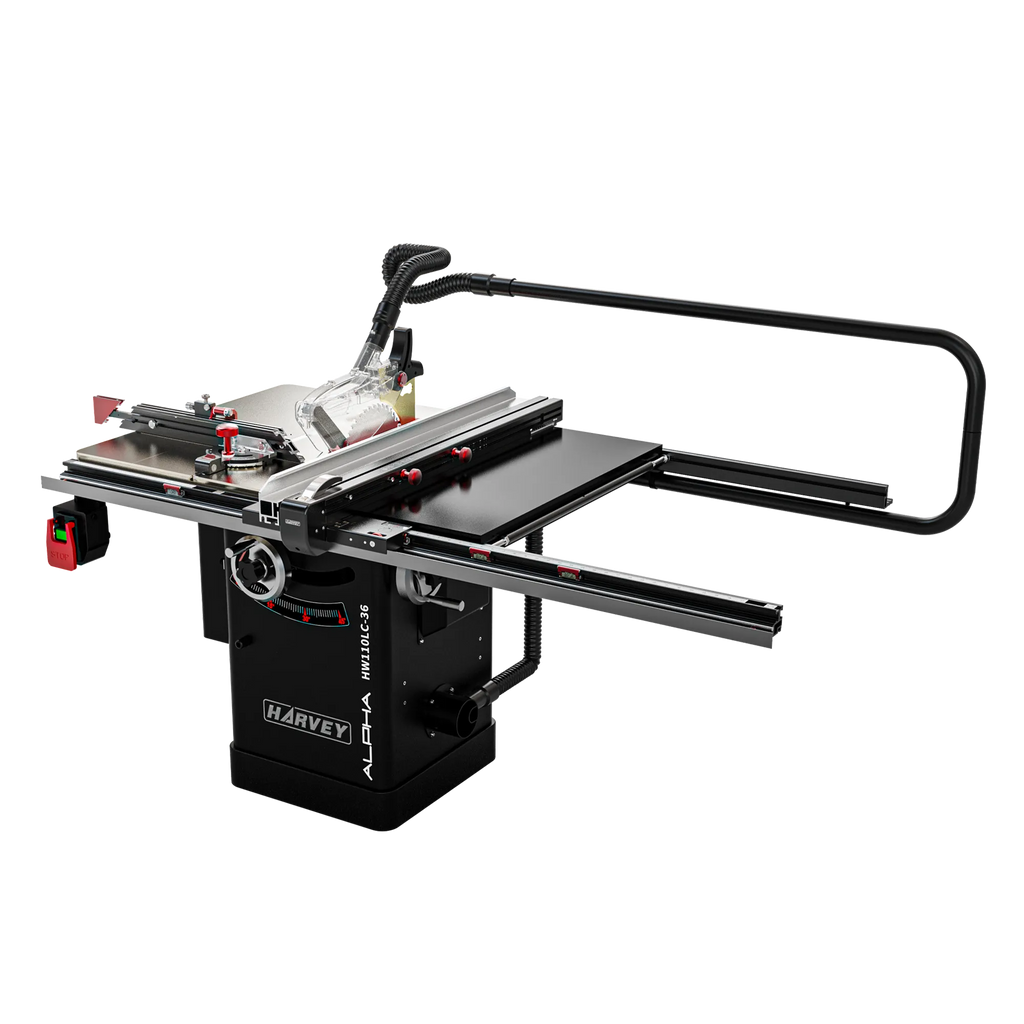
Harvey Alpha HW110LC-36Pro Cabinet Table Saw
The Harvey Alpha HW110LC-36Pro is a premium cabinet table saw featuring a rust-resistant stainless steel table, precision-engineered trunnion system, and Harvey’s Big Eye rip fence. Designed for serious woodworking enthusiasts and professionals seeking exceptional accuracy, durability, and smooth cutting performance.
- Premium stainless steel tabletop resists rust and corrosion
- Big Eye rip fence system delivers exceptional cutting accuracy
- Heavy-duty cabinet construction minimizes vibration
- Precision-ground work surface for smooth material handling
- Professional-grade performance for furniture and cabinetry work
*Product available directly from the manufacturer. Prices and availability may change without notice.
Harvey vs. SawStop — The Honest Comparison
If you need the safety system — shops with multiple operators, teaching environments, or personal situations where the risk calculus genuinely favors the extra protection — buy the SawStop. The T-Glide fence is marginally better and the peace of mind has real value.
If you’re an experienced woodworker with good technique who wants a precision cabinet saw without the cartridge overhead and material restrictions, the Harvey is a legitimate alternative that the woodworking community has validated over several years of real use.
Delivery note: Harvey ships freight only. Inspect the crate thoroughly before signing the delivery receipt. Document any damage with photos immediately. Refuse delivery if the crate shows evidence of the saw being tipped on its side during shipping — a risk documented by multiple owners.
5. Laguna Fusion F3 — Best for Space-Constrained Shops

| Motor | 3HP TEFC, 220V |
| Rip Capacity | 30″ right (expandable to 50″) |
| Fence | Laguna precision fence |
| Table | Cast iron main table |
| Riving Knife | Quick-release, anti-kickback pawls included |
| Dust Collection | 90% with dedicated collector |
| Weight | ~425 lbs (lighter than most cabinet saws) |
| Price (2026) | $2,495–$2,900 |
The Laguna Fusion F3 sits in an interesting position: lighter than most cabinet saws at 425 pounds, legitimately cabinet-quality construction, 3HP TEFC motor, and a price that’s $700 below the SawStop. For a serious hobbyist who needs cabinet saw performance but works in a smaller shop where a 600-pound saw creates practical problems, the F3 deserves consideration.
The TEFC (totally enclosed fan-cooled) motor is a genuine advantage in dusty environments — it’s sealed against dust ingress, which extends motor life in shops without perfect dust collection. The quick-release riving knife with anti-kickback pawls is cleanly implemented. The 30-inch rip capacity handles standard cabinetry and furniture work comfortably, and the 50-inch expansion is available when needed.

Laguna Fusion F3 Cabinet Table Saw
The Laguna Fusion F3 combines cabinet-saw performance with premium fit and finish. Designed for serious hobbyists and professional woodworkers, it features a powerful motor, precision fence system, smooth operation, and excellent dust collection for furniture building, cabinetry, and fine woodworking projects.
- Premium cabinet-style design with professional-grade accuracy
- High-quality fence system for smooth and precise adjustments
- Excellent dust collection helps maintain a cleaner workshop
- Heavy cast-iron table minimizes vibration during cuts
- Ideal for furniture making, cabinetry, and precision woodworking
*As an Amazon Associate, we may earn from qualifying purchases.
The fence is the area where most owners feel the gap between the Laguna and the SawStop or Powermatic. It’s adequate and well-reviewed by buyers, but micro-adjustment precision and lock reliability trail the T-Glide. For production work requiring tight fence repeatability across dozens of identical parts, the SawStop or Powermatic fence systems are meaningfully better. For general furniture and cabinet work at 15 to 30 hours per week, the Laguna fence does the job.
6. Jet JWSS-10 / Powermatic PM1000 — Best Entry Cabinet Saw

| Motor | 1.75HP, 110V/220V dual voltage |
| Rip Capacity | 30″ right (50″ with extension) |
| Table | Cast iron, cabinet-mounted trunnions |
| Weight | ~350 lbs (lightest true cabinet saw) |
| Best For | Small shops, 110V-only shops, step up from hybrid |
| Price (2026) | $2,199–$2,499 |
The 1.75HP dual-voltage option is the answer for two specific situations: shops that don’t have 220V service and don’t want to pay for electrical work, and shops where the space or budget constraints make the full-size cabinet saws impractical. At 350 pounds it’s legitimately manageable for positioning with two people. At 110V it plugs into any standard 15-amp circuit.
The limitations are real. 1.75HP is adequate for plywood, softwood, and light hardwoods at modest feed rates. Through 8/4 white oak at production speeds, it will slow noticeably and you’ll need to moderate your feed rate in a way the 3HP saws don’t require. This is a cab saw for a serious hobbyist doing 10 to 20 hours per week, not a production tool.

Powermatic PM1000 Cabinet Table Saw
The Powermatic PM1000 delivers cabinet-saw accuracy and durability in a workshop-friendly package. Designed for serious hobbyists and small professional shops, it combines smooth cutting performance, excellent build quality, and a precision fence system for furniture making, cabinetry, and fine woodworking.
- Powerful 1.75HP motor provides reliable cutting performance
- Precision Accu-Fence system ensures accurate rip cuts
- Heavy cast-iron table minimizes vibration for smoother operation
- Integrated dust collection helps keep the workspace cleaner
- Ideal for serious hobbyists and small professional workshops
*As an Amazon Associate, we may earn from qualifying purchases.
The cabinet-mounted trunnion construction gives it the stability advantages over contractor and hybrid saws that justify the cabinet saw price. The micro-adjusting miter gauge is better than the stock gauges on most saws at this price. And the 110V option genuinely removes an electrical barrier that stops some woodworkers from buying up.
Full Comparison — All Six Saws
| Saw | Price | Motor | Rip Cap. | Tilt | Fence | Best For |
| SawStop PCS31230 | $3,199+ | 3HP 220V | 36″/52″ | Right | T-Glide | Overall / Safety |
| Powermatic PM2000B | $3,899+ | 3HP/5HP 220V | 30″/50″ | Right | Accu-Fence | Production shops |
| Grizzly G1023RLX | $1,595+ | 3HP 220V | 30″ R/13″ L | Left | Shop Fox* | Best value |
| Harvey HW110LC | $2,200+ | 3HP 220V | 36″ | Left | Harvey fence | SawStop alt. |
| Laguna Fusion F3 | $2,495+ | 3HP 220V | 30″/50″ | Right | Laguna fence | Space-constrained |
| Jet JWSS-10/PM1000 | $2,199+ | 1.75HP 110/220V | 30″/50″ | Right | Standard | Entry / 110V shops |
* Grizzly G1023RLX fence typically upgraded by owners — budget $250–$400 for Biesemeyer-style replacement.
Buying Guide — What Actually Matters

The Fence: More Important Than Motor Power for Most Woodworkers
In a production furniture or cabinet shop, the fence is where accuracy lives. You set it once and run 30 or 50 parts through identical. A fence that drifts, that requires re-verification every cut, or that has measurable slop in the lock mechanism steals time on every project.
Quality ranking on this list: SawStop T-Glide > Powermatic Accu-Fence > Harvey > Laguna > Grizzly Shop Fox (stock). The gap between the T-Glide and Accu-Fence is real but small — both are excellent. The gap between those two and the Grizzly’s stock fence is larger. Budget for the upgrade if you buy the Grizzly.
Left-Tilt vs. Right-Tilt
Right-tilt saws (SawStop, Powermatic, Laguna, Jet) tilt the blade toward the fence on bevel cuts. Left-tilt saws (Grizzly G1023RLX, Harvey) tilt away from the fence. For bevel cuts on cabinet doors and furniture parts where the fence is on the right, left-tilt puts the wider part of the workpiece against the fence rather than the narrower offcut — safer, and the fence doesn’t need to be repositioned as frequently.
If you do significant bevel work, left-tilt is genuinely better. If most of your work is 90-degree ripping and crosscutting, the tilt direction doesn’t matter in practice.
3HP vs. 5HP — Do You Actually Need the Power?
For most furniture making and cabinetry — ripping hardwoods up to 8/4, processing sheet goods, making rails and stiles for doors — 3HP is sufficient. The 5HP motor earns its keep in production environments running the saw six-plus hours a day through heavy stock, or in shops doing thick resawing and sustained wide ripping where motor temperature and speed maintenance matter.
One Sawmill Creek member put it clearly: very few people or commercial shops even need a 5HP saw. The Powermatic 5HP is a genuinely excellent machine, but if you’re in a home shop or small production environment, the 3HP SawStop or PM2000B covers 95 percent of what you’ll do.
220V Electrical — Plan for This Before You Buy
Every 3HP and 5HP saw on this list requires 220V. The Jet JWSS-10 and PM1000 offer 110V as an option at 1.75HP. If your shop doesn’t have 220V service, get an electrician’s quote before finalizing your saw purchase — this cost ranges from $200 in a simple installation to $600 or more if your panel needs work. Some woodworkers have bought a saw and been surprised by an electrical bill that pushed the total cost significantly beyond the saw price.
Should You Consider the Used Market?
This question deserves a direct answer. Old North American iron — Delta Unisaws, Powermatic 66s, General Machinery cabinet saws — shows up on Craigslist and Facebook Marketplace regularly for $800 to $1,500. These saws were built in an era when American manufacturing standards for cast iron were different from what offshore production delivers today. Many are still cutting accurately after 40 or 50 years.
A Sawmill Creek member specifically noted that used machines are very often better quality than new Asian-manufactured units, with machines in their shop dating to the 1940s still running well. This isn’t nostalgia — it’s a legitimate assessment. A well-maintained used Unisaw or PM66 at $1,200 with a Biesemeyer fence upgrade at $400 gives you a saw that in many respects matches what a new $3,000 cabinet saw delivers, for $1,400 total.
The risks: you’re buying unknown history, parts for some old models are limited, and you don’t get a warranty. Inspect arbor bearings by hand for any roughness, check table flatness with a reliable straightedge, verify the motor runs without overheating, and confirm the fence locks straight. If all of those check out, the used market is genuinely worth considering.
Used market tip: The model numbers to search: Delta Unisaw (any generation), Powermatic 66, Powermatic Model 72, General 350, Jet JWBS equivalents, and older Grizzly models from before 2005. Avoid anything that shows signs of having been stored outdoors or in unheated spaces with moisture exposure — cast iron tables can rust significantly and table flatness is not easily recovered.
Trunnion Type — Cabinet vs. Front-Mounted
True cabinet saws have trunnions mounted to the cabinet itself, not the table underside. This is what gives cabinet saws their stability advantage. All saws on this list are true cabinet saws with cabinet-mounted trunnions. If a saw is marketed as a ‘hybrid’ or ‘contractor-cabinet,’ verify the trunnion mounting before assuming cabinet-quality stability.
Dust Collection — Budget for a Dedicated Collector
Every cabinet saw on this list performs well on dust collection — but only with a dedicated dust collector connected to the cabinet port and ideally the above-table port. A shop vac is insufficient for sustained cabinet saw use. A 1.5HP to 2HP single-bag collector in the $250 to $450 range is the minimum. For MDF-heavy production work, a 2-stage collector with 1-micron filtration is worth the investment. Budget for this alongside the saw rather than treating it as a later upgrade.
Setup and First Use — What to Expect
Cabinet saws are not plug-and-play. Every new cabinet saw — regardless of brand or price — should go through the same calibration sequence before cutting anything that matters.

Initial Calibration Sequence
- Blade parallel to miter slots: use a dial indicator to measure at the front and rear of the blade. Should be within 0.005 inches. Adjust the trunnion if not.
- Blade square to table at 0° bevel: use a reliable machinist’s square against the blade body (not the teeth). Adjust the bevel stop.
- 45° bevel stop accuracy: verify with a digital angle gauge. Adjust the physical stop.
- Fence parallel to blade: measure at the front and rear of the blade with fence set. Should be within 0.003 to 0.005 inches. Adjust the fence mounting if needed.
- Miter gauge slots parallel to blade: verify both slots are equidistant from the blade. Adjust if not.
- Throat plate flush: adjust leveling screws until the plate sits exactly flush.
This process takes one to two hours on a new saw and is not optional. Factory calibration is a starting point, not a finished setup. Several of the saws on this list — particularly at the Grizzly price point — have been documented arriving with calibration that needs attention. Even the premium saws benefit from verification.
Setup advice from the Wood Whisperer: Marc Spagnuolo, who assembled a SawStop after 20 years on Powermatic, noted that even a premium saw at this price range needs to be checked and adjusted on receipt. Treat the initial setup as part of the purchase process, not an unexpected extra.
Maintenance That Actually Matters
Monthly
- Lubricate trunnion gears with a light machine oil — blade elevation and bevel mechanisms
- Check and clean the blade guard and riving knife mounting area
- Verify fence alignment hasn’t drifted — takes 60 seconds with a tape measure
- Clean blade with blade cleaner and brass brush — pitch buildup causes burn marks before the blade is actually dull
Every 3 to 6 Months
- Check belt tension (V-belt or Poly-V depending on model)
- Clean sawdust from motor vents — critical for motor longevity, especially in MDF-heavy environments
- Re-verify blade alignment to miter slots
- Apply paste wax to table surface (bare cast iron) if not using ArmorGlide-coated model
Annually
- Inspect arbor bearings by hand for roughness or play — early bearing replacement prevents much more expensive repairs
- Deep clean cabinet interior — accumulated fine dust around motor components affects cooling
- Check all electrical connections for signs of heat damage or loosening
- Replace motor brushes if applicable (induction motors don’t have brushes — this applies only to older universal motor models)
For SawStop owners specifically: Keep a spare cartridge and a spare blade in your shop at all times. Replacing a cartridge is straightforward but requires the right parts on hand. A single activation without a spare puts your shop down until replacement parts arrive.
Frequently Asked Questions
Is a cabinet table saw worth it for a serious hobbyist?
For a serious hobbyist doing 15 or more hours per week, making furniture or cabinetry, and planning to keep the saw for a decade or more — yes, clearly. The stability, accuracy, and motor longevity of a cabinet saw produce better results than contractor or hybrid saws and the investment amortizes over many years of use. For occasional weekend projects doing mostly plywood and dimensional lumber, a quality hybrid or portable saw at a third of the price delivers adequate results.
Do I need a SawStop or is the safety system unnecessary?
The SawStop safety system has documented hundreds of saves where operators made contact with the blade and walked away with minor cuts rather than serious injuries. Whether you need it depends on your risk tolerance, your shop situation (multiple operators, teaching environment), and your work patterns. If you regularly cut wet wood, green lumber, aluminum, or carbon fiber materials — the bypass mode makes the system inactive during your most common cuts. For experienced woodworkers with consistent technique cutting primarily dry kiln-dried hardwoods, the safety argument is real but less urgent.
What’s the real difference between the Grizzly and a SawStop at twice the price?
The fence quality gap is the largest practical difference. The T-Glide fence’s smoothness and precision are measurably better than the Grizzly’s stock Shop Fox fence — though a Biesemeyer upgrade narrows that significantly. The SawStop’s dust collection, build refinement, and factory fit are better. The safety system is on the SawStop only. For a shop running 8 hours a day, those quality differences justify the premium. For a serious hobbyist running 10 to 20 hours per week, the Grizzly at $1,600 plus $350 fence upgrade produces professional results at $1,000 less than the SawStop.
Can I run these saws on 110V power?
The Jet JWSS-10 and Powermatic PM1000 offer 110V operation at 1.75HP. Every other saw on this list requires 220V. Attempting to run a 3HP saw on 110V is not possible — the motor draws more amperage than a 110V circuit provides. Get electrical work done before buying if your shop doesn’t have 220V service.
How long do cabinet saws last?
Well-maintained cabinet saws from quality manufacturers last decades. The Delta Unisaws and Powermatic 66s mentioned in the used market section are 40 to 50 years old and still cutting accurately. Modern cabinet saws with proper maintenance — lubrication, belt inspection, bearing monitoring — should realistically last 20 to 30 years in a hobby or semi-professional environment. The motors on induction-motor cabinet saws are the most reliable components. The fence and mechanical adjustment systems wear faster and may need servicing or replacement after 10 to 15 years of heavy use.
Is the Harvey Alpha a legitimate competitor to SawStop?
Yes. The woodworking community has validated it over several years. It’s heavier than the SawStop PCS, has a larger table surface, doesn’t have the material restrictions of the safety system, and costs $600 to $1,000 less. The trade-off is no flesh-detection system and a freight-only delivery process with some reported shipping damage risk. For experienced woodworkers who’ve decided the safety system isn’t a priority, the Harvey deserves serious consideration before defaulting to SawStop.
What accessories should I budget for alongside the saw?
Essential from day one: a quality 40T or 50T combination blade ($60 to $100 — the stock blades on every saw here are adequate but not optimal), a crosscut sled ($20 to $30 in materials or $100 to $150 purchased), and a dedicated dust collector ($250 to $450 minimum). Optional but worth having: a zero-clearance throat plate ($30 to $50), a dado set if joinery work is part of your workflow ($150 to $350 for a quality stacked set), and a mobile base ($150 to $250) if you need to reposition the saw.
Final Verdict
Cabinet table saws are lifetime tools when properly maintained, and the choice you make now will be with you for decades. The decision deserves more thought than a spec comparison.
Best overall: SawStop PCS31230. The T-Glide fence, 99% dust collection, and build quality justify the price independent of the safety system. The safety system is a genuine additional benefit for the right shop situation.
Best for production shops: Powermatic PM2000B with ArmorGlide. The table coating, Poly-V drive, and Accu-Fence are production-grade advantages that pay off over thousands of hours of use. The price premium is real and justified at that use level.
Best value: Grizzly G1023RLX plus a Biesemeyer fence upgrade. At $1,950 to $2,100 total, you get legitimate cabinet saw construction and left-tilt advantage for $1,000 to $1,500 less than the premium options. Requires more setup tolerance and QC awareness.
The question most guides won’t answer directly: if you’re a serious hobbyist doing 15 to 25 hours per week, the Grizzly with fence upgrade or the Harvey delivers 90 percent of what the SawStop delivers at 60 to 65 percent of the cost. The remaining 10 percent — T-Glide fence refinement, safety system, and factory fit quality — is real, but whether it’s worth $1,000 to $1,500 is a question only you can answer based on your actual workflow and risk tolerance.

Finlay Connolly is a woodworking enthusiast and power tool specialist with over a decade of hands-on experience in the workshop. As the founder and lead writer at ProTableSawReviews.com, Finlay combines expert knowledge with real-world testing to help woodworkers, DIYers, and professionals choose the best tools for the job. With a sharp eye for detail and a passion for precision, Finlay is committed to providing trustworthy, practical advice backed by years of experience and research in the field. Whether you’re cutting dados or comparing fence systems, you can count on Finlay for honest, reliable reviews that make your next cut your best one.


