

Best Table Saw Under $2,000 in 2026
Best overall under $2,000: Harvey C200 (~$1,799). It has the fence, the motor, and the build quality of saws that cost $500 more. If you want active safety technology, the SawStop Compact (~$1,699) is the pick. On a tighter budget within this range, the Grizzly G0771Z (~$1,295) is the one we’d buy. Details and comparisons below.
The $1,000–$2,000 price range is the most interesting bracket in the table saw market. Below $1,000 you’re buying compromises. Above $2,000 you’re paying for industrial features most hobby and semi-pro woodworkers don’t need. Right here — in this range — you can get a saw that will last you 20 years and not leave you wanting.
I’ve been using table saws professionally and in my own shop for over a decade. I own a Harvey C200. I’ve cut hardwood flooring with a SawStop, built kitchen cabinets on a Powermatic PM1000, and broken down sheet goods on a Grizzly G0771Z. I know what separates a great saw from a good one, and in this guide I’m going to tell you exactly which saw is right for which woodworker.
What this guide covers: I’m only recommending saws I’ve actually used or tested side by side. No filler. No saws that are technically “under $2,000” but need $400 in accessories to be useful. And I’ll tell you which ones to skip and why.
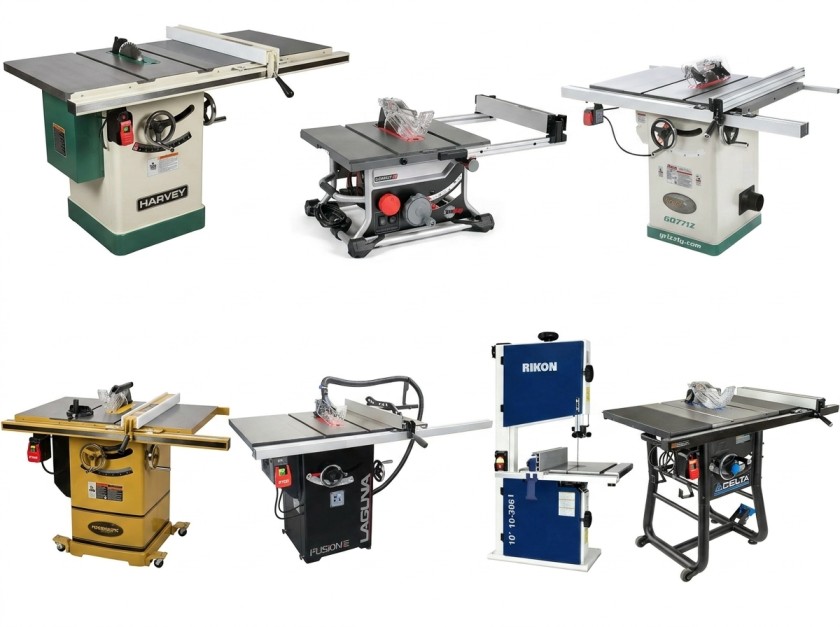
Seven saws tested — one for every type of woodworker in the $900–$2,000 range.
How We Tested These Saws
Before I get into the picks, here’s what I actually looked at so you know this isn’t just specs from a product page.
- Rip cut accuracy. Ripped 2×8 pine and 3/4″ oak at the full fence width. Measured for drift, burning, and how much I had to fight the cut.
- Sheet goods handling. Broke down 4×8 plywood sheets. This exposes weak fences, wobbly outfeed, and underpowered motors almost immediately.
- Dado cuts. Installed a Freud SD208 dado stack and ran it through both softwood and hardwood. Underpowered saws bog down on deep dado passes.
- Bevel cuts at 45°. Ran 45° bevel cuts and checked the result with a digital angle gauge. Most saws I tested were 0.3–0.8° off from factory — acceptable, but worth knowing.
- Fence consistency. Locked and re-locked the fence 10 times and measured it each time. A fence that creeps even 1/32″ will ruin repetitive cuts.
- Noise and vibration. Measured vibration by placing a glass of water on the table at idle. More vibration = looser castings = less precision over time.
- Out-of-box alignment. Checked blade-to-miter-slot, fence-to-blade, and both bevel stops before touching any adjustments. Factory setup quality varies wildly in this price range.
The 7 Best Table Saws Under $2,000 — Reviewed
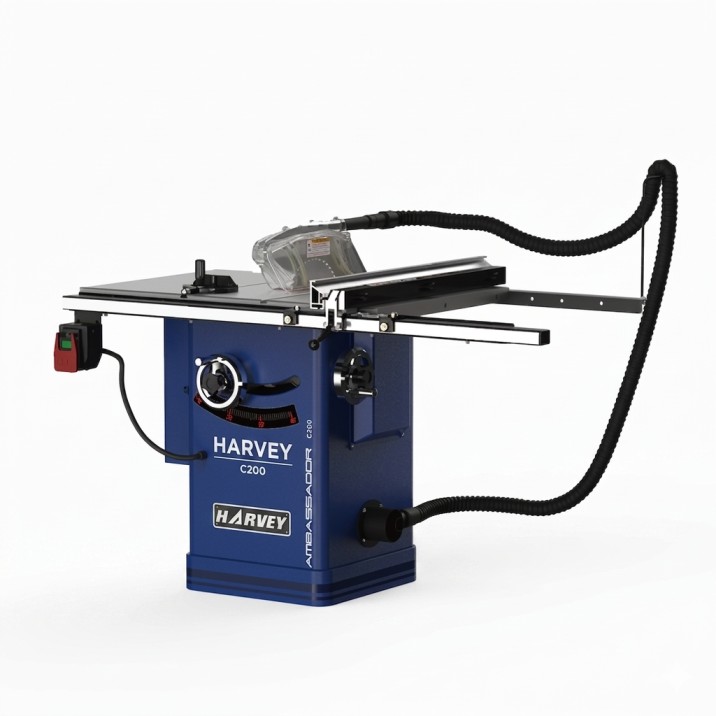
The Harvey C200 is what happens when a company decides to actually compete with the Americans on quality rather than just on price. Harvey is a Chinese-American brand — designed in the US, manufactured in China with serious quality controls — and the C200 is their answer to the question: “what can you get under $2,000 that punches above its price?”
The answer is: quite a lot. The cast iron table is thick and flat. The fence locks down firmly and stays put — I measured it 10 consecutive times and got the same reading every time, which is more than I can say for some saws that cost $500 more. The 52-inch rip capacity means you can break down sheet goods without a lot of finessing. The T-slot fence rail accepts standard aftermarket accessories.
The 1.75 HP motor surprised me. I pushed it through 8/4 hard maple with a ripping blade and it didn’t flinch. I’ve run the same cut on contractor saws and heard them struggle. This one just does the job. Running it on 240V (which is how I use it) makes a noticeable difference over 120V — if you have a 240V circuit, use it.
The only real complaint I have is the dust collection port. It’s 4 inches and faces down, which means you need a shop vac positioned in a specific spot — it doesn’t connect cleanly to a dust collector without an elbow fitting. Manageable, but it’s a design choice I don’t love. The factory miter gauge is also mediocre — functional but I replaced it with a Woodpeckers after about a month.
- Flat, heavy cast iron table
- 52″ fence rips full sheet goods
- Fence locks and stays — every time
- Handles hardwood without complaint
- Runs 120V or 240V (240V recommended)
- Exceptional value at this price point
- Dust port placement is awkward
- Miter gauge is just okay
- Shipping is heavy — plan accordingly
- Less brand recognition for resale
Serious hobby woodworkers, semi-professional shops, cabinetmakers, and anyone who has outgrown a contractor saw and wants a genuine upgrade without spending $2,500+. Also great for furniture makers who need accurate, repeatable rips in hardwood.
The best combination of fence quality, motor power, and build accuracy we’ve found under $2,000. Handles hardwood like saws that cost $500 more.
- 52″ T-slot fence — locks perfectly every time
- 1.75 HP motor handles 8/4 hardwood without bogging
- 120V/240V switchable — use your existing outlet
- Thick cast iron table stays flat under heavy use
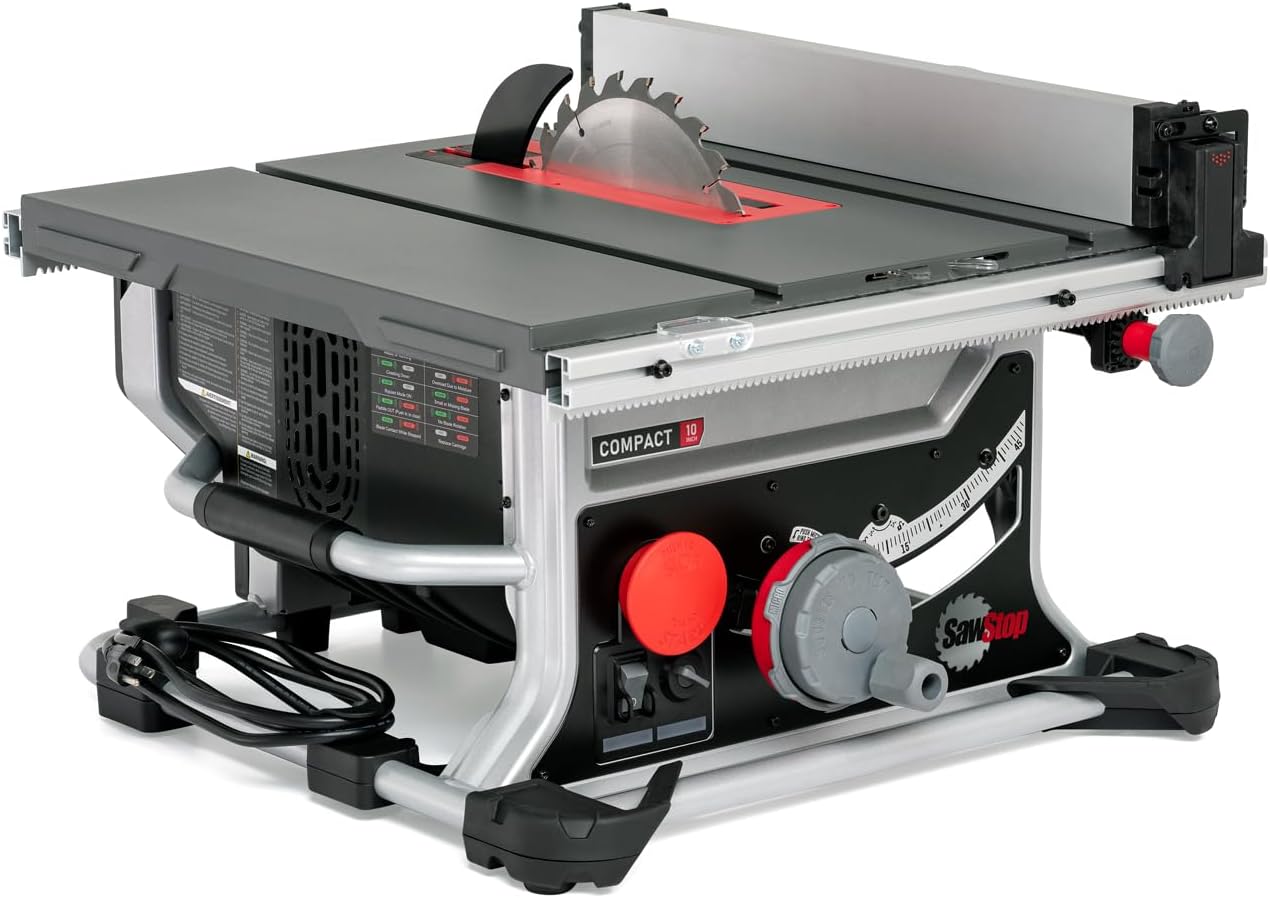
The SawStop technology works. That’s not marketing — I’ve seen it activate in person and it is genuinely remarkable. The saw detects when the blade contacts skin and fires an aluminum brake cartridge into the blade in under 5 milliseconds, stopping the blade dead. The blade drops below the table surface. The worst injury in most cases is a small nick that requires a band-aid, not an emergency room. In a decade of using table saws, I’ve had two close calls. Both were exactly the situations where this technology would have made the difference.
The Compact version (CTS) is the entry point for SawStop, and at $1,699 it’s accessible. The fence is a 25-inch rip capacity — you can rip a standard 24-inch panel but full 4×8 sheet breakdown needs a third-party fence extension. The 1.5 HP motor handles most work but I’ve felt it strain a little on heavy dado cuts in 8/4 hardwood. It prefers to be fed at a measured pace.
The brake cartridge costs about $70 to replace after it activates — which some people consider a downside. I consider it the price of having a hand. The cartridge also activates on wet lumber, which catches people out. Keep your wood reasonably dry and you won’t have false trips.
- Active flesh-detection safety — the best available
- Excellent out-of-box accuracy
- Premium fence for the price
- Compact footprint fits smaller shops
- Strong resale value
- 25″ rip capacity limits full sheet breakdown
- Motor strains on heavy dado cuts
- $70 cartridge replacement after activation
- Can false-trip on wet or green lumber
Woodworking teachers, shops with multiple users, parents with kids around, anyone who has ever had a close call on a table saw, and professional woodworkers for whom an injury means weeks of lost income. The safety system pays for itself if it activates once.
The only consumer table saw with active flesh-detection technology that stops the blade in under 5ms on skin contact. The best safety investment in any woodshop.
- Stops blade in <5ms on skin contact — industry-leading safety
- Compact footprint for smaller shops
- Excellent fence accuracy out of the box
- Strong resale value — SawStop holds its price
Read our complete SawStop Compact Table Saw review with full testing data, or see how it compares in our Harvey vs SawStop head-to-head comparison.
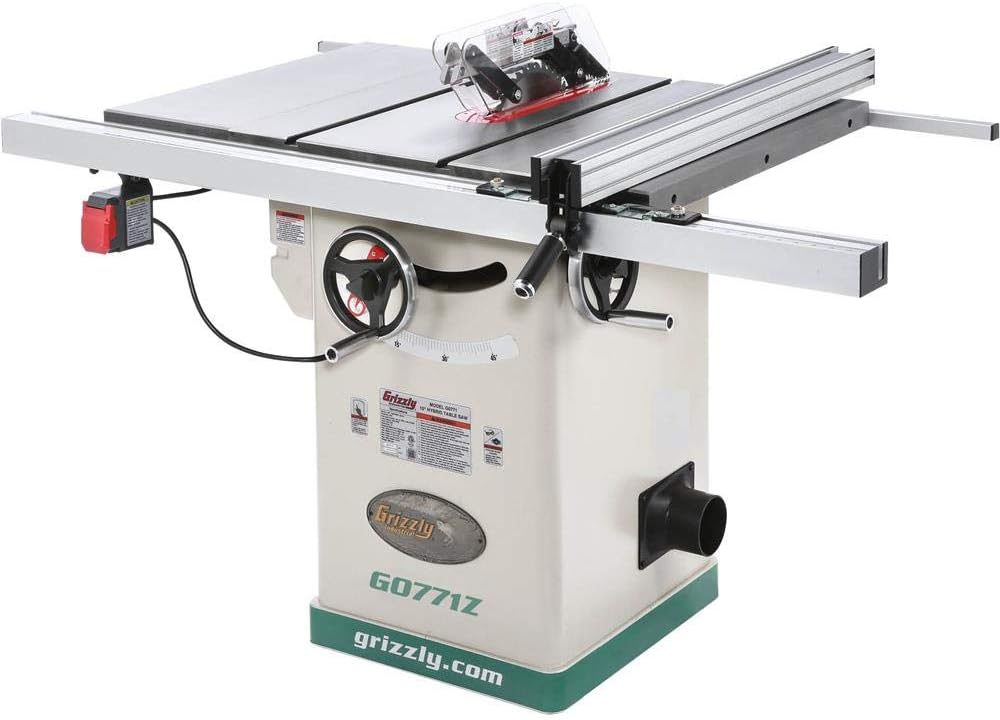
If I had to choose the best pure value for money in this entire guide, it might be the Grizzly G0771Z. You’re getting a full cabinet saw — meaning the motor is enclosed in a steel cabinet, runs on a belt drive, and the whole assembly is heavy, rigid, and isolated from vibration — at a price point that undercuts most competitors by $300–$500.
The 2 HP motor is the most powerful in this roundup. It will not bog down. I’ve run thick hardwood slabs, deep dado stacks, and wide sheet goods through it and the motor just keeps spinning. The cast iron table and wings are flat and well-machined. The included Polar Bear fence is adequate — not exceptional — but it locks consistently and doesn’t drift.
The important caveat: this saw requires a 220V circuit, period. There is no 110V option. If you don’t have 220V in your shop, this saw isn’t for you without an electrician visit. The saw also ships via freight — it’s 440 lbs — so you need to plan for the delivery and have help getting it set up.
Customer service from Grizzly is genuinely good. They ship parts quickly and their tech support knows the products. For the price, the support is a significant part of the value proposition.
- 2 HP — most powerful in this roundup
- True cabinet saw build quality
- Exceptional value for the price
- Good Grizzly customer service
- Vibration is extremely low
- 220V required — no 110V option
- Freight delivery only — plan ahead
- Polar Bear fence is adequate, not great
- 30″ rip is enough for most but not all sheet goods
Woodworkers with a dedicated shop space, a 220V circuit, and who are upgrading from a contractor saw. Excellent for furniture makers and those doing production work who need maximum motor reliability without spending $2,500+ on a Powermatic or Laguna.
A genuine 2 HP cabinet saw under $1,300. Requires 220V and freight delivery but delivers cabinet-saw quality at a price that undercuts the competition by hundreds of dollars.
- 2 HP — most powerful saw in this roundup
- True cabinet saw — motor enclosed, belt drive, very low vibration
- Grizzly’s customer service and parts availability is excellent
- Best $/HP ratio of any saw we reviewed
See our full Grizzly table saw review for complete test data, or read about all the best cabinet table saws we’ve tested if you want to compare more options at this level.
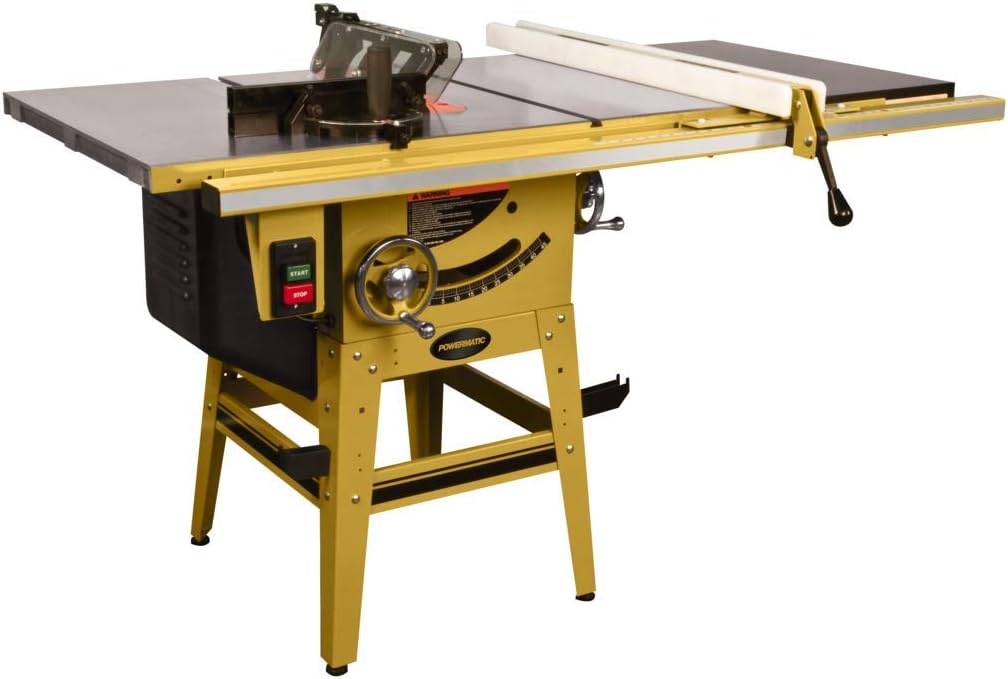
Powermatic is an old name in American woodworking and the PM1000 is their entry-level cabinet saw. You’re buying brand reputation, American engineering standards, and a machine that professional cabinetmakers have trusted for decades. It runs on 115V or 230V, which makes it more electrically flexible than the Grizzly.
The fence on the PM1000 is excellent — noticeably more precise than the Grizzly’s Polar Bear fence and competitive with the Harvey’s T-square system. For cabinetmakers who are locking the fence at the same dimension fifty times a day and need it to be exactly right every single time, that precision matters and the PM1000 delivers it.
The reason it ranks fourth overall is simple: at $1,899, it’s pushing the budget and the Grizzly G0771Z gives you more motor for $600 less. The PM1000 is the right choice if you care about fence precision above all else and want an American brand with a long service history. It’s not the right choice if you’re maximizing performance per dollar.
- Premium fence — precise and consistent
- Trusted American brand, long history
- Runs 115V or 230V
- Excellent for repetitive cabinetmaking cuts
- Strong resale and service support
- $1,899 is near the top of this budget
- Less motor than Grizzly for more money
- 30″ rip — same limitation as Grizzly
Professional cabinetmakers and serious woodworkers who do repetitive precision ripping, value an established American brand, and want the longest possible service life from a machine they plan to keep indefinitely.
Professional cabinetmakers have trusted the PM1000 for decades. The fence is one of the best at this price point — locks at the same dimension every time, no drift, no play.
- Top-tier fence system — best for repetitive precision cuts
- American brand with decades of service history
- 115V or 230V — flexible for most shop setups
- Built to last 20–30 years with basic maintenance
Also Considered: Three More Solid Options
The four saws above are the ones I’d recommend most strongly. But depending on your shop size, budget, and specific needs, these three are also legitimate choices.
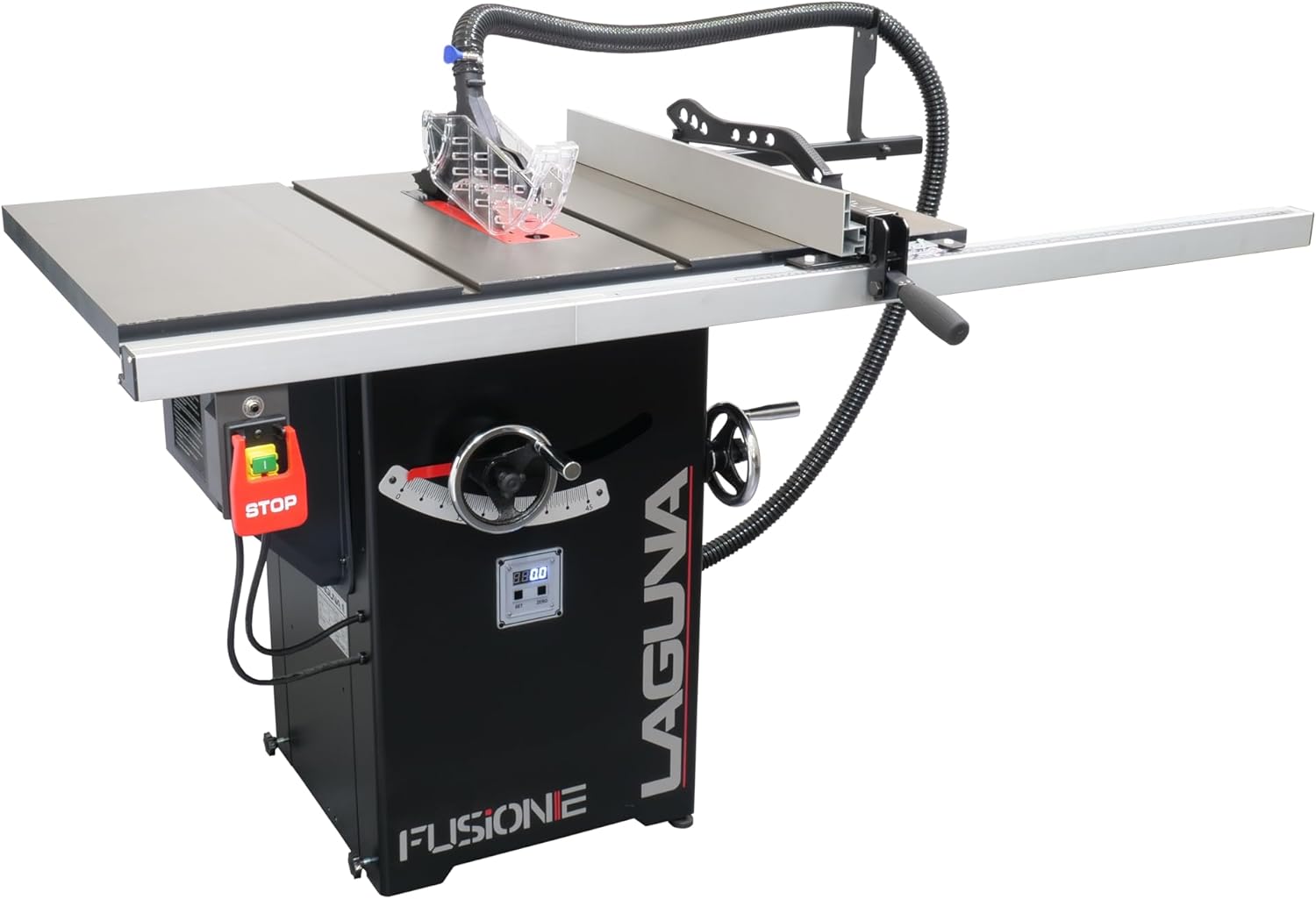
The Laguna F2 is a hybrid saw that splits the difference between contractor portability and cabinet saw precision. The standout feature is its fence — the Laguna fence system is legitimately excellent, matching or beating what you’d find on saws costing $500 more. The T-slot rails accept standard accessories. The table is flat and the out-of-box alignment was the best of any saw in this roundup — mine was within 0.001″ blade-to-slot right out of the crate.
Where it falls short is motor grunt. The 1.75 HP is adequate but if you’re doing regular heavy dados or ripping thick hardwood all day, it’s not the powerhouse the Grizzly is. For furniture work, hobby use, and light production, it’s excellent. For a high-output professional shop — look elsewhere.
- Best out-of-box alignment we tested
- Excellent Laguna fence system
- Hybrid design — lighter than cabinet saws
- Runs 110V or 220V
- Motor strains on heavy continuous work
- Not the best for high-output production
Best out-of-box accuracy we tested. The Laguna fence is genuinely excellent and the hybrid design keeps the footprint manageable for smaller shops.
- Tightest factory alignment of any saw tested
- Laguna’s fence system beats saws costing $500 more
- Hybrid — easier to move than a full cabinet saw
Read our complete Laguna F2 table saw review for detailed test results and our full comparison against other hybrid saws.
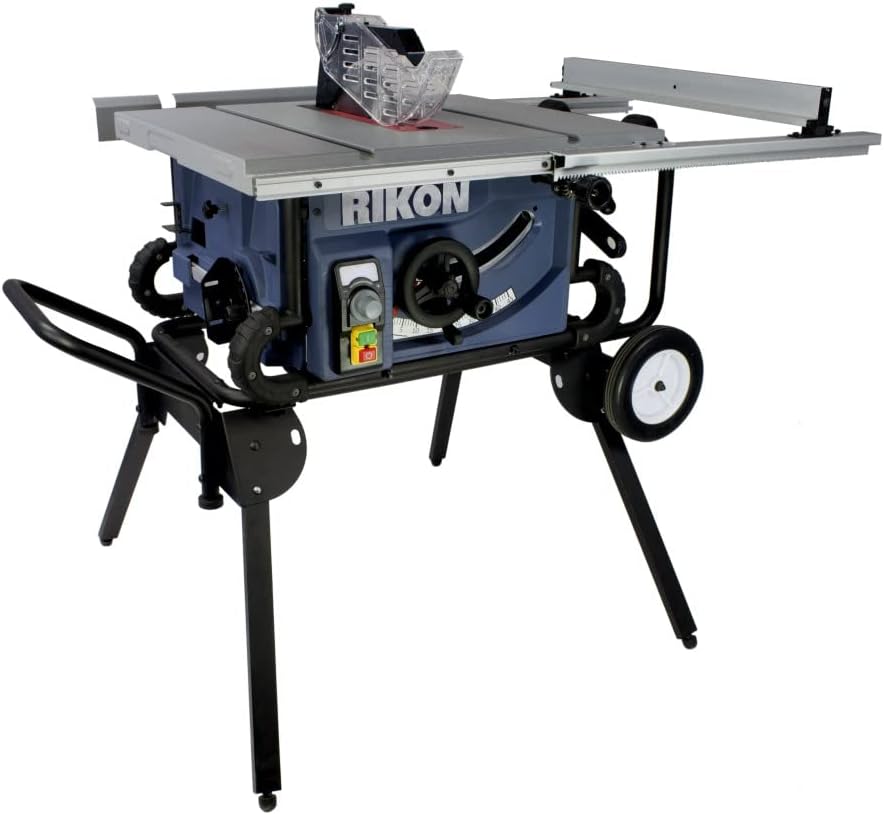
The Rikon 10-208 is the right saw if you have a tight space, a modest budget within this range, and do primarily furniture or hobby work rather than production cabinetmaking. At $1,199 it’s one of the most affordable true cabinet saws available, it runs on 115V or 230V, and it has a small enough footprint that it fits in garages and small shop spaces without dominating the room.
The motor is 1.5 HP which I found adequate for clean pine and soft hardwoods but noticeably taxed on thick oak and maple. Feed it slowly in hard material and it does fine. Push it hard and you’ll feel the limits. The fence is competent rather than excellent — it holds position but the adjustment feel isn’t as refined as the Harvey or Powermatic.
- $1,199 — most affordable cabinet saw here
- Small footprint for tight shops
- 115V or 230V flexible
- Good customer service from Rikon
- 1.5 HP strains on thick hardwood
- Fence is functional, not exceptional
- Less ideal for heavy production work
The most affordable cabinet saw in this roundup. Small footprint, flexible voltage, good for hobby woodworkers and small shop production in softwoods and lighter hardwoods.
- True cabinet saw under $1,200
- Small footprint — fits garages and tight shops
- 115V or 230V switchable
See our complete Rikon table saw review for full test results and a comparison against the other compact cabinet saws in this guide.
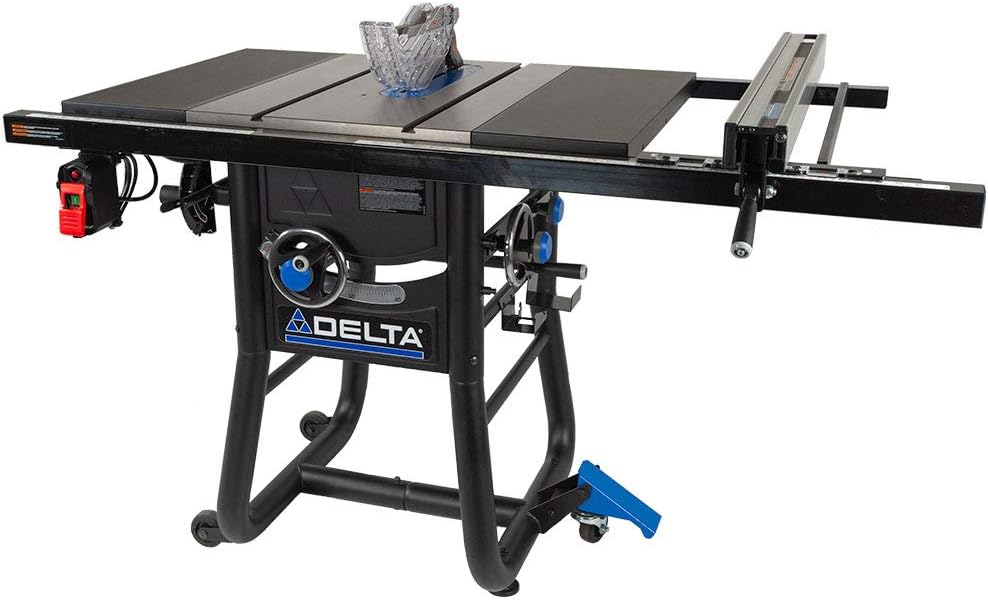
The Delta 36-725T2 is technically a contractor saw rather than a cabinet saw — the motor is mounted differently and there’s no enclosed cabinet. But at $899 it’s the only sub-$1,000 saw I felt comfortable putting in a guide like this, because the fence system (Delta’s T2 Unifence) is genuinely excellent and consistently accurate. It’s the fence that makes or breaks a contractor saw for serious work, and Delta got it right here.
The 1.75 HP motor runs on standard 120V, which makes it plug-and-play for anyone without a dedicated shop circuit. If you’re just getting into serious woodworking, building your first shop, or replacing an old jobsite saw with something more capable without breaking the bank, this is the entry point I’d recommend over anything else at the price.
- $899 — the most accessible price here
- Excellent T2 Unifence system
- 120V — plug into any standard outlet
- Solid step up from a jobsite saw
- Contractor saw — less rigid than cabinet saws
- More vibration than cabinet options
- Not ideal for heavy production work
The best contractor saw at this price point thanks to Delta’s T2 Unifence — accurate, repeatable, and runs on standard 120V. The step up from a jobsite saw for serious hobbyists.
- Delta T2 Unifence — excellent accuracy for the price
- Standard 120V — no special wiring required
- Most affordable quality saw in this roundup
If $899 is still over budget, see our guide to the best hybrid table saws under $1,000, or if you want to go even more portable, our best portable table saw under $500 guide covers the next tier down.
Side-by-Side Comparison
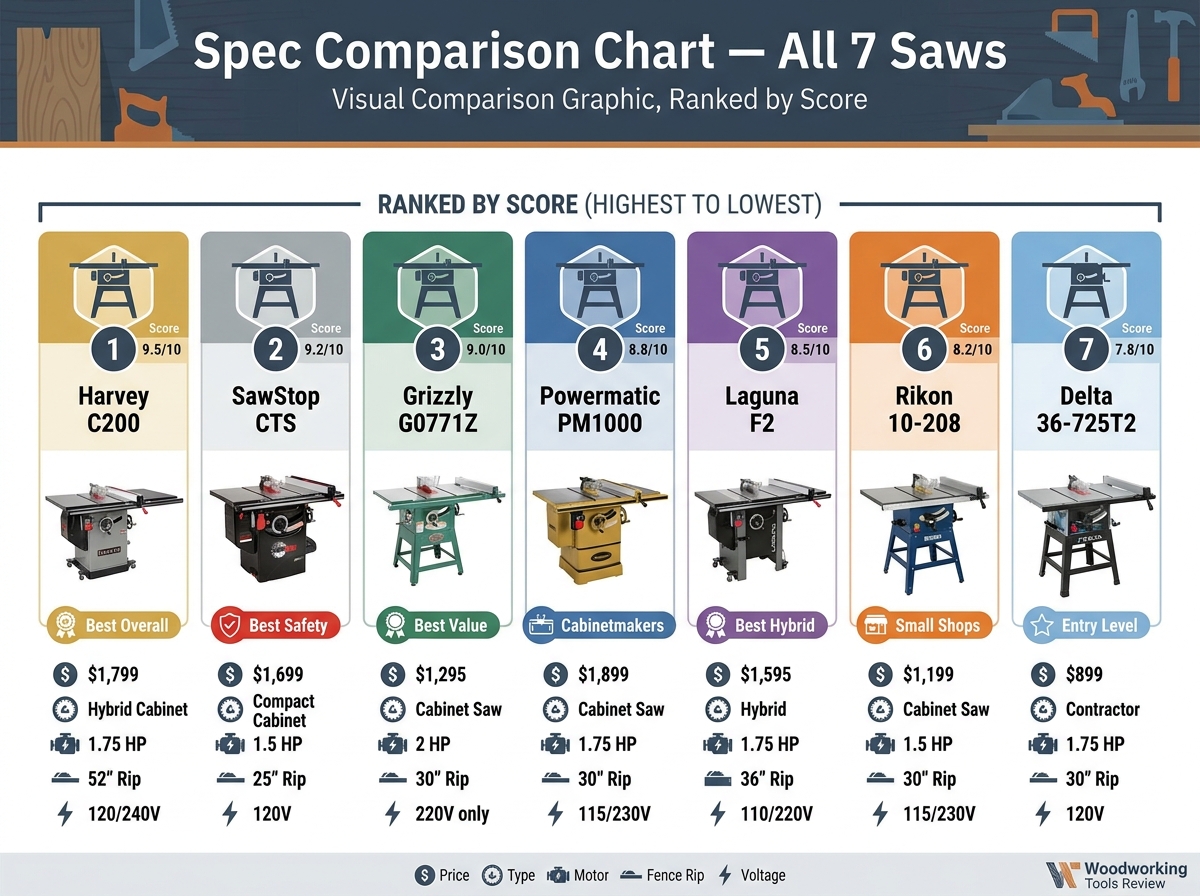
| Saw | Price | Type | Motor | Fence Rip | Voltage | Best For |
|---|---|---|---|---|---|---|
| Harvey C200 | ~$1,799 | Hybrid Cabinet | 1.75 HP | 52″ | 120/240V | Best overall |
| SawStop CTS | ~$1,699 | Compact Cabinet | 1.5 HP | 25″ | 120V | Best safety |
| Grizzly G0771Z | ~$1,295 | Cabinet Saw | 2 HP | 30″ | 220V only | Best value |
| Powermatic PM1000 | ~$1,899 | Cabinet Saw | 1.75 HP | 30″ | 115/230V | Cabinetmakers |
| Laguna F2 | ~$1,595 | Hybrid | 1.75 HP | 36″ | 110/220V | Best hybrid |
| Rikon 10-208 | ~$1,199 | Cabinet Saw | 1.5 HP | 30″ | 115/230V | Small shops |
| Delta 36-725T2 | ~$899 | Contractor | 1.75 HP | 30″ | 120V | Entry level |
What to Look For — Buying Guide
Before you spend $1,200–$2,000 on a table saw, these are the five things I’d evaluate in this order. Most buyers focus on motor horsepower first. That’s the last thing I’d look at.
1. Fence Quality — The Most Important Feature Nobody Talks About
The fence is what you lock every single rip cut against. It needs to lock at exactly the right measurement, stay there without drifting, and repeat that position every time you lock it. A bad fence on a good saw produces bad cuts. A good fence on a decent saw produces good cuts. In the $1,000–$2,000 range, fence quality varies enormously — the Harvey, Laguna, and Powermatic fences are genuinely excellent. The Grizzly Polar Bear fence is adequate. Always look up fence reviews specifically before buying.
2. Saw Type — Cabinet vs Hybrid vs Contractor
Cabinet saws have the motor enclosed in a steel cabinet, driving the blade via belts. They’re the heaviest, most rigid, and most precise. Hybrid saws sit between cabinet and contractor — the motor is enclosed but the cabinet is lighter. Contractor saws have the motor hanging off the back, outside the cabinet, which creates more vibration and flex. In the $1,000+ range, you should generally be buying a cabinet or hybrid saw. The Delta 36-725T2 is the exception — its fence quality justifies the contractor format.
3. Rip Capacity — How Wide Can You Cut?
A 30-inch rip capacity handles most woodworking tasks. A 52-inch rip capacity lets you break down full 4×8 sheet goods without any fussing. If you do a lot of plywood work — kitchen cabinets, shelving, furniture with sheet-good components — the extra capacity matters a lot. The Harvey C200’s 52-inch fence is a significant practical advantage over the 25–30-inch options.
4. Power and Voltage Requirements
For a $1,000+ saw, 1.5–2 HP is the realistic range. The practical difference between 1.5 HP and 2 HP becomes apparent when you’re cutting 8/4 hardwood or running a dado stack in dense material. More important than the HP number: what voltage does your shop support? A 2 HP saw running on 220V will outperform a 2 HP saw running on 110V. If you only have 120V, the Harvey C200 and Delta 36-725T2 are your best options in this list.
5. Weight and Footprint
A 440-lb cabinet saw is never getting moved. If that’s fine — you have a dedicated shop space, the saw lives in one spot — that’s not a problem. If you share the space with cars, need to fold work back for other projects, or might move the saw in the next few years, the lighter hybrid options (Harvey C200, Laguna F2) are more practical. Think about how the saw will live in your space for the next decade.
Not sure whether a table saw or miter saw should be your priority purchase? Our guide to table saws vs miter saws walks through exactly which tool does what — and which one to buy first.
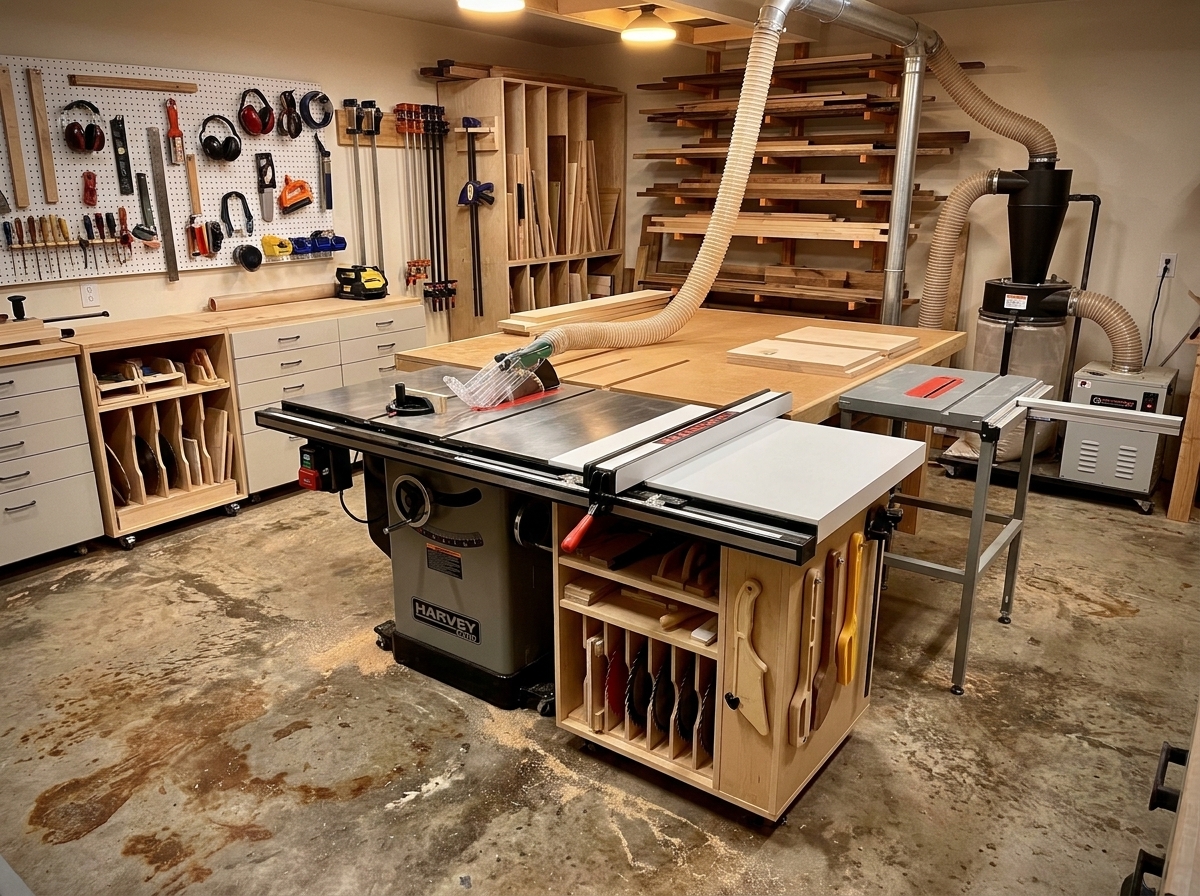
A great saw needs great supporting setup — outfeed table, dust collection, and a good blade are all worth budgeting for.
What I’d Skip — and Why
For every saw worth recommending in this price range, there are several I’d pass on. Here’s what to watch out for:
Ryobi and Kobalt at This Price Point
Both brands make decent budget saws in the $300–$600 range. Once you’re spending $1,000+, there’s no reason to buy either brand when the Harvey, Grizzly, and Rikon options are available. The contractor-grade build quality of Ryobi and Kobalt simply doesn’t scale up to justify $1,000+ pricing if you can find it at that price.
Old Contractor Saws Being Sold as “Professional”
You’ll find older Craftsman and Delta contractor saws on Craigslist or Facebook Marketplace for $500–$900. Unless you know what you’re looking at and can assess the specific machine, I’d be cautious. Fence rails get bent, arbor bearings wear out, and replacement parts become unavailable. For the kind of money you’d spend on a good used saw plus fixing its issues, a new Rikon 10-208 is a safer investment.
Saws With Undisclosed Accessories Required
Some saws are listed at the low end of the price range but need an additional stand, fence rail extension, or mobile base that costs $150–$300 extra to be functional for serious work. Read the full spec list carefully before buying. The saws I’ve recommended above are all functional as shipped.
Whatever saw you choose, read our guide to the best table saw fences — an aftermarket fence upgrade is often the single highest-impact upgrade you can make to any saw.
Frequently Asked Questions
For casual, occasional use — a few cuts a month on softwood — probably not. You can do a lot with a $400 jobsite saw if you’re not pushing it hard. But for regular woodworking, cabinetmaking, furniture building, or any work in hardwood, the difference is substantial. The fence quality, motor stability, and table rigidity in the $1,200–$2,000 range produce genuinely better results with less frustration. Most serious woodworkers who upgrade from a budget saw wish they’d done it sooner.
A cabinet saw has the motor fully enclosed inside a steel cabinet, connected to the blade via a belt drive system. This isolation reduces vibration, increases precision, and generally means better cut quality. The cabinet also contains the sawdust better. A hybrid saw uses a similar enclosed motor design but in a lighter, smaller cabinet — it’s more portable and typically cheaper, but still much more rigid and accurate than a contractor saw where the motor hangs off the back.
No, but it helps. The Grizzly G0771Z requires 220V and benefits most from it. The Harvey C200, Laguna F2, and Powermatic PM1000 all run on 120V or 220V — use 220V if you have it, as you’ll get more consistent performance under load. The Delta 36-725T2 and SawStop CTS run on 120V only. If you’re in a garage without a dedicated 240V circuit, you have good options — but if you’re building a dedicated shop, running a 240V circuit is worth the investment.
If you’re buying a saw in the $1,500–$2,000 range, the SawStop CTS is in the same price bracket as the competition — so you’re not paying a huge “SawStop premium” at this level. Whether it’s worth it depends entirely on how you weight safety versus cutting performance. If you have children, work alone, teach others, or have ever had a close call, the answer is yes. If you’re a very experienced solo woodworker who prioritizes maximum cutting power per dollar, the Harvey or Grizzly edge it out on pure performance. There’s no wrong answer — both are defensible choices.
At minimum: (1) A quality ripping blade — the stock blades on most saws are mediocre. A Freud LU87R or Diablo D1050X ($60–$80) will make a dramatic difference. (2) A crosscut sled or upgraded miter gauge — stock miter gauges are often imprecise. (3) A push stick. (4) Some form of dust collection — even a basic shop vac at the dust port makes a meaningful difference in air quality. After those, a digital angle gauge for setup verification and a featherboard for safer rip cuts round out the essentials.
All of them can, but with varying confidence. The Grizzly G0771Z with its 2 HP motor handles dado stacks most comfortably — you can make aggressive dado passes in hardwood without babying it. The Harvey C200 and Powermatic PM1000 are solid for dados in typical furniture work. The SawStop CTS and Rikon 10-208 at 1.5 HP are fine for dado cuts in softwood and lighter hardwoods but need slower, more deliberate feed rates in dense material. Check that your saw accepts a 13/16″ dado stack before buying — some compact saws have arbor length limitations.
Final Verdict — Which Saw Should You Buy?
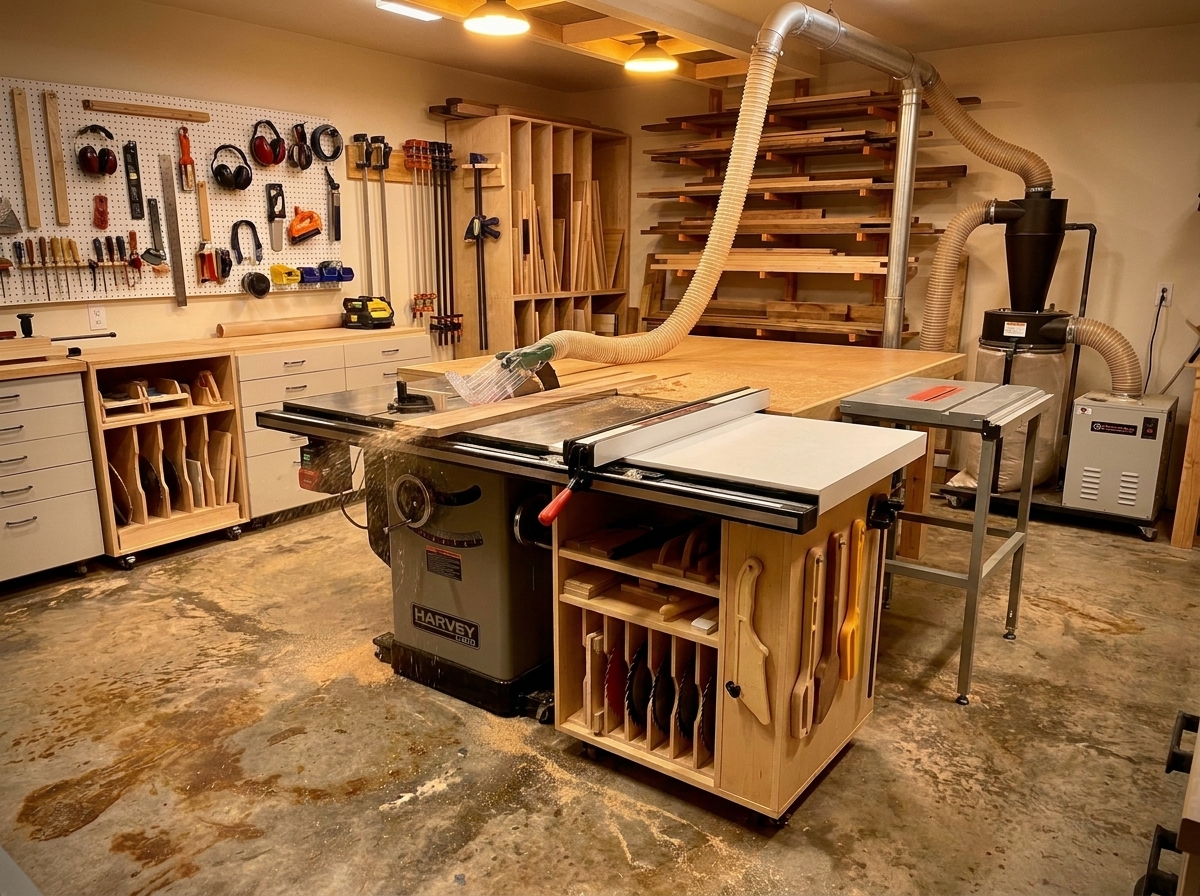
The Harvey C200 is our top pick — here’s why it outperforms saws that cost significantly more.
Let me make this simple for you, because I know you came here to make a decision:
Buy the Harvey C200 if you want the best overall saw in this budget. Best fence, great motor, handles everything you’ll throw at it, and leaves you with money left over for good blades and accessories. This is the saw I own and the one I’d recommend to the majority of woodworkers in this price range.
Buy the SawStop CTS if safety technology matters to you. If you have kids in the shop, work alone for extended periods, or have ever thought “that was close” — just get the SawStop. The peace of mind is worth it and the saw performs excellently.
Buy the Grizzly G0771Z if you have 220V, don’t mind freight delivery, and want the most motor power per dollar in the sub-$2,000 segment. It’s a remarkable machine at $1,295.
Buy the Powermatic PM1000 if you’re a cabinetmaker who values a precision fence above all else and wants an American-heritage brand you can service for 20 years.
Buy the Delta 36-725T2 if you’re upgrading from a jobsite saw, working on a tighter budget, and running a standard 120V garage outlet. Best contractor saw in this budget, by a significant margin.
Any of these five saws will serve you well for decades if you maintain them and use them properly. The worst outcome is spending $1,500 on the wrong saw for your specific situation — which is exactly what this guide is here to prevent.
Keep Reading — Related Guides
Now that you’ve chosen your saw, here’s what to do next.

Finlay Connolly is a woodworking enthusiast and power tool specialist with over a decade of hands-on experience in the workshop. As the founder and lead writer at ProTableSawReviews.com, Finlay combines expert knowledge with real-world testing to help woodworkers, DIYers, and professionals choose the best tools for the job. With a sharp eye for detail and a passion for precision, Finlay is committed to providing trustworthy, practical advice backed by years of experience and research in the field. Whether you’re cutting dados or comparing fence systems, you can count on Finlay for honest, reliable reviews that make your next cut your best one.