
Vevor Table Saw Review: Pros, Cons & What Owners Say
It matches the search intent very directly and gives you room to cover both the positive and negative owner feedback without making the title overly negative.
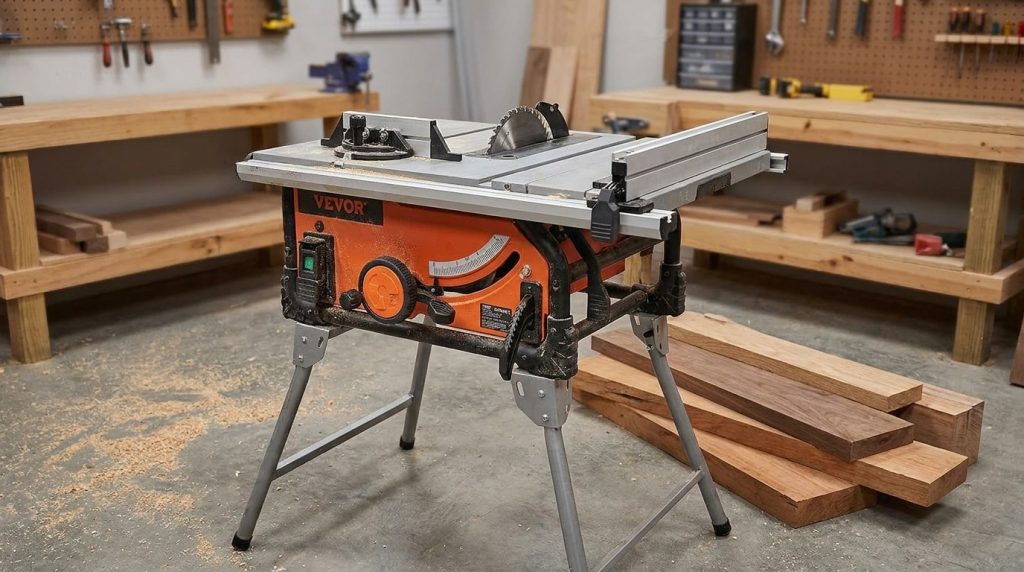
Vevor isn’t a woodworking-focused brand — it’s a broad, budget import retailer selling everything from welders to greenhouse kits, and table saws are just one category among hundreds. That context matters for how to read this review. Vevor’s full-size 10-inch jobsite saw is a genuinely usable budget option with one real, repeatedly documented weak spot: fence stability. Their mini hobby saws are a different story, and the fence problem there is worse, confirmed independently across multiple real owner reviews rather than a single complaint.
In this article
Vevor’s full-size 10-inch jobsite table saw
| Spec | Detail |
|---|---|
| Motor | 15-amp, up to 5,000 RPM (an earlier variant tops out at 4,500 RPM) |
| Blade | 10-inch, 40-tooth, 5/8″ arbor |
| Rip capacity | 25 inches |
| Max cutting depth | 3.3″ at 90°, 2.2″ at 45° |
| Miter gauge range | -60° to +60°, sliding design |
| Dado capacity | Not recommended — confirmed directly by Vevor’s own customer Q&A |
| Weight | About 60.6 lbs |

On paper, this competes reasonably well with budget saws from more established brands — a 15-amp motor and 25-inch rip capacity are solid numbers for the price tier Vevor typically sits in. Real owner experience is more mixed than the spec sheet suggests, though, and it’s worth going through both sides honestly.
What real owners say works. Setup gets consistent praise — one detailed hands-on account described the saw arriving almost fully assembled, with the remaining steps quick and straightforward, and successfully used it for a real project cutting wood scraps within minutes of finishing assembly. Several reviews specifically call out easy setup as a strength worth noting, especially compared to a saw the reviewer was replacing.
What real owners say doesn’t. One direct, specific complaint: “the gate moves unless you use vice grips and the motor struggles with ripping boards.” That’s a real fence stability problem paired with a power complaint from an actual buyer, not a generic gripe. A second reported issue was a defective unit that arrived with a blade that wouldn’t raise or lower — Vevor’s customer service replaced it without a fight, which the buyer specifically praised, but it’s still a real quality control miss worth knowing exists. And directly from Vevor’s own product Q&A: this saw is not meant to run a dado stack, which rules out a real category of joinery work some budget competitors, like the SKIL TS6307-00, do handle.
One more practical tip that shows up repeatedly: skip the printed setup manual and look up the assembly video instead. Multiple reviewers specifically say the included instructions are confusing enough that the video guide saves real frustration.
Vevor’s mini hobby table saws

Vevor also sells smaller, multi-function desktop saws — the 96W and 200W models, both under 2 inches of cutting depth, built more for craft and hobby work than general woodworking. These bundle in extra attachments like a drill chuck and a buffing wheel, positioning the tool as several small machines in one rather than a dedicated saw.
Real owner feedback here is more consistently critical on one specific point: the fence. Two separate, independent reviews on two different Vevor mini saw models used almost identical language — “not accurate and flimsy” and “the blade fence is weak, supported and adjusted by two movable wingnuts.” That’s not one unlucky buyer; it’s the same complaint showing up twice, independently, which is a real signal rather than noise. One of those reviewers actually fixed it themselves, milling a small oak strip into a replacement fence and adding sliding bolts for more rigidity — a real, workable fix if you’re comfortable modifying the tool yourself, but not something a buyer should have to do out of the box.
On the positive side, reviewers do like these saws for what they’re actually built for: one specifically praised clean cuts on Lexan for a boat instrument panel, and general sentiment on portability and light-duty use is genuinely favorable. Just plan on clamping it to a bench, since more than one reviewer noted it’s light enough to shift around during use without being secured.
If you’re comparing this category more broadly, our review of the Saker Mini Multi-Functional Table Saw covers a direct competitor in this same small-saw space, worth cross-shopping before committing to either brand.
What Vevor as a company is actually like to deal with

Based on the real reviews above, Vevor’s customer service reputation looks genuinely decent — the defective-unit replacement was handled without hassle, and that pattern shows up in more than one review across their table saw lineup. What’s less consistent is manufacturing quality control itself, which lines up with what you’d expect from a broad multi-category import retailer rather than a company specialized in one type of equipment. That’s not necessarily a dealbreaker, but it does mean inspecting your saw carefully on arrival is a reasonable habit rather than an overreaction.
Who should actually buy a Vevor table saw

The full-size jobsite saw makes sense for light, occasional DIY work, or as a low-cost entry point while you figure out how much you’ll actually use a table saw before investing more. If you go this route, plan on checking fence tightness carefully before your first real project, and skip the printed manual in favor of a video walkthrough. The mini hobby saws suit small craft projects, thin material, and light hobby use specifically — just budget for a fence fix or accept its real limitations going in, rather than expecting precision work out of the box.

VEVOR 4500 RPM Portable Jobsite Table Saw
A compact 10-inch table saw with a 15A motor delivering up to 4,500 RPM. It features a 40-tooth blade, adjustable rip fence, -45° to 45° bevel adjustment, dust port, blade guard, and overload protection for woodworking, flooring, cabinets, and jobsite use.
Who should look elsewhere

If dado capability matters to your projects, Vevor’s full-size saw rules itself out by its own admission — a saw like the SKIL TS6307-00 handles that at a similar budget price point. If fence reliability is your top priority and you’re not interested in modifying the tool yourself, the repeated, independent fence complaints on Vevor’s mini saws are worth taking seriously before buying. And if you want a name-brand track record and a broader, more established parts and support network, our table saws for beginners guide covers more established alternatives in a similar price range.
Common mistakes people make with Vevor table saws
Following the printed setup manual instead of looking up a video walkthrough is the most consistently reported avoidable frustration. Assuming the mini saw’s stock fence is accurate without checking it against a square first is another, given how often that specific complaint shows up independently. Expecting dado capability on the full-size jobsite saw, when Vevor’s own support explicitly says not to, is worth ruling out before buying rather than discovering after. And not inspecting a new unit carefully on arrival, given at least one documented case of a saw shipping with a non-functional blade height adjustment.
FAQ
Is Vevor a reliable table saw brand? Mixed, and it depends which product line. The full-size jobsite saw gets generally workable feedback with one recurring fence stability complaint. The mini hobby saws have a more consistent, independently repeated criticism of their stock fence specifically.
Can I use a dado stack on a Vevor table saw? Not on the full-size 10-inch jobsite saw — Vevor’s own customer support explicitly advises against it. If dado capability matters to your work, look at a different saw in this price range instead.
Is Vevor’s customer service actually good? Based on real owner accounts, yes, reasonably. At least one buyer with a defective unit reported a smooth, hassle-free replacement, and multiple reviews mention positive support experiences.
Are Vevor’s mini table saws good for anything besides crafts? They’re built specifically for light, small-scale work — thin material, acrylic, small craft pieces — not general woodworking. The stock fence’s documented weakness makes precision work harder without a DIY fix.
Should I follow the included setup manual? Multiple reviewers specifically recommend skipping it in favor of a video assembly walkthrough, since the printed instructions have a reputation for being confusing relative to how simple the actual assembly turns out to be.

Finlay Connolly is a woodworking enthusiast and power tool specialist with over a decade of hands-on experience in the workshop. As the founder and lead writer at ProTableSawReviews.com, Finlay combines expert knowledge with real-world testing to help woodworkers, DIYers, and professionals choose the best tools for the job. With a sharp eye for detail and a passion for precision, Finlay is committed to providing trustworthy, practical advice backed by years of experience and research in the field. Whether you’re cutting dados or comparing fence systems, you can count on Finlay for honest, reliable reviews that make your next cut your best one.


