
Table Saw Blades & Accessories
Best Table Saw Blade Guards: 5 Top Picks Compared 2026
Looking for the best table saw blade guard? We compare 5 aftermarket guards for safety, dust collection, dado cuts, bevels, compatibility, and value.
In this article
The Short Answer
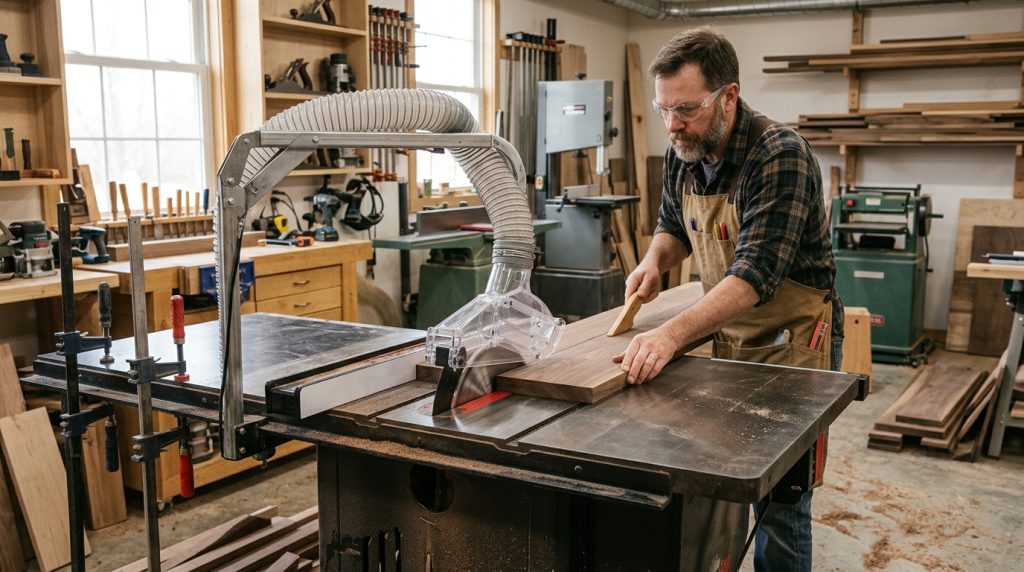
The Grizzly T10113 Universal Overarm Blade Guard is the best aftermarket table saw guard for most woodworkers. It’s self-supporting, bolts to almost any saw’s base without a complicated install, includes real integrated dust collection, and pivots out of the way in seconds when you need to run a dado or non-through cut. If you own a SawStop cast-iron saw specifically, the SawStop TSG-DC is the better pick, since it’s built and warrantied for that exact platform.

Worth knowing before you buy anything: a longtime contributor at the Woodworkers Guild of America, who has reviewed and used a wide range of guard designs, states plainly that overarm guards, meaning guards mounted separately from the saw’s riving knife or splitter, are the best category overall, since they offer the most flexibility and the most coverage for the widest range of cuts. That opinion shapes most of the recommendations in this guide.
Guard Comparison at a Glance
| Guard | Best For | Type | Dust Collection |
| Grizzly T10113 | Overall best, most saws | Overarm, self-supporting | Yes, integrated 4″ port |
| SawStop TSG-DC | SawStop cast-iron saw owners | Above-table, OEM | Yes, narrow-cut compatible |
| Excalibur Overarm | Non-through cuts, dado work | Overarm | Yes, well regarded |
| Delta Uniguard / 34-976 | Bevel cuts, arbor-mounted needs | Splitter-mounted | No |
| Penn State Industries | Budget-conscious buyers | Overarm, wing or ceiling mount | Yes |
Why the Factory Guard Often Isn’t Enough
Most stock table saw guards are directly attached to the riving knife or splitter, which keeps them simple but also limits them. They’re often bulky enough to block your view of the cut line, they typically don’t collect dust thrown up off the top of the blade, and they usually need to be fully removed for non-through cuts like dadoes, rabbets, or grooves, which means the saw runs unguarded until you remember to put it back. That gap, an unguarded saw during setup and non-through cuts, is exactly what pushes a lot of woodworkers toward an aftermarket guard.
Overarm Guards vs. Splitter-Mounted Guards

This is the real category split worth understanding before comparing individual products. A splitter-mounted guard rises and tilts with the blade automatically, since it’s physically attached to the same assembly, but it has to come off completely for non-through cuts and generally doesn’t handle dust collection well. An overarm guard mounts independently, usually from an arm bolted to the saw’s table or base, and swings up and away when you need to run a dado stack or make a cut that doesn’t go all the way through the material, without leaving the blade completely unguarded during the rest of your work.
The trade-off is setup. Overarm guards need to be positioned and adjusted for each saw, and, as one detailed hands-on review discovered, a guard’s arm length and mounting hardware won’t always play nicely with every rail length or accessory table already installed on your saw. That’s worth checking before you buy, not after.
The Guards Worth Buying
Grizzly T10113 — Best Overall

This is Grizzly’s universal overarm guard, and it earns the overall recommendation by being both genuinely well-built and broadly compatible. It’s totally self-supporting, meaning it doesn’t rely on your saw’s fence rails for structure, so installation is just bolting it to the saw’s base rather than a complicated multi-point mounting process.
Key specs: Integrated 4-inch dust collection port built into the overarm assembly, dual rollers that ride along the workpiece, 6.5 inches of vertical adjustment at the guard, extends 39 to 68 inches from the support arm, pivots 90 degrees out of the way when not needed.
Strengths: A hands-on owner review described it as extremely solid and well built, made mostly of steel, with straightforward roughly 20-minute assembly. Real dust collection, not just a guard that happens to sit near the dust port.
Weaknesses: That same detailed review ran into real setup friction on a saw with 8-foot rails and a large table to the left, requiring some workarounds specific to that shop’s layout. Measure your saw’s rail length and surrounding table space before ordering.
Best for: Most woodworkers with a contractor or cabinet saw who want one guard that handles both normal cuts and dust collection without a specialty setup.

Grizzly T10113 Universal Overarm Blade Guard for Table Saws
A heavy-duty overarm blade guard designed to improve dust collection around the top of a table saw blade. It features an integrated 4-inch dust collection line, a see-through blade guard, 6-1/2 inches of vertical adjustment, and an adjustable boom that extends from 39 to 68 inches for compatibility with a wide range of cabinet-style table saws.
Check Price on Amazon (opens Amazon in a new tab)Who should skip it: Anyone with an unusually long rail system or a crowded table to the left of the blade should measure carefully first, or expect to problem-solve the install.
SawStop TSG-DC — Best for SawStop Owners

This is SawStop’s own above-table dust collection guard, built specifically for their cast-iron saw platform, and it comes standard on their 3 horsepower and larger models. For owners of a smaller 1.75 horsepower cast-iron SawStop, it’s available as an upgrade.
Key specs: Independent lateral slides that minimize blade exposure, a low profile design that allows cuts as narrow as 3/4 inch, direct connection to a dust collection system, compatible with SawStop’s separate Overarm Dust Collection Assembly for combined above and below-table collection.
Strengths: Purpose-built for SawStop’s exact riving knife and safety system, so there’s no compatibility guesswork the way there can be with universal aftermarket guards. Genuinely narrow cut capability most overarm designs can’t match.
Weaknesses: Not compatible with SawStop’s jobsite saw line, only their cast-iron models. It’s also a closed ecosystem purchase, useless if you don’t own a compatible SawStop.
Best for: SawStop cast-iron saw owners who want factory-matched above-table dust collection without adapting a universal guard to fit.

SawStop Dust Collection Blade Guard Assembly TSG-DC
A SawStop blade guard designed to provide above-table dust collection while helping protect against blade contact and kickback. The TSG-DC features independent lateral slides, integrated anti-kickback pawls, and a dust port that connects directly to a dust collection system.
Check Price on Amazon (opens Amazon in a new tab)Who should skip it: Anyone not already running a compatible SawStop cast-iron saw.
Excalibur Overarm Guard — Best for Non-Through Cuts

This guard comes up specifically and favorably in longtime woodworker discussions, with one Sawmill Creek forum member who added it to their cabinet saw describing genuinely good dust collection and real usefulness for non-through cuts like rebates and dadoes, which many splitter-mounted guards simply can’t do at all without full removal.
Strengths: Real-world praise specifically for handling the non-through cut scenario cleanly, which is where a lot of aftermarket guards fall short. Solid dust collection according to the same owner account.
Weaknesses: Less widely documented online than the Grizzly, so expect to lean more on the manufacturer’s own fitment guidance when checking compatibility with your specific saw.
Best for: Woodworkers who regularly run dado stacks or non-through cuts and want a guard that stays useful for that work instead of coming off entirely.
Who should skip it: Buyers who want the most widely documented, broadly reviewed option, where the Grizzly has a longer public track record.
Delta Uniguard / Delta 34-976 — Best for Bevel Work

This is a splitter-mounted design rather than an overarm guard, and it earns its place here for one specific reason: the fixed splitter tilts along with the arbor during bevel cuts, staying correctly aligned with the blade automatically rather than needing manual repositioning.
Strengths: Splitter alignment that tracks the blade through bevel adjustments without extra setup. Fully removable for non-through cuts when needed.
Weaknesses: No dust collection built in, which puts it behind every overarm option in this guide on that specific feature. One owner also noted needing to file the splitter holder bracket slightly to get a clean fit during installation.
Best for: Woodworkers doing frequent bevel work who value automatic splitter alignment over dust collection.
Who should skip it: Anyone who wants dust collection built into the guard itself rather than handled separately.

Delta 34-976 Deluxe Uniguard Table Saw Blade Guard
An overhead blade guard designed for Delta 10-inch Unisaw and contractor saws. The Uniguard uses a clear guard for better visibility, a removable splitter with anti-kickback pawls, and an overhead support design that keeps the area behind the blade clear for dado and molding operations.
Check Price on Amazon (opens Amazon in a new tab)Penn State Industries Guard — Best Budget Pick

Identified in Fine Woodworking’s own forum discussion as one of the least expensive credible store-bought options, this guard includes dust collection and can mount either from your saw’s table wing or from the ceiling, giving you flexibility depending on your shop layout.
Strengths: Lower price than most name-brand overarm guards while still including dust collection, which cheaper options often skip entirely. Ceiling-mount flexibility if your shop layout makes a floor or table-mounted arm impractical.
Weaknesses: Less rigid and less broadly documented than premium options like the Grizzly, and ceiling mounting requires overhead clearance and structure most garages don’t have without some planning.
Best for: Budget-conscious buyers who still want real dust collection rather than a bare-bones plastic guard with no airflow management at all.

PSI Woodworking TSGUARD Table Saw Dust Collection Guard
An overhead table saw blade guard designed to improve dust collection while providing additional protection during cutting. The TSGUARD connects to a standard 4-inch dust collection system, supports blades up to 16 inches, and features an adjustable overhead boom for flexible positioning.
Check Price on Amazon (opens Amazon in a new tab)Who should skip it: Buyers who want the most rigid, most road-tested option regardless of price.
Should You Just Build Your Own?

It’s a genuinely common path, and experienced woodworkers on Fine Woodworking’s own forums point newcomers toward shop-built overarm guard plans regularly, since the core design, an arm holding a clear guard and dust pickup above the blade, isn’t especially complex to replicate. If you go this route, the same core advice applies regardless of whether you buy or build: make sure dust collection is part of the design, not an afterthought, since retrofitting it onto a finished shop-built guard is a lot more work than including it from the start.
Checking Compatibility Before You Buy
- Measure your saw’s rail length and any tables or accessories to the left of the blade, since overarm guard arms can conflict with longer rail systems
- Confirm whether the guard mounts to the saw’s base, table, or requires a separate stand, and whether your shop has room for that footprint
- Check minimum CFM requirements against your dust collector or shop vac’s actual output before assuming the dust collection feature will perform as advertised
- Verify the guard is compatible with your saw’s specific riving knife or splitter if you’re pairing it with, rather than replacing, that factory part
- For SawStop or other proprietary platforms, confirm the guard is designed for your exact saw class before assuming a universal option will fit
Common Mistakes People Make
- Buying a splitter-mounted guard expecting dust collection, when most designs in that category don’t include it at all
- Not measuring rail length or table space before ordering an overarm guard, then fighting a fitment problem after it arrives
- Leaving the guard off entirely after a non-through cut instead of swapping back to a through-cut configuration promptly
- Assuming any guard automatically improves dust collection, when the difference between guards on this specific point is real and significant
- Choosing the cheapest available guard without checking whether it includes basic features like dust collection at all
- Overlooking bevel compatibility, buying a fixed guard that doesn’t tilt with the blade on a saw where bevel cuts are common
Frequently Asked Questions
Are overarm guards better than the stock guard that came with my saw?
For most woodworkers, yes. An experienced Woodworkers Guild of America contributor specifically considers overarm guards the best category overall, since they offer more flexibility and coverage across more types of cuts than a guard permanently attached to the splitter. The main trade-off is that overarm guards need their own mounting and setup, rather than coming pre-installed and aligned the way a stock guard does.
Do aftermarket table saw guards include dust collection?
It varies by design. Overarm guards like the Grizzly T10113, the Excalibur, and the Penn State Industries model all include real dust collection. Splitter-mounted guards like the Delta Uniguard generally don’t, since their design prioritizes automatic blade alignment through bevel cuts instead.
Can I use an aftermarket guard for dado cuts?
Overarm guards handle this well, since they pivot out of the way without leaving the blade completely unguarded the way removing a splitter-mounted guard does. This is specifically why real owners recommend guards like the Excalibur for regular non-through cut work like dadoes and rebates.
Will an aftermarket guard fit any table saw?
Not automatically. Rail length, table space to the left of the blade, and your saw’s existing riving knife or splitter all affect fitment, and at least one detailed hands-on review ran into real compatibility friction with a longer rail system. Measure your saw carefully and check the manufacturer’s fitment guidance before ordering. If you’re also upgrading dust collection more broadly, our Best Table Saws With Dust Collectors guide covers how guard-based collection fits into a saw’s overall dust performance.
Is it worth building my own blade guard instead of buying one?
It’s a reasonable path if you’re comfortable with basic shop fabrication, and experienced woodworkers on forums like Fine Woodworking regularly point newcomers toward shop-built plans. The most important thing to get right, whether building or buying, is including real dust collection in the design from the start. Our Table Saw Accessories guide covers other add-ons worth pairing with whichever guard you choose.
Bottom Line
A good aftermarket guard solves the two biggest complaints about stock table saw guards: they get in the way of your cut line, and they don’t collect dust. The Grizzly T10113 is the safest default for most saws, thanks to genuinely solid construction and real dust collection, as long as you measure your rail length first. SawStop owners should go straight to the TSG-DC for guaranteed compatibility, and anyone doing frequent dado or non-through cut work should give real weight to the Excalibur’s specific strength in that exact scenario.

Finlay Connolly is a woodworking enthusiast and power tool specialist with over a decade of hands-on experience in the workshop. As the founder and lead writer at ProTableSawReviews.com, Finlay combines expert knowledge with real-world testing to help woodworkers, DIYers, and professionals choose the best tools for the job. With a sharp eye for detail and a passion for precision, Finlay is committed to providing trustworthy, practical advice backed by years of experience and research in the field. Whether you’re cutting dados or comparing fence systems, you can count on Finlay for honest, reliable reviews that make your next cut your best one.


