
Best Table Saw Outfeed Tables (2026) + Free DIY Plans
Discover the best table saw outfeed tables for every shop. Compare top ready-made options, learn when you need one, and get free DIY outfeed table plans.

Short answer: the Rockler Outfeed/Assembly Table is the best ready-made option for most home shops, a shop-built plywood outfeed table is the better move if you want more surface area for less money, and if space is tight, a fold-down wall-mounted outfeed table gives you support when you need it without eating up floor space the rest of the time.
That covers the quick decision. Here’s the full picture, including a free plan for building your own.
In this article
- What an outfeed table actually fixes
- Do you actually need one?
- Ready-made vs DIY outfeed tables
- Best ready-made outfeed tables
- How to build a basic outfeed table (free plan)
- What material works best for the table top
- Sizing your outfeed table to your shop
- Fixed vs folding vs mobile outfeed tables
- Adding shelving or storage underneath
- Working solo vs with a second person
- Common mistakes people make with outfeed tables
- Pairing an outfeed table with the rest of your setup
- Which saws benefit most from an outfeed table
- FAQ
What an outfeed table actually fixes

Cut a long board on a table saw without one, and you already know the problem. The board tips down as it clears the back of the saw, and your hand ends up fighting the weight of the material instead of guiding the cut.
That tip isn’t just annoying. It’s one of the more common ways a cut goes crooked right at the end, and it’s a real factor in kickback, since a board that’s dropping can bind against the blade or the fence on its way down.
An outfeed table catches the board as it exits the saw, keeping it level all the way through the cut. On sheet goods especially, this is the difference between a controlled cut and wrestling a four-by-eight sheet of plywood by yourself.
Do you actually need one?
| Situation | Outfeed Table Needed? |
|---|---|
| Cutting full plywood sheets alone | Yes, close to essential |
| Ripping long boards (6 feet or more) | Yes, strongly recommended |
| Small shop, mostly short crosscuts | Not critical, a helper or roller stand can substitute |
| Two people working the saw together | Less urgent, a second person can support the far end |
| Cabinet or furniture work with long stock | Yes, especially for repeat cuts |
If you work alone and cut sheet goods more than occasionally, this is one of the higher-value additions you can make to a shop, right up there with a decent aftermarket fence.
Ready-made vs DIY outfeed tables

| Ready-Made | DIY | |
|---|---|---|
| Cost | Moderate to high | Often under $75 in materials |
| Sizing | Fixed dimensions | Built to fit your exact shop |
| Extra features | Some double as assembly tables with storage | Add whatever you want — shelving, clamps, outlets |
| Setup time | Assemble out of the box | A weekend project |
| Mobility | Often on casters already | You choose — fixed, folding, or mobile |
A ready-made table is the faster path if you want it working this weekend without a build project. A DIY table wins if your shop has an odd layout or you want it sized to double as assembly space.
Best ready-made outfeed tables
| Product | Best For | Height Adjustable? | Notes |
|---|---|---|---|
| Rockler Outfeed/Assembly Table | Most home shops | Yes | Doubles as a workbench, has built-in storage |
| Bora Portamate Outfeed Support | Small shops, occasional use | Yes | Folds flat against the wall when not needed |
| Grizzly Mobile Outfeed Table | Cabinet and production shops | Yes | Larger surface, casters for repositioning |
| Generic roller stand (single or pair) | Budget option, long boards | Fixed | Doesn’t support sheet goods well, best for narrow rips |
| Shop-built plywood table | Any budget | Build to your height | Best value, sized exactly to your saw |
Rockler — best if you want an outfeed table that pulls double duty as assembly space. In a smaller shop, having one surface that does two jobs is often worth the higher price.
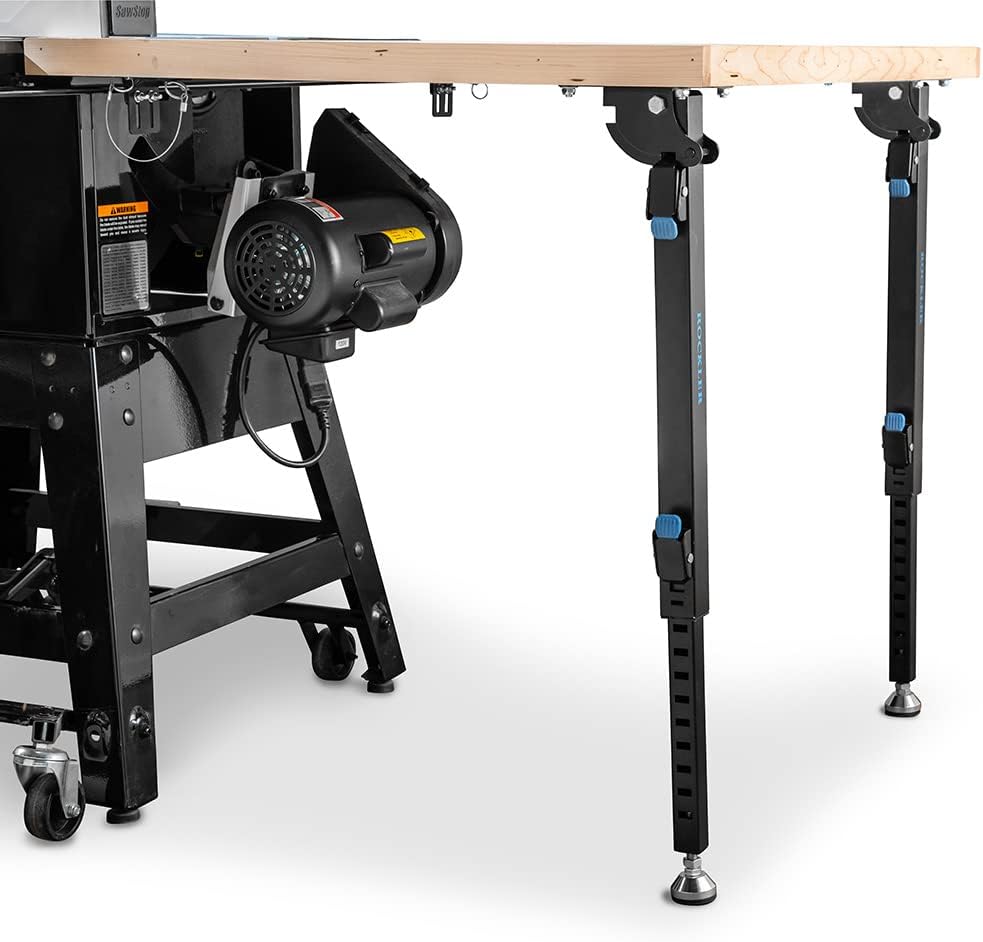
Rockler Rock-Steady Knock-Down Table Saw Outfeed Kit
Space-saving outfeed table kit with folding, adjustable legs and quick-release hardware for most cabinet and contractor table saws.
Check Price on Amazon (opens Amazon in a new tab)Bora Portamate — best for a shop where floor space matters more than convenience. It folds down when you’re not ripping long stock, then locks flat when you need it.
Grizzly Mobile — best for a shop cutting sheet goods regularly, especially if more than one person uses the saw. The larger surface handles full sheets without the far edge hanging in space.
Roller stands — fine for narrow board ripping, but they don’t give sheet goods the flat, continuous support they need. A single point of contact under a wide panel still lets the edges droop.
Shop-built — best if you want the table sized to your exact saw height and shop layout, and you’re comfortable with basic building.
How to build a basic outfeed table (free plan)
This build assumes a fixed table, roughly the width of your saw’s table and a few feet deep. Adjust the dimensions to fit your space.

Materials:
| Item | Purpose |
|---|---|
| 3/4″ MDF or plywood, sized to your space | Table top |
| 2×4 lumber for the frame and legs | Structure and support |
| Wood screws and glue | Assembly |
| Locking casters (optional) | Mobility, if you want to roll it out of the way |
Steps:
- Measure your saw’s table height carefully. The outfeed table needs to sit at the exact same height, or very slightly lower — never higher, or boards will catch on the edge.
- Build a simple leg frame from 2x4s, sized so the top of the frame matches your saw table height once the plywood top is added.
- Attach the plywood or MDF top to the frame with screws, keeping the surface flat and free of any high spots.
- Sand or wax the top surface so boards slide smoothly instead of dragging.
- Position it directly behind the saw, leaving a small gap or none at all, so long boards transition cleanly from the saw table to the outfeed surface.
- If you added casters, use locking ones and confirm the table doesn’t shift under load once it’s locked in place.
A slightly lower outfeed table is safer than one that’s too high. If the height is off, err on the side of a hair lower — a board can slide down a small step without catching, but it’ll snag hard on a table that’s even slightly too tall.
What material works best for the table top

| Material | Pros | Cons |
|---|---|---|
| MDF | Dead flat, smooth surface, cheap | Heavy, and it sags over a wide span without enough support underneath |
| Baltic birch plywood | Strong, resists sagging better than MDF | Costs more |
| Melamine-coated particleboard | Very slick surface, boards slide easily | Brittle at the edges, chips if bumped hard |
| Standard plywood with a laminate top | Durable, smooth if finished well | More work to build |
Melamine gets used a lot for outfeed tables specifically because of how slick it is. A board that drags across a rough top fights your hand the whole way through the cut, which defeats a lot of the point of having outfeed support in the first place. If you’re building your own and can find melamine-coated sheet stock, it’s worth the extra cost over plain plywood.
Sizing your outfeed table to your shop
There’s no single right size, but a few guidelines help.
- Width should match or exceed your saw table’s width, so cuts made anywhere along the rip fence are fully supported.
- Depth (how far it extends behind the saw) depends on what you cut most. Two to three feet handles most sheet goods reasonably well. Deeper is better if you regularly cut long stock like baseboard or crown molding.
- Height has to match the saw table, not a standard workbench height. This is the one measurement you shouldn’t guess on.
If your shop is tight on space, a narrower table that still matches the saw’s width is a better compromise than a full-depth table you have to squeeze past every time you walk through the shop.
Fixed vs folding vs mobile outfeed tables
| Type | Best For | Trade-off |
|---|---|---|
| Fixed table | Shops with dedicated saw space | Always in the way if space is tight |
| Wall-mounted folding table | Small shops, occasional long cuts | Takes a minute to set up each time |
| Mobile table on casters | Shops that rearrange often | Needs locking casters to stay stable during a cut |
A folding table is the right call if your shop doubles as a garage or a space you need clear most of the time. A fixed table makes more sense if the saw has a permanent spot and you’re not moving things around often.
Adding shelving or storage underneath

Since the space under an outfeed table often sits empty, most shop-built versions end up with a shelf or two added underneath. This isn’t required for the table to function, but it’s an easy way to reclaim floor space in a smaller shop.
A few things worth keeping in mind if you go this route:
- Keep the shelf low enough that it doesn’t interfere with the leg frame’s rigidity.
- Avoid stacking anything heavy enough to make the table difficult to move, if it’s meant to be mobile.
- Leave clearance underneath if you’re running dust collection hose along the floor behind the saw.
It’s a small addition, but it’s one of the more common upgrades people add once the basic table has been in use for a while.
Working solo vs with a second person
An outfeed table matters most when you’re working alone, which is most of the time in a home shop.

With two people, one person can feed the board and the other can support the far end as it clears the saw, which does the same job an outfeed table does. That’s fine occasionally, but it’s not a reliable long-term solution if you’re the only one in the shop most days, or if your helper isn’t always available exactly when you need them.
Building or buying an outfeed table means you’re not dependent on having someone else around every time you need to break down a sheet of plywood.
Common mistakes people make with outfeed tables
- Setting the height too high. Even a small lip at the transition point catches boards and stops the cut cold, sometimes with the blade still engaged.
- Leaving a gap between the saw and the table. A gap lets narrow strips or thin material dip and catch as they cross it. Keep the tables close, or bridge the gap with a filler piece.
- Building it too narrow. An outfeed table that’s narrower than your rip fence’s full range won’t support cuts made at the wider end of the fence.
- Skipping a smooth top finish. A rough plywood surface drags on boards instead of letting them slide, which partly defeats the purpose.
- Not securing a mobile table before cutting. Casters that aren’t locked can roll under load, which is worse than having no outfeed support at all.
Pairing an outfeed table with the rest of your setup
An outfeed table solves what happens after the cut clears the blade, but it doesn’t replace good hand control through the cut itself. Pair it with a push block or push stick for the part of the cut near the blade, and let the outfeed table take over supporting the material once it’s past.
If you’re cutting sheet goods to rough size before a final rip, a crosscut sled paired with outfeed support handles the whole workflow — rough crosscuts on the sled, then a supported rip cut with the outfeed table catching the long piece.
And if your rip fence drifts or flexes under a full sheet of plywood, that’s worth fixing before anything else. Check our guide on aftermarket table saw fences for options that hold up under heavier material.
If dust collection is also on your list, an outfeed table is a good spot to route hose or duct work along the back of the saw. Our guide to dust collection setups covers how to keep that hardware out of the way without blocking the outfeed surface.
Which saws benefit most from an outfeed table
| Saw Type | Why It Matters |
|---|---|
| Portable / jobsite saw | Small table means almost every long cut needs outfeed support |
| Contractor saw | Standard table helps, but long rips and sheet goods still benefit |
| Cabinet saw | Larger table already, but sheet goods still droop past the edge without one |
Smaller saws benefit the most, simply because there’s less table to begin with. If you’re running a compact or portable saw, an outfeed table does more heavy lifting relative to the size of the saw itself.
FAQ
How far behind the saw should an outfeed table sit? Right behind it, with little to no gap. Any noticeable gap gives thin material a chance to dip and catch as it crosses from the saw table to the outfeed surface.
Does an outfeed table need to be the same height as the saw table? Yes, or very slightly lower. Never higher. A table that’s even a little too tall will catch the leading edge of a board mid-cut.
Can I use a workbench as an outfeed table? Yes, as long as the height matches your saw table and it’s positioned close enough behind the saw with no gap. Many woodworkers build their outfeed table and main workbench as the same surface for exactly this reason.
Is a roller stand a good substitute for a full outfeed table? For narrow rips, yes. For full sheets of plywood, not really — a single roller under the center of a wide panel still lets the edges sag, since it’s only supporting one point rather than the whole width.
Do I need an outfeed table if I mostly do small crosscuts? Not really. Outfeed support matters most for long rips and sheet goods. If your cuts are mostly short and you’re using a crosscut sled, the sled itself already provides enough support for most of that work.

Finlay Connolly is a woodworking enthusiast and power tool specialist with over a decade of hands-on experience in the workshop. As the founder and lead writer at ProTableSawReviews.com, Finlay combines expert knowledge with real-world testing to help woodworkers, DIYers, and professionals choose the best tools for the job. With a sharp eye for detail and a passion for precision, Finlay is committed to providing trustworthy, practical advice backed by years of experience and research in the field. Whether you’re cutting dados or comparing fence systems, you can count on Finlay for honest, reliable reviews that make your next cut your best one.


