
Festool Track Saw Review: TS 55, TSC 55 & TS 75 Tested
Festool track saw review covering TS 55, TSC 55 and TS 75, cut quality, Kickback Stop, dust collection, real-world use, price and cheaper alternatives.
In this article
- The Short Answer
- A Bit of History Worth Knowing
- The Festool Track Saw Lineup
- Cut Quality and Control
- The Safety Test Most Reviews Skip
- Dust Collection: The Actual Numbers
- A Use Case Almost Nobody Talks About: Jointing
- Corded vs. Cordless Within the Festool Lineup
- What Real, Long-Term Use Actually Looks Like
- The Honest Price Conversation
- Real-World Use Cases
- Common Mistakes People Make
- How It Compares to Cheaper Alternatives
- Frequently Asked Questions
- Bottom Line
The Short Answer
Festool’s track saws, the TS 55 and its variants, remain the benchmark the entire category gets measured against, and that’s not just brand loyalty talking. Festool invented the track saw more than 40 years ago, and while DeWalt, Makita, and Grizzly now all sell their own versions, independent reviewers who’ve tested competitors side by side still consistently point back to Festool as the reference point. The honest caveat, and every serious reviewer includes it: price. If you’re on a tight budget or don’t need dead-accurate cuts every single time, a Makita or DeWalt track saw will genuinely get the job done for less money.

This review covers what that premium actually buys you, backed by real testing rather than marketing copy, including one detail almost no other review covers: how the saw performs when someone deliberately tries to make it fail.
A Bit of History Worth Knowing
This matters more than it sounds like it should. Festool didn’t just enter the track saw market, they created it, and every track saw sold today, regardless of brand, borrows from the design language Festool established decades ago. That’s part of why independent professional reviewers keep coming back to the same conclusion: competitors have gotten genuinely good, but Festool is still the saw everyone else is being compared against, not the other way around.
The Festool Track Saw Lineup
| Model | Power | Best For | Price |
| TS 55 REQ | Corded | Fixed shop setups, unlimited runtime | ~$585 |
| TSC 55 KEB | Cordless | Mobile jobsite work, added Kickback Stop safety | Premium tier |
| TSC 55 K | Cordless, brushless | Buyers wanting Festool’s smoothest, most current cutting performance | Premium tier |
| TS 75 EQ | Corded | Thicker stock, uses the same rail system | Above TS 55 |
Cut Quality and Control

The core cutting experience is where Festool’s reputation actually gets earned. The scribe line matches the cut line precisely, which sounds like a small thing until you’ve fought a saw where it doesn’t. The plunge action is smooth and controlled, and the bevel range runs from -1 to 47 degrees, useful for undercuts and precise miters, with cutting depth staying consistent even when the blade is tilted, a detail that matters directly when you’re fitting baseboard or flooring into a tight angled corner and can’t afford the depth to shift on you mid-adjustment.
Blade changes use Festool’s FastFix system, which locks the arbor and lets you swap blades tool-free, a genuinely practical time-saver if you’re moving between different cutting tasks on the same job.
The Safety Test Most Reviews Skip

Pro Tool Reviews did something with the cordless TSC 55 KEB that most reviews never bother with: they deliberately tried to trigger kickback, more than once, specifically to test the saw’s Kickback Stop system. The system senses the moment the blade or saw lifts unexpectedly from the material. In their testing, the saw jumped back about a quarter to a half inch and the blade stopped almost instantly, then reset automatically so the saw was immediately ready to continue, without damaging the blade or, in most cases, the material being cut. That’s a genuinely rare piece of real-world safety verification, not a manufacturer claim repeated without scrutiny.
Dust Collection: The Actual Numbers

According to Festool’s own figures, verified in the same Pro Tool Reviews testing, the saw’s dust collection bag alone captures about 90 percent of dust generated during a cut. Connect it to a genuine Festool dust extractor and that number climbs to 98 percent. The reviewer specifically noted keeping a small dust extractor connected for most cuts, only switching to the bag when the hose was too short to manage an awkward diagonal cut across a full sheet of plywood. That’s a rare, specific, testable claim rather than the vague “great dust collection” language most reviews settle for.
A Use Case Almost Nobody Talks About: Jointing

One long-term TS 55 owner writing for Pro Tool Reviews described a genuinely clever secondary use for the saw’s rail system: connecting two guide rails together with the Rail Connector Set to create a straight edge long enough to joint rough lumber, without owning an actual jointer. This is a real, practical workaround worth knowing about if shop space or budget doesn’t allow for a dedicated jointer. Our Table Saw vs Jointer guide covers why this kind of workaround matters, and where it still falls short of what a true jointer does for face-jointing rather than just edge work.
Corded vs. Cordless Within the Festool Lineup

The corded TS 55 REQ remains the choice for a fixed shop setup where consistent, unlimited power matters more than mobility. The cordless TSC 55 KEB and the newer TSC 55 K, which added a brushless motor and runs on 5.2Ah batteries, trade that unlimited runtime for the freedom to cut in a driveway or on a jobsite without dragging out a long extension cord. One reviewer actively testing the TSC 55 K called it Festool’s best track saw yet in terms of smoothness and power, though that assessment was still ongoing at the time. If you’re weighing this same corded-versus-cordless trade-off more broadly, our Corded vs Cordless Circular Saw guide covers the general principles that apply here too.
What Real, Long-Term Use Actually Looks Like
Specs and lab tests only tell part of the story. At least one contractor with close to two decades in construction and several years of daily use with a corded TS 55 described it as one of the most reliable and precise tools in his entire kit, using it regularly for flooring, stair treads, deck boards, and cabinetry work. That kind of account is worth taking with the understanding that it’s one person’s experience rather than a controlled test, but it lines up consistently with the more rigorous testing from Pro Tool Reviews and Tool Box Buzz, which is exactly the kind of cross-source agreement that builds real confidence in a tool’s reputation.
The Honest Price Conversation

Every credible review of this saw includes some version of the same caveat, and it’s worth repeating rather than burying: this is an expensive tool, and it’s not the right purchase for everyone. One reviewer put it about as bluntly as it gets: if you’re on a tight budget, or you don’t need perfect cuts every single time, a Makita or a DeWalt track saw will do the job. The premium here buys you refinement, verified safety performance, and a rail and accessory ecosystem that’s been built out and refined for decades, not a categorically different ability to make a straight cut. Whether that premium is worth it depends entirely on how much your work depends on that last increment of precision and reliability.

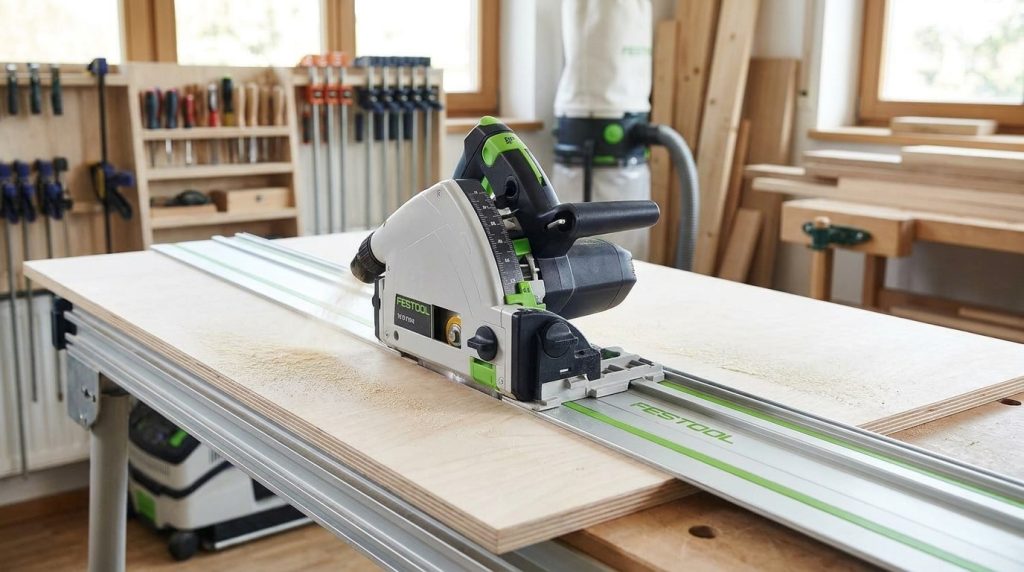
Festool TS 55 FEQ-F Plus FS Plunge Cut Track Saw
A precision-focused plunge-cut track saw designed for clean, accurate cuts in materials up to 55 mm thick. The TS 55 features a 6-1/2-inch blade, guide-rail compatibility, a riving knife, adjustable bevel from -1° to 47°, and a splinter guard for cleaner cuts.
Real-World Use Cases

Trim Carpentry and Installation Crews
Track saws are a genuine alternative to hauling a full table saw into the field, and Festool’s is specifically well suited to accurate, repeatable cuts on flooring, ductwork repair, and similar installation work where a mistake means a return trip.
Breaking Down Full Sheets in a Small Shop
Small shops without room for a table saw and outfeed support consistently favor track saws for exactly this reason, and the optional Guide Rail Set extends serial ripping capacity up to nearly 26 inches wide for wider panels.
Flooring, Stair Treads, and Finish Carpentry
This is where the consistent depth-at-bevel and precise scribe line genuinely pay off, especially fitting angled cuts into tight corners where a small error is immediately visible in the finished work.
Jobsite Work Without Reliable Power
The cordless TSC 55 line solves this directly, letting you trim panels or make finish cuts without running a long extension cord across a client’s driveway or living space.
Common Mistakes People Make

- Assuming a guide rail is always included in every bundle, when some packages sell the saw and track separately
- Expecting the saw to fully replace a table saw for ripping thick stock or repetitive small parts, which it isn’t built for
- Buying the premium accessory kits before confirming you actually need serial ripping capacity or blind-cut kickback protection for your specific work
- Underestimating how much the corded-versus-cordless decision matters for your specific work environment before choosing between TS 55 and TSC 55 models
- Assuming Festool is the right choice regardless of budget, when several honest reviews openly recommend cheaper alternatives for buyers who don’t need the last degree of precision
- Skipping a genuine Festool dust extractor and expecting the bag alone to match the 98 percent collection rate that’s only achieved with the full system
How It Compares to Cheaper Alternatives
DeWalt’s track saw is priced comparably to the TS 55 REQ, while Makita and other competitors generally undercut Festool on price. None of the credible reviews here dismiss those alternatives as bad tools, several specifically acknowledge they’ll do the job for buyers without Festool’s exact precision and ecosystem needs. The real differentiators favoring Festool are the verified kickback safety performance, the specific 90/98 percent dust collection numbers, and a decades-deep accessory ecosystem that newer competitors haven’t fully matched yet.
Frequently Asked Questions
Is the Festool TS 55 worth the extra money over cheaper track saws?
It depends on how much your work depends on precision and reliability. Multiple independent reviewers are honest that budget-conscious buyers or those who don’t need perfect cuts every time can get by fine with a Makita or DeWalt track saw instead. Festool’s premium buys refinement, verified safety features like the Kickback Stop system, and a mature accessory ecosystem, not a fundamentally different ability to cut straight.
Can a Festool track saw replace a table saw?
For many tasks, yes, particularly straight cuts in sheet goods where portability matters. It won’t fully replace a table saw for ripping thick stock or making many small repetitive parts, where a table saw’s fence and repeatable setup remain more efficient.
How good is the dust collection on Festool track saws?
According to Festool’s own figures, verified through independent testing, the saw’s dust bag alone captures about 90 percent of dust generated during cutting. Paired with a genuine Festool dust extractor, that climbs to about 98 percent.
Does the guide rail come included with the saw?
It depends on the specific bundle. Some packages include a 55-inch guide rail standard, while others sell the saw and rail separately. Always check exactly what’s included before purchasing rather than assuming.
Should I get the corded TS 55 or a cordless TSC 55 model?
Choose the corded TS 55 for a fixed shop setup where unlimited runtime matters most. Choose a cordless TSC 55 model if your work moves between locations and running a cord isn’t always practical, like trimming panels on a client’s property or working somewhere power access is unreliable.
Bottom Line
Festool’s track saws earn their reputation through decades of refinement, not just brand prestige. The verified kickback safety performance, the specific and testable dust collection numbers, and consistent depth control through bevel adjustments are all real, demonstrable advantages, not marketing language. The honest counterpoint, repeated across nearly every credible review, is that this precision comes at a real price premium, and buyers who don’t need the last word in accuracy can get genuinely capable results from cheaper competitors. If your work regularly depends on that precision, the reputation holds up under real scrutiny.

Finlay Connolly is a woodworking enthusiast and power tool specialist with over a decade of hands-on experience in the workshop. As the founder and lead writer at ProTableSawReviews.com, Finlay combines expert knowledge with real-world testing to help woodworkers, DIYers, and professionals choose the best tools for the job. With a sharp eye for detail and a passion for precision, Finlay is committed to providing trustworthy, practical advice backed by years of experience and research in the field. Whether you’re cutting dados or comparing fence systems, you can count on Finlay for honest, reliable reviews that make your next cut your best one.


