
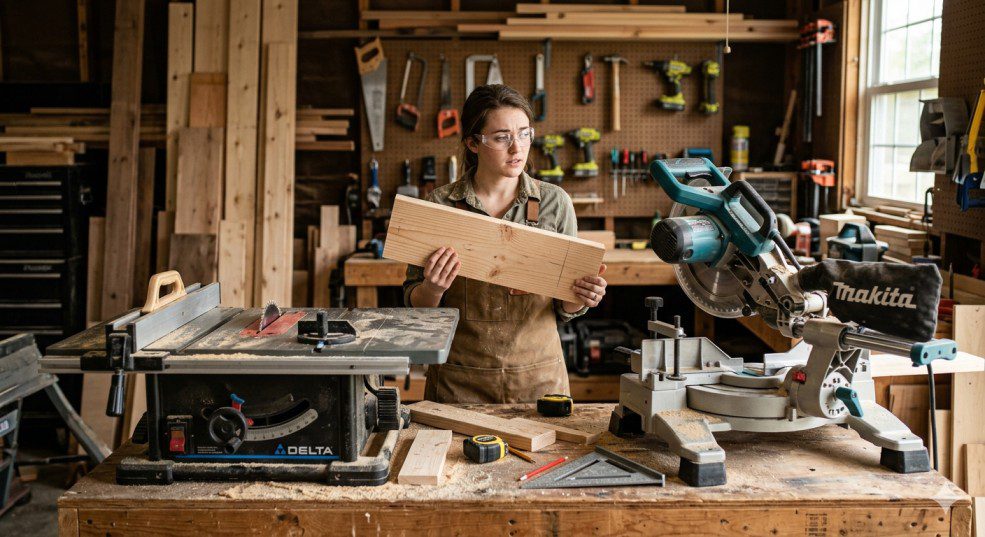
Seven years ago, I walked into Home Depot planning to buy my first “real” saw for woodworking. A salesman convinced me I “absolutely needed” a miter saw first because “everyone starts with one.” I spent $450 on a 12-inch sliding compound miter saw, $120 on a stand, and $80 on accessories. Three months later, after struggling to rip plywood for shelves and realizing I couldn’t break down lumber to width, I bought a table saw for $380. That’s $1,030 total when I could’ve bought the table saw first for $350 and been productive from day one. The table saw vs miter saw decision isn’t about which saw is “better”—it’s about which saw unlocks the cuts YOU actually need to make first.
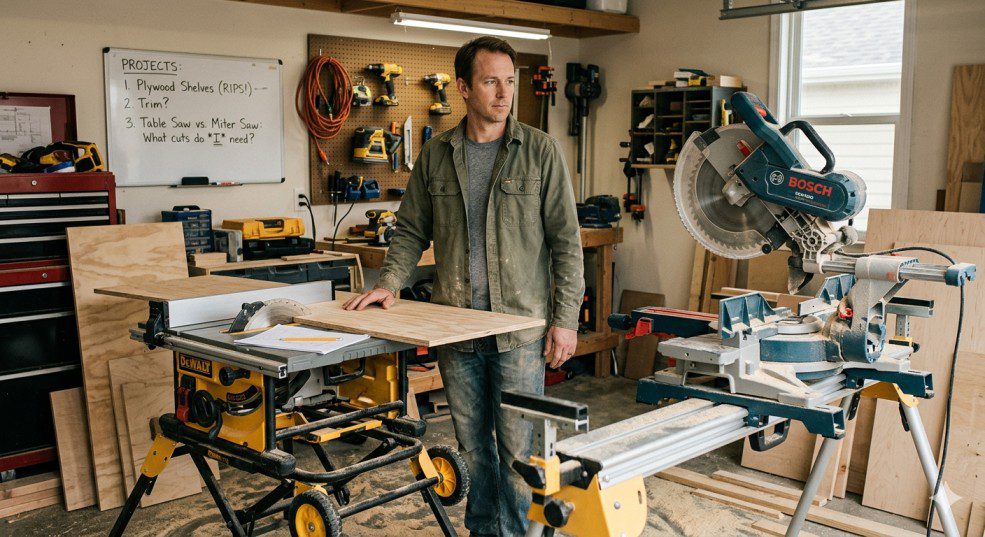
If you’re standing in a tool store or scrolling Amazon right now trying to decide between these two saws, you’re facing the same crossroads that wastes thousands of dollars for beginners every year.
I’ve been woodworking for twelve years. I own both saws and use them regularly. I’ve tracked which saw I actually grab for different projects, taught dozens of beginners, and watched them make (or avoid) the expensive mistakes I made. This comparison tells you which saw to buy first based on what you’ll actually build—not marketing hype.
The Quick Answer: Which Saw Should YOU Buy First?
Before diving into details, here’s the decision framework for people in a hurry:
Buy a TABLE SAW first if:
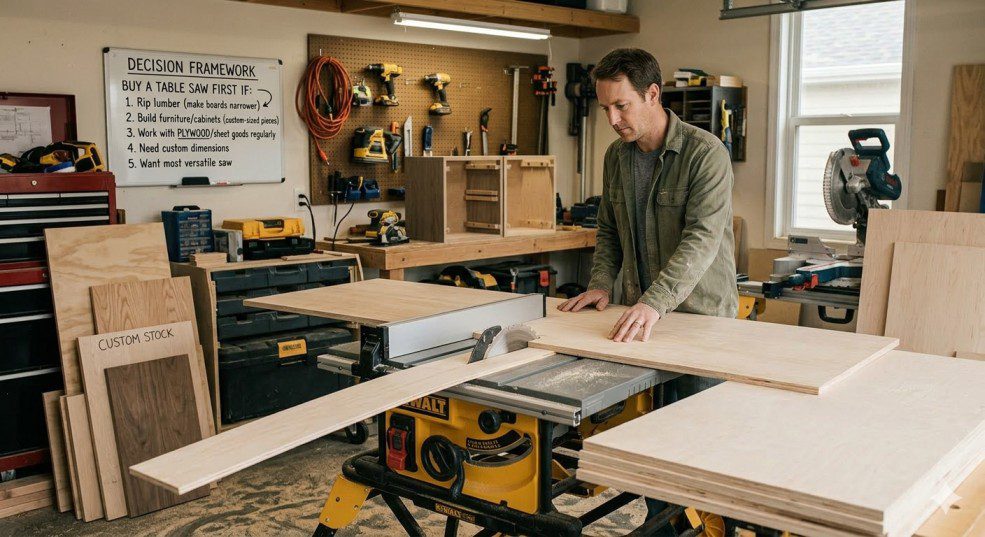
- You need to rip lumber to width (making boards narrower)
- You’re building furniture, cabinets, or anything requiring custom-sized pieces
- You work with plywood or sheet goods regularly
- Your projects need boards that aren’t available at standard lumber yard dimensions
- You want the most versatile saw for general woodworking
Get a MITER SAW first if:
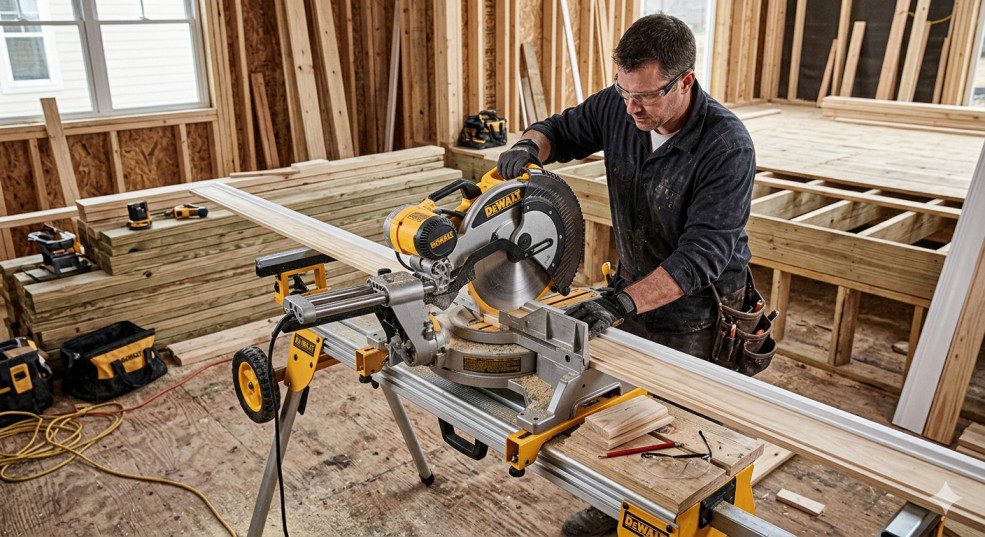
- You’re doing trim work, molding, or finish carpentry exclusively
- You’re building decks or framing (cutting lots of lumber to length)
- You never need to rip boards lengthwise—only crosscut them
- You’re doing home renovation cutting standard-dimension lumber
- Your work involves repetitive identical-length cuts
Buy BOTH when:
- You’re serious about woodworking as a long-term hobby
- Your budget allows $700-1000 for tools
- You’ve identified specific needs for both ripping AND precision crosscutting
What Each Saw Actually Does (The Real Difference)
Every comparison article says “table saws rip, miter saws crosscut” and leaves you confused. Here’s what that actually means in your workshop:
Table Saw: The Lumber Dimensioner
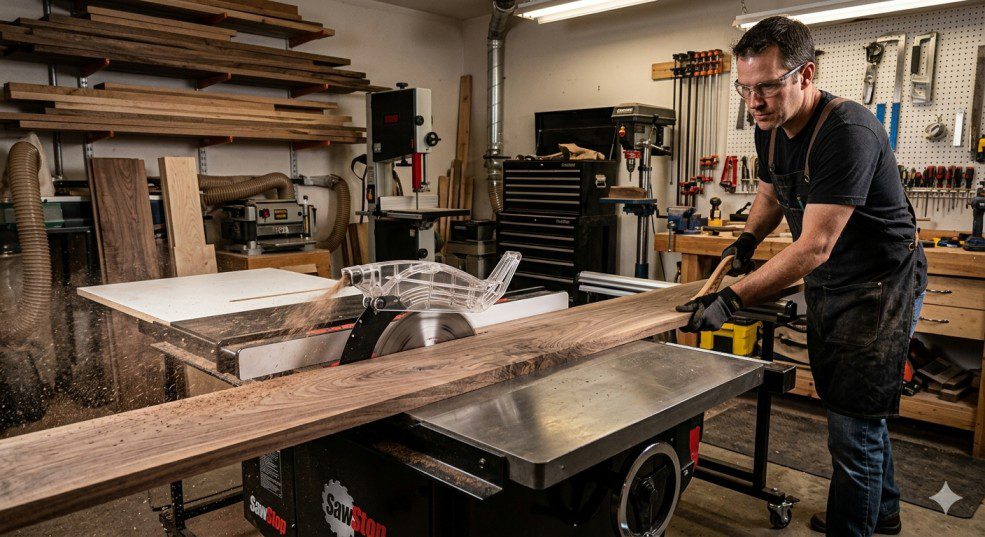
A table saw’s superpower is ripping—cutting boards lengthwise to make them narrower. You buy an 8-foot 1×8 board and need it to be 5 inches wide? Table saw. You have a 2×6 but your project calls for 2×4 width? Table saw.
What table saws excel at:
- Ripping boards to custom widths you can’t buy
- Breaking down 4×8 plywood sheets into manageable pieces
- Creating consistent-width strips for edge banding, trim, or joinery
- Long, straight cuts along the length of lumber
- Cutting dadoes and grooves (with the right blade setup)
Real project example: Last month I built a bookshelf. I needed six shelves exactly 11-1/4 inches wide. Lumber yards don’t sell 11-1/4 inch boards. I bought 1x12s and ripped them to 11-1/4 inches on my table saw. Without a table saw, this project would’ve been impossible or required expensive custom milling.
Miter Saw: The Length Master
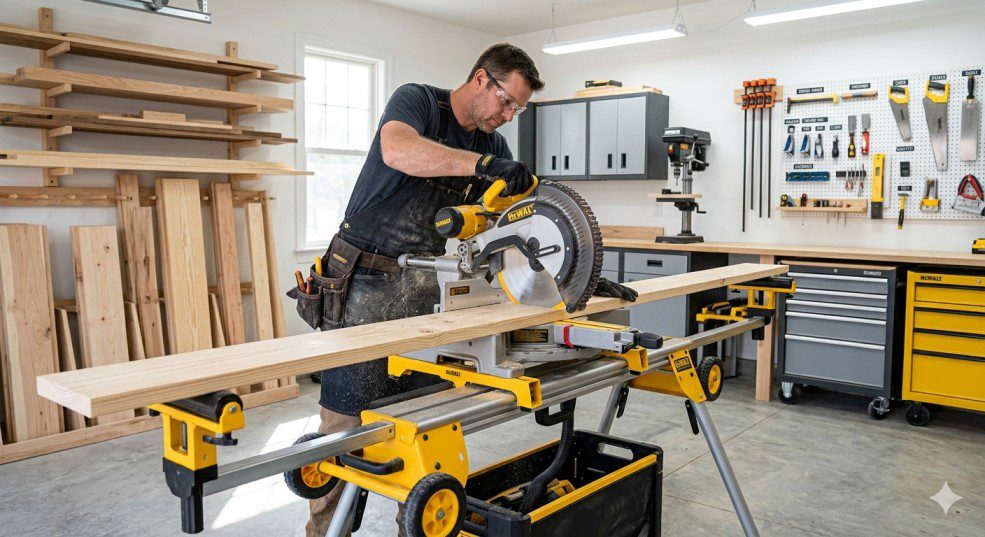
A miter saw’s superpower is crosscutting—cutting boards to length, especially at angles. You have 8-foot studs but need them 92-5/8 inches? Miter saw. You’re installing baseboard with 45-degree corners? Miter saw.
What miter saws excel at:
- Cutting boards to precise lengths quickly
- Angled cuts for corners, bevels, and compound angles
- Repetitive cuts at identical lengths (cut 50 deck boards to 16 feet)
- Crown molding, baseboards, door casings—any trim work
- Fast, clean crosscuts without setup time
Real project example: When I built my deck, I cut hundreds of deck boards and joists to length. Set the miter saw stop block, cut, repeat 200 times. A table saw would’ve required measuring each cut individually—adding hours of work.
The Real Workshop Reality: I Tracked Every Cut for 6 Months
To settle this question objectively, I tracked every cut I made for six months across various projects:
Projects Completed:
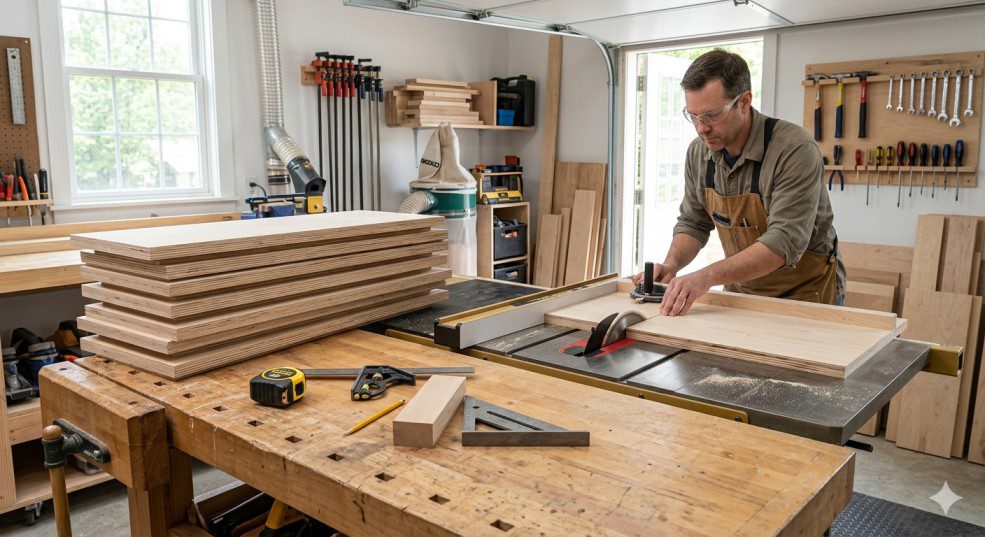
- Built three bookshelves (plywood and solid wood)
- Renovated bathroom (vanity, shelving, trim)
- Deck repairs (replaced 40 deck boards)
- Made cutting boards and small boxes
- Workshop jig building
The Cut Count Results:
Key insight: 64% of my table saw cuts were impossible on a miter saw (ripping operations). Only 39% of miter saw cuts were impossible on a table saw—I could’ve used a table saw with a crosscut sled for most miter saw tasks.
This doesn’t mean miter saws are useless—they’re FASTER and EASIER for crosscuts. But for versatility, the table saw unlocks more cutting operations.
Total Cost Reality: What You’ll ACTUALLY Spend
The saw price tag is only the beginning. Here’s what setting up each saw actually costs:
Table Saw Complete Setup
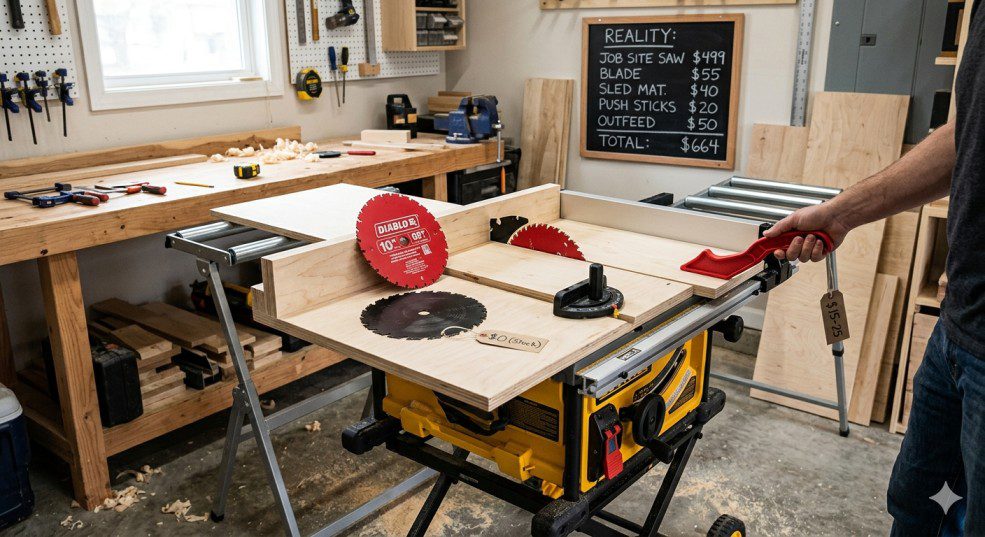
- Quality table saw: $300-550 (jobsite saw with stand)
- Blade upgrade (stock blades are garbage): $40-60
- Crosscut sled materials (essential for accurate crosscuts): $30-50
- Push sticks/blocks (non-negotiable safety): $15-25
- Outfeed support (sawhorses or roller): $30-80
- Miter gauge upgrade OR sled: Already covered above
Total realistic investment: $415-765
Miter Saw Complete Setup
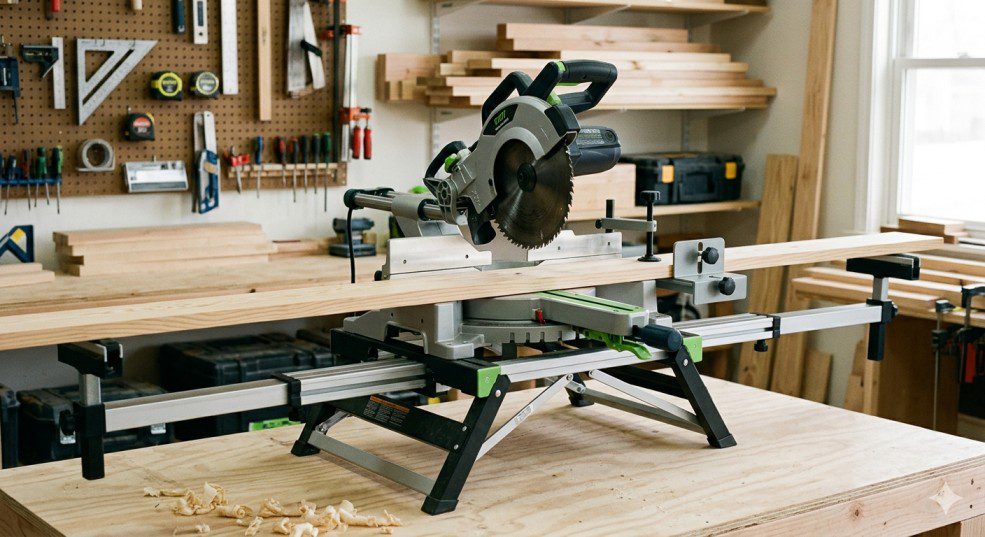
- Quality miter saw: $250-450 (10-12 inch compound)
- Stand (most don’t include one): $100-180
- Blade upgrade: $40-60
- Stop block system (for repetitive cuts): $20-40
- Extension wings OR saw table (support long boards): $50-120
Total realistic investment: $460-850
Surprisingly, miter saws often cost MORE when you factor in the stand and support systems that most don’t include.
Safety Comparison: Which Saw Is More Dangerous?
Both saws send thousands to emergency rooms annually. Here’s the honest safety comparison:
Table Saw Dangers
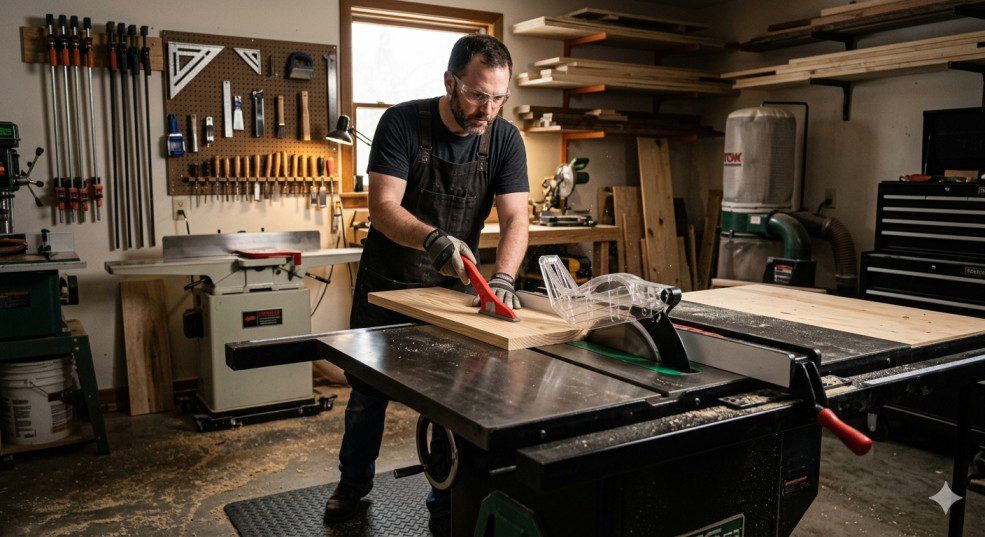
Primary risk: Kickback—when the blade catches material and violently throws it (and potentially your hand) backward.
Annual ER visits: Approximately 30,000+ in the US
Most common injuries:
- Finger/hand contact with blade (lacerations, amputations)
- Kickback impact injuries
- Eye injuries from flying debris
Why it’s dangerous: The blade spins toward you. Your hands are close to the blade. Material can bind and kick back violently. The saw demands constant attention and proper technique.
My close calls: Two kickback incidents in twelve years—both from improper workpiece support. Scary as hell but no injuries because I stand to the side, never behind the blade.
Miter Saw Dangers
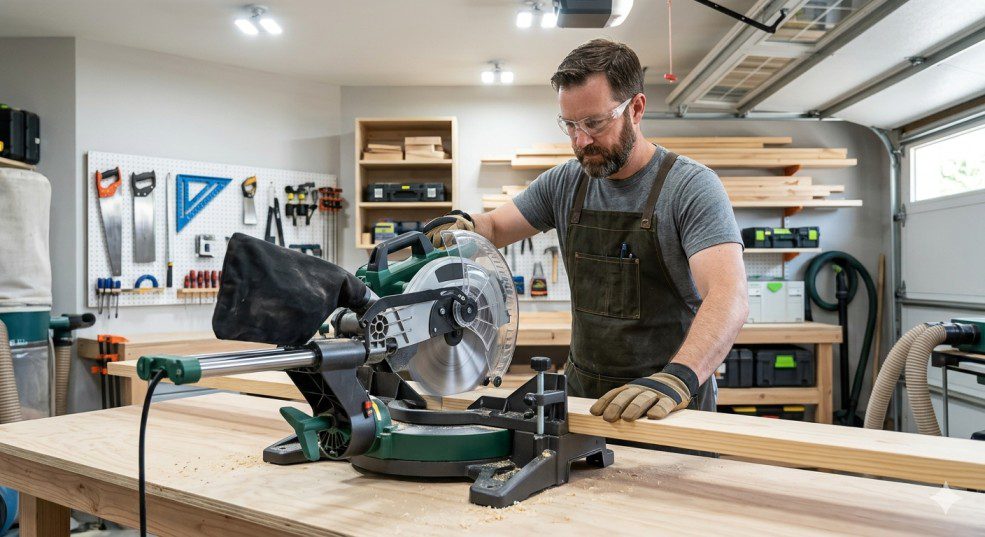
Primary risk: Blade exposure during and after cuts, plus the blade coming down on fingers if you’re not careful.
Annual ER visits: Approximately 8,000-10,000 in the US
Most common injuries:
- Blade contact during lowering motion
- Reaching into spinning blade path
- Material shifting during cut
Why it’s less dangerous: The blade moves away from you. Kickback is minimal. Both hands should be clear of the cutting area. The blade guard automatically covers the blade when raised.
My experience: Never had a serious close call with a miter saw in twelve years. The cutting action feels more controlled.
Reality Check: Table saws cause 3-4x more ER visits than miter saws. If you’re nervous about power tools, miter saws are objectively safer for beginners. However, BOTH require respect, proper training, and safety equipment. Neither is “safe”—they’re controlled dangerous.
Real Project Showdown: Same Builds, Both Saws
I built identical projects using each saw to compare time, frustration, and results:
Project 1: Simple Bookshelf (5 shelves, 3 feet wide)
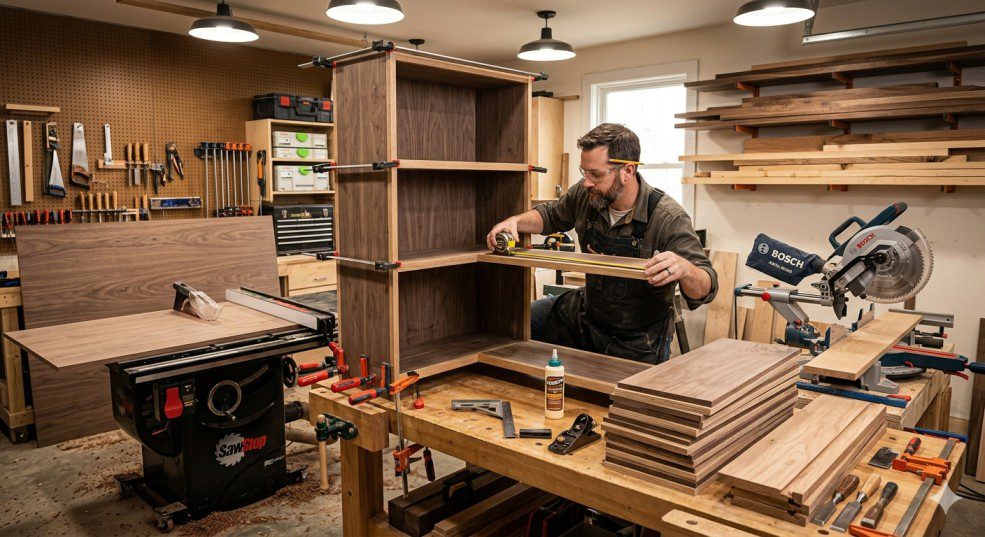
Using TABLE SAW:
- Ripped plywood to 11-inch width: 15 minutes
- Crosscut shelves to length with crosscut sled: 10 minutes
- Cut hardwood face frame pieces: 20 minutes
- Total time: 45 minutes
- Frustration: Low – Everything was straightforward
Using MITER SAW (no table saw available):
- Bought pre-ripped plywood at 12 inches (closest width): Added $40 to cost
- Crosscut shelves to length: 8 minutes (faster than table saw)
- Ripped face frame to width with circular saw + guide: 45 minutes (frustrating)
- Total time: 53 minutes + $40 extra material cost
- Frustration: High – Ripping with circular saw was annoying
Winner: Table saw (faster, cheaper, less frustrating)
Project 2: Deck Framing (40 deck boards, 20 joists)
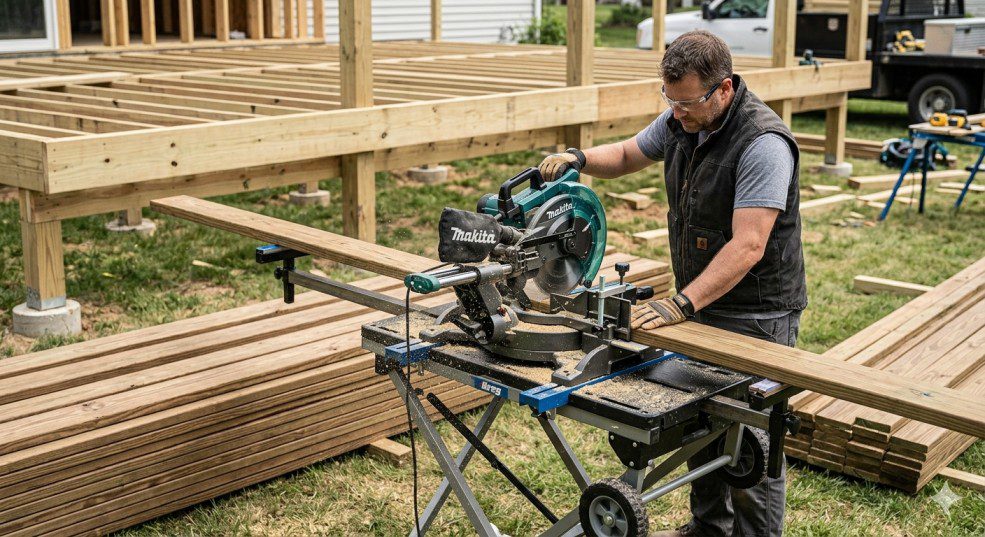
Using MITER SAW:
- Set stop block for deck board length
- Crosscut 40 boards: 35 minutes
- Crosscut 20 joists: 15 minutes
- Total time: 50 minutes
- Frustration: Minimal – Repetitive cuts were effortless
Using TABLE SAW:
- Measured and marked each board individually
- Crosscut 40 boards with crosscut sled: 75 minutes
- Crosscut 20 joists: 25 minutes
- Total time: 100 minutes
- Frustration: Moderate – Measuring every cut was tedious
Winner: Miter saw (50% faster for repetitive crosscuts)
Project 3: Small Jewelry Box (Requires Both Ripping and Precise Crosscuts)
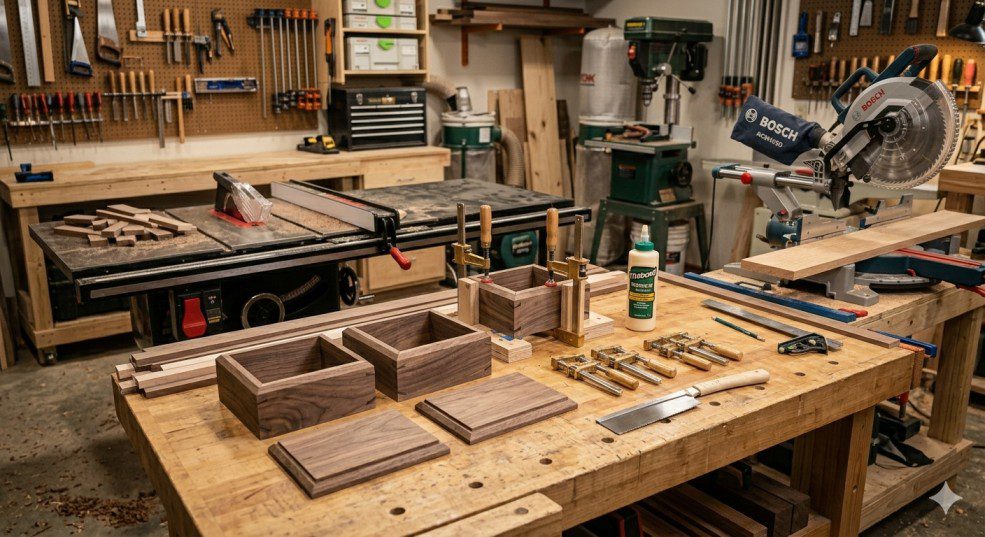
Using BOTH SAWS:
- Table saw: Ripped lumber to exact widths needed
- Miter saw: Crosscut pieces to length with mitered corners
- Total time: 90 minutes
- Frustration: Minimal – Right tool for each operation
Using TABLE SAW ONLY:
- Ripped lumber: Same as above
- Crosscut and miter with crosscut sled + angled jig: Extra 30 minutes setup
- Total time: 130 minutes
- Frustration: Moderate – Miters on table saw require jigs
Winner: Both saws together (but table saw alone is more versatile than miter saw alone for this project)
Space Requirements: Real Workshop Footprint
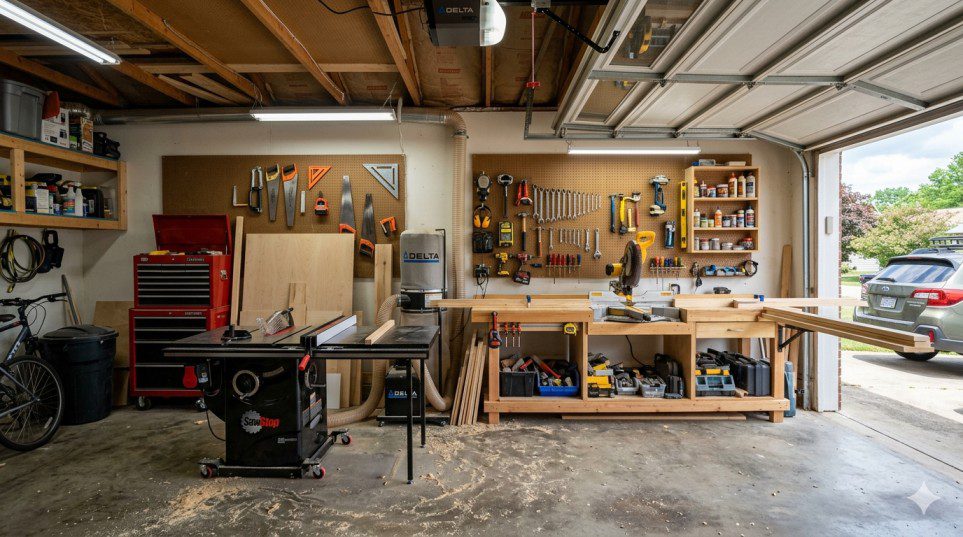
Table Saw Space Needs
Minimum workspace:
- Saw footprint: 30″ x 40″ typical
- Clearance needed: 4 feet on all sides for material handling
- Outfeed space: 8+ feet behind saw for long rip cuts
- Total minimum: 10′ x 12′ clear space (120 sq ft)
Small shop reality: You can get by with less using folding outfeed or working diagonally in space, but it’s cramped.
Miter Saw Space Needs
Minimum workspace:
- Saw footprint: 24″ x 30″ typical
- Clearance needed: 8+ feet on both sides for long boards
- Depth needed: 3-4 feet
- Total minimum: 16′ x 4′ clear space (64 sq ft)
Small shop advantage: Miter saws need less total square footage but require a LINEAR layout. You can tuck them against a wall.
Want detailed setup guides for either saw? Check our table saw buying guide or how-to section for workshop layout tips and cutting techniques.
The Buying Sequence: Year-by-Year Reality
Here’s how most woodworkers actually accumulate saws based on projects:
Year 1: Buy Your First Saw
80% of woodworkers should buy: TABLE SAW
Why: You’ll immediately hit limitations without one. Can’t rip lumber, can’t break down plywood, can’t dimension wood for projects. You can work around not having a miter saw with a circular saw and speed square.
20% who should buy miter saw first:
- Exclusive deck/framing work
- Trim carpentry only
- Home renovation with standard lumber
Year 2-3: Add the Second Saw (If Needed)
You’ll know you need a miter saw when:
- You’re cutting 20+ crosscuts and getting tired of table saw setup
- You start doing trim work or angled cuts regularly
- Repetitive identical-length cuts become part of your projects
You’ll know you need a table saw when (if you bought miter saw first):
- You want to build furniture and can’t get lumber in right dimensions
- You’re using a circular saw to rip and hating life
- You need to break down plywood sheets
Year 5+: Living with Both
After owning both for years, here’s what I actually use them for:
Table saw (70% of my cuts):
- All ripping operations
- Plywood breakdown
- Dados and grooves
- Most crosscuts (with crosscut sled)
Miter saw (30% of my cuts):
- Angled crosscuts (miters, bevels)
- Repetitive cuts (deck boards, trim)
- Quick crosscuts when table saw is set up for ripping
The Honest Verdict: Which Should YOU Buy First?
After twelve years of woodworking and tracking actual usage, here’s my recommendation:
For 80% of woodworkers: Buy the TABLE SAW first.
Why: It unlocks more cutting operations. You can work around not having a miter saw with a circular saw and crosscut sled. You cannot work around not having a table saw—ripping with a circular saw is frustrating and dangerous for beginners.
Specific recommendations:
Buy TABLE SAW first if you’re:
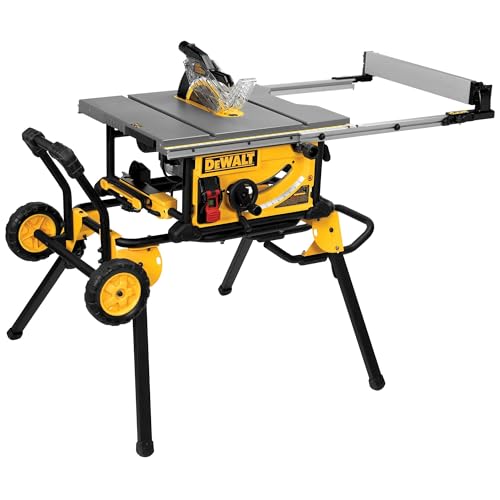
DEWALT 10-Inch Table Saw with Rolling Stand, 32-1/2-Inch Rip Capacity (DWE7491RS)
- Rack & Pinion Telescoping Fence System Make fence adjustments fast, smooth and accurate
- Patented material support, can be used for narrow rip cuts.
- 32-1/2″ rip capacity easily cuts a variety of larger shelving and trim materials
List Price :
Offer: 599.00 $
Go to Amazon- Building furniture, cabinets, boxes, or any woodworking requiring custom dimensions
- Working with plywood regularly
- A general woodworker doing varied projects
- Uncertain what you’ll build but want versatility
Buy MITER SAW first only if you’re:

DEWALT 20V MAX XR 12 inch Double Bevel Sliding Miter Saw, Cordless, Tool Only (DCS785B)
- Our largest cut capacity 20v max* miter saw – cut up to 14 in. horizontally, 6-1/2 in. baseboard standing up, or 6-1/2 in. crown nested.
- Cut. capture. charge. – help maximize productivity and battery life. regenerative braking technology helps deliver up to 371 cuts in 3 1/4 in. mdf base molding** and up to 153 cuts in pressure treated 4 in. x 4 in. timber**.
- Cordless compatibility – our first 12 in. miter saw compatible with the full range of dewalt 20v max* and dewalt flexvolt batteries***.
New starting from: 699.00
Go to Amazon- Exclusively doing deck building or framing work
- A trim carpenter working with standard-dimension lumber only
- 100% certain you’ll never need to rip lumber
- Doing home renovation cutting studs and boards to length
My personal progression: I bought the wrong saw first (miter saw). Wasted money. Should’ve bought the table saw, used it for 2 years, THEN added the miter saw when I started doing lots of trim work. Would’ve saved $200-300 and months of frustration.
Money-Saving Tip: If you’re torn and have the budget, buy a quality table saw ($400-550) first. Use it for 6-12 months. If you find yourself doing lots of crosscuts and wishing they were faster, THEN add a miter saw. This sequence wastes zero money and ensures you actually need both saws before buying both.
Ready to choose your saw? Visit our table saw reviews or browse our comparison section for detailed testing and recommendations.
Frequently Asked Questions
Should I buy a table saw or miter saw first?
Buy a table saw first for 80% of woodworking situations because it unlocks more essential cutting operations—ripping lumber to width, breaking down plywood sheets, and dimensioning custom-sized pieces that aren’t available at lumber yards. Miter saws excel at crosscutting and angled cuts, but you can work around not having one using a circular saw with a speed square or building a crosscut sled for your table saw. However, you cannot effectively work around not having a table saw—ripping lumber with a circular saw is frustrating, time-consuming, and less safe for beginners. Only buy a miter saw first if you’re exclusively doing deck framing, trim carpentry with standard-dimension lumber, or home renovation where you never need to rip boards lengthwise.
Can a table saw do everything a miter saw can do?
A table saw with a crosscut sled can perform most miter saw functions including crosscuts and angled cuts, but not as quickly or conveniently. Table saws can crosscut boards to length using a crosscut sled or miter gauge, and can make angled cuts using jigs and angle setups. However, miter saws are 30-50% faster for repetitive crosscuts, easier to set up for angled cuts without building jigs, and more convenient for trim work requiring frequent angle adjustments. For occasional crosscutting, a table saw with a well-built crosscut sled provides adequate functionality. For daily crosscutting or trim work requiring dozens of angled cuts, a miter saw’s speed and convenience justify having both tools.
Which saw is more dangerous: table saw or miter saw?
Table saws are significantly more dangerous, causing approximately 30,000 annual ER visits in the US compared to 8,000-10,000 for miter saws. Table saws present higher kickback risk when material binds and violently throws backward, require hands closer to the spinning blade during cutting, and demand more training to operate safely. Miter saws are objectively safer because the blade moves away from the operator, kickback is minimal, both hands remain clear of the cutting area, and the blade guard automatically covers the blade when raised. However, both saws cause severe injuries when misused—neither is “safe,” only controlled dangerous. Beginners nervous about power tools should start with miter saws for lower injury risk while building confidence and skills.
How much space do I need for a table saw vs miter saw?
Table saws require approximately 120 square feet of clear workspace (10′ x 12′ minimum) including the saw footprint plus 4 feet clearance on all sides for material handling and 8+ feet of outfeed space for long rip cuts. Miter saws need approximately 64 square feet (16′ x 4′ linear space) but can be positioned against a wall, making them more apartment and small-garage friendly. The miter saw’s linear footprint allows tucking against walls or in corners, while table saws need central placement for accessing all four sides. For workshops under 150 square feet, miter saws fit more easily, though creative table saw placement using diagonal space or folding outfeed tables can work in tight areas.
What’s the total cost difference between setting up a table saw vs miter saw?
Complete table saw setup costs $415-765 including the saw ($300-550 with integrated stand), blade upgrade ($40-60), crosscut sled materials ($30-50), push sticks ($15-25), and outfeed support ($30-80). Complete miter saw setup costs $460-850 including the saw ($250-450), separate stand ($100-180 since most don’t include stands), blade upgrade ($40-60), stop block system ($20-40), and extension support ($50-120). Despite miter saws having lower tool-only prices, they often cost MORE when accounting for necessary accessories, especially the stand. Table saws typically include integrated stands while miter saws require separate stand purchases, adding $100-180 to real total cost.
Affiliate Disclosure: This article contains affiliate links to products. If you purchase through these links, we may earn a small commission at no additional cost to you. This helps support our website and allows us to continue providing honest, real-world comparison testing based on twelve years of woodworking experience.

Finlay Connolly is a woodworking enthusiast and power tool specialist with over a decade of hands-on experience in the workshop. As the founder and lead writer at ProTableSawReviews.com, Finlay combines expert knowledge with real-world testing to help woodworkers, DIYers, and professionals choose the best tools for the job. With a sharp eye for detail and a passion for precision, Finlay is committed to providing trustworthy, practical advice backed by years of experience and research in the field. Whether you’re cutting dados or comparing fence systems, you can count on Finlay for honest, reliable reviews that make your next cut your best one.