
Best Miter Saw for Woodworking (2026): 5 Top Picks Compared
The best miter saws for woodworking compared: DeWalt DWS780 and DWS779, Festool Kapex, Milwaukee M18 FUEL and Bosch CM8S, plus blade advice and a buying guide.

The short answer: for most woodworkers, the DeWalt DWS780 is the best all-round miter saw. It is accurate, reliable and easy to line up thanks to its XPS LED shadow line. The DeWalt DWS779 gives you nearly the same cutting for less money without the LED, and the Festool Kapex KS 120 leads for fine furniture work and dust collection.
- 🏆 Best overall: DeWalt DWS780
- 🎯 Best for fine woodworking: Festool Kapex KS 120 REB
- 💰 Best value: DeWalt DWS779
- 🔋 Best cordless: Milwaukee M18 FUEL 2734-21HD
- 📦 Best compact: Bosch CM8S
Comparing saw types? See chop saw vs miter saw and our guide to the best sliding compound miter saws.
A miter saw that drifts even half a degree off square leaves gaps in every joint, which hurts when you are cutting expensive hardwood. Choosing the right saw makes a bigger difference than most people expect.
We compared the most popular miter saws for woodworkers using manufacturer specifications, owner feedback and long-term reliability reports, and weighed what matters most for furniture, trim and DIY work. Three saws stand out, but the “best” one depends on what you build.
In this article
- How We Chose These Saws
- Best Miter Saw for Woodworking: Our Top Pick
- DEWALT DWS780 12-Inch Sliding Compound Miter Saw
- Best Miter Saw for Fine Woodworking
- Festool Kapex KS 120 REB Sliding Compound Miter Saw
- Best Value Miter Saw for Woodworking
- DEWALT DWS779 12-Inch Sliding Compound Miter Saw
- Best Cordless Miter Saw
- Milwaukee 2734-21HD 10-Inch Sliding Compound Miter Saw
- Best Compact Miter Saw
- Bosch CM8S Single-Bevel Sliding Compound Miter Saw
- Essential Buying Guide
- Blade Selection for Woodworking
- Freud Ultimate Plywood & Melamine Saw Blade
- Freud LU91R010 Sliding Compound Miter Saw Blade
- Diablo D1260X 12-Inch Combination Saw Blade
- Complete Comparison Table
- Frequently Asked Questions
- Final Recommendation
How We Chose These Saws
We did not run our own hands-on lab tests. Instead, we checked each saw against the things that matter most to woodworkers:

What we looked at:
- Cut capacity for furniture parts, trim and 2× lumber (from manufacturer specifications)
- Accuracy features such as miter detents, fences, bevel stops and cut-line guides
- Dust collection design and how well each saw works with a vacuum or extractor
- Owner feedback on reliability and how well each saw holds its settings over time
Who each pick suits:
- Furniture and cabinet makers who need repeatable accuracy
- Trim carpenters cutting crown and baseboard
- Deck, fence and DIY builders
- Small shops with limited space or mobile setups
This isn’t sponsored content. We may earn a small commission if you buy through our Amazon links, at no extra cost to you, but brands have no say in what we recommend.
Best Miter Saw for Woodworking: Our Top Pick
DeWalt DWS780 12″ Double Bevel Sliding Compound Miter Saw

DEWALT DWS780 12-Inch Sliding Compound Miter Saw
Professional-grade 12-inch sliding compound miter saw built for precision crosscuts, bevel cuts, and heavy-duty woodworking with smooth sliding performance.
- Powerful 15-amp motor for demanding cuts
- 12-inch blade with sliding rail system
- Accurate bevel and miter adjustments
- Ideal for trim work, framing, and carpentry
*As an Amazon Associate, we may earn from qualifying purchases.
The DWS780 is the saw many woodworkers end up with. It is not perfect, but it delivers professional results without the Festool price tag.
Why It Won
Accuracy That Holds: Owners consistently report that the DWS780 holds its settings well, even with job site transport. Its key accuracy features include:
- An adjustable stainless steel miter detent plate with positive stops
- Tall sliding fences that support crown and base molding
- DeWalt’s XPS LED shadow line for adjustment-free cut-line indication
That stability matters when you are cutting expensive hardwood.
XPS LED Shadow System: Unlike lasers, which can drift out of alignment, DeWalt’s shadow line shines light past both sides of the blade to cast a shadow exactly where the kerf will be, so it needs no calibration.
That is especially helpful on figured wood, where busy grain can hide pencil lines.
Dust Collection:
- DeWalt says the system captures over 75% of the dust generated
- Results improve noticeably with a dedicated dust extractor
- The dust bag alone catches much less
Tip: connect a shop vacuum or extractor to the dust port for the cleanest results.
Cut Capacity:
- 13.25″ crosscut (handles most furniture parts)
- 7.5″ nested crown molding
- 2×14 dimensional lumber at 90°
With its sliding head, it handles wide furniture parts such as table aprons and case sides in a single pass.
What Could Be Better
Weight: about 56 lbs, so it is happiest on a bench or stand rather than carried around every day.
Fence Design: The fence is not zero-clearance out of the box. Adding a shop-made MDF sacrificial fence or insert is a common fix that greatly reduces tear-out on thin stock.
Dust Bag: Like most miter saw bags, it catches only part of the dust. Budget for a real dust extractor if you work indoors.
What Owners Report
- Commonly praised: accuracy that holds over time
- Commonly praised: the XPS shadow line, which needs no calibration
- Common complaint: the stock blade is fine for framing but not for fine work
- Common complaint: the weight and the small dust bag
Who Should Buy This
Perfect for:
- Cabinet makers needing repeatable accuracy
- Furniture builders working with expensive hardwoods
- Trim carpenters doing high-end residential
Skip it if:
- You move saws between job sites daily (too heavy)
- Your shop is under 100 sq ft
- You primarily cut construction lumber (the DWS779 costs less)
Integration with Your Workshop
This saw works well alongside a table saw. A common workflow:
- Table saw: Rip boards to width
- Miter saw: Crosscut to length with precision
- Table saw: Cut joinery
Many woodworkers find crosscutting to length faster on a miter saw than on a table saw with a sled, especially with long boards.
Best Miter Saw for Fine Woodworking
Festool Kapex KS 120 REB
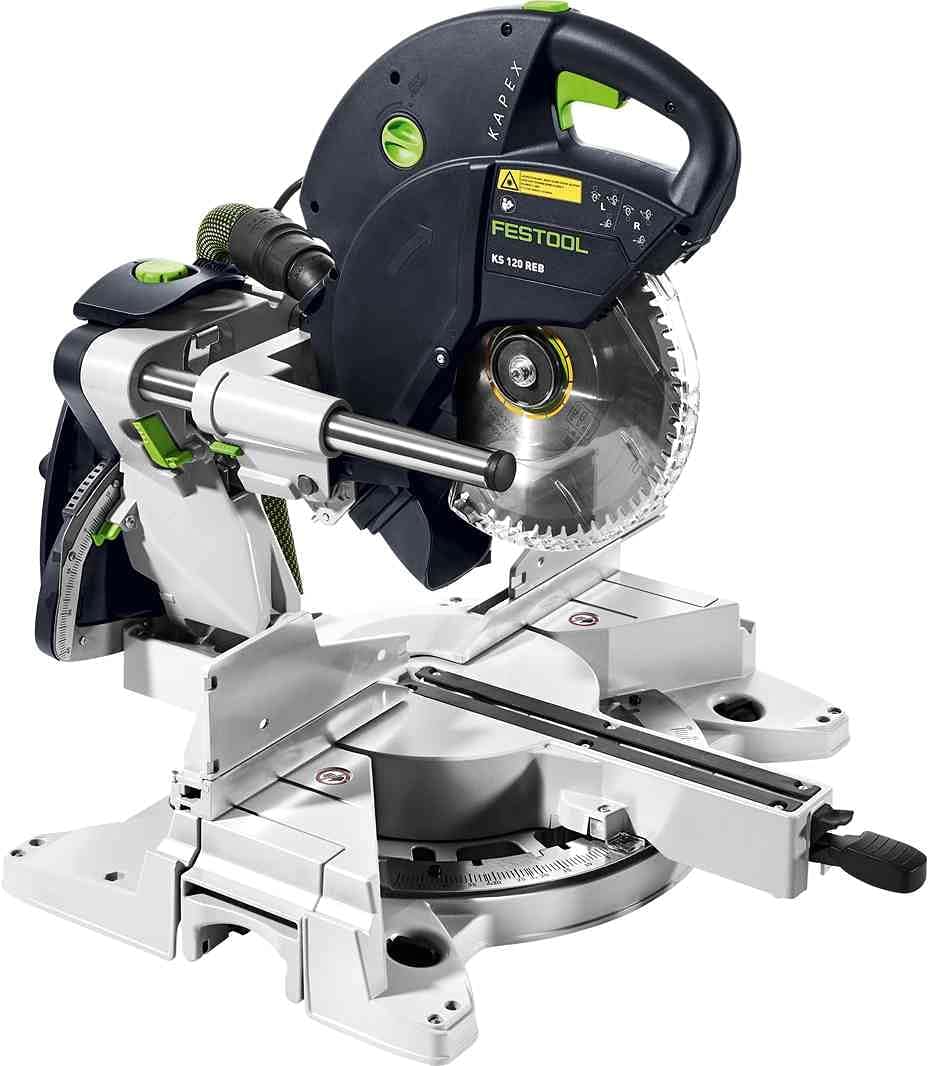
Festool Kapex KS 120 REB Sliding Compound Miter Saw
Premium professional-grade sliding compound miter saw engineered for ultra-precise cuts, exceptional dust collection, and smooth dual-rail performance for fine woodworking.
- Laser-guided precision cutting system
- Dual-slide rail mechanism for smooth operation
- Exceptional dust extraction efficiency
- Ideal for trim work and fine carpentry
*As an Amazon Associate, we may earn from qualifying purchases.
The Kapex has a devoted following among cabinet makers and finish carpenters, and its feature list explains why.
Why It Costs More
Dual Laser System: It projects lines showing both sides of the kerf. Combined with its rail-forward design, you can line up cuts from either side of the blade, which helps when working around defects in figured wood.
Precision Features:
- Fine adjustment for precise miter and bevel settings
- Dual lasers that mark both sides of the kerf
- A rail-forward slide that works close to a wall
That precision matters most on expensive stock like mahogany crown, where every gap shows.
Dust Collection: Dust extraction is one of the Kapex’s strongest features, especially when paired with a Festool extractor.
Rail-Forward Design: Traditional sliders need clearance behind them for the rails. The Kapex’s rails sit in front, so the saw can sit closer to a wall, which is a big help in small shops.
What Stops Me From Buying
Price: It costs far more than the DeWalt, so it only makes sense if your projects demand that extra precision.
Blade Lock-In: 10.25″ blades aren’t at every hardware store. You’re buying Festool blades ($60-$120) or specialty brands.
Who Should Buy This
Perfect for:
- Cabinet makers charging premium prices
- Furniture builders with exotic woods
- Anyone who loses sleep over 1/32″ gaps
- Woodworkers already in Festool ecosystem
Don’t buy if:
- You build decks or rough framing
- Your budget is under $1,000
- You need easily replaceable parts
Best Value Miter Saw for Woodworking
DeWalt DWS779 12″ Sliding Compound Miter Saw

DEWALT DWS779 12-Inch Sliding Compound Miter Saw
Heavy-duty sliding compound miter saw designed for accurate crosscuts, bevel cuts, and smooth performance for woodworking, trim work, and framing projects.
- Powerful 15-amp motor for tough cuts
- 12-inch blade with sliding rail system
- Dual bevel design for angled precision
- Ideal for trim, framing, and carpentry
*As an Amazon Associate, we may earn from qualifying purchases.
Price: check today’s price on Amazon
Rating: 8.7/10
Best For: Budget-conscious woodworkers
The DWS780’s little brother: essentially the same saw without the XPS LED shadow line. The money you save can go toward a premium blade.
What You Get
Same Core Performance:
- 15-amp motor, 3,800 RPM (identical to DWS780)
- Same 13.25″ crosscut capacity
- The same adjustable stainless steel miter detent plate with 10 positive stops
For construction work like decks and fences, owners report that it performs much like the DWS780.
What’s Missing
No XPS LED: There is no built-in shadow line, so you line up cuts by eye with a sharp pencil mark or add an aftermarket guide.
Crown Stops: If your setup lacks them, simple stops made from scrap hardwood do the job.
Rougher Stock Blade: Budget $60-$90 for a Diablo or Freud blade immediately.
Best Uses
- Deck and fence building
- Framing and shop projects
- Trim work with an upgraded blade
- Beginners who may upgrade later
The money you save versus the DWS780 can buy a better blade, a shop vacuum and a sturdier stand.
Who Should Buy This
Perfect for:
- Shop furniture and utility projects
- Deck and fence builders
- Sub-$500 budgets
- Beginners upgrading in 3-5 years
Best Cordless Miter Saw
Milwaukee M18 FUEL 2734-21 HD 10″ Dual Bevel Sliding

Milwaukee 2734-21HD 10-Inch Sliding Compound Miter Saw
Cordless sliding compound miter saw built for professional woodworking and jobsite performance with powerful brushless motor technology and precise cutting accuracy.
- POWERSTATE brushless motor technology
- Cordless M18 FUEL performance system
- Sliding rail design for wide crosscuts
- Portable professional-grade construction
*As an Amazon Associate, we may earn from qualifying purchases.
Price: check today’s price on Amazon
Rating: 8.9/10
Best For: Mobile woodworkers and outdoor workshops
Cordless saws like this one are ideal where there is no power, such as remote deck builds, and the M18 FUEL is one of the strongest cordless options available.
Battery Performance Reality
Battery and runtime:
- Runtime depends heavily on battery size; larger M18 packs give more cuts per charge
- Keeping two batteries in rotation helps avoid downtime
- Check whether your kit includes a battery and charger
Recharge time depends on the battery and charger you use. With two batteries in rotation, most users can keep working through the day.
Where It Matches Corded
Accuracy: It offers dual bevel and sliding cuts, and owners generally rate its accuracy highly for a cordless saw.
Power: The brushless motor is designed to handle thick stock such as 4×4 posts.
Dust Collection: Connecting a vacuum improves dust capture considerably compared with the bag alone.
Where Cordless Falls Short
Cut Capacity: 10″ blade limits you to 12″ crosscut versus 13.25″ on 12″ sliders.
Running Costs: Batteries are the hidden cost of cordless tools, so factor in high-capacity packs if you do not already own them.
Who Should Buy This
Perfect for:
- Trim carpenters in homes without power
- Outdoor deck builders
- Already invested in Milwaukee M18 platform
Best Compact Miter Saw
Bosch CM8S 8.5″ Single Bevel Sliding

Bosch CM8S Single-Bevel Sliding Compound Miter Saw
Compact sliding compound miter saw designed for accurate woodworking cuts with lightweight portability, smooth sliding action, and reliable jobsite performance.
- Compact lightweight portable design
- Smooth sliding rail cutting system
- Precise single-bevel cutting capability
- Ideal for trim and finish carpentry
*As an Amazon Associate, we may earn from qualifying purchases.
Rating: 8.4/10
Best For: Small shop woodworkers
Its small size makes it a good fit for a mobile bench and small projects.
Why Smaller Works
Footprint: noticeably smaller than 12-inch sliders, which frees up space in a small shop.
Weight: about 37 lbs, so it is easy to move around.
Blade Speed: 5,500 RPM means cleaner cuts than slower 12″ blades. Less deflection on thin stock.
Real Capacity
Cuts:
- 12″ crosscut (fine for cabinets)
- 3.5″ vertical baseboard
- 2×8 lumber at 90°
Doesn’t cut:
- Wide table aprons over 12″
- 2×12 joists
- Tall baseboards over 5.5″
Best Uses
- Paint-grade trim and baseboard
- Small furniture and cabinet parts
- Picture frames and small boxes
- Shops with limited space
For trim and small furniture, it covers most needs at a much lower cost than a 12-inch slider.
Essential Buying Guide
Blade Size: How Big Do You Need?

10″ Blades: Sweet spot for small shops. 14-15″ crosscut, handles most furniture. Most versatile.
12″ Blades: Maximum 16″ crosscut. Essential for large furniture or 2×12 joists. More blade deflection on thin stock.
Our recommendation: 10″ for most woodworkers, 12″ if you build large furniture or work construction.
Sliding vs. Non-Sliding

Non-Sliding:
- Lighter, smaller footprint
- Limited 7-9″ crosscut
- Inadequate for furniture
Sliding:
- 12-16″ crosscut capacity
- Requires rear clearance or costs more (rail-forward)
- Essential for furniture building
Reality: If you build anything beyond trim, you need a slider.
Single vs. Dual Bevel
Single Bevel: $50-$150 cheaper, must flip workpieces for right bevel cuts.
Dual Bevel: No flipping needed, faster workflow, better for crown molding.
Many woodworkers who start with a single-bevel saw find that flipping heavy crown molding for opposite bevels adds time and makes it easier to drop a piece.
Our take: dual bevel for anyone cutting compound miters regularly.
Price Ranges
Under $250: Entry-level, often non-sliding. Too limited for furniture.
$250-$500: Sweet spot. Quality 10″ or 12″ sliders from DeWalt, Bosch, Makita, Milwaukee.
$500-$1,000: Premium features. Marginal improvements for most woodworkers.
$1,000+: Festool territory. Only worth it for professional cabinet makers.
Blade Selection for Woodworking
Stock blades are barely adequate. Upgrading transforms cut quality more than any other change.

Tooth Count Guide
40-Tooth (Aggressive):
- Best for: Framing, deck boards, rough cuts
- Fast but rough edges
60-80 Tooth (Balanced):
- Best for: General woodworking, hardwood and softwood
- Clean cuts with minimal sanding
- A great everyday choice for most cuts
80-100+ Tooth (Ultra-Fine):
- Best for: Figured woods, veneers, no-sand finish
- Glass-smooth but slower
- Final cuts on visible furniture faces
Our Top 3 Blades
1. Freud LU80R010 10″ 80-Tooth

Freud Ultimate Plywood & Melamine Saw Blade
Premium fine-finish circular saw blade engineered for ultra-clean cuts in plywood, melamine, veneered panels, and hardwood materials.
- High tooth count for smooth finish cuts
- Ideal for plywood and melamine panels
- Laser-cut anti-vibration blade design
- Durable carbide cutting edges
*As an Amazon Associate, we may earn from qualifying purchases.
- Price: check Amazon
- Lifespan: long-lasting carbide teeth that can be resharpened
- Why: a fine-finish blade that is popular for clean cuts in hardwood and plywood
2. Freud LU91R010 10″ 100-Tooth

Freud LU91R010 Sliding Compound Miter Saw Blade
High-performance miter saw blade engineered for ultra-smooth crosscuts and clean finish work in hardwood, softwood, plywood, and trim materials.
- Precision-ground carbide cutting teeth
- Designed for sliding compound miter saws
- Clean finish cuts with reduced tear-out
- Laser-cut anti-vibration blade design
*As an Amazon Associate, we may earn from qualifying purchases.
- Price: check Amazon
- Lifespan: long-lasting carbide teeth that can be resharpened
- Why: designed for very clean crosscuts on sliding miter saws
3. Diablo D1260X 12″ 60-Tooth

Diablo D1260X 12-Inch Combination Saw Blade
Professional-grade 12-inch combination blade designed for smooth ripping and crosscutting with long-lasting durability and ultra-clean finish quality.
- 60-tooth combination blade design
- Excellent for ripping and crosscuts
- Laser-cut stabilizer vents reduce vibration
- Durable carbide teeth for longer blade life
*As an Amazon Associate, we may earn from qualifying purchases.
- Price: check Amazon
- Lifespan: long-lasting carbide teeth that can be resharpened
- Why: strong performance for the price
Blade Maintenance
Clean blades cut cooler and stay sharp longer, so removing pitch build-up regularly is one of the easiest ways to extend blade life.
Cleaning Process (whenever you see pitch build-up):
- Remove blade (unplug saw!)
- Spray with Simple Green
- Soak 15-20 minutes
- Scrub with brass brush (not steel)
- Rinse and dry completely
When to sharpen: Burn marks despite clean blade. Professional sharpening: $15-$25, can be done 3-5 times per blade.
Complete Comparison Table
| Model | Price | Blade | Cut Capacity | Weight | Dust Collection | Bevel | Best For |
|---|---|---|---|---|---|---|---|
| DeWalt DWS780 | Check Amazon | 12″ | 13.25″ | 56 lbs | Over 75% (claimed) | Dual | All-around workhorse |
| Festool Kapex | Check Amazon | 10.25″ | 12″ | 55 lbs | Excellent with Festool extractor | Dual | Fine woodworking |
| DeWalt DWS779 | Check Amazon | 12″ | 13.25″ | 56 lbs | Over 75% (claimed) | Dual | Best value |
| Milwaukee M18 | Check Amazon | 10″ | 12″ | 42 lbs | Better with a vacuum | Dual | Cordless |
| Bosch CM8S | Check Amazon | 8.5″ | 12″ | 37 lbs | Better with a vacuum | Single | Small shops |
Frequently Asked Questions
What size miter saw do I need for furniture building?
A 10″ or 12″ sliding compound miter saw with at least 12″ of crosscut capacity handles wide table aprons, case sides and drawer fronts without repositioning. A 12″ slider such as the DeWalt DWS780 covers almost any furniture part.
How often should I replace my miter saw blade?
It depends on the wood, the blade and how often you clean it. Replace or resharpen a blade when you see burn marks or rough cuts even after cleaning. Removing pitch regularly helps a blade last longer, and good 60–80 tooth blades can be professionally resharpened several times.
Can a miter saw replace a table saw for woodworking?
No. They’re complementary, not replacements. Miter saws excel at crosscuts and angles. Table saws excel at ripping boards to width and cutting joinery. Check our table saw reviews to understand how they work together.
Is a dual bevel miter saw worth the extra cost?
Yes, if you cut compound miters regularly (crown molding, picture frames, angled cases). Dual bevel means you do not have to flip workpieces, which saves time and reduces handling of long, heavy pieces. It usually costs a little more, and it is worth it for anyone beyond basic trim.
Why does my miter saw leave burn marks?
Three common causes: (1) a dull blade, so replace or resharpen it; (2) a dirty blade, so clean off the pitch; (3) the wrong blade, since too many teeth can create friction in thick stock. Cleaning regularly and using a 60-tooth blade for thick hardwood solves most burning.
Final Recommendation
If you are starting fresh:
Primary Saw: DeWalt DWS780. The best all-around miter saw for most woodworkers. It is accurate, reliable and handles everything from trim to thick hardwood, and its XPS LED shadow line needs no calibration.
Complete Setup:
- DeWalt DWS780 miter saw
- A fine-finish 80-tooth blade such as the Freud LU80R010
- A dust extractor or a good shop vacuum
- A sturdy miter saw stand with material supports
Tighter Budget: DeWalt DWS779 plus a 60-tooth Diablo blade and a shop vacuum. You lose the LED shadow line but keep most of the cutting performance.
Money No Object: Festool Kapex KS 120 paired with a Festool extractor, for top-tier precision features and excellent dust collection.

Finlay Connolly is a woodworking enthusiast and power tool specialist with over a decade of hands-on experience in the workshop. As the founder and lead writer at ProTableSawReviews.com, Finlay combines expert knowledge with real-world testing to help woodworkers, DIYers, and professionals choose the best tools for the job. With a sharp eye for detail and a passion for precision, Finlay is committed to providing trustworthy, practical advice backed by years of experience and research in the field. Whether you’re cutting dados or comparing fence systems, you can count on Finlay for honest, reliable reviews that make your next cut your best one.


