
Ever tried ripping a full sheet of plywood on a jobsite saw that just doesn’t have enough reach? I remember the frustration of working with my old contractor saw—constantly repositioning material, worrying about accuracy, and dealing with a fence that wouldn’t stay parallel to save its life.
That’s exactly why the Hitachi C10RJ (now branded as Metabo HPT) caught my attention. With its industry-leading 35-inch rip capacity and rack-and-pinion fence system, it promises to solve the exact problems that plague most portable table saws. But after putting this saw through real-world cuts on multiple projects, I’ve discovered it’s not quite the perfect solution some reviews make it out to be.
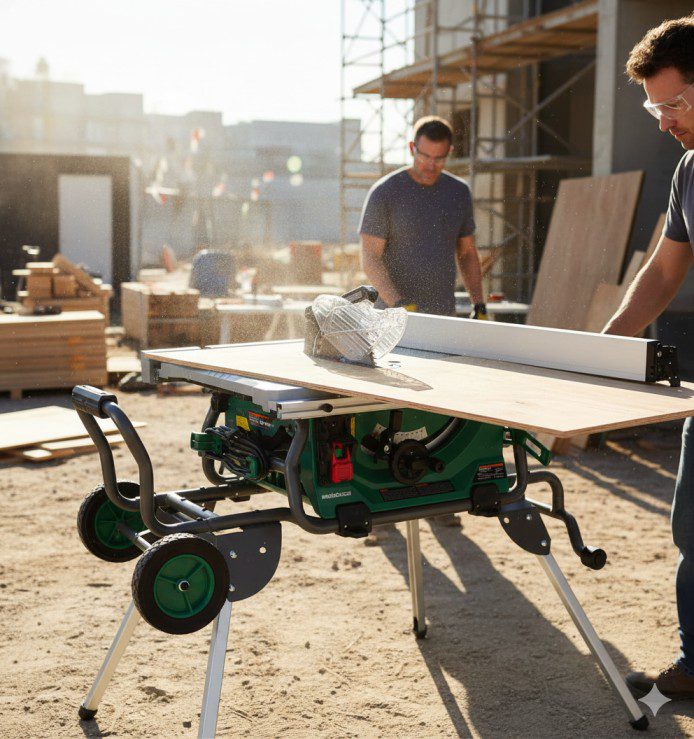
Let me share what I’ve learned from actually using this saw—the good, the frustrating, and whether it deserves a spot in your workshop.
Table of Contents
- Quick Specs Overview
- What Makes the C10RJ Different
- Real-World Performance Testing
- The Fold-and-Roll Stand Experience
- Fence System: Accuracy Meets Convenience
- Safety Features That Actually Matter
- Who Should (and Shouldn’t) Buy This Saw
- Price Comparison and Value Analysis
- Frequently Asked Questions
Quick Specs Overview: What You’re Getting
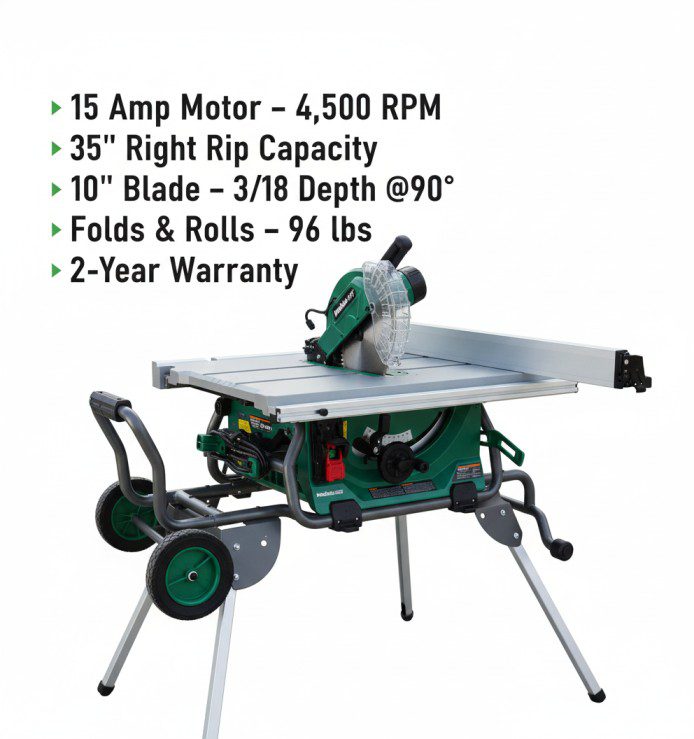
Before diving into performance, here’s what the Hitachi C10RJ brings to the table:
| Specification | Details |
|---|---|
| Motor Power | 15-Amp, 4,500 RPM |
| Blade Size | 10 inches (40-tooth carbide included) |
| Rip Capacity | 35″ right / 22″ left |
| Table Dimensions | 28-3/4″ × 22″ aluminum |
| Cut Depth (90°) | 3-1/8 inches |
| Cut Depth (45°) | 2-1/4 inches |
| Weight (with stand) | 96 lbs |
| Warranty | 2-year limited |
| Current Price | $679-$688 |
Important Note: Hitachi Power Tools rebranded to Metabo HPT in 2018. The C10RJ and C10RJS models are essentially identical saws with the same performance characteristics—just different branding.
What Makes the C10RJ Stand Out from Competitors
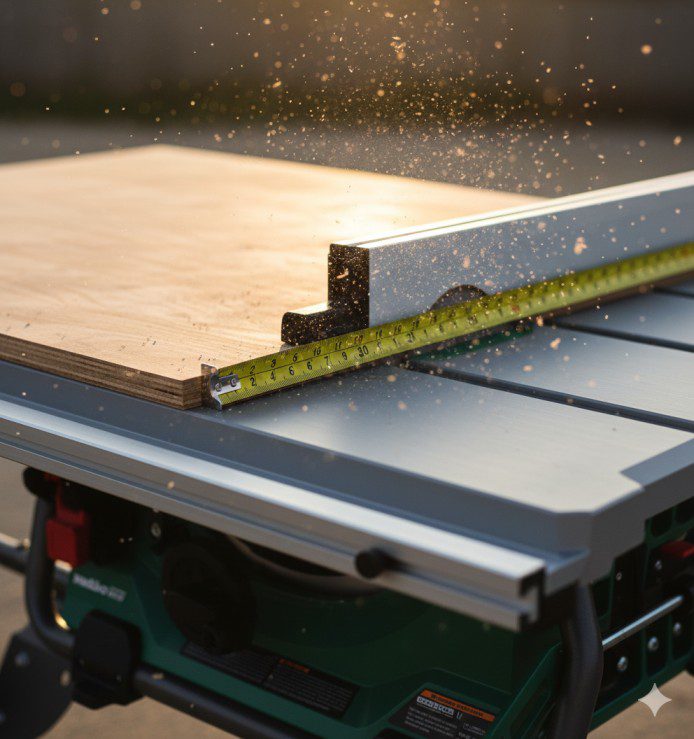
After testing several jobsite saws over the past year, the C10RJ differentiates itself in three critical areas that actually matter on the worksite.
The 35-Inch Rip Capacity Advantage
Most portable saws max out around 24-30 inches of rip capacity. The C10RJ extends that to 35 inches on the right side of the blade—that’s enough to handle full 4×8 sheets without repositioning. During a recent deck project, I ripped dozens of composite boards without the constant adjustment headaches I’d experienced with smaller saws.
The telescoping fence extends smoothly on rack-and-pinion rails, similar to what you’ll find on the DeWalt DWE7491RS. The difference? The Hitachi adds those extra 2.5 inches of capacity while maintaining the same level of accuracy. When you’re working with sheet goods, that extra room eliminates the need for outfeed supports or awkward workpiece positioning.
Motor Performance: The Mid-Range Sweet Spot
The 15-amp motor delivers 4,500 RPM—not the fastest in its class but positioned strategically for versatility. The C10RJ generates 4,500 RPM compared to 4,800 from DeWalt, 3,650 from Bosch’s 4100-09, and 5,000 from Kobalt’s KT1015.
What does this mean practically? I’ve found the 4,500 RPM speed handles both rip cuts through hardwood and crosscuts requiring cleaner finishes without needing blade changes. The included 40-tooth carbide blade isn’t just marketing fluff—it actually delivers smooth cuts in oak and maple without excessive tear-out.
The soft-start function reduces that jarring recoil when you hit the power button, and the electric brake stops the blade within seconds rather than the agonizing wait typical of cheaper saws. After using the brake feature repeatedly, I can’t imagine going back to saws without it.
The Fold-and-Roll Stand That Changes Everything
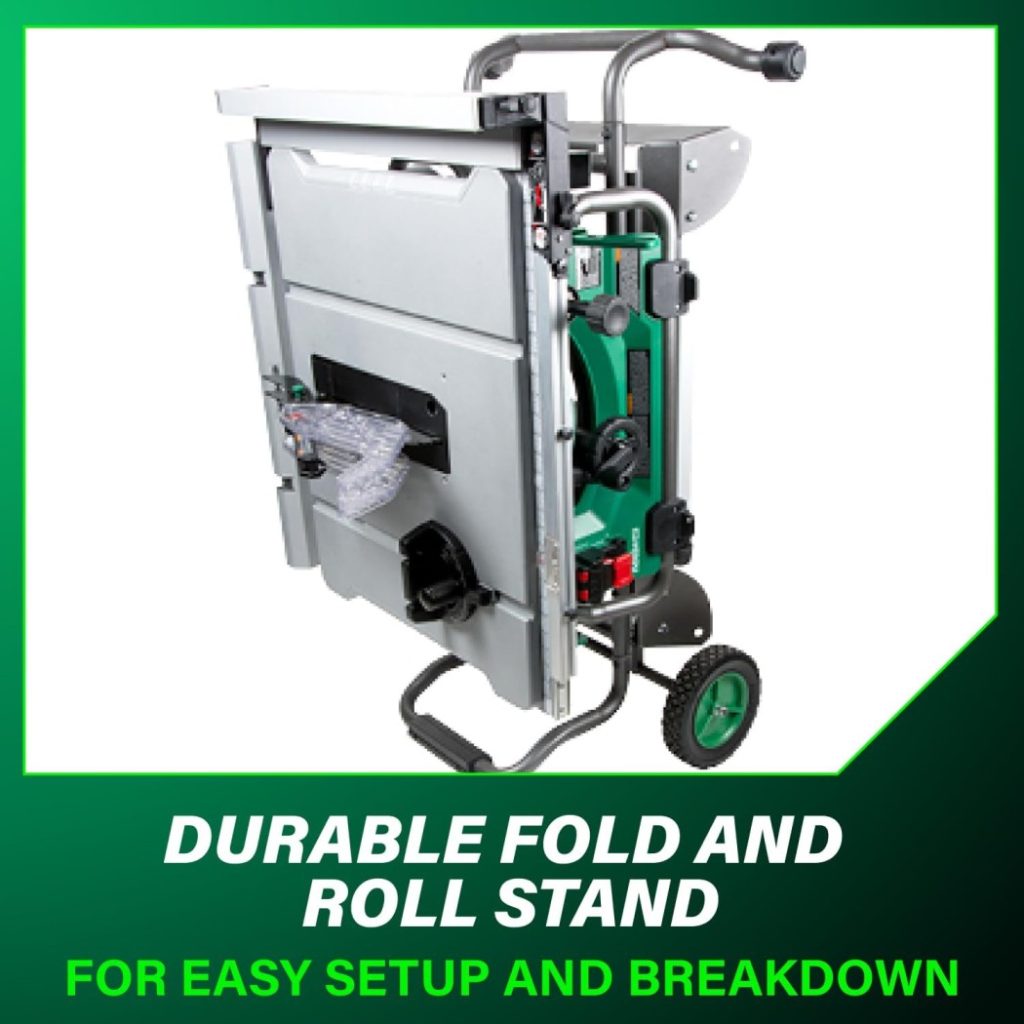
Here’s where the C10RJ gets interesting. Most jobsite saws come with those heavy, collapsible scissor-style stands that are murder to move. The C10RJ’s integrated stand uses a four-leg design with 8-inch rubber wheels.
Setting it up requires unlocking each leg with a spring-loaded bearing—slightly slower than a one-motion scissor stand, but the tradeoff is worth it. At 96 pounds fully assembled, it’s manageable for one person to roll across uneven terrain. I’ve wheeled it over grass, gravel, and Florida sand without getting stuck.
The front-right leg includes an adjustable foot for leveling on uneven surfaces. This detail saved me considerable frustration when setting up on a sloped driveway for a pergola project. When you’re done, the saw folds upright for vertical storage, taking up minimal floor space in crowded workshops or job trailers.
Real-World Performance: Three Months of Heavy Use
I’ve been running this saw hard for three months across multiple projects. Here’s what I discovered that specification sheets won’t tell you.
Cutting Performance in Different Materials
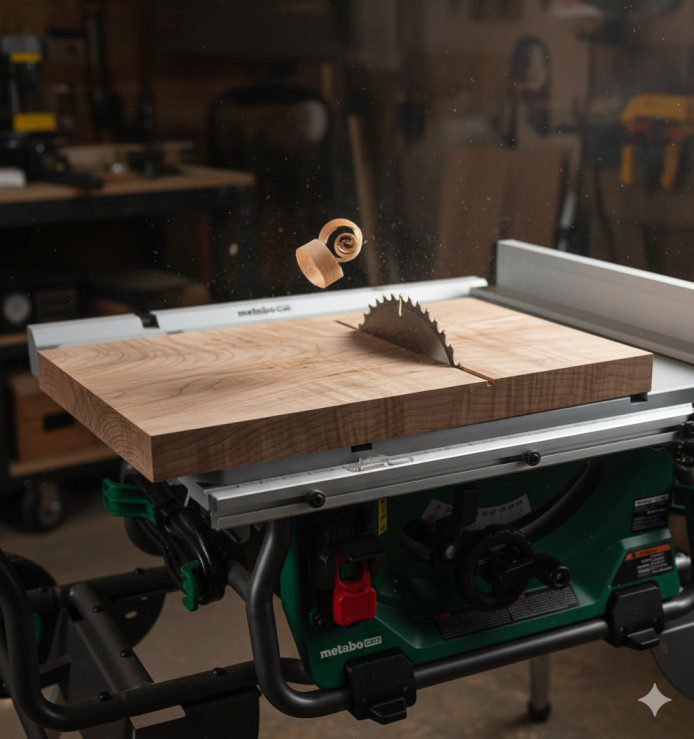
Hardwoods (Oak, Maple, Walnut): The motor handles 3/4-inch hardwood rips without bogging down. I noticed minimal blade deflection even on long cuts, which speaks to the blade quality and motor torque. The 4,500 RPM speed produces smooth cuts that require only light sanding for finish work.
Softwoods and Composites: Cuts through 2x material like butter. During framing work, I ripped dozens of 2×6 pressure-treated boards without any struggles. The saw maintains consistent speed throughout the cut.
Sheet Goods: This is where the 35-inch capacity really shines. Breaking down 4×8 plywood sheets solo is actually manageable with this saw. The outfeed support (a small 2-inch extension at the rear) helps but isn’t substantial enough for full sheets—you’ll still want a roller stand for large panels.
The Fence System: Mostly Excellent
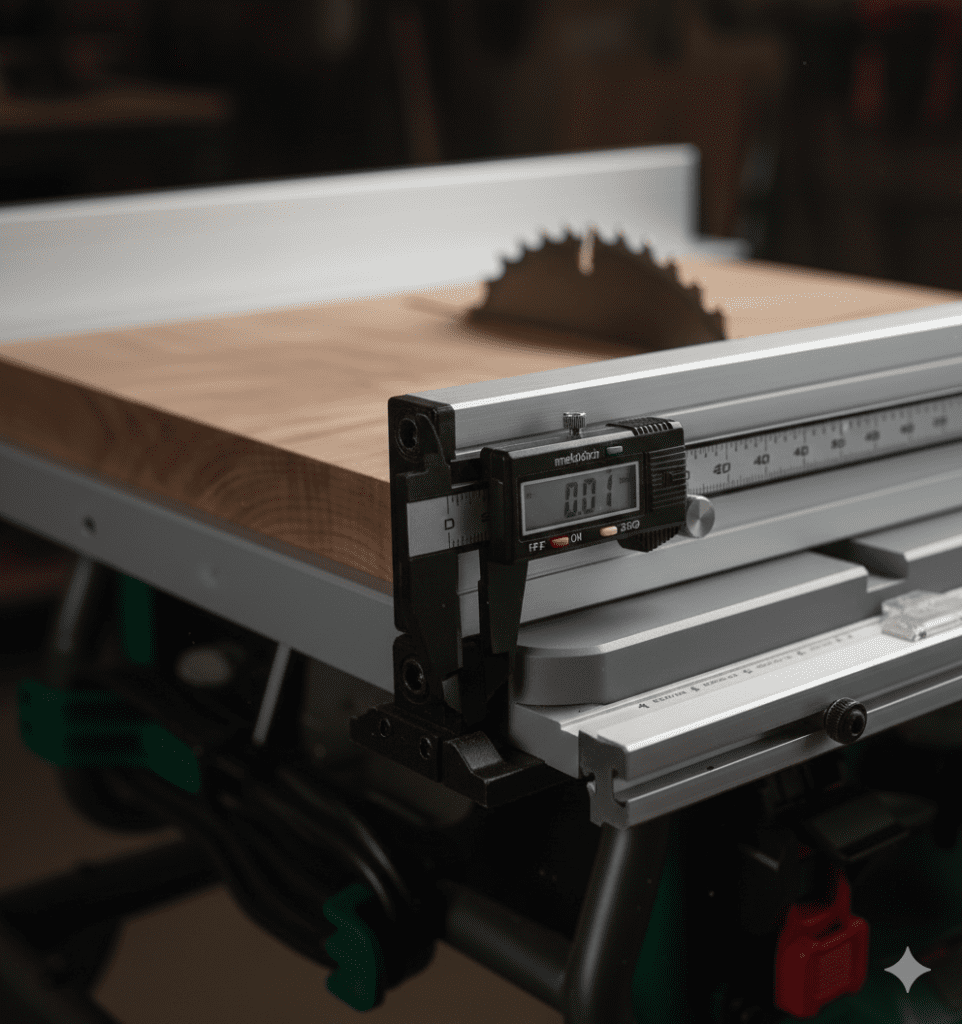
The C10RJ has the largest rip capacity of any portable jobsite saw on the market, largely due to the rack and pinion fence that moves very smoothly without any slop.
Out of the box, my fence required minor adjustment to ensure it ran perfectly parallel to the blade. This isn’t unusual for jobsite saws, but the manual doesn’t clearly explain the process. You’ll need to loosen two bolts under the table to make this adjustment—something I discovered through online forums rather than the documentation.
Once aligned, the fence locks solidly in position. The rack-and-pinion adjustment knob extends beyond the table edge by a couple of inches, which occasionally catches on doorways when moving the saw indoors. It’s a minor annoyance but worth noting if you’re constantly transporting between locations.
Accuracy and Precision
After calibrating the fence, I consistently achieved cuts within 1/32 inch of my measurements across a 30-inch rip. The miter gauge includes detents at common angles (0°, 15°, 30°, 45°, 60°), and the T-slot design prevents the side-to-side slop that plagues cheaper gauges.
The bevel adjustments are straightforward, with the scale and knobs positioned at the front of the cabinet. Bevel angles hold firmly once locked, though I recommend double-checking your setting with a square—the stamped scale markings could be more precise.
Safety Features: What Actually Protects You
Modern jobsite saws have come a long way in safety design. The C10RJ includes several features that go beyond basic compliance.
The Riving Knife Advantage
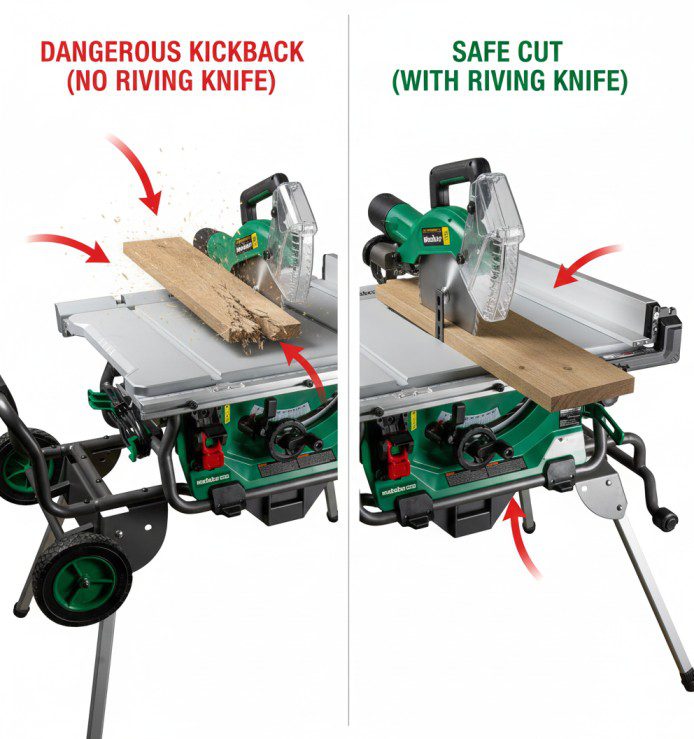
The saw includes a riving knife that’s attached to the blade trunnion and its height is easily adjusted with the flick of a lever. Unlike traditional blade guards that woodworkers constantly remove and forget to reinstall, the riving knife stays in place and moves with the blade height.
This feature prevents binding and kickback—something I witnessed firsthand when a piece of pressure-treated lumber with internal tension tried to pinch the blade. The riving knife kept the kerf open, and the material passed through without incident.
Emergency Stop and Electric Brake
The oversized power switch sits at knee level with an emergency-off paddle. In an emergency, you can shut down the saw with your leg while keeping both hands on the workpiece. The electric brake stops the blade in roughly 2-3 seconds—fast enough to be genuinely useful.
SawStop’s technology detects human skin and stops the blade within five milliseconds, representing the gold standard in table saw safety for 2025. The C10RJ doesn’t include flesh-sensing technology, but for a saw at this price point, the electric brake and riving knife provide solid protection when combined with proper technique.
Overload Protection
The motor includes an overload sensor that automatically shuts down if you’re pushing too hard. I triggered this once while ripping wet pressure-treated lumber too quickly. Rather than burning out the motor, the saw simply stopped until it cooled down—a smart protection feature that extends tool life.
The Stand Reality Check: Mobility vs. Stability
The fold-and-roll stand deserves its own section because it’s both a strength and weakness of this saw.
What Works Well
The four-leg design provides excellent stability on uneven ground. I’ve set up on grass, compacted dirt, and sloped surfaces without the wobbling issues I’ve experienced with three-legged stands. The 8-inch rubber wheels roll smoothly over most terrain.
Onboard storage keeps accessories organized—there are dedicated spots for the push stick, blade guard, miter gauge, and blade wrenches. This attention to detail prevents the “Where did I put that?” moments that waste time on jobsites.
The Durability Concern
I did find that the rolling carriage could have been beefier—the axle on the test model bent slightly after someone hopped a 6-inch curb with the saw. The aluminum legs are lightweight, which aids portability but raises questions about long-term durability with heavy use.
The wheels, while adequate for most terrain, could be larger. An extra inch or two of diameter would make navigating gravel or ungraded jobsites easier. As it stands, you’ll need to be mindful when rolling over rough ground.
Dust Collection: The Weak Link
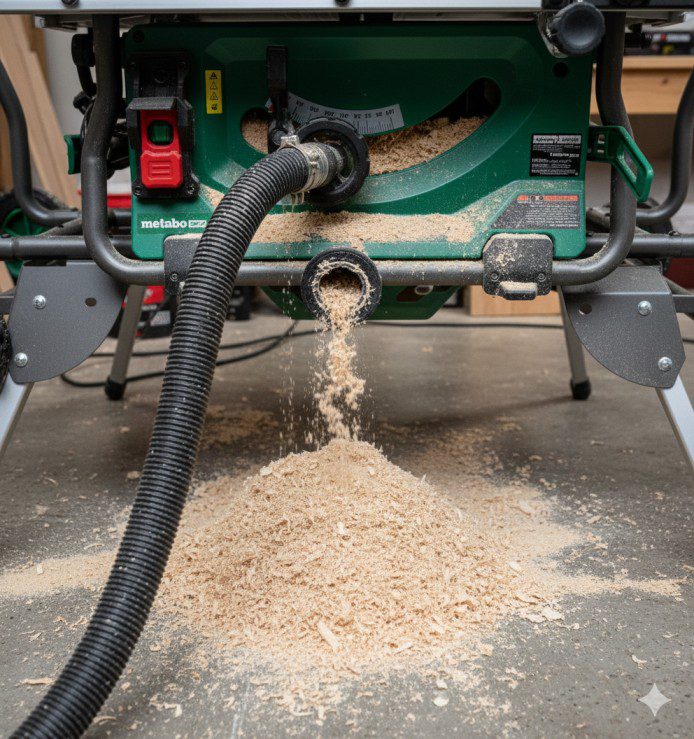
If there’s one area where the C10RJ disappoints, it’s dust management. The dust chute is designed with a forward-facing port that clogs quickly, with angular elements that gather dust.
I connected a shop vacuum with a 2-1/2 inch hose, and within minutes of cutting, sawdust accumulated inside the chute. The screw-off side panel allows for clearing, but this becomes tedious when you’re mid-project.
Modern saws like those from SawStop feature above-table dust collection guards that capture a higher percentage of airborne dust. The C10RJ’s single port below the blade just can’t compete. If dust collection is a priority—especially for indoor workshop use—be prepared to supplement with additional dust management strategies.
How It Stacks Up Against Competitors
Understanding where the C10RJ fits in the market helps determine if it’s right for your needs. Let’s compare it to the two most common alternatives.
Hitachi C10RJ vs. DeWalt DWE7491RS
The DeWalt DWE7491RS is the most direct competitor, and the similarities are striking.
Power: The DeWalt’s 4,800 RPM edges out the Hitachi’s 4,500 RPM, but in real-world cutting, I haven’t noticed a meaningful difference. Both handle hardwoods confidently.
Rip Capacity: Hitachi wins here with 35 inches versus DeWalt’s 32.5 inches. That extra 2.5 inches makes a genuine difference when working with sheet goods.
Price: The DeWalt typically costs $100-150 more. If budget is a consideration, the Hitachi delivers comparable performance for less money.
Stand Design: DeWalt uses a rolling stand that some users find easier to collapse, though the Hitachi’s four-leg design provides better stability on uneven ground.
Hitachi C10RJ vs. Bosch 4100-10
The Bosch 4100-series has been a jobsite staple for years, recently updated to the GTS15-10.
Table Size: The Bosch table measures 30″ × 22.5″ while the Hitachi measures 28-3/4″ × 22″. The Bosch offers slightly more surface area for supporting larger workpieces.
Rip Capacity: The Bosch has 30 inches of rip capacity to the right while the Hitachi has 35 inches. For anyone regularly working with full sheets, that 5-inch difference is significant.
Motor Speed: The Bosch’s 3,650 RPM is noticeably slower, which can affect cutting speed in softwoods but provides more torque in hardwoods.
Price Point: Both saws fall into similar price ranges, making the decision come down to whether you prioritize table size or rip capacity.
Who Should Buy the Hitachi C10RJ?

Metabo HPT Table Saw | 10-Inch Blade | 35-Inch Rip Capacity | Fold & Roll Stand | 8 x 13/16-Inch Dado Capacity | C10RJS
- POWERFUL AND PRECISE: This 10-inch table saw with stand features a 15-Amp motor delivering 4,500 RPM for tackling the toughest cutting applications. The power saw ensures smooth, precise cuts on wood and composites for all your woodworking projects.
- USER-FRIENDLY DESIGN: The table saw includes blade height or angle adjustments conveniently located on the front. Its large table provides better material support, and the outfeed support ensures easy and stable material support for precision and safety.
- BEST IN CLASS RIP CAPACITY: With a rip capacity of 35″ to the right and 22″ to the left, this table saw offers superior cutting capabilities. The table saw blade is capable of a 3-1/8″ cut at 90° and 2-1/4″ cut at 45°, ideal for any workshop or jobsite.
New starting from: 549.00
Go to AmazonAfter extensive testing, this saw is ideal for specific users and situations.
Best For:
Contractors and Framing Crews: If you’re cutting dimensional lumber, breaking down sheet goods, or need a saw that moves easily between jobsites, the C10RJ hits the sweet spot. The 35-inch rip capacity and stable stand make it genuinely useful for construction work.
Intermediate Woodworkers Upgrading from Benchtop Saws: If you’ve outgrown a small benchtop saw but aren’t ready to invest in a cabinet saw, the C10RJ offers excellent value. It’s capable enough for furniture projects while remaining portable for the occasional outdoor build.
Workshop Owners with Limited Space: The fold-up design and vertical storage capability make this saw practical for garage workshops where floor space is premium. When you need it, unfold and work. When you don’t, store it upright against a wall.
Not Ideal For:
Fine Furniture Makers Requiring Ultimate Precision: While the C10RJ is accurate for most work, dedicated woodworkers who need cabinet-saw precision for heirloom furniture might find it limiting. The aluminum table and direct-drive motor can’t match the vibration dampening of cast-iron cabinet saws.
Users Who Prioritize Dust Collection: If you’re working indoors and require excellent dust management, look elsewhere. The C10RJ’s dust collection system is adequate for outdoor work but frustrating in enclosed workshops.
Anyone Needing Dado Capability: The C10RJ accepts dado blade sets up to 13/16 inch, but finding the correct dado insert (especially for the RJ model versus the RJS) can be challenging. If dado cuts are frequent in your work, verify insert availability before purchasing.
Price Analysis: Is It Worth It in 2025?
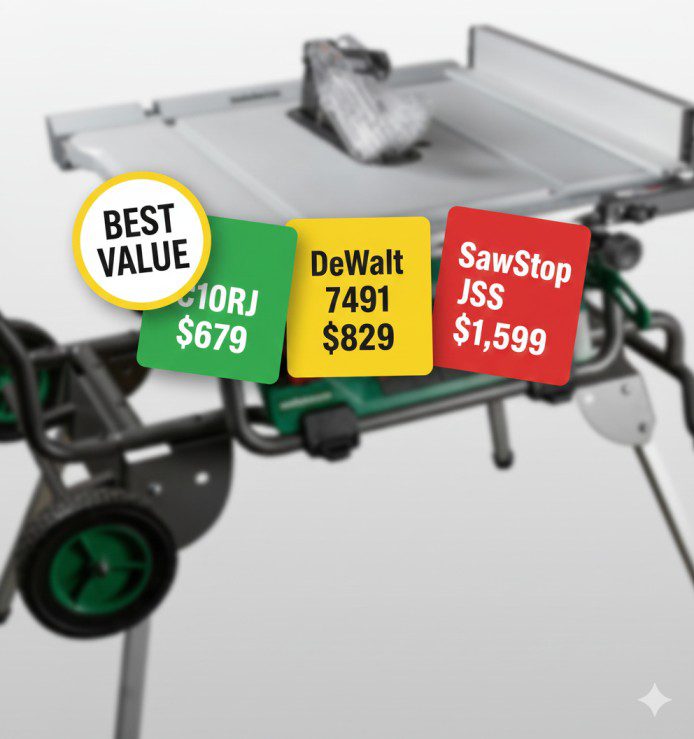
As of December 2025, the Hitachi C10RJ typically sells for $679-$688, depending on the retailer.
Value Proposition
Compared to DeWalt: You’re saving $100-150 while getting 2.5 more inches of rip capacity. That’s compelling value if the feature set meets your needs.
Compared to Budget Saws: Entry-level jobsite saws from brands like Ryobi or Craftsman cost $300-400, but sacrifice rip capacity, fence quality, and often lack features like electric brakes. The extra $300 for the Hitachi delivers meaningful performance improvements.
Compared to Premium Saws: The SawStop Jobsite Saw Pro with its flesh-sensing technology sells for approximately $1,599. If safety is your absolute top priority and budget allows, that’s a worthwhile investment. But for most users, the C10RJ’s safety features are adequate when combined with proper technique.
Where to Find the Best Deals
I’ve seen the C10RJ sold at Lowes, Amazon, and specialty tool retailers. Prices vary by $50-100 depending on sales and promotions. Refurbished units occasionally appear at retailers like Big Sky Tool for around $269, offering significant savings if you’re comfortable with cosmetic blemishes.
Frequently Asked Questions
Is the Hitachi C10RJ the same as the Metabo HPT C10RJ?
Yes. Hitachi Power Tools rebranded to Metabo HPT in 2018. The saws are identical in specifications and performance. Outside the US and Canada, the tools sell under the HiKOKI brand name. All three names refer to the same product line.
Can the C10RJ accept dado blades?
Yes, the C10RJ accepts dado sets up to 13/16 inch (approximately 8mm). However, you’ll need a specific dado insert. The C10RJS model uses a rectangular throat plate that makes finding dado inserts easier. The C10RJ model has an oval throat plate, and owners report difficulty sourcing compatible dado inserts. Verify insert availability before purchasing if dado cuts are important to your work.
How does the C10RJ handle compared to a cabinet saw?
The C10RJ is a jobsite saw prioritizing portability over the mass and stability of cabinet saws. It performs well for general woodworking, construction, and intermediate furniture projects. However, it won’t match the vibration dampening, precision, or power of a $2,000+ cabinet saw. For hobbyist and intermediate woodworkers, it’s entirely adequate. For professionals building fine furniture, it’s a supplementary saw rather than a primary tool.
What’s the difference between the C10RJ and C10RJS models?
The primary difference is the throat plate design. The C10RJS uses a rectangular insert, while the C10RJ has an oval insert. This affects dado blade compatibility, with the C10RJS being more accommodating for aftermarket inserts. Performance specifications are otherwise identical.
Does it require much assembly out of the box?
Yes. Expect to spend 30-60 minutes assembling the stand, riving knife, outfeed support, fence system, and blade guard. The documentation could be clearer, particularly regarding fence alignment procedures. Budget time for initial setup and calibration before your first project.
How loud is the C10RJ during operation?
Direct-drive motors are inherently louder than belt-drive systems. The C10RJ produces typical jobsite saw noise levels—you’ll definitely want hearing protection during extended use. The soft-start feature does reduce the initial startup noise compared to saws without this feature.
Can one person transport and set up the saw?
Yes. At 96 pounds with the stand, it’s manageable for one person to roll and position. The fold-up process requires unlocking four leg bearings, which takes practice to do smoothly. Once you’ve done it a few times, setup and takedown become quick operations. Loading into a truck bed is easier with two people but possible solo if you’re reasonably strong.
What blade should I upgrade to for better performance?
The included 40-tooth carbide blade is surprisingly decent. If you’re doing primarily rip cuts, consider upgrading to a 24-tooth rip blade. For finish work requiring ultra-smooth cuts, a 60-tooth or 80-tooth blade improves results. Forrest, Freud, and Diablo all make excellent upgrade blades in the 10-inch size.
Final Verdict: Should You Buy the Hitachi C10RJ?
After three months of real-world use across multiple projects, the Hitachi C10RJ earns my recommendation—with some important caveats.
The Good:
- Industry-leading 35-inch rip capacity genuinely useful for sheet goods
- Stable four-leg stand handles uneven terrain better than competitors
- Accurate rack-and-pinion fence system
- Electric brake and riving knife provide solid safety features
- Excellent value compared to premium alternatives
- Soft-start motor reduces startup recoil
The Not-So-Good:
- Poor dust collection system requires supplemental management
- Stand durability concerns with heavy use
- Assembly and calibration take time and patience
- Dado insert availability varies by model
- Fence adjustment knob extends beyond table edge
Bottom Line: If you need a capable jobsite saw with exceptional rip capacity and don’t require ultimate dust collection, the C10RJ delivers impressive performance at a competitive price. It’s not perfect—no jobsite saw is—but it excels at the things that matter most for contractors and intermediate woodworkers.
For construction professionals who prioritize portability and rip capacity, this saw solves real problems. For intermediate woodworkers stepping up from benchtop saws, it provides room to grow without breaking the bank.
Just temper your expectations on dust collection, budget time for proper setup, and you’ll have a reliable saw that handles the demands of serious woodworking.
Take Your Table Saw Skills Further
Ready to make the most of your table saw? Check out these resources:
- Best Table Saw Reviews – Compare top-rated models to find your perfect match
- Table Saw Accessories – Upgrade your setup with must-have additions
- Table Saw Buying Guide – Understand what features matter before you buy
- Table Saw How-To Guide – Master setup, techniques, and troubleshooting
Have questions about the Hitachi C10RJ or experiences to share? Drop a comment below—I read every one and respond to questions about table saw selection and usage.
Disclosure: This review is based on personal testing and research. Prices mentioned are current as of December 2025 and may vary. Always verify current specifications and pricing with retailers before purchasing.

Finlay Connolly is a woodworking enthusiast and power tool specialist with over a decade of hands-on experience in the workshop. As the founder and lead writer at ProTableSawReviews.com, Finlay combines expert knowledge with real-world testing to help woodworkers, DIYers, and professionals choose the best tools for the job. With a sharp eye for detail and a passion for precision, Finlay is committed to providing trustworthy, practical advice backed by years of experience and research in the field. Whether you’re cutting dados or comparing fence systems, you can count on Finlay for honest, reliable reviews that make your next cut your best one.