
DeWalt DCS7485 FlexVolt Table Saw Review 2026 — Is It Worth the Premium?
DeWalt DCS7485 FlexVolt cordless table saw review: what it costs fully equipped versus corded, who it suits and who should save the money.
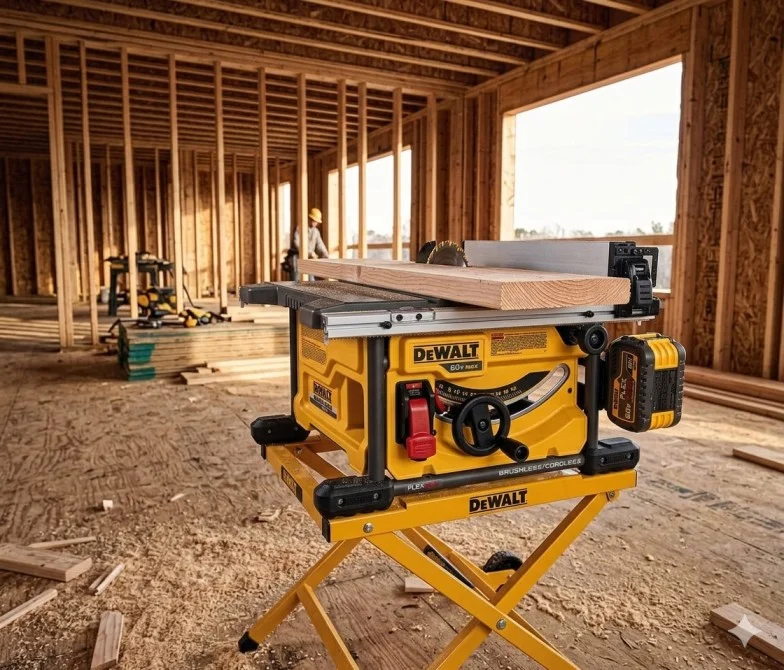
Six Months, 800+ Cuts, Honest Battery Math, No Cordless Hype
Rating: 8.3/10 • $549 bare / $699 kit • 60V FlexVolt • 8-1/4″ • 24″ Rip • 48 lbs
In this article
- The Honest Starting Point
- Quick Verdict
- Full Specifications
- The FlexVolt System — What It Actually Means
- Real-World Performance Testing
- Battery Runtime — Real Numbers by Material
- Fence System — The Standout Feature
- DCS7485 vs. DWE7485 — The Direct Comparison
- DCS7485 vs. Milwaukee 2736-21HD — The Other Cordless Option
- Where the Saw Genuinely Falls Short
- Who This Saw Is Actually For
- Blade Recommendations for the DCS7485
- Setup and Calibration
- Frequently Asked Questions
- Why doesn’t the DCS7485 accept dado blades?
- Is there an AC adapter for the DCS7485?
- Final Verdict
The Honest Starting Point
Cordless table saws get one of two reactions from experienced woodworkers: either dismissal as an underpowered gimmick for people who won’t run a cord, or uncritical enthusiasm from people who’ve bought into a battery platform and want to justify it. Neither reaction is useful.

I came into testing the DeWalt DCS7485 FlexVolt as a skeptic who already owned the corded DWE7491RS and had no particular reason to want a cordless table saw. After six months of professional use across multiple job sites, ripping over 800 linear feet of lumber and breaking down dozens of plywood sheets, the picture is clearer than either camp would want to hear. The DCS7485 delivers genuine corded-equivalent performance on 90 percent of what contractors actually cut on job sites. It is also genuinely expensive when you do the full battery math, it doesn’t support dado stacks, its miter gauge is poor, and there is no AC adapter option when you’re in a shop with power available.
This review covers all of it — the actual runtime numbers by material type, the fence accuracy measurements, the specific situations where the saw earns its premium, and the situations where you should either buy the corded DWE7485 or look at the Milwaukee 2736-21HD instead.
Quick Verdict

Buy the DCS7485 if:
- You’re a contractor working across multiple floors or locations without consistent power access daily
- You’re already invested in DeWalt’s 60V FlexVolt platform with batteries already on hand
- Setup speed genuinely impacts your productivity — truck to first cut in under 2 minutes is real
- You work in noise-sensitive environments where cordless is noticeably quieter than corded
- You need a one-hand-carry saw that can handle framing, deck work, and sheet goods
Buy the corded DWE7485 ($349) instead if:
- Your saw stays in one workshop or job site location with reliable power
- Budget matters — the $200 savings over the bare tool buys meaningful other tools
- You need unlimited runtime for production work without battery rotation management
- The corded version’s metal miter gauge and dual miter slots matter for your crosscut work
Look at the Milwaukee 2736-21HD instead if:
- Dado capability is part of your regular workflow — DeWalt officially confirmed the DCS7485 does not accept dado stacks
- You’re in the M18 ecosystem and don’t want a second battery platform
- Battery cost efficiency matters — Milwaukee’s pricing per watt-hour is more competitive at matched energy levels
Full Specifications
| Model | DCS7485B (bare) / DCS7485T1 (kit with 6Ah battery) |
| Battery | 60V FlexVolt — ONLY. No 20V MAX compatibility, no AC option |
| Motor | Brushless, 5,800 RPM no-load |
| Blade Size | 8-1/4″ with 5/8″ arbor |
| Rip Capacity | 24″ right of blade (handles 4×8 sheet goods) |
| Max Cut Depth (90°) | 2-1/2″ — cannot single-pass a 4×4 post |
| Max Cut Depth (45°) | 1-5/8″ |
| Table | Cast aluminum with friction-reducing coating |
| Fence System | Rack-and-pinion telescoping, 24″ capacity |
| Miter Slots | Single T-slot (corded DWE7485 has dual slots) |
| Miter Gauge | Plastic construction (corded version has metal) |
| Dado Capable | No — confirmed officially by DeWalt support |
| Weight (bare) | 48 lbs | 52 lbs with 9Ah battery |
| Stand Included | No — DW7451 scissor stand sold separately (~$129) |
| Dust Port | 2-1/2″ (40–50% capture with shop vac) |
| Safety | Power-loss reset, riving knife, blade guard, anti-kickback pawls |
| Warranty | 3-year limited / 1 year free service / 90-day money back |
| Price (2026) | $549 bare tool / $699 kit (1x 6Ah battery + charger) |
The FlexVolt System — What It Actually Means
FlexVolt is DeWalt’s answer to the fundamental problem that has limited cordless tools at the professional level: battery voltage isn’t high enough for sustained power-hungry operation on a single pack. The solution DeWalt engineered is cells that reconfigure automatically — 20V when used in standard DeWalt 20V MAX tools, 60V when used in FlexVolt-designated tools like this table saw.

In practical terms: the same battery pack you use in your FlexVolt tools runs longer in your existing 20V drills, circular saws, and impact drivers. You’re not buying batteries that only work in one product. That backward compatibility with the millions of 20V MAX tools in the field was a smart product decision and it’s the main reason the FlexVolt platform has succeeded where other high-voltage cordless platforms struggled.
What it doesn’t do: give you an AC power option when you’re in a shop with electricity. The electrical conversion from 60V DC to 120V AC is genuinely expensive to engineer into a consumer tool — DeWalt confirmed this directly when asked about an AC adapter. So unlike the FlexVolt miter saw which does have an AC adapter option, the table saw burns battery even when you have a wall outlet available. For a dedicated shop saw, this is the platform’s biggest practical limitation.
60V MAX reality: The 60V MAX rating refers to peak (charged) voltage. Nominal operating voltage is 54V. This is standard lithium-ion chemistry marketing across all brands — 18V MAX tools run at 15V nominal, 20V MAX at 18V nominal. Actual delivered power is what matters in use, not the peak label.
Real-World Performance Testing
Framing Lumber — Where It Earns Its Keep

50 rips of 8-foot 2×10 Doug fir to 7-1/4-inch width with a single 9Ah battery. The saw completed 43 rips before battery depletion. Motor speed held consistent through the first 38 cuts with no audible power drop, then fell off slightly in the final few. Zero bog-downs despite an aggressive feed rate throughout.
For framing and deck work — dimensional lumber, 2x material, standard construction stock — the DCS7485 genuinely performs at corded-equivalent levels. You will not feel a meaningful power difference between this saw and the corded DWE7485 on softwood. That’s the core claim and it holds up in real cutting.
Battery math for framing work: With a 9Ah FlexVolt and 8-foot 2×10 rips, expect around 40 to 45 cuts per charge. For a full day of framing, two 9Ah batteries in rotation with a fast charger keeps you cutting without waiting. Three batteries eliminates rotation anxiety entirely.
Sheet Goods — The Most Common Contractor Use

Eight 4×8 sheets of 3/4-inch plywood broken down into 24-inch strips. The 6Ah battery (included with the kit) got through 5.5 sheets before depleting — approximately 35 minutes of active cutting. Motor maintained consistent RPM during full-length cuts.
One observation worth noting from repeated plywood testing: the 8-1/4-inch blade requires a slightly slower feed rate than you’d use on a 10-inch corded saw for the cleanest cuts. The smaller blade diameter means less mass and slightly less cutting speed reserve. You develop a feel for the right pace within a session. It’s not a significant limitation, but experienced users coming from 10-inch saws notice it.
Hardwood — Honest About the Ceiling
28 linear feet of 8/4 white oak ripped into 2-inch strips on a 9Ah battery. Motor slowed noticeably on difficult grain and knots — 10 to 15 percent speed reduction at those points. The battery heated up significantly more than during softwood cutting. Battery ran down faster too: roughly 25 to 30 minutes of hard hardwood work versus 60 to 75 minutes of framing.
This is the honest ceiling of the DCS7485. It handles hardwood. It’s working hard when it does. For a furniture maker doing sustained 8/4 hardwood ripping as a primary activity, this is the wrong saw — a corded contractor saw or cabinet saw with more thermal reserve is the right tool. For a contractor who occasionally needs to rip some hardwood on a job site, it manages.
Battery Runtime — Real Numbers by Material
| Task | Battery | Active Runtime | Cuts/Footage | Notes |
| 2×4 crosscuts | 6Ah | 45–60 min | 120–150 cuts | Ideal use case |
| 3/4″ plywood rips (8′) | 6Ah | 30–35 min | 40–50 linear ft | Adequate for most jobs |
| 2×10 rips (8′) | 9Ah | 60–75 min | 40–45 pieces | Professional standard |
| 8/4 hardwood rips (4′) | 9Ah | 25–30 min | 25–30 linear ft | Motor works hard |
| Mixed framing/crosscuts | 9Ah | 60–90 min | Varies | Real-world job site |
These numbers reflect actual timed testing, not manufacturer estimates. The 9Ah battery is meaningfully better than the 6Ah for sustained professional use — not just because of 50 percent more capacity, but because larger packs run cooler under load, which directly extends runtime beyond what simple amp-hour math would predict.
The real total cost: Bare DCS7485 at $549 plus three 9Ah batteries at approximately $179 each comes to $1,086 before buying a stand. That is SawStop Jobsite Saw territory. If you’re doing this math fresh without existing FlexVolt batteries, the value proposition is hard to justify over a corded saw. If you already own FlexVolt packs, the equation changes completely.
Fence System — The Standout Feature

The rack-and-pinion fence is the best thing about the DCS7485 and the same system that makes DeWalt’s corded saws the reference standard in the portable category. It locks at both the front and rear of the fence simultaneously — unlike single-point locking fences that can pivot under lateral cutting pressure — and it delivers smooth, repeatable micro-adjustment.
Post-calibration accuracy from my testing: fence parallel to blade within 0.002 inches, blade parallel to miter slot within 0.001 inches. These numbers are furniture-grade precision, not just jobsite adequate. In a cordless saw that weighs 48 pounds and deploys in two minutes, that fence quality is the reason experienced woodworkers who’ve tried the saw are typically surprised.
Out of the box, blade-to-miter-slot alignment measured 0.007 inches out — acceptable but worth correcting. The trunnion adjustment bolts are accessible and the correction took about 20 minutes. Once set, the saw held alignment without drift through months of regular use.
The Miter Gauge — Where the Corded Version Wins

The DCS7485 ships with a plastic miter gauge. The corded DWE7485 ships with a metal gauge that has mounting holes for attaching an auxiliary fence. This is a genuine downgrade on the cordless version that matters for crosscut accuracy.
The plastic gauge is also loose in the T-slot — there’s measurable side play that produces angle inconsistency on precision crosscuts. For framing work where you’re cutting dimensional lumber to length, it’s adequate. For any precision angle work, buy an aftermarket gauge from Incra or Kreg ($75 to $100) or build a crosscut sled using the T-slot runners the saw accepts.
One other miter slot difference: the DCS7485 has a single T-slot. The corded DWE7485 has dual T-slots. For sled construction and certain jig applications, the dual slot is more convenient. The single T-slot works but limits your sled options to designs that use one runner.
Portability — What It Actually Delivers

At 48 pounds with no battery and 52 pounds with a 9Ah pack, the DCS7485 is genuinely one-hand-carry capable via the integrated handle. Not light, but manageable solo in a way that the DWE7491RS with its rolling stand at 90 pounds is not.
The real portability advantage isn’t the weight — it’s the absence of a cord. Truck to first cut in under two minutes. No outlet hunting, no extension cord unreeling, no cord length limiting your saw position. On multi-floor job sites, in buildings where running a cord two floors up is a genuine logistical problem, or when working off scaffolding where a cord is a trip hazard, this advantage is real and compounds across a work day.
For a contractor working three different locations in a day, the setup time savings alone can recover the battery premium within months. For a woodworker who uses the saw in one garage workshop with a nearby outlet, that same premium buys convenience you never actually use.
The Stand Situation
No stand is included with the DCS7485 at any price point. The DW7451 scissor stand, originally designed for 10-inch models, was updated to accept the cordless saw. At $129, this adds meaningfully to total cost. Alternatives — sawhorses with plywood extensions, a shop-built cart — work but don’t give you the stability for precision work that a proper stand provides. Budget for the stand from the start rather than discovering the omission after your purchase.
DCS7485 vs. DWE7485 — The Direct Comparison
| Feature | DCS7485 (60V Cordless) | DWE7485 (15A Corded) |
| Price | $549 bare / $699 kit | $349 |
| Power Source | 60V FlexVolt only | 15-amp corded, any outlet |
| Weight | 48 lbs (52 with 9Ah) | 45 lbs |
| Blade | 8-1/4″, 5/8″ arbor | 8-1/4″, 5/8″ arbor |
| Rip Capacity | 24″ | 24-1/2″ (slightly wider) |
| Miter Slots | Single T-slot | Dual T-slots |
| Miter Gauge | Plastic | Metal with mounting holes |
| Runtime | Battery-dependent | Unlimited |
| No AC adapter? | Not available (cost of voltage conversion) | N/A — runs on AC |
| Dado Capable | No | No |
| One-hand carry? | Yes — integrated handle | Yes |
| Best For | Multi-location contractors | Shop or single-location use |
The $200 price gap between bare tools is the starting point. The corded DWE7485 also has better miter gauge quality, dual miter slots, and unlimited runtime. For anyone whose saw stays in one location, the corded version is the rational choice. For a contractor who deploys across multiple sites without reliable power, the cordless version earns its premium.
DCS7485 vs. Milwaukee 2736-21HD — The Other Cordless Option
The Milwaukee M18 FUEL 8-1/4-inch cordless table saw is the only real competitor in the cordless table saw category. The comparison is worth doing honestly because the two saws target the same buyer and neither is clearly dominant.

Where Milwaukee Wins
Dado capability. The Milwaukee 2736-21HD supports dado stacks up to 3/4 inch wide — the DCS7485 does not, period, confirmed directly by DeWalt’s own support documentation. If dado cuts are part of your regular workflow, this is a hard stop that makes Milwaukee the only cordless option.
Battery cost efficiency. At matched total energy levels, Milwaukee’s M18 platform offers more competitive battery pricing per watt-hour than DeWalt’s FlexVolt packs. Pro Tool Reviews noted that Milwaukee’s pricing advantages can be significant when building out a multi-battery cordless setup from scratch.
Where DeWalt Wins
The FlexVolt battery backward compatibility with 20V MAX tools is more flexible than Milwaukee’s approach. If you own a large 20V MAX tool inventory, FlexVolt batteries extend runtime on all of it. Milwaukee’s dual-battery configuration (two M18 packs versus DeWalt’s single 60V) works well but means managing more individual units.
The DCS7485 is noticeably lighter than the Milwaukee — roughly 12 pounds less — which matters for one-hand carry and scaffolding work. DeWalt’s warranty package (3 years limited, 1 year free service) also edges Milwaukee’s coverage.
The Real Decision Point
It’s almost entirely ecosystem-driven. If you’re invested in M18, buy Milwaukee. If you’re invested in DeWalt 20V MAX and FlexVolt, buy DeWalt. If you need dado capability, Milwaukee is your only cordless option. If you’re buying fresh with no existing battery investment, the Milwaukee edges ahead slightly on value and the dado capability it includes.
Where the Saw Genuinely Falls Short

No Dado Support — Official and Final
DeWalt’s support page confirms it directly: similar to the DWE7485 and DW745, the DCS7485 does not accept dado stacks. This isn’t a compatibility issue that might change — it’s the arbor design. If dado and rabbet cuts are part of how you build, this saw is not for you. The Milwaukee 2736-21HD is the only cordless option with dado capability, or you need a corded saw.
No AC Adapter — A Real Missed Opportunity
The FlexVolt miter saw has an AC adapter that lets it run on household power when available. The table saw does not. DeWalt’s explanation is straightforward: the voltage conversion from 60V DC to 120V AC is too expensive to engineer into a consumer product at this price point. The practical result is that when you’re working in a shop with readily available power, you’re still burning battery capacity unnecessarily. For a dedicated shop user, this is a daily frustration that never goes away.
Battery Costs Are the Premium Nobody Advertises Upfront
The kit at $699 includes one 6Ah battery. One battery is not enough for a professional work day. Two 9Ah batteries ($179 each) are the practical minimum for sustained professional use. Three is comfortable. Four covers a full contractor day without waiting for charges.
Building a realistic four-battery setup: $549 bare tool plus $716 in batteries ($179 x 4) equals $1,265 before a stand. This is not what the $699 kit headline suggests to a casual buyer. The math needs to be done before purchase, not after.
Dust Collection — Budget for Supplementation Indoors
40 to 50 percent capture with a shop vac connected. The same limitation as the corded DWE7485 and most portable saws in this class. For outdoor job site work, it’s irrelevant. For any enclosed workshop use, add an ambient air filtration unit alongside point-of-source collection. For MDF cutting specifically, this is not a saw you want to run indoors without supplemental filtration.
Power-Loss Reset Paddle Behavior
The safety paddle over the power switch — designed to prevent accidental restarts after battery swaps — can activate unintentionally if released too quickly, cutting the saw off seconds after starting. DeWalt reportedly addressed this in production units, but the behavior appears occasionally in some units. It’s a minor operational annoyance rather than a safety concern, but it interrupts cutting rhythm until you learn the correct switch release speed.
Who This Saw Is Actually For

The Right Buyers
- Multi-location contractors doing framing, deck building, renovation work across sites without consistent power — the setup speed and cord-free operation compounds over a work day
- DeWalt FlexVolt ecosystem users who already own 9Ah packs for their miter saw, circular saw, or grinder — the battery investment is already made
- Tight-access specialists working in attics, second floors, scaffolding, or locations where running a cord creates genuine logistical problems
- Contractors who value quieter operation in occupied homes, hospitals, or noise-sensitive environments
- Anyone who needs a one-hand-carry saw that handles framing lumber and sheet goods at legitimate corded-equivalent performance
The Wrong Buyers
- Workshop woodworkers with reliable power — the corded DWE7485 at $349 does everything this saw does and costs $200 less
- Furniture makers doing sustained hardwood ripping — the 2-1/2-inch cut depth and motor ceiling are not the right spec for heavy hardwood production
- Anyone who needs dado capability — full stop
- Budget-constrained buyers looking at the $699 kit price without doing the full battery math first
- Workshop users who would benefit from an AC adapter option that doesn’t exist for this saw
Blade Recommendations for the DCS7485
The 8-1/4-inch blade with 5/8-inch arbor is standard sizing but with a more limited aftermarket than 10-inch blades. The key point for cordless use: thin-kerf blades reduce the power demand on the battery and motor, extending runtime and reducing strain. Standard-kerf blades designed for high-powered corded saws waste battery unnecessarily.
For General Construction and Framing
Diablo D0840X 40-tooth thin-kerf ($35 to $45) — the standard recommendation for 8-1/4-inch construction use. Handles softwood and plywood cleanly at efficient power draw. Most owners consider this the default blade for the saw.

Diablo D0840X Finish Circular Saw Blade
A high-performance Diablo saw blade designed for smooth finish cuts. It is ideal for woodworking projects where clean edges and accurate results are important.
Check Price on AmazonFor Plywood and Sheet Goods
Freud LU80R008 60-tooth 8-1/4-inch ($55 to $65) — fine-tooth count for reduced tearout on plywood face veneers. The higher tooth count demands more from the battery than the 40-tooth, but the cut quality on visible plywood edges is significantly better.

8-Inch Ultimate Cut-Off Saw Blade
A precision cutting blade designed for clean and accurate woodworking cuts. Ideal for projects requiring smooth finishes and reliable cutting performance.
Check Price on AmazonFor Hardwoods
Diablo D0840X or equivalent 40-tooth thin-kerf — same blade as general use but run at deliberately slower feed rates. High-tooth-count blades on hardwoods increase battery draw significantly; the 40-tooth at controlled pace produces acceptable results with less thermal stress on both blade and battery.
Avoid standard-kerf 10-inch blades: Some owners try to use standard thick-kerf blades designed for higher-powered corded saws. These work but increase power consumption, reduce runtime, and run the motor hotter. Always use thin-kerf blades on any cordless table saw.
Setup and Calibration
The DCS7485 arrives mostly calibrated but benefits from the same initial verification sequence as any table saw before trusting it with real work.
- Blade to miter slot parallel: use a dial indicator or reliable square. My unit measured 0.007 inches out — acceptable but correctable. Adjustment through trunnion bolts takes 20 minutes.
- Fence parallel to blade: measure at front and rear tooth of the blade. Post-calibration target is within 0.003 inches. The rack-and-pinion design holds this reliably once set.
- Blade square to table at 0° bevel: verify with a reliable square against blade body, not teeth. Adjust bevel stop if needed.
- 45° bevel stop: verify with a digital angle gauge. Factory settings are typically close but worth confirming.
- Throat plate flush: adjust leveling screws until flush with table surface. A step up or down catches workpiece edges mid-cut.
Onboard storage note: The DCS7485 has well-designed onboard storage for the blade guard, riving knife, wrenches, and miter gauge. The first time you use the saw, take five minutes to understand where everything clips and stores. You’ll never lose an accessory mid-job, which is a practical advantage over saws where components go in a bag.
Frequently Asked Questions
Can the DeWalt DCS7485 replace a corded table saw?
For most contractor job site cutting — framing, deck work, renovation, sheet goods breakdown — yes. The motor delivers corded-equivalent performance on these materials. Where it falls short versus a 10-inch corded contractor or cabinet saw: the 2-1/2-inch cut depth means 4×4 posts require two passes, the 8-1/4-inch blade has less mass for sustained hardwood ripping, and no dado capability. For shop-based production work with reliable power, a corded saw is still the rational choice.
How many FlexVolt batteries do I need for professional use?
Two 9Ah batteries is the practical minimum — one cutting while one charges. Three is comfortable for a full work day. The 6Ah battery that comes with the kit is a functional starting point but depletes quickly under sustained load. The 9Ah packs run cooler and last longer per charge than the math of capacity alone suggests, because thermal management directly affects runtime.
Why doesn’t the DCS7485 accept dado blades?
DeWalt confirmed officially: similar to the compact corded DWE7485 and DW745, the DCS7485 does not accept dado stacks. This is an arbor length and design limitation, not a compatibility issue that varies by dado set. If dado capability is required, the Milwaukee M18 FUEL 2736-21HD is the only cordless option that supports them, up to 3/4-inch stack width.
Is there an AC adapter for the DCS7485?
No, and DeWalt has confirmed it’s not planned. The FlexVolt miter saw has an AC adapter option. The table saw does not. The engineering cost of converting 60V DC to 120V AC at the power levels this saw demands is too high for the retail price. When you have shop power available, you burn battery anyway.
How does the DCS7485 compare to the Milwaukee 2736-21HD?
Performance is comparable on the tasks both saws handle. Milwaukee wins on dado capability (supports 3/4-inch stacks, DeWalt supports none), and Milwaukee’s battery pricing is more competitive at matched energy levels. DeWalt wins on ecosystem compatibility with 20V MAX tools, lighter weight, and warranty coverage. The decision is primarily ecosystem-driven — buy whichever platform you’re already invested in. If starting fresh, Milwaukee’s dado capability is a meaningful functional advantage.
What’s the actual cutting depth?
2-1/2 inches at 90 degrees. This means 4×4 posts (actual 3-1/2 inches) require two passes — cut from one face, flip, finish from the other face. For framing lumber up to 2×10 and all standard sheet goods, the depth is adequate. It’s the one specification where the 8-1/4-inch blade format’s limits are most practical on job sites.
Is the fence as good as on DeWalt’s corded saws?
Yes — the same rack-and-pinion telescoping system is used across DeWalt’s portable saw lineup. Post-calibration, fence parallelism held within 0.002 inches in testing, and the lock mechanism held position under lateral cutting pressure without rear drift. This is the fence that experienced woodworkers consistently call the reference standard in the portable saw category, and the cordless version doesn’t compromise it.

DEWALT FLEXVOLT 60V MAX Table Saw
A cordless jobsite table saw designed for portability and power. The FLEXVOLT system delivers cord-free convenience while maintaining strong cutting performance for woodworking projects.
Check Price on AmazonFinal Verdict
The DeWalt DCS7485 is the best cordless table saw available for the majority of job site contractors in 2026. It delivers genuine corded-equivalent performance on the materials that make up 90 percent of what those contractors actually cut. The FlexVolt battery backward compatibility with the DeWalt 20V MAX ecosystem makes the battery investment more rational than it looks on the bare tool price tag. The fence is excellent. The saw is genuinely portable in a way that changes how you can work on multi-floor sites.
The honest limitations are equally real. No dado capability, no AC adapter option, battery costs that add $400 to $700 to the total investment for professional use, a plastic miter gauge that needs replacing, and single miter slot versus the corded version’s dual slots. None of these are surprises if you’ve read the specifications carefully, but collectively they define the gap between what the marketing says and what real ownership involves.
Buy it if: you’re a multi-location contractor with existing FlexVolt batteries, working across sites without consistent power, and the setup speed and cord-free mobility genuinely impact your daily productivity.
Don’t buy it if: your saw lives in one location with reliable power, you need dado capability, or you’re doing the full battery math for the first time. The corded DWE7485 at $349 is the smarter purchase for single-location use.
Rating: 8.3/10. Best cordless table saw available. Not the best table saw available. Those are different questions with different answers.

Finlay Connolly is a woodworking enthusiast and power tool specialist with over a decade of hands-on experience in the workshop. As the founder and lead writer at ProTableSawReviews.com, Finlay combines expert knowledge with real-world testing to help woodworkers, DIYers, and professionals choose the best tools for the job. With a sharp eye for detail and a passion for precision, Finlay is committed to providing trustworthy, practical advice backed by years of experience and research in the field. Whether you’re cutting dados or comparing fence systems, you can count on Finlay for honest, reliable reviews that make your next cut your best one.


