DeWalt DWS715 Review: A 12-Inch Miter Saw Worth Buying?
 Finlay Connolly
10 min read
Finlay Connolly
10 min read
By Finlay Connolly
Why This Saw Still Comes Up Constantly
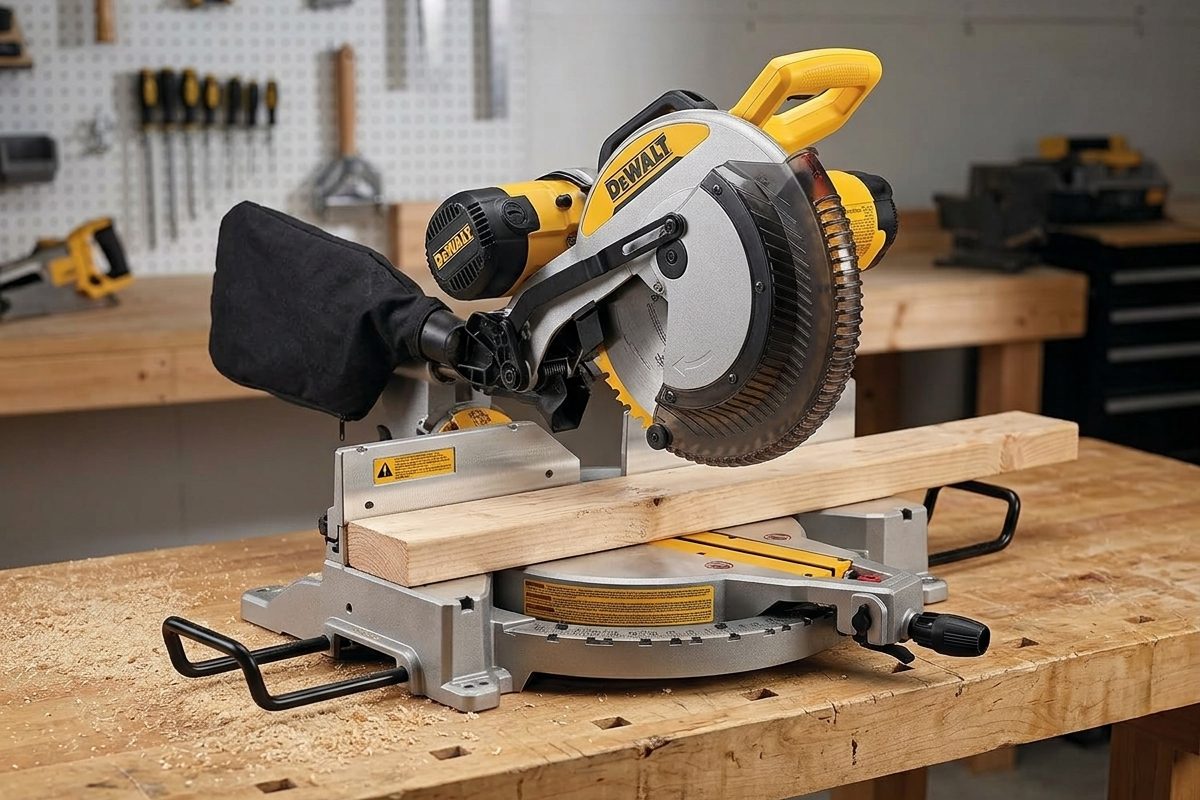
The DWS715 has been around in one form or another since it replaced the older DW715, and it’s stuck around for a reason: it’s a straightforward, no-frills 12-inch miter saw that does the core job well without charging you for a sliding rail or a laser you might not need. It’s a common pick for trim carpenters, deck builders, and DIYers who want a bigger blade than a 10-inch saw without stepping up to sliding-compound pricing.

This review pulls from independent lab testing, real owner reports on woodworking forums, and manufacturer specs, not just a restatement of the box copy. Where the saw genuinely has a limitation, that gets said plainly.
What This Saw Actually Is

The DWS715 is a single-bevel compound miter saw. Compound means the blade can tilt for bevel cuts in addition to pivoting for miter cuts, letting you make compound cuts, like crown molding, in one setup. Single-bevel means the blade only tilts one direction, left, from 0 to 48 degrees, with a small 3-degree range to the right. It does not have sliding rails, which is the single biggest thing separating it from DeWalt’s more expensive DWS779 and DWS780 models.
No sliding rail means the blade drops straight down through the material instead of sliding forward and back. That caps how wide a board you can crosscut, since the blade can only cut as deep as its own diameter allows without the extra sliding travel.
Full Spec Sheet
| Spec | Detail |
| Motor | 15 amp, around 4,000 RPM no-load |
| Blade | 12-inch carbide, 5/8-inch arbor |
| Bevel range | 0° to 48° left, 0° to 3° right (single bevel, no positive stops) |
| Miter detent plate | Stainless steel, 14 positive stops |
| Cut capacity | 2×8 at 90°, 2×6 at 45° (non-sliding) |
| Molding capacity | 5-1/2″ base or crown, vertically nested against fence |
| Weight | About 36 lbs |
| Typical price | $219 to $299, depending on sales |
Quick Verdict

Buy it if: you mostly cut 2×8 or smaller dimensional lumber, trim, and molding, and you want strong accuracy out of the box without paying for a sliding rail you may not need.
Skip it if: you regularly need to crosscut wider boards, want a double-bevel saw to avoid flipping material for opposite-angle cuts, or want a built-in cutline laser or LED.
Short version: for its price and category, this saw delivers real accuracy and power without much fuss. Its limitations are exactly the ones you’d expect from a non-sliding, single-bevel design, not hidden surprises.
Performance in Real Use

Independent lab testing from Tested’s TechGearLab measured this saw’s dust collection directly rather than just eyeballing it. After 100 cuts with no vacuum attached, only 1.17 ounces of sawdust remained on the floor, which their testers noted was one of the better results among the saws in that review group. Hook it up to a shop vac and dust collection improves further, which is typical of nearly every miter saw in this class.
The same testing praised the saw’s out-of-box calibration as excellent, meaning the miter and bevel settings were genuinely accurate straight from the factory rather than needing immediate adjustment. That matters more than it sounds like it should, since a miter saw that’s off by even half a degree throws off every joint you cut until you catch and fix it.
The real limitation testers flagged is the bevel adjustment. Unlike the miter side, which has a stainless steel detent plate with 14 positive stops you can feel and lock into, the bevel side has no positive stops at all. Setting a precise bevel angle means relying on the scale and your own careful adjustment rather than a satisfying click into a pre-set position. For most crosscutting and standard trim work, this doesn’t matter much. For repeated identical bevel cuts, it means double-checking your angle more carefully than a saw with positive bevel stops would require.
Real Owner Feedback Worth Knowing About

A recurring, genuinely useful tip from a Fine Homebuilding forum discussion: the stock blade on many DeWalt miter saws ships with paint coating the teeth, which reduces cutting efficiency and can cause the blade to drift slightly during a cut. More than one experienced woodworker in that thread specifically credited a blade swap, removing that painted stock blade for a sharper aftermarket one, with fixing accuracy problems they’d otherwise blamed on the saw itself. If your cuts aren’t coming out as clean as you’d expect, checking the blade before assuming the saw is at fault is worth doing first.
On the DW715, the direct predecessor to this saw, a LumberJocks forum thread described a saw that had seen over a year of near-daily use tripping a 20-amp breaker on its first startup of the day, something that hadn’t happened when the saw was newer. This kind of thing shows up more as a symptom of extended heavy use without maintenance than a flaw baked into the saw itself, but it’s a fair data point if you’re planning on running this saw daily for years without ever cleaning or servicing it.
It’s also worth being precise about a separate issue that sometimes gets mixed up with this model: DeWalt issued an official recall covering the DWS779, DWS780, and DHS790 miter saws, where the plastic rear guard assembly could break or shatter and expose the blade. The DWS715 covered in this review is not part of that recall. If you’re cross-shopping this saw against its sliding siblings, that’s a distinction worth keeping straight rather than assuming it applies here too.
Real-World Use Cases
Framing and Deck Work

Crosscutting 2×8 and smaller dimensional lumber is exactly what this saw is built for, and it handles that work all day without strain. The 15-amp motor pushes through pressure-treated lumber without bogging down.
Trim and Crown Molding

The tall sliding fence supports 5-1/2 inches of base or crown molding standing vertically against it, which is the setup most trim carpenters actually use rather than laying crown flat and calculating compound angles. Single-bevel is a real limitation here compared to a double-bevel saw, since you’ll need to flip some moldings rather than just adjusting the saw to the opposite angle, but plenty of trim carpenters work this way without issue.
Picture Framing and Fine Detail Work

The 14 positive miter stops make repeating common angles fast and reliable, which matters for anyone making multiples of the same joint, like picture frames or repeated furniture parts.
Where It Falls Short
Anything wider than a 2×8 at 90 degrees is outside this saw’s range, since there’s no sliding rail to extend its reach. If your work regularly involves wide crosscuts, base cap, or deep stock, you’ll run into this ceiling quickly and consistently.
Common Mistakes and Setup Issues

- Blaming the saw for drift or rough cuts before checking whether the stock blade still has paint on the teeth reducing cut quality
- Assuming the bevel angle is locked accurately without positive stops, when it actually needs a careful, double-checked manual adjustment
- Buying this saw expecting to crosscut wider than 2×8 material, then being frustrated by a limitation that was always part of the non-sliding design
- Confusing this model’s safety record with the separate DWS779/DWS780/DHS790 rear guard recall, which does not apply to the DWS715
- Running the saw for years without basic maintenance, then being surprised by motor strain or electrical issues that regular cleaning would have caught earlier
- Not connecting a shop vac and expecting the same dust performance TechGearLab measured, since their strong 1.17 ounce result assumed careful measurement, not necessarily a completely dust-free floor
Cost Reality
Street pricing on this saw bounces between roughly $219 and $299 depending on sales and retailer. For comparison, DeWalt’s DWS716XPS, which adds double-bevel capability and an LED cutline system, runs close to $299 as well when discounted, and the fully sliding DWS779 lists closer to $499. That pricing gap is worth sitting with: you’re paying a real premium to add sliding capacity or double-bevel convenience, and for a lot of buyers doing standard trim and framing work, the DWS715 covers the job without that extra cost.

How It Compares

DWS715 vs. DWS716XPS
The 716XPS adds double-bevel capability, so you can tilt the blade both directions instead of needing to flip material for opposite-angle cuts, plus an LED cutline system that projects a shadow line showing exactly where the blade will cut. For trim carpenters doing a lot of crown molding, double-bevel saves real time. If neither of those features matters much to your work, the DWS715 gets you the same core cutting performance for less.
DWS715 vs. DWS779 (Sliding Compound): The sliding rails on the DWS779 let it crosscut significantly wider material, since the blade travels forward and back through the cut instead of just dropping straight down. If your projects regularly involve wide boards or deep stock, that added capacity is worth the roughly $200 price jump. Our Best Sliding Compound Miter Saw guide covers that category in more depth if wider cut capacity is the deciding factor for you.
Who Should Buy This Saw
- Framers and deck builders whose material stays at or under 2×8 dimensional lumber
- Trim carpenters comfortable working with single-bevel setups who don’t need an LED cutline
- Picture framers and hobbyists who value the fast, repeatable miter detent stops
- Budget-conscious buyers who want real accuracy without paying for sliding rails they won’t use
Skip it if wide crosscuts or double-bevel convenience matter to your work. In that case, it’s worth browsing our Best Miter Saw for Woodworking roundup for other options that might fit better.
Frequently Asked Questions
Is the DeWalt DWS715 a good beginner miter saw?
Yes, for most standard framing, trim, and general cutting tasks. Its strong out-of-box accuracy, according to independent lab testing, means a beginner isn’t fighting an inaccurate saw while also learning to cut. The single-bevel design and lack of positive bevel stops are the two things a beginner should know going in, since they mean occasionally flipping material and double-checking bevel settings rather than relying on a locked-in click like the miter side offers.
Can the DWS715 cut a 2×10 or wider board?
Not in a single 90-degree crosscut. Its non-sliding design caps crosscut capacity at 2×8 at 90 degrees and 2×6 at 45 degrees. Wider material needs to be cut in multiple passes with the board flipped, or you’ll need a sliding compound saw like the DWS779 for a single clean pass through wider stock.
Was the DWS715 part of any DeWalt miter saw recalls?
No. The official DeWalt recall affecting a rear guard assembly that could break or expose the blade covers the DWS779, DWS780, and DHS790 models specifically. The DWS715 is a different design and is not included in that recall.
Why doesn’t the bevel adjustment have positive stops like the miter side does?
This is a cost and design trade-off DeWalt made on this specific model. The miter detent plate has 14 positive stops for fast, repeatable common angles, but the bevel side relies on the scale and manual adjustment instead. It’s a real limitation compared to pricier saws with positive bevel stops on both axes, and it means bevel cuts need more careful double-checking, especially for repeated identical angles.
Should I upgrade the stock blade right away?
It’s worth considering. Forum discussion among experienced users points to the stock blade sometimes shipping with paint on the teeth, which can reduce cut quality and cause slight drift. If your cuts aren’t as clean as expected, swapping to a sharp aftermarket blade before assuming the saw itself has a problem is a reasonable first troubleshooting step.
Final Thoughts
The DWS715 earns its long-running popularity honestly. It’s accurate out of the box, powerful enough for daily framing and trim work, and priced well below its sliding and double-bevel siblings. Its limitations, a 2×8 cut ceiling and no positive bevel stops, are the direct, predictable result of keeping it simple and affordable, not hidden flaws. If your work fits inside those limits, this saw will handle years of regular use without much drama. If it doesn’t, DeWalt’s own lineup has the sliding and double-bevel options to step up to without leaving the brand.

Finlay Connolly is a woodworking enthusiast and power tool specialist with over a decade of hands-on experience in the workshop. As the founder and lead writer at ProTableSawReviews.com, Finlay combines expert knowledge with real-world testing to help woodworkers, DIYers, and professionals choose the best tools for the job. With a sharp eye for detail and a passion for precision, Finlay is committed to providing trustworthy, practical advice backed by years of experience and research in the field. Whether you’re cutting dados or comparing fence systems, you can count on Finlay for honest, reliable reviews that make your next cut your best one.