DeWalt vs Bosch Table Saw: DWE7491RS vs 4100-10
 Finlay Connolly
8 min read
Finlay Connolly
8 min read
By Finlay Connolly
Quick Answer
For most buyers, the DeWalt DWE7491RS is the safer overall pick. It has a bigger rip capacity on both sides of the blade, a 3-year warranty compared to Bosch’s 1-year, and its fence has a stronger track record for staying accurate over time. The Bosch 4100-09, and its updated version the 4100-10, wins on setup speed and portability thanks to the Gravity-Rise stand, and it runs a bit quieter. If you’re breaking down full sheets of plywood regularly, DeWalt’s extra rip capacity matters. If you’re setting up and packing down the saw multiple times a day, Bosch’s stand makes that part of the job noticeably easier.
Why This Comparison Usually Means These Two Saws

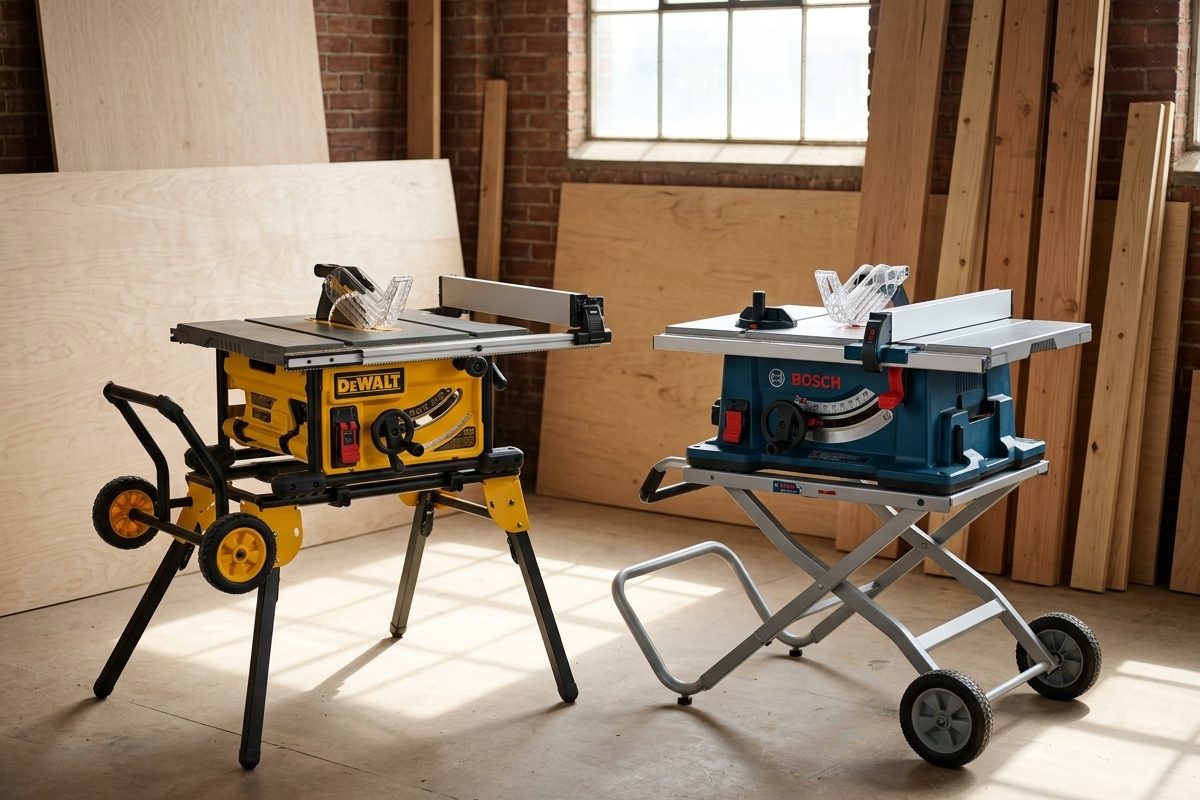
When people search “DeWalt vs Bosch table saw,” they’re almost always really asking about one specific matchup: the DeWalt DWE7491RS against the Bosch 4100-09, or its newer version the 4100-10. Both brands make other table saws too, but these two jobsite models are the ones that actually compete head to head for the same buyer, at close to the same price, for close to the same job. That’s the comparison this article focuses on, with a shorter note near the end on where else these two brands compete if you’re shopping outside the jobsite category.
Comparison at a Glance
| Factor | DeWalt DWE7491RS | Bosch 4100-09/10 |
| Motor | 15A, around 4,800 RPM | 15A, around 3,650 to 4,000 RPM |
| Rip capacity, right of blade | 32-1/2″ | 25″ to 30″, depending on version |
| Rip capacity, left of blade | 22″ to 24″ | Around 8-1/2″ |
| Max cut depth | 3-1/8″ at 90°, 2-1/4″ at 45° | 3-1/8″ at 90°, 2-1/4″ at 45° |
| Stand | Rolling stand, 4-leg design | Gravity-Rise stand, widely praised |
| Warranty | 3 years | 1 year |
| Typical price | $599 to $900 | Similar range |
Power and Cutting Speed

Both saws run 15-amp motors, so on paper the raw power draw is nearly identical. Where they differ is RPM and how that power gets delivered. The DeWalt spins faster, up around 4,800 RPM, while the Bosch runs slower, generally cited between 3,650 and 4,000 RPM depending on the specific version. Bosch includes a soft-start feature that eases the motor up to speed instead of hitting full RPM instantly, which is easier on the motor and less jarring when you’re standing right next to it.
In practice, both saws cut plywood, dimensional lumber, and hardwood without much drama. Neither one is going to leave you disappointed on a typical framing or remodeling job. The bigger differences show up elsewhere.
Rip Capacity: Where DeWalt Pulls Ahead

This is the most consistently reported difference between the two saws, and it’s not a small one. The DeWalt’s rack-and-pinion telescoping fence gives it a 32-1/2 inch rip capacity to the right of the blade and roughly 22 to 24 inches to the left. The Bosch comes in lower on the right side, typically 25 to 30 inches depending on the version, and noticeably lower on the left, around 8-1/2 inches.
That left-side gap matters more than people expect until they run into it. If you ever need to rip a piece of material using the left side of the blade, which comes up more than you’d think when you’re breaking down oddly sized offcuts, the Bosch runs out of room fast. For straightforward right-side ripping on standard material, this difference matters less. For anyone regularly cutting full plywood sheets down, the DeWalt’s extra capacity on both sides is a real, practical advantage.
Setting Up and Packing Down

This is where the Bosch earns its reputation. The Gravity-Rise stand is widely regarded as one of the easier stand designs to deploy and fold, using the saw’s own weight to help raise and lower it rather than requiring you to wrestle four separate legs into place. The DeWalt’s rolling stand is sturdy and stable once it’s set up, but more than one reviewer has described it as slightly more effort to deploy than the Bosch.
If your work means setting the saw up and breaking it down multiple times a day, moving between rooms or job sites, that difference adds up over a week in a way it wouldn’t if the saw mostly stays in one spot.
What Real Owners Report

Fence accuracy is the detail that comes up most in long-term owner feedback for the Bosch. As covered in our full Bosch 4100-09 Table Saw Review, the fence is the single most repeated complaint across different woodworking forums going back over a decade, described by different owners as wobbly, painful to adjust, or prone to twisting slightly out of square when locked down. Plenty of owners also say it’s fine once you’ve spent time truing it up properly, but that’s a setup step DeWalt owners report needing less often.
DeWalt’s saw isn’t flawless either. A recurring but minor complaint is that the table deck isn’t perfectly flat on every unit, and dado cuts require buying a separate throat plate insert, something the Bosch includes standard with its own dado-compatible insert.
Warranty: A Real Difference, Not a Footnote

DeWalt backs the DWE7491RS with a 3-year warranty. Bosch covers the 4100-09/10 for just 1 year. For a tool that’s going to see years of jobsite use, that’s a meaningful gap, not a minor detail to skim past. If something goes wrong with either saw outside the warranty window, you’re paying for the repair either way, but DeWalt gives you two extra years of coverage before that becomes your problem.
Noise and Everyday Comfort

Several hands-on comparisons note the Bosch runs a bit quieter than the DeWalt, along with small ergonomic advantages like an accessible arbor lock and adjustable leveling feet for uneven jobsite ground. None of these are dealbreakers on their own, but if you’re standing next to this saw for hours at a time, small comfort details like these add up.
Beyond the Jobsite Saw: Where Else These Brands Compete
If your budget or needs go beyond a standard jobsite saw, both brands have other options worth knowing about. DeWalt’s FlexVolt 60V table saw trades the corded jobsite format for cordless power and portability, which our DeWalt FlexVolt 60V Table Saw Review covers in detail. Bosch’s answer to SawStop’s flesh-detection safety technology is the REAXX line, which works differently enough from a standard jobsite saw that it’s worth its own comparison, covered in our SawStop vs Bosch REAXX Table Saw breakdown.
Common Mistakes People Make

- Assuming both saws have the same rip capacity because they’re priced similarly and look alike on the shelf
- Not checking left-side rip capacity, then being surprised when the Bosch runs out of room on an off-center cut
- Buying based on RPM alone, when soft-start and real-world cutting behavior matter more than the number on the spec sheet
- Skipping the fence alignment check on a new Bosch, then blaming the saw for cuts that were actually a setup issue
- Overlooking the warranty gap, which matters more the longer you plan to keep and rely on the saw
- Choosing based on stand convenience alone without weighing how much rip capacity your actual projects need
Which One Should You Buy

Choose the DeWalt DWE7491RS if you regularly break down full sheets of plywood, want the longer warranty, or need rip capacity on the left side of the blade for irregular cuts. It’s the more capable, better-covered saw for buyers who keep a saw for years rather than one season.
Choose the Bosch 4100-09 or 4100-10 if setup speed and portability matter more to your workflow than maximum rip capacity, or if a quieter, slightly more refined feel matters to you day to day. Just plan on checking and adjusting the fence when it’s new, since that’s the one area where owner reports consistently ask for a little patience.
Frequently Asked Questions
Is the DeWalt DWE7491RS better than the Bosch 4100-09?
It depends on what you value most. The DeWalt has a larger rip capacity on both sides of the blade, a longer 3-year warranty, and a fence with a stronger long-term accuracy track record. The Bosch sets up and folds down faster thanks to its Gravity-Rise stand, and runs a bit quieter. Neither saw is a clear winner in every category, which is why the right choice depends on which of those differences matters more for how you actually work.
Why is the Bosch’s left-side rip capacity so much smaller?
This comes down to the fence rail design on each saw. DeWalt’s rack-and-pinion telescoping fence system extends further on both sides of the blade, while the Bosch’s fence rail setup limits how far you can rip material to the left. For most standard right-side ripping, this difference doesn’t matter. It only becomes a real limitation if you regularly need to cut material using the left side of the blade.
Does the Bosch 4100-09 or 4100-10 have known fence problems?
Fence accuracy is the most commonly repeated complaint from long-term Bosch 4100-09 owners across multiple woodworking forums, described variously as wobbly or prone to shifting slightly out of square when locked. Many owners also report the fence holds fine once it’s been properly trued up after purchase, so it’s more of a setup step to expect than a defect you’re guaranteed to run into.
Is a 3-year warranty worth choosing DeWalt over Bosch by itself?
For buyers planning to keep and rely on the saw for years, especially in professional use, the extra two years of coverage is a real, tangible advantage, not just a marketing detail. For occasional home use where the saw sees light duty, the warranty gap matters less, and other differences like stand convenience or rip capacity might carry more weight in your decision.
Final Verdict
Both of these saws have earned their reputations, and neither one is a bad choice. The DeWalt DWE7491RS is the more capable, better-covered saw overall, with more rip capacity and a longer warranty backing it up. The Bosch 4100-09 and 4100-10 make up for a smaller rip capacity with genuinely excellent setup convenience and a quieter, more refined feel in daily use. If you’re not sure which matters more for your specific work, rip capacity and warranty length are the two factors most likely to actually affect you a year or two down the road.

Finlay Connolly is a woodworking enthusiast and power tool specialist with over a decade of hands-on experience in the workshop. As the founder and lead writer at ProTableSawReviews.com, Finlay combines expert knowledge with real-world testing to help woodworkers, DIYers, and professionals choose the best tools for the job. With a sharp eye for detail and a passion for precision, Finlay is committed to providing trustworthy, practical advice backed by years of experience and research in the field. Whether you’re cutting dados or comparing fence systems, you can count on Finlay for honest, reliable reviews that make your next cut your best one.