Miter Saw vs Cut-Off Saw: The Actual Difference (and Why They Get Confused)
 Finlay Connolly
7 min read
Finlay Connolly
7 min read
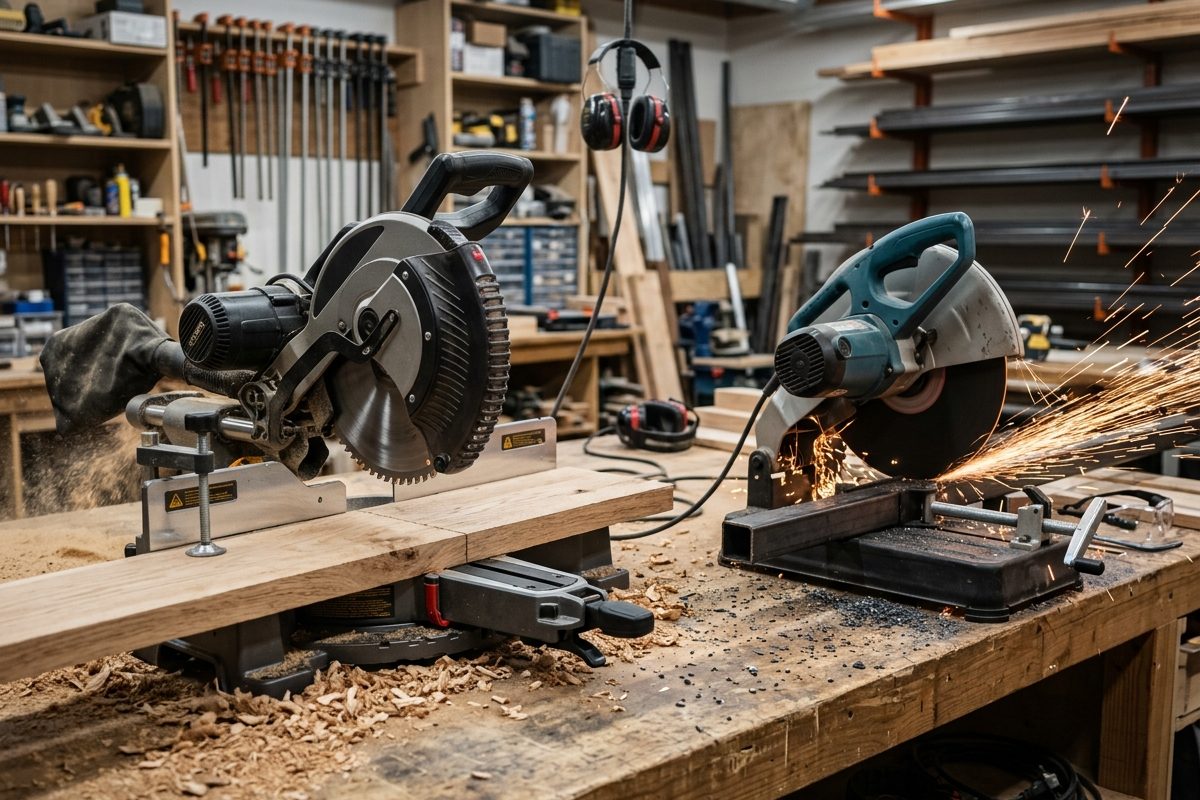
A miter saw cuts wood at angles. A cut-off saw cuts metal in a straight line. If that’s all you needed, you’re done. If you want to understand why the two get confused, which one fits your actual project, and what happens when you try to use the wrong one — keep reading.
The main difference between a miter saw and a cut-off saw is that a miter saw is designed for cutting wood at precise angles, while a cut-off saw is designed for cutting metal in straight 90-degree cuts. Miter saws use carbide-toothed blades, whereas cut-off saws use abrasive discs or cold saw blades.
— Written by Finlay Connolly
I keep both in my shop. The miter saw — a Ridgid R4222 12-inch sliding compound — is bolted to a dedicated station along the left wall. The cut-off saw, a Makita LC1230 12-inch cold saw, lives on the floor near the metal rack because it throws chips and I don’t want them anywhere near my woodworking area. I’ve used the Ridgid for everything from crown molding on a full kitchen renovation to cutting the angled legs on a walnut coffee table. The Makita has cut hundreds of steel square sections, aluminum tube, and the occasional copper pipe.

They look vaguely similar from across a room. They do completely different jobs. Here’s the clearest way I know to explain the difference.
The Real Difference in Plain English

A miter saw is a wood-cutting tool first. Its blade is a carbide-tipped circular blade with many small teeth — designed to slice cleanly through timber, MDF, plywood edging, and similar materials. The head swings left and right on a rotating base so you can set precise angles. Compound models also tilt sideways for bevel cuts. That’s what makes it essential for trim carpentry — baseboards, crown molding, door casing — where the corners need to meet at exactly 45 degrees or some other specific angle.
A cut-off saw (also called a chop saw, abrasive saw, or cold saw depending on the blade type) is a metal-cutting tool first. It cuts straight down, at 90 degrees only in most cases, using either an abrasive grinding disc or a cold saw blade. There’s no angle adjustment on a standard cut-off saw. It doesn’t need one — its job is to cut steel pipe, angle iron, aluminum extrusion, rebar, or conduit quickly and cleanly. The abrasive disc type generates significant heat and leaves rough, slightly burred edges. Cold saw versions run slower and leave a cleaner cut.
| Miter Saw | Cut-Off Saw | |
|---|---|---|
| Primary material | Wood, MDF, trim | Metal (steel, aluminum, copper) |
| Blade type | Carbide-tipped, toothed | Abrasive disc or cold saw blade |
| Angle cuts? | Yes — up to 45°+ left and right | No (90° straight cuts only, on most models) |
| Surface finish | Clean, smooth | Rough (abrasive) or clean (cold saw) |
| Sparks? | No | Yes (abrasive type) |
| Typical price range | $150–$900 | $100–$600 |
Why People Get Confused

The confusion usually comes from two things.
First, both saws have a pivoting arm that swings down onto the material. They look mechanically similar, especially in photos. If you’ve never used either one, it’s an easy mistake to assume they’re interchangeable versions of the same tool.
Second, the naming is genuinely inconsistent. “Chop saw” is used by some people to describe a cut-off saw for metal — and by others to describe a basic miter saw that only cuts at 90 degrees. “Cut-off saw” sometimes means an abrasive metal saw, and sometimes refers to any saw that cuts material to length. I’ve seen contractor supply stores label a basic 10-inch miter saw as a “cut-off saw” on the shelf tag.
If you’re shopping and unsure what you’re looking at: check the blade. A toothed carbide blade = miter saw. An abrasive disc (looks like a grinding wheel) = cut-off saw for metal. A cold saw blade (thick, toothed, designed for slow metal cutting) = cold saw / cold cut-off saw.
What Each One Actually Feels Like to Use

The miter saw is precise and quiet by comparison. When I was trimming out the windows in a house renovation last spring — about 40 sets of window casing in total — I ran every piece through the Ridgid R4222. The process was: mark the angle, lock the miter at 45 degrees, drop the blade, done. The cut surface was clean enough to caulk and paint directly. No sanding required on most cuts. The fence kept everything square and the detents (preset angle stops) at common angles like 22.5° and 31.6° made repetitive cuts fast. I did roughly 200 cuts that day with one blade change.
The cut-off saw is louder, produces more debris, and demands more respect. When I was cutting steel square tube for a welding project — building a workbench frame — I used the Makita LC1230 cold saw. Each cut took about 15–20 seconds through 40x40mm mild steel. The chips came off as small curls rather than hot sparks, which is the advantage of a cold saw over an abrasive type. But even so, I was wearing a face shield, not just safety glasses. The cut ends were clean enough to weld directly without grinding, which is the reason cold saws are worth the higher price if you weld.
By contrast, the time I borrowed a neighbor’s abrasive disc cut-off saw to cut some rebar quickly — I ended up with hot sparks landing across a 6-foot radius, rough cut ends that needed a grinder, and a shop that smelled like burning iron for an hour. It did the job. Not pleasant.
Which One Do You Actually Need?
Get a miter saw if:
- You’re doing any woodworking — furniture, trim, cabinetry, framing
- You need to cut at angles (anything other than a straight 90-degree crosscut)
- You’re working with wood, MDF, plywood edging, plastic trim, or similar materials

Get a cut-off saw if:
- You’re cutting steel, aluminum, copper pipe, rebar, or conduit
- You only need straight 90-degree cuts
- You’re doing metalwork, plumbing, or structural steel fabrication

Get neither if you’re cutting tile, concrete, or masonry — that’s a different tool category altogether (angle grinder with diamond disc, or a wet tile saw).
The Hybrid Option Worth Knowing About

There’s a third category that’s grown significantly over the last several years: multi-material miter saws, most famously made by Evolution Power Tools. Their RAGE series saws use a specialized carbide-tipped blade that cuts wood, metal, and plastic — and the saw head swings to angles like a miter saw.
I haven’t personally run an Evolution RAGE as my primary tool for either application, but I’ve used one on a jobsite where the contractor had it set up for cutting steel stud framing. It handled the steel stud cleanly and quickly. The finish wasn’t as clean as a dedicated cold saw on steel, and it wouldn’t replace a proper miter saw for fine trim work, but as a single versatile saw for a mixed-material site where you don’t want to haul two machines — it makes sense.
The trade-off with multi-material saws: you’re compromising on the best-case performance of each dedicated tool, in exchange for flexibility. If 90% of your work is wood trim, get a proper miter saw. If 90% is metal cutting, get a cut-off saw. If you’re regularly doing both and space or budget is tight, the Evolution route is worth considering.
One Mistake Worth Avoiding

Do not put a wood blade on a cut-off saw body and try to cut metal with it. Do not put an abrasive metal disc on a miter saw and try to cut steel.
I’ve seen both attempts. The first one destroys carbide teeth on contact with hard steel, sends tooth fragments across the shop, and can cause the blade to shatter. The second generates sparks that land on your wooden fence and table — a fire hazard, plus the abrasive disc is typically rated for higher RPM than a miter saw runs, and mismatched speeds can cause disc failure.
The blades are not interchangeable. The tools look similar. They are not the same.
Quick Buying Guidance
If you’ve decided you need a miter saw and you’re not sure which size, a 10-inch sliding compound is the most practical starting point for most people. It handles boards up to about 12 inches wide, cuts cleanly at any angle you’ll realistically need, and doesn’t weigh as much as a 12-inch model. We’ve reviewed several current models in detail — the Ridgid sliding miter saw lineup and best miter saw for woodworking are good starting points.
If you’ve decided you need a cut-off saw for metal work, decide first whether you want an abrasive or cold saw. Abrasive saws are cheaper ($100–200) and work fine for rough cuts where finish quality doesn’t matter. Cold saws start around $300–400 and produce cleaner cuts suitable for welding without rework. For aluminum, a cold saw or a carbide-tipped multi-material saw is much better — abrasive discs load up and overheat on aluminum.
The tools solve different problems. Pick the one that matches the work, not the one that looks close enough.

Finlay Connolly is a woodworking enthusiast and power tool specialist with over a decade of hands-on experience in the workshop. As the founder and lead writer at ProTableSawReviews.com, Finlay combines expert knowledge with real-world testing to help woodworkers, DIYers, and professionals choose the best tools for the job. With a sharp eye for detail and a passion for precision, Finlay is committed to providing trustworthy, practical advice backed by years of experience and research in the field. Whether you’re cutting dados or comparing fence systems, you can count on Finlay for honest, reliable reviews that make your next cut your best one.