Best Table Saw Power Feeders (2026): Reviews & Buying Guide
 Finlay Connolly
15 min read
Finlay Connolly
15 min read
By Finlay Connolly
Quick Answer
For most home shops and small production setups, the Powermatic PF-41 is the best table saw power feeder. It runs on standard 115V single-phase power, so it doesn’t need a phase converter, and its 4-roller design holds stock more securely than the 3-roller feeders most competitors offer at this price. If you’re running a saw all day in a production shop, step up to a 3-phase model like the Powermatic PF-33. If you’re a hobbyist feeding lighter material occasionally, the Shop Fox W1764 covers that need without the cost of a full-size feeder.
Power Feeder Comparison at a Glance
| Feeder | Best For | Rollers | Power |
| Powermatic PF-41 | Overall best, home and small shop use | 4 | 1 HP, 115V single-phase |
| Powermatic PF-33 | Industrial, daily production use | 3 | 1 HP, 230V 3-phase |
| Powermatic PF-33-Jr | Best reach for table saws, solo install | 3 | 1 HP, 115V or 230V |
| Shop Fox W1765 | Best value, full-size feeder | 3 | 1/2 HP, 110V |
| Shop Fox W1764 | Best for light hobbyist use | 3 | 1/8 HP, 110V |
| Grizzly G4173 | Budget-friendly, occasional use | 3 | 1/8 HP, 110V |
What a Power Feeder Actually Does

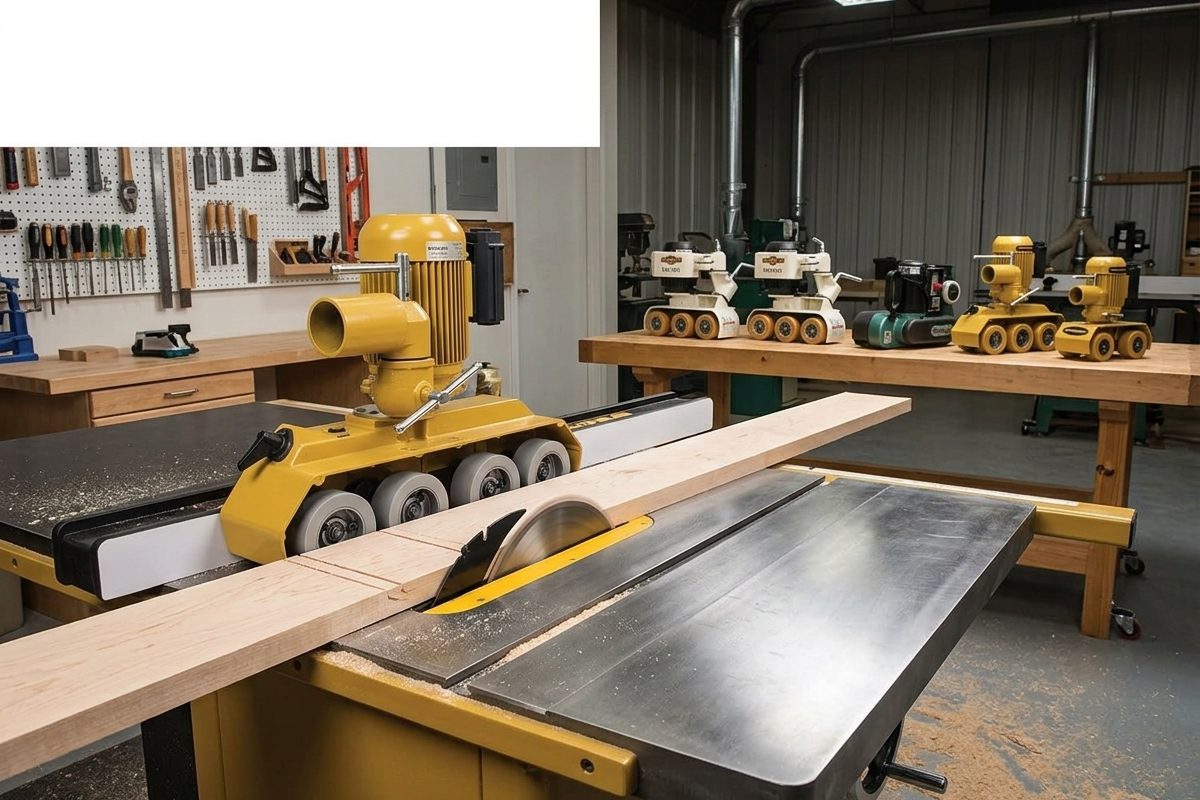
A power feeder is a motorized unit that clamps or bolts near your table saw fence and pushes material through the blade at a steady, controlled speed using a set of spinning rubber rollers. Instead of your hands pushing the board, the feeder does it, at a consistent rate, with consistent downward and inward pressure holding the material against the table and fence the whole way through the cut.
The safety benefit is the obvious one. Your hands never get near the blade during a feeder-assisted rip cut. But the bigger reason production shops use these day to day is consistency. A feeder doesn’t slow down partway through a long board, doesn’t drift off the fence, and doesn’t get tired after the fortieth identical cut of the day. That consistency is what actually shows up in the finished cut quality, not just the safety numbers.
Top Power Feeders for Table Saws
1. Powermatic PF-41 — Best Overall

This is Powermatic’s 4-roller feeder, and the extra roller compared to most competing feeders is the real story here. More rollers in contact with the stock means more consistent downward pressure across the length of a cut, which matters most on longer boards that a 3-roller feeder might let flex or lift slightly partway through.
Advantages: runs on standard 115V single-phase power, so it plugs into a normal shop outlet without a phase converter, and the continuous-duty motor is built to run for extended sessions without overheating.
Downsides: it costs more than 3-roller alternatives at a similar power rating, and the added roller means a slightly larger footprint on your saw’s table board or mounting surface.
Compatibility: mounts to most cabinet and contractor saws with a table board or extension wing sturdy enough to support the feeder’s weight.
Who should buy it: serious hobbyists and small shops doing regular ripping who want a feeder they won’t outgrow, without committing to 3-phase industrial equipment.
When to avoid it: if you’re only feeding material occasionally, this is more feeder than you need. A lighter-duty model will save you money without holding you back.

2. Powermatic PF-33 — Best for Industrial, Daily Use

The PF-33 is Powermatic’s 3-roller industrial feeder, built around a cast iron body and a continuous-duty motor rated for the kind of 8 to 10 hour daily use you’d see in a production shop. It runs on 230V 3-phase power, which is standard in commercial shops but not something most home garages have without a phase converter.
Advantages: genuinely built for continuous, all-day operation, with a cast iron body that resists vibration far better than lighter feeders, and universal joints that let it lock into horizontal, vertical, or angled feed positions.
Downsides: at roughly 134 pounds, it’s heavy enough that mounting and removing it solo is a real chore, and the 3-phase power requirement rules it out for most home shops without additional electrical work.
Compatibility: designed for shaper and table saw use in commercial settings with 3-phase service already in place.
Who should buy it: cabinet shops and production woodworking businesses running the saw most of the day, most days of the week.
When to avoid it: skip it if you don’t already have 3-phase power or aren’t willing to add a phase converter. The PF-41 or PF-33-Jr cover the same quality tier without that requirement.

3. Powermatic PF-33-Jr — Best Reach for Table Saw Work

This one sits in an odd spot in Powermatic’s lineup, technically grouped with their smaller feeders but performing closer to a full-size unit. At 71 pounds, it’s roughly half the weight of the PF-33, which makes it realistic for one person to mount and remove without help, a real consideration if your feeder needs to come off the saw between projects.
Advantages: the standard post-style mounting design gives it more horizontal reach than clamp-on style feeders, which matters specifically for table saw work where you need the feeder positioned well ahead of the blade. It’s also light enough for solo installation.
Downsides: it costs a few hundred dollars more than entry-level 3-roller feeders, and it’s still a post-mount system, which takes more setup time than a simple clamp-on base.
Compatibility: works well on table saws specifically, more so than shaper-focused feeders in the same catalog.
Who should buy it: buyers who want Powermatic build quality and reach on a table saw specifically, and who need to mount and remove the feeder without a second person helping.
When to avoid it: if budget is the main constraint, the Shop Fox W1765 gets you most of the practical function at a noticeably lower price.
4. Shop Fox W1765 — Best Value

Shop Fox’s full-size feeder line consistently gets described as the best price-to-performance option in this category, and the W1765 is a good example why. It includes forward and reverse feed direction, multiple feed speeds, and XYZ axis adjustment, features that on a Powermatic unit would usually come at a real premium.
Advantages: genuinely competitive feature set for the price, a 2-year warranty, and compatibility with the widely available Steelex clamp-on base, which simplifies mounting on saws that don’t already have a dedicated feeder mount.
Downsides: build quality and vibration control fall short of true Powermatic units under heavy daily use, which matters for production shops but not for occasional home use.
Compatibility: pairs with Steelex clamp-on bases, making it one of the easier feeders to mount on a saw without existing feeder hardware.
Who should buy it: small shops and serious hobbyists who want real feed control and multiple speeds without paying industrial pricing.
When to avoid it: production shops running the saw daily for years will likely outlast this feeder’s duty cycle faster than a true industrial unit.
5. Shop Fox W1764 — Best for Light Hobbyist Use
This is Shop Fox’s mini power feeder, built around a 1/8 HP motor for lighter material and lower-volume use. It’s a genuinely different category from the full-size feeders above, more comparable to a motorized featherboard than an industrial feed unit.
Advantages: low cost, variable speed control, and a compact footprint that doesn’t dominate your saw’s table the way a full-size feeder does.
Downsides: limited power for heavier stock, and fewer speed options than the larger Shop Fox and Powermatic models.
Compatibility: works with the same Steelex clamp-on base as the W1765, making it easy to swap between the two if your needs change.
Who should buy it: hobbyists doing smaller projects who want the safety and consistency benefit of a feeder without the cost or footprint of a full-size unit.
When to avoid it: if you’re feeding hardwood or thicker stock regularly, this motor won’t keep up, and you’ll want the W1765 or a Powermatic model instead.
Single-Phase vs. Three-Phase Power
This is one of the first things to check before buying, and it trips up more first-time buyers than any other spec. Most home shops run standard 115V or 230V single-phase power. Industrial 3-phase power, common in commercial shops, isn’t something most home garages have without adding a phase converter, which is its own added expense. Before buying a feeder built around 3-phase power, confirm what your shop actually has, since a great deal on a 3-phase unit isn’t a deal at all if you need to buy a converter to run it.
3-Roller vs. 4-Roller Feeders

Three rollers is the standard configuration and works fine for most work. Four rollers add extra contact points along the material’s length, which helps most on longer boards where a 3-roller feeder might let the far end lift or drift slightly before the next roller catches it. For short to medium stock, the difference is minor. For long rips on full-length boards, the extra roller earns its keep.
Feed Speed and Gear Sets
Most feeders offer a few fixed feed speeds through interchangeable gears, and some offer an optional slow-speed gear set for delicate work, in the range of about 13 feet per minute on the slow end. Faster feed rates suit straightforward ripping where speed matters more than a perfect edge. Slower rates suit denser hardwood, thin stock prone to chipping, or joinery cuts where control matters more than throughput.
If you’re running a dado stack for repeat joinery cuts, matching your feed speed to the blade setup matters even more than on a standard rip cut. Our Dado Set for Table Saw guide covers blade and stack selection that pairs well with a slower feeder setting for clean, repeatable dado work.
Mounting: Clamp-On vs. Post-Style
Clamp-on bases are simpler and faster to install, and several budget and mid-range feeders, including the Shop Fox models above, are compatible with the widely available Steelex clamp-on base. Post-style mounting, like Powermatic’s PF-33-Jr, takes more setup time but generally gives better horizontal reach and a more rigid mount, which matters more on a table saw than on a shaper or router table.
Do You Actually Need a Power Feeder?

Not every shop does. If you’re ripping the occasional board and you’re comfortable with standard push sticks and push blocks, a full power feeder is solving a problem you might not have yet. Two lighter-weight alternatives are worth knowing about before spending feeder money: featherboards, which hold stock against the fence using spring-loaded fingers without any motor, and stock guides, which apply both downward and inward pressure similarly to a feeder but without powered rollers pushing the material through.
Featherboards and stock guides won’t replace a feeder’s consistency on long production runs, but for a home shop doing occasional ripping, they cover most of the same safety benefit at a fraction of the cost. It’s worth checking our Best Table Saw Featherboards guide for those lighter-duty options before committing to a full feeder setup.
Real-World Use Cases

Ripping Long Boards Alone
This is the single biggest reason most woodworkers buy a feeder. Ripping an 8-foot board by hand means walking the material through the cut while keeping consistent pressure against the fence the entire way. A feeder does that automatically, freeing you to support and guide the far end of the board instead of pushing it.
Repetitive Production Cuts
Cabinet shops cutting the same width strip dozens or hundreds of times in a day rely on feeders for consistency as much as safety. A feeder cuts the same way on cut number one and cut number two hundred, which hand-feeding simply can’t match over a full shift.
Resawing and Thin Stock
Thin or resawn stock is more prone to chipping or binding if your feed rate isn’t steady. A feeder’s consistent speed reduces the kind of stop-start feeding that causes burn marks and chip-out on thinner material.
Moulding and Shaper Crossover Work
Many feeders, including several models in this guide, are built to work across both table saws and shapers or router tables. If your shop does both, a feeder that mounts to multiple machines is worth more than one that’s locked into a single tool.
Common Mistakes Buyers Make
- Buying a 3-phase feeder without checking whether their shop actually has 3-phase power available
- Assuming more horsepower always means a better feeder, when roller count and feed consistency matter more for most cuts
- Mounting the feeder without a sturdy enough table board or extension wing, which lets it vibrate and drift during use
- Running a single fixed feed speed for every material instead of adjusting for hardwood, thin stock, or joinery cuts
- Buying a full-size industrial feeder for occasional home use when a lighter mini feeder or a featherboard would do the job
- Forgetting that a feeder doesn’t replace a riving knife or blade guard. It adds consistency and keeps hands clear, but it isn’t a substitute for the saw’s other safety systems
Setup Tips That Actually Help
Mount the feeder so the rollers make contact with the material just ahead of the blade, angled slightly to hold the stock firmly against the fence as it feeds. Check that your table board or mounting surface is rigid enough to prevent vibration, since a wobbly mount undoes a lot of the consistency benefit a feeder is supposed to provide. Start with a slower feed speed when you’re new to using a feeder, since it’s easier to speed up a clean cut than to slow down and fix a scorched one.
Frequently Asked Questions
Do I need 3-phase power for a table saw power feeder?
Not necessarily. Many feeders, including Powermatic’s PF-41 and most Shop Fox and Grizzly models, run on standard 115V or 230V single-phase power, which is what most home shops already have. Only the heavier industrial feeders, like Powermatic’s PF-33, are built specifically around 230V 3-phase power, which usually means adding a phase converter in a home shop that doesn’t already have 3-phase service.
How many rollers should a power feeder have?
Three rollers is the standard and works well for most ripping and general shop use. Four rollers add extra contact points along the material, which helps most with longer boards that might otherwise lift or drift before the next roller catches them. For shorter stock or occasional use, the difference between three and four rollers is minor enough that it shouldn’t be the deciding factor on its own.
Can a power feeder replace a riving knife or blade guard?
No. A power feeder controls feed speed and keeps your hands away from the blade during the cut, but it doesn’t address kickback the way a riving knife does, and it doesn’t guard against blade contact the way a blade guard does. Treat a feeder as an addition to your saw’s existing safety systems, not a replacement for them.
What feed speed should I use for hardwood?
Slower feed speeds generally produce cleaner cuts on dense hardwood, since they give the blade more time per inch of material and reduce the chance of burning or binding. Many feeders offer a few fixed speeds through interchangeable gears, and if you’re working with hardwood regularly, a feeder with a slow-speed option, sometimes down around 13 feet per minute, is worth prioritizing over one with only fast fixed speeds.
Is a mini power feeder worth it for a home shop?
For occasional use on lighter material, yes. A mini feeder like the Shop Fox W1764 costs a fraction of a full-size unit and still provides the core safety and consistency benefit for smaller projects. If you find yourself feeding hardwood or thicker stock regularly and the mini feeder starts to feel underpowered, that’s the signal to step up to a full-size model rather than pushing a small motor past what it’s built for.
Final Recommendation
For most home shops and small production setups, the Powermatic PF-41 is the safest starting point. It runs on power most shops already have, its 4-roller design handles long stock better than 3-roller alternatives, and it’s built to last through years of regular use. Step up to the PF-33 only if you’re already running 3-phase power and using the saw most of the day. Step down to a Shop Fox model if budget matters more than industrial-grade duty cycles, and consider a mini feeder or a simple featherboard if your ripping is occasional rather than routine.
If a feeder is part of a bigger shop upgrade, it’s worth thinking about whether the saw underneath it can support the work you’re planning. Our Best Cabinet Table Saw guide is a useful next stop if you’re setting up a saw and feeder combination from scratch rather than adding a feeder to a saw you already own.

Finlay Connolly is a woodworking enthusiast and power tool specialist with over a decade of hands-on experience in the workshop. As the founder and lead writer at ProTableSawReviews.com, Finlay combines expert knowledge with real-world testing to help woodworkers, DIYers, and professionals choose the best tools for the job. With a sharp eye for detail and a passion for precision, Finlay is committed to providing trustworthy, practical advice backed by years of experience and research in the field. Whether you’re cutting dados or comparing fence systems, you can count on Finlay for honest, reliable reviews that make your next cut your best one.