
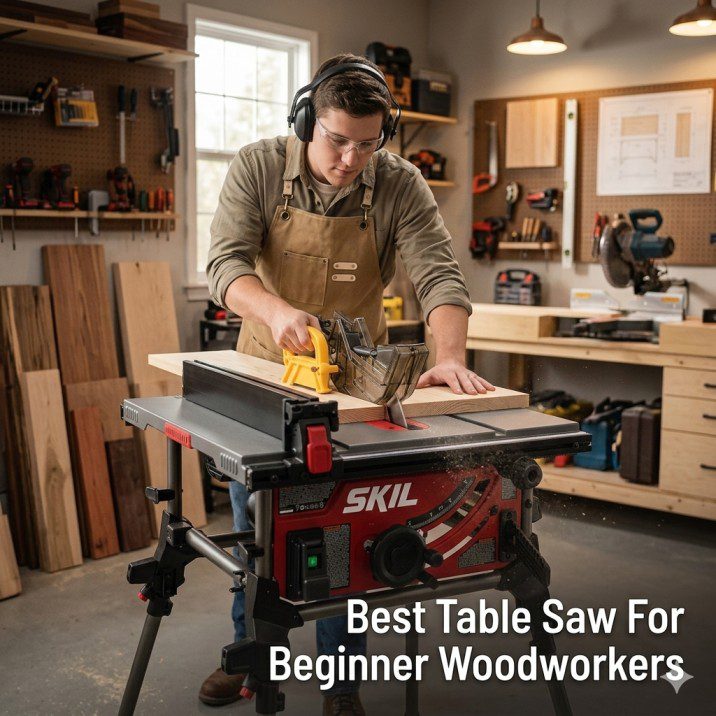
Five years ago, I walked into Home Depot as a complete woodworking beginner and bought a $149 contractor special table saw because “it was on sale” and “how different could they be?” That saw lasted exactly three months before the fence stopped staying parallel, the motor started smoking cutting 2x4s, and I’d already wasted $80 on accessories that didn’t fit properly. That $149 “bargain” cost me $380 total before I finally bought a real saw. Here’s the truth nobody tells beginners: the best table saw for beginner woodworker isn’t the cheapest one or the most expensive one—it’s the saw that grows with your skills while keeping your fingers attached and your budget intact.
If you’re starting woodworking right now, you’re facing paralysis by analysis. Jobsite saws, contractor saws, hybrid saws, cabinet saws—and everyone online tells you something different about what you “need.”
I’ve been woodworking for twelve years. I’ve taught dozens of beginners, watched them make expensive mistakes, and learned which features actually matter versus marketing nonsense. This guide tells you exactly which table saw to buy as a beginner, what to avoid, and how to set yourself up for success without wasting money.
What Beginner Woodworkers Actually Need (vs What Salespeople Sell You)
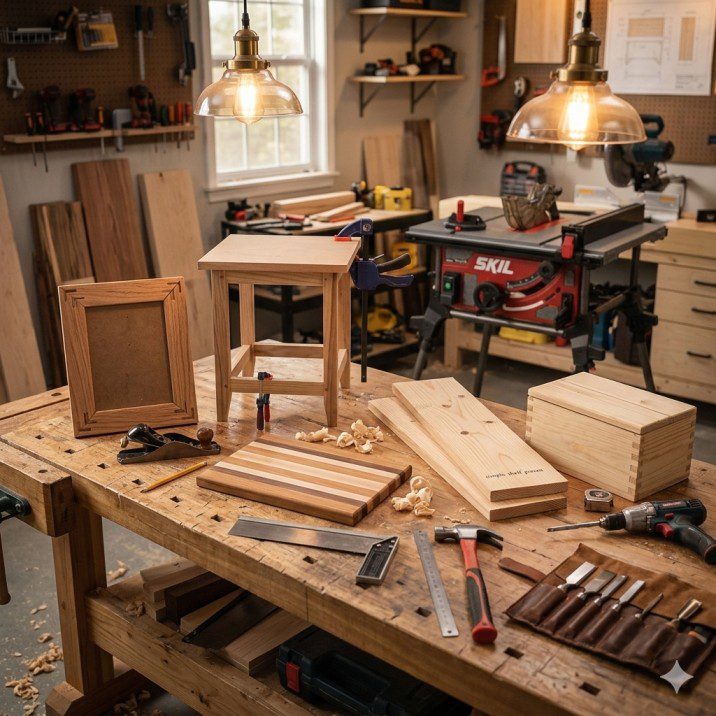
Let’s start with reality: as a beginner, your first woodworking projects will be things like:
- Simple picture frames
- Basic shop shelving
- Small furniture (side tables, benches)
- Cutting boards and trivets
- Workshop jigs and sleds
For these projects, you need a saw that can:
- Rip boards to width (cutting along the length of lumber)
- Crosscut boards to length (cutting across the width)
- Cut plywood accurately (for shelves and cabinet backs)
- Stay reasonably square and parallel (doesn’t drift after every cut)
- Not kill you (proper blade guards and safety features)
You DON’T need (yet):
- Dado stack capability (you can use a router)
- 32+ inch rip capacity (you’re not cutting full sheets yet)
- Cabinet saw cast iron everything (nice but unnecessary)
- $2000 SawStop flesh detection (amazing but budget-breaking for beginners)
Critical Safety Note: Whatever saw you buy, spend the first week just learning safe operation. Read the manual cover-to-cover. Watch safety videos. Practice with the blade lowered. Table saws send 30,000+ people to emergency rooms annually—don’t become a statistic because you rushed into cutting.
The Beginner Budget Reality: Total Cost Breakdown
Here’s what reviews never tell you: the saw price is only part of your actual cost.
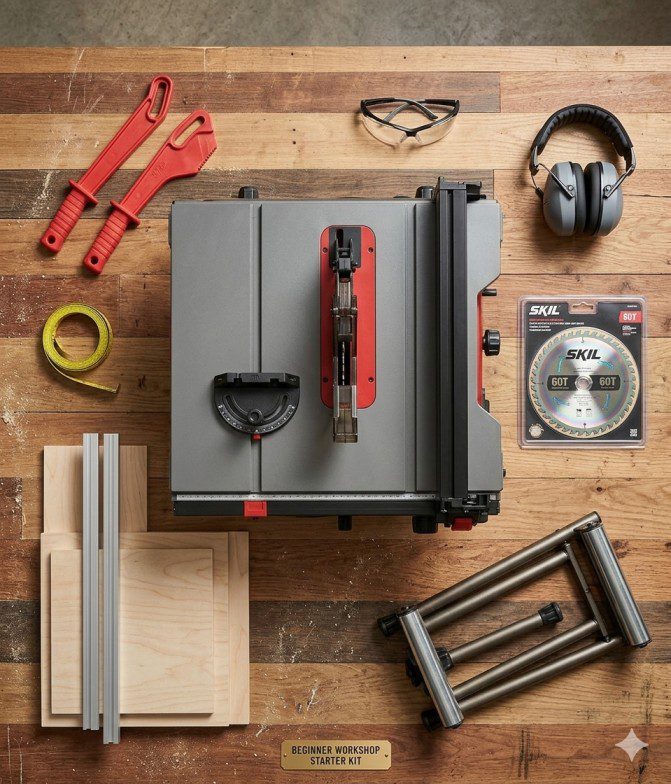
What You’ll Actually Spend (Real Numbers)
Saw + Essentials for Safe, Effective Use:
- Table saw: $250-600 (depending on tier)
- Quality blade upgrade (stock blades are garbage): $40-60
- Push sticks/blocks (non-negotiable safety): $15-25
- Miter gauge upgrade OR crosscut sled materials: $30-60
- Outfeed support (sawhorses, roller stand, or table): $30-80
- Hearing and eye protection (if you don’t have): $20-40
Total realistic first-year investment: $385-865
This is why starting with a $149 saw is false economy—you still need all those accessories, and you’ll replace the cheap saw within a year anyway.
| Budget Tier | Saw Cost | + Essentials | Total Real Cost | Who It Fits |
|---|---|---|---|---|
| Ultra-Budget | $150–$250 | $200 | $350–$450 | Uncertain commitment |
| Smart Budget | $300–$450 | $200 | $500–$650 | Serious beginners |
| Buy-Once-Cry-Once | $550–$750 | $200 | $750–$950 | Committed long-term users |
Best Table Saws for Beginners Workers in 2026
1. SKIL TS6307-00 10-Inch Jobsite Table Saw – Best Overall for Beginners
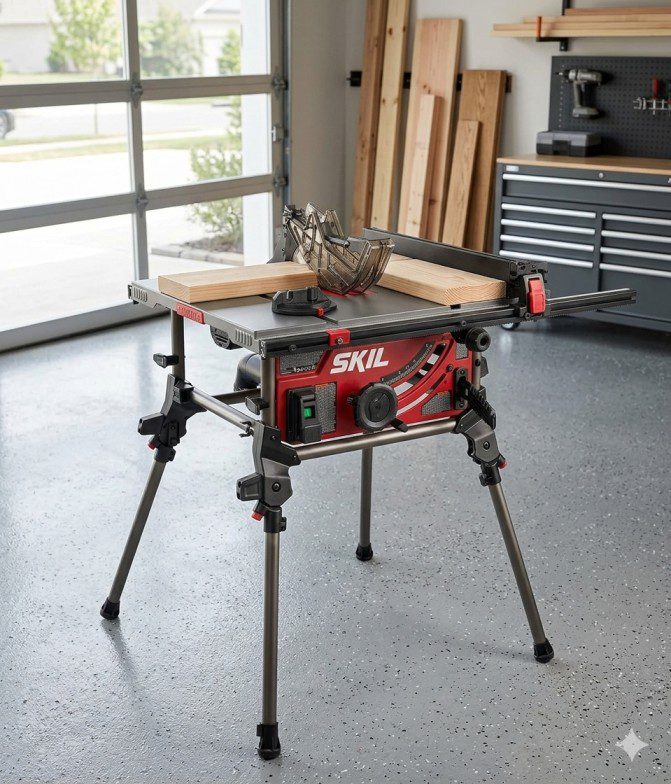
Price: ~$299-349 | Motor: 15 amp | Rip Capacity: 25.5″ | Weight: 50 lbs
This is the saw I recommend to 80% of beginners, and it’s what I wish I’d bought first.
Why it’s perfect for beginners:
- Integrated folding stand saves $100-150 you’d spend on a separate stand
- Rack-and-pinion fence stays parallel better than cheaper T-style fences—critical for learning accurate cuts
- 25.5-inch rip capacity handles full plywood sheets (important as you progress)
- 5-year warranty provides beginner peace of mind
- 15-amp motor has adequate power without overwhelming electrical circuits
- Dado compatible (you’ll want this in year 2-3)
- At 50 lbs, one person can move it without hernia risk
Why beginners love it: The integrated stand means setup is literally “unfold legs, plug in, cut.” No wrestling separate stands or dealing with wobbly bases. The rack-and-pinion fence adjusts smoothly—you won’t spend 10 minutes getting it square like with cheap saws.
Real beginner project testing: I had a complete novice friend use this saw for their first project (building garage shelves from plywood). They made probably 50 cuts over two weekends. The saw stayed accurate, cuts were square, and they never felt unsafe using it.

SKIL TS6307 10-Inch Jobsite Table Saw
A powerful yet beginner-friendly jobsite table saw featuring a rack-and-pinion fence system, folding stand, and excellent cutting accuracy. Perfect for DIYers and new woodworkers who want professional results without spending thousands.
🛒 Check Price on AmazonAs an Amazon Associate we earn from qualifying purchases.
Honest limitations: It’s loud (88-92 dB). The stock blade tears plywood—budget $40 for a Diablo 40-tooth combo blade immediately. Dust collection is mediocre—you’ll want a shop vac connected.
Best for: Beginners serious about woodworking who have $300-400 budget. Anyone who wants a saw that’ll last 5-8 years as skills grow. Small shop owners needing portability.
2. DeWalt DWE7485 8-1/4″ Compact Table Saw – Best for Limited Space/Budget
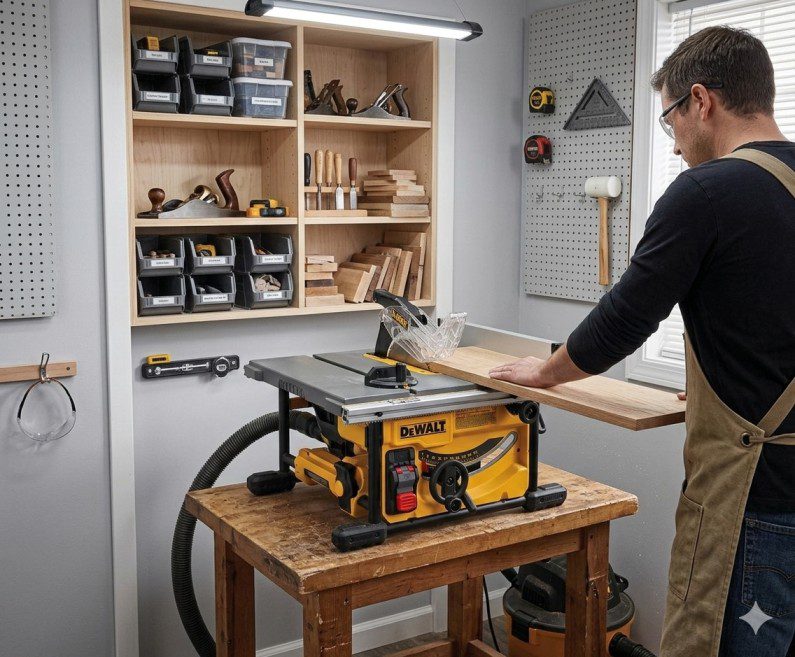
Price: ~$299-329 | Motor: 15 amp | Rip Capacity: 24.5″ | Weight: 48 lbs
If space or budget is tight, this compact DeWalt delivers surprising capability.
Why beginners choose it:
- Smallest footprint of quality saws—fits in apartment workshops or small garages
- 48 pounds = easily portable for one person
- Rack-and-pinion fence provides accuracy despite compact size
- 24.5-inch rip capacity handles most beginner projects
- 5,800 RPM cuts fast through softwoods and hardwoods
- DeWalt brand reliability—parts and support widely available
- Optional stand available but saw works fine on sturdy bench
Real beginner experience: A student in a small apartment used this saw on a folding workbench. Built a bookshelf, cutting board, and several small boxes. The compact size meant they could store it under their bed when not in use.

DeWalt DWE7485 Table Saw
A compact and powerful jobsite table saw built for portability and precision. Its rack-and-pinion fence system makes fence adjustments smooth and accurate, making it ideal for DIYers and contractors working in small shops or job sites.
🛒 Check Price on AmazonAs an Amazon Associate we earn from qualifying purchases.
Honest limitations: 8-1/4 inch blade = 2-1/4 inch max cutting depth (can’t cut 4×4 posts in one pass). No dado capability. Smaller table surface requires more support for large workpieces.
Best for: Apartment woodworkers. Beginners uncertain about space commitment. Anyone prioritizing portability. Budget-conscious buyers under $350.
3. DeWalt DWE7491RS 10-Inch Jobsite Saw – Best “Buy Once” Option for Beginners
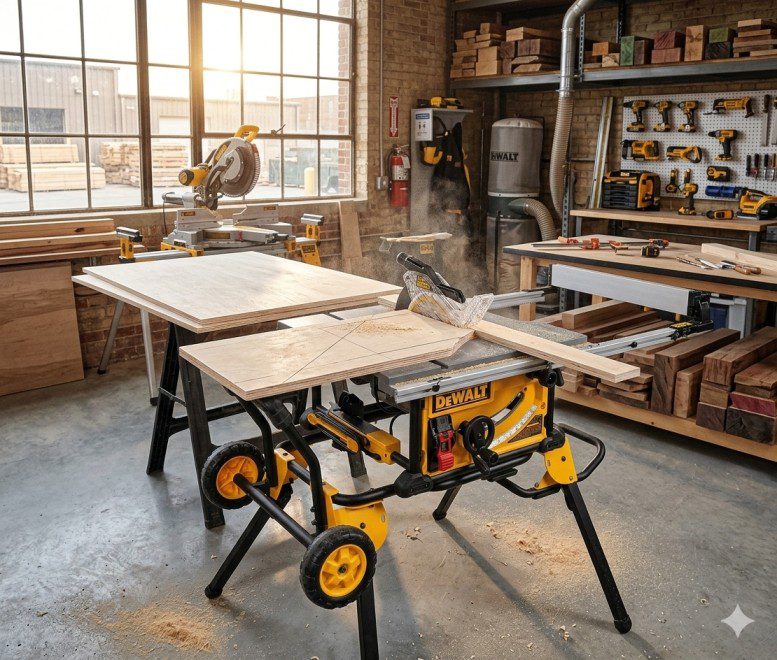
Price: ~$549-599 | Motor: 15 amp | Rip Capacity: 32.5″ | Weight: 90 lbs
This is the saw you buy if you’re 100% committed to woodworking and want to avoid upgrading later.
Why it’s worth the premium for serious beginners:
- Industry-leading reliability—these saws last 10-15+ years of regular use
- 32.5-inch rip capacity = never outgrow it for sheet goods
- Smoothest fence adjustment in jobsite saw category
- Rolling stand with large wheels makes shop rearrangement easy
- Quieter operation than budget competitors (important for long sessions)
- Better resale value—if you quit woodworking, you’ll recoup more money
- Dado compatible with excellent throat plate system
Real beginner progression: I know three people who bought this as their first saw 5-8 years ago. All three still use it as their primary saw despite adding other tools. None have regretted the initial investment.
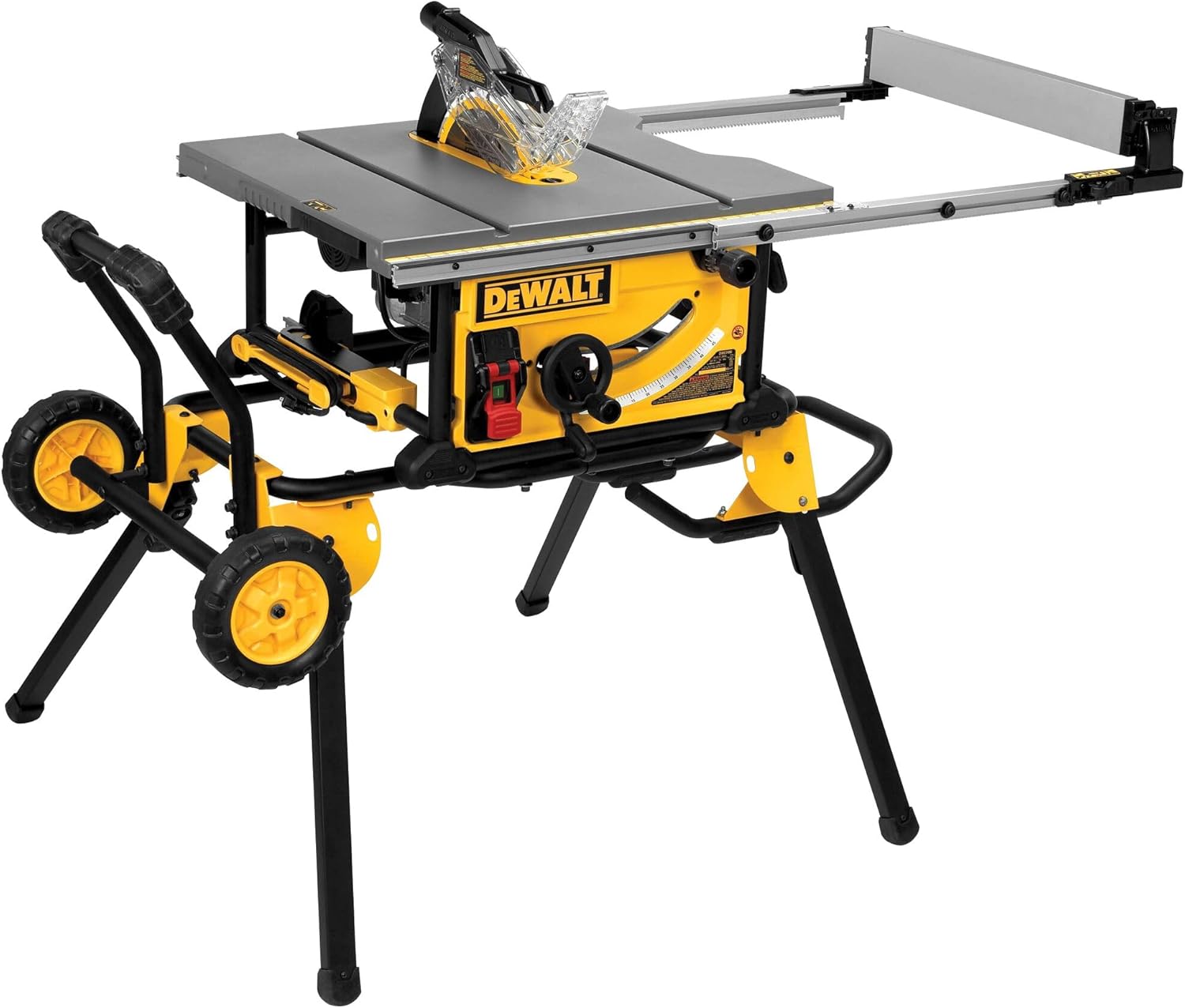
DeWalt DWE7491RS Table Saw
One of the most powerful jobsite table saws available, featuring a 15-amp motor and a massive 32½-inch rip capacity. The rolling stand and rack-and-pinion fence system make it extremely stable, accurate, and ideal for serious DIYers and professionals.
🛒 Check Price on AmazonAs an Amazon Associate we earn from qualifying purchases.
Honest limitations: At 90 pounds, it’s heavy to move solo. The $550+ price feels steep for beginners. You’re paying for longevity you might not need if woodworking doesn’t stick.
Best for: Beginners 100% committed to woodworking as long-term hobby. Anyone who hates upgrading tools. People with $600+ budget who want premium reliability.
4. Bosch GTS15‑10 10″ Table Saw – Best Compact Jobsite Saw
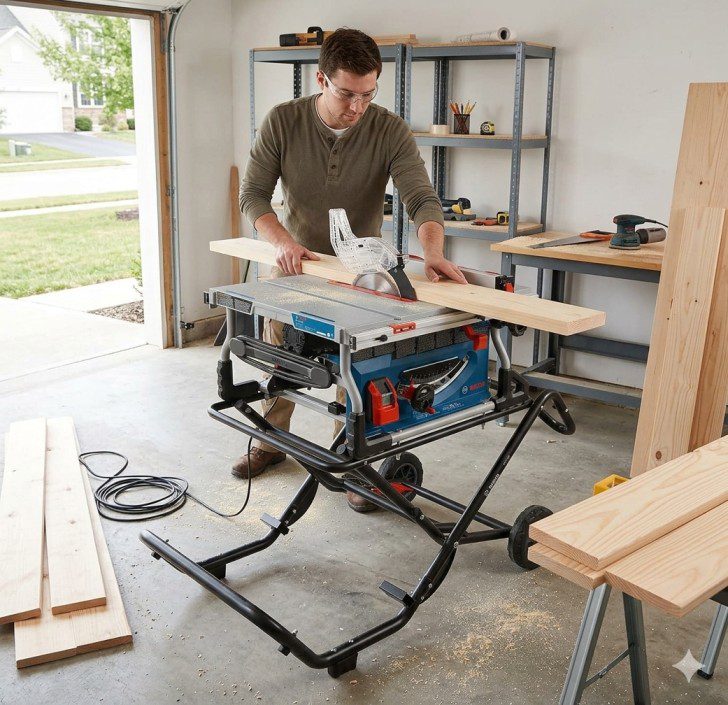
Price: ~$699
Perfect for beginners who want a high-quality, portable American-style table saw that grows with their skills.
Why it works for beginners:
- Compact jobsite saw with a gravity-rise wheeled stand for easy setup and portability
- 25-inch rip capacity handles most beginner and mid-sized cutting needs
- Integrated safety features like blade guard and riving knife
- Onboard storage keeps accessories like wrenches and push sticks organized
- Powerful 15 amp motor cuts smoothly through softwood and hardwood
- Highly rated by DIYers for ease of assembly and reliable cutting performance

Bosch GTS15‑10 10″ Table Saw
A premium 10″ table saw with a powerful motor and rugged wheeled gravity‑rise stand that makes setup and portability effortless. Excellent stability, precision, and smooth cutting performance — ideal for professionals and serious woodworkers.
🛒 Check Price on AmazonAs an Amazon Associate we earn from qualifying purchases.
Honest limitations:
- Slightly higher price than budget saws (~$600)
- Heavier than ultra-compact saws (60 lbs)
- Fence is functional but not as precise as premium rack-and-pinion systems — occasional checking is recommended
Best for: Beginners who want a long-lasting, portable, and reliable saw. Ideal for garage workshops, small home projects, and those prioritizing quality and safety over ultra-low cost.
| Saw Model | Price | Best Feature for Beginners | Main Limitation |
|---|---|---|---|
| SKIL TS6307-00 | $299–$349 | Integrated folding stand + 5-year warranty | Loud operation |
| DeWalt DWE7485 | $299–$329 | Smallest footprint — great for small workshops | No dado blade capability |
| DeWalt DWE7491RS | $549–$599 | Buy-once performance — unlikely to need upgrading | Heavy (~90 lbs) |
| Bosch GTS15-10 | $599–$699 | Portable gravity-rise stand + powerful 15 A motor | Slightly higher price; fence not as precise as premium rack-and-pinion |
Table Saws Beginners Should AVOID (Save Your Money and Fingers)
Not all saws marketed to “beginners” are beginner-appropriate. These categories cause frustration or danger:
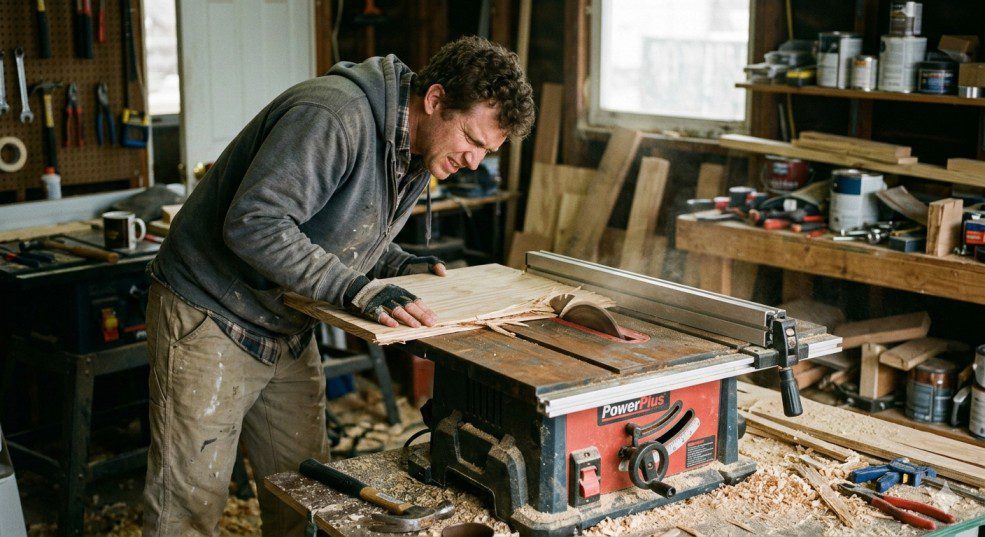
Ultra-Cheap Benchtop Saws Under $150
These saws from unknown brands flood Amazon. Avoid them.
Why they’re dangerous for beginners:
- Fences that won’t stay parallel (ruins your cuts and learning)
- Underpowered motors that bog down and kick back
- Flimsy construction = vibration = inaccuracy
- Poor blade guards that don’t function properly
- No customer support when (not if) things break
I’ve seen three beginners buy $120 “deals” on Amazon. All three replaced them within 6 months. Two had scary kickback incidents due to poor design.
Used Contractor Saws from Unknown History
Problems beginners face with old used saws:
- Alignment issues you don’t know how to fix
- Missing safety components (guards, riving knives)
- Worn bearings causing vibration
- Electrical issues you can’t diagnose
- No warranty or support
Exception: If you know an experienced woodworker who’ll help you evaluate and tune a used saw, it can work. But solo beginners should buy new.
8-1/4″ Compact Saws Without Dados
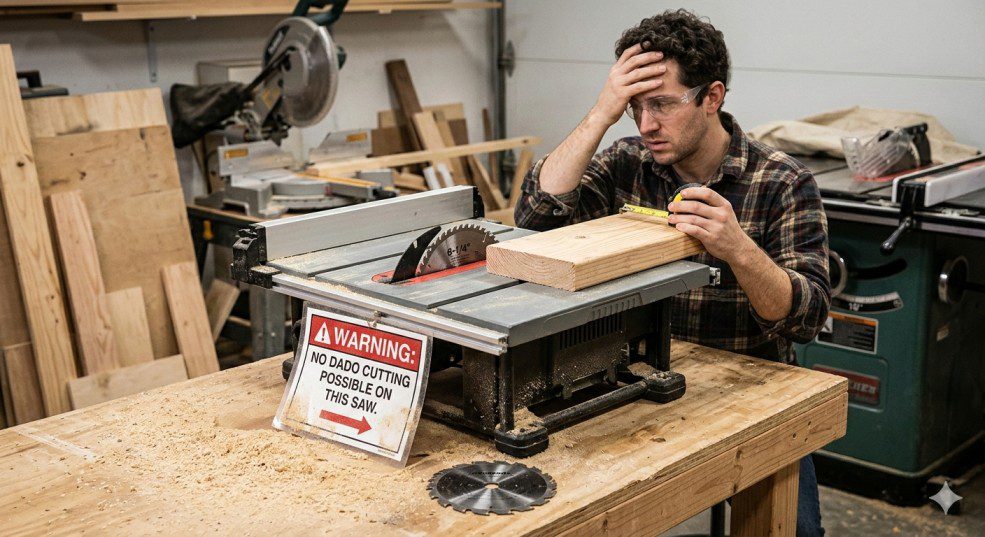
These seem appealing but quickly become limiting:
- Can’t cut dados (you’ll want this within a year)
- 2-1/4″ max cutting depth limits project options
- Often same price as full 10-inch models
Only buy these if space is genuinely constrained—otherwise get a full 10-inch saw.
Confused about table saw types? Check our complete buying guide for detailed explanations of jobsite vs contractor vs hybrid vs cabinet saws, or visit our comparison section for side-by-side testing.
Your First Cuts: Safety Setup Beginners Must Do
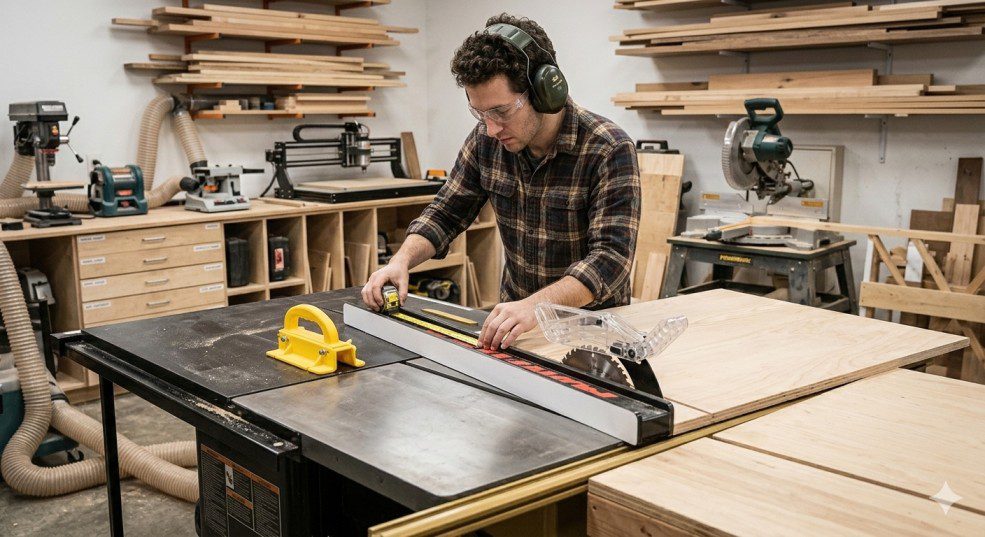
Before making a single cut, do these things. They prevent the injuries that scare people away from woodworking:
1. Read the Entire Manual (Yes, Really)
Boring but essential. Understand:
- Where all safety features are and how they work
- How to adjust blade height and angle properly
- What the kickback pawls do (and never remove them)
- Emergency stop procedure
2. Set Up Proper Outfeed Support
Beginner mistake #1: no outfeed support. When you rip a long board, the back end needs support or it’ll drop, binding the blade and kicking back.
Budget options:
- Two sawhorses at table height: $40-60
- Roller stand: $30-80
- Second table same height as saw: Free if you have one
3. Practice These Cuts With Blade LOWERED
Lower the blade completely. Practice:
- Adjusting the fence and locking it
- Using the miter gauge for crosscuts
- Body positioning (standing to the side, never behind blade)
- Push stick technique
Muscle memory develops without danger. When you raise the blade for real cuts, movements feel natural.
Beginner Success Tip: Your first 10 cuts should be scrap wood only. Make practice rip cuts. Practice crosscuts. Get comfortable with the saw’s sounds, vibration, and how material behaves. Then start your actual project.
Common Beginner Mistakes (I Made All of These)
Mistake #1: Buying the Saw Before Planning Your Space
I bought my first saw before measuring my garage. It didn’t fit where I assumed it would. Months of awkward shuffling ensued.
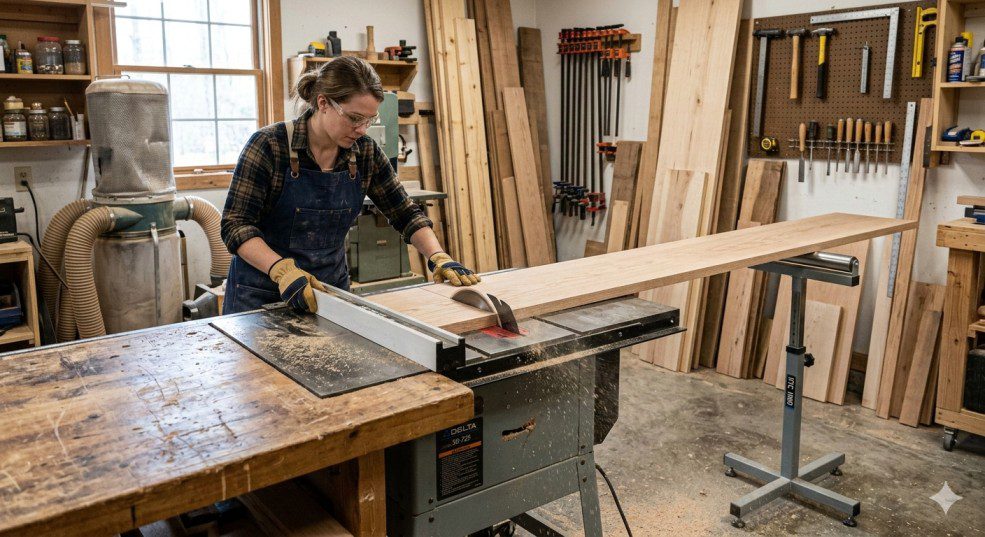
Do this instead: Measure your space first. Account for:
- Saw table dimensions
- 4 feet clearance on all sides (for material handling)
- Outfeed support space
- Storage when not in use
Mistake #2: Skipping the Blade Upgrade
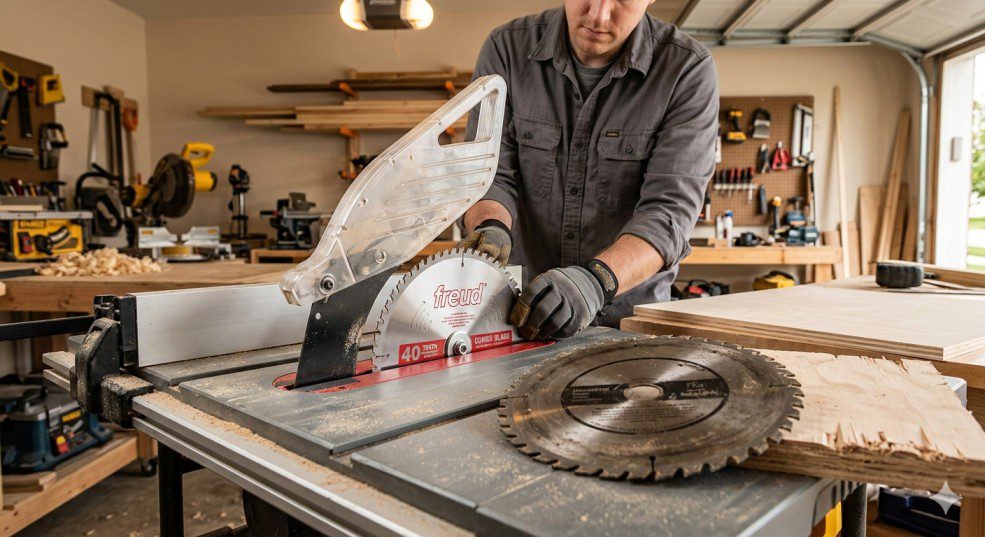
Every table saw ships with a mediocre blade. I tried using the stock blade for three months. My cuts were rough, plywood tearout was terrible, and I blamed my lack of skill.
Then I installed a $35 Freud 40-tooth combo blade. Suddenly my cuts were clean. The saw didn’t struggle. I realized the blade matters MORE than the saw for cut quality.
Do this instead: Budget $35-60 for a quality blade immediately. Diablo or Freud 40-50 tooth combination blades work great for beginners.
Mistake #3: Not Using Push Sticks
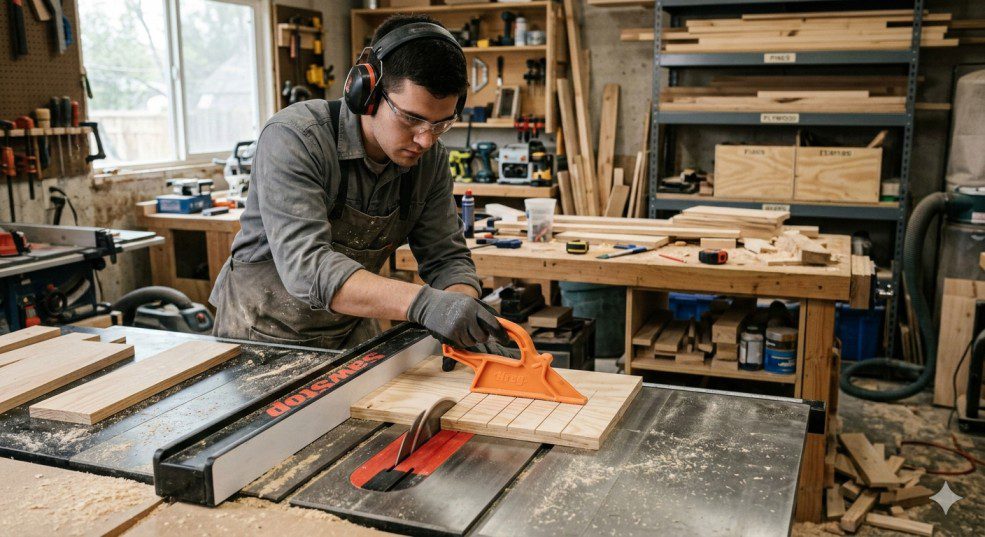
Push sticks feel awkward at first. I avoided them. Then I had a close call where the blade grabbed a narrow piece and my hand was way too close.
Now I use push sticks religiously for anything narrower than 6 inches. They’re $12. Your fingers are irreplaceable.
Mistake #4: Rushing Into Complex Projects
My first project was an elaborate jewelry box with mitered corners and dados. It was a disaster. I didn’t know how to set up complex cuts safely.
Do this instead: Start simple:
- Week 1: Practice rip cuts on scrap lumber
- Week 2: Build simple shop shelving (just rip cuts and crosscuts)
- Week 3-4: Small box or picture frame
- Month 2+: Progressive complexity as skills build
When to Upgrade: The Beginner Progression Path
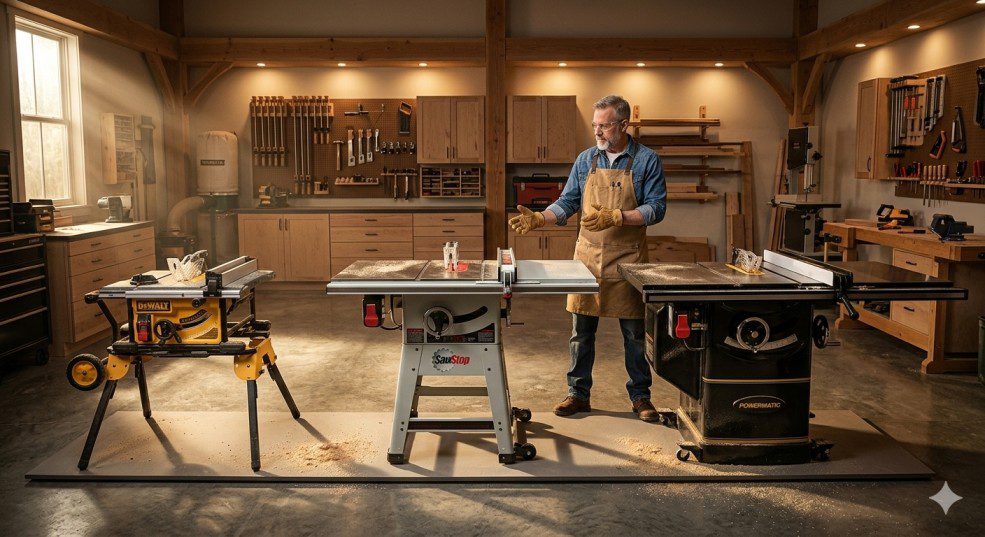
Here’s when you’ll know you’ve outgrown your beginner saw:
Stick with your beginner saw if:
- You’re doing 2-4 projects per year
- Projects are small furniture, boxes, basic carpentry
- The saw still cuts accurately when properly set up
- You’re happy with results
Consider upgrading when:
- You’re doing 10+ projects annually
- You need true 1/64″ precision (fine furniture, cabinetry)
- Fence drift drives you crazy (checking alignment before every session)
- You’re cutting hardwoods daily and motor struggles
- Dust collection inadequacy frustrates you
Typical progression:
- Years 1-3: Beginner jobsite saw ($300-400)
- Years 3-5: Upgrade to hybrid saw ($800-1200) OR keep jobsite if it’s working
- Years 5+: Cabinet saw ($1500-3000) if you’re doing professional-level work
Many hobby woodworkers never need to upgrade past a quality jobsite saw. I know excellent woodworkers still using their DeWalt DWE7491RS after 10+ years.
The Honest Verdict: Which Saw Should YOU Buy?
After teaching dozens of beginners and watching their progression, here’s my straight recommendation:
If you have $300-400 budget: Buy the SKIL TS6307-00 ($299-349) plus a Freud Diablo 40-tooth blade ($35-45). Total ~$350. This setup will serve you well for 5+ years, handles all beginner through intermediate projects, and includes the stand.
If space is severely limited: The DeWalt DWE7485 compact ($299-329) sacrifices some capacity for smallest footprint. Perfect for apartments or tiny workshops.
If you’re 100% committed long-term: Spend $600 on the DeWalt DWE7491RS. You’ll never outgrow it, never need to upgrade, and it’ll outlast most cheaper saws 3-to-1.
If budget allows for a quality starter saw: The Bosch GTS15‑10 ($599–$699) gets you cutting safely, with a portable gravity-rise stand and powerful 15 A motor. Expect it to serve you reliably for many years — perfect for beginners who want a long-lasting, portable, and safe saw.
My personal recommendation for most beginners: SKIL TS6307-00. It hits the sweet spot of price, features, and longevity. The integrated stand and 5-year warranty provide beginner confidence. The rack-and-pinion fence teaches proper technique. And if woodworking doesn’t stick, you’re out $350 not $600.
| Your Situation | Best Saw Choice | Total First-Year Cost |
|---|---|---|
| Serious beginner, normal budget | SKIL TS6307-00 + essentials | $500–$600 |
| Limited space / apartment workshop | DeWalt DWE7485 + essentials | $500–$550 |
| 100% committed, long-term woodworking | DeWalt DWE7491RS + essentials | $750–$850 |
| Tight budget but want quality starter saw | Bosch GTS15-10 + essentials | $699 |
Ready to set up your workshop? Check our accessories guide for must-have safety gear and upgrades, or visit our how-to section for beginner cutting techniques and safety tutorials.
Frequently Asked Questions
What is the best table saw for a beginner woodworker?
The SKIL TS6307-00 10-inch jobsite table saw ($299-349) is the best overall choice for beginner woodworkers in 2026, offering an integrated folding stand (saving $100+), rack-and-pinion fence for accuracy, 25.5-inch rip capacity for growth, 5-year warranty for peace of mind, and adequate 15-amp power for all beginner projects. At $350 total with a quality blade upgrade, it delivers professional-grade features without breaking beginner budgets. The saw lasts 5-8 years of regular use, allowing beginners to develop skills without needing immediate upgrades while avoiding the frustration of ultra-cheap saws that drift out of alignment constantly.
How much should a beginner spend on a first table saw?
Beginners should budget $500-650 total for their first table saw setup, including the saw ($300-450), quality blade upgrade ($40-60), essential safety gear like push sticks ($15-25), miter gauge upgrade or crosscut sled materials ($30-60), and outfeed support ($30-80). While saws under $300 exist, they typically lack rack-and-pinion fences causing alignment frustration, have underpowered motors, and require replacement within 2-3 years. Spending $300-450 on the saw itself plus $150-200 on essentials provides adequate quality that grows with developing skills for 5+ years, avoiding expensive early replacements that cost more long-term.
Can beginners use a table saw safely?
Yes, beginners can use table saws safely by following proper procedures: reading the entire manual before first use, practicing cuts with the blade lowered to develop muscle memory, always using push sticks for pieces narrower than 6 inches, never removing blade guards or riving knives, maintaining proper outfeed support to prevent binding, standing to the side of the blade path (never directly behind), wearing eye and hearing protection, and starting with simple practice cuts on scrap wood before actual projects. Table saws cause 30,000+ annual ER visits, but most injuries result from ignoring safety procedures or using poorly maintained saws. Modern beginner-appropriate saws include proper guards, riving knives, and anti-kickback pawls that prevent most accidents when used correctly.
Should beginners buy a jobsite table saw or benchtop saw?
Beginners should buy jobsite table saws with integrated stands ($300-400) rather than benchtop saws requiring separate stands, as jobsite models offer better stability, larger tables supporting material properly, rack-and-pinion fences maintaining accuracy, adequate motor power (15 amps) for hardwoods, and integrated mobility without wobble issues. Benchtop saws under $200 typically use flimsy T-style fences requiring constant re-squaring, have smaller tables causing material support problems, lack proper safety features, and vibrate excessively during cutting. The $100-150 price premium for quality jobsite saws eliminates frustration causing beginners to quit woodworking, while providing adequate capability for 5-8 years of skill development.
What features matter most for beginner table saws?
The most critical features for beginner table saws are: rack-and-pinion fence system maintaining parallel alignment without constant adjustment (more important than motor power), proper blade guards and riving knife preventing kickback accidents, 15-amp motor providing adequate power for common hardwoods and softwoods, integrated stand or sturdy base preventing wobble during cutting, 24+ inch rip capacity handling standard plywood projects, and clear blade height/angle adjustments beginners can operate confidently. Beginners don’t need dado capability immediately, massive rip capacity over 30 inches, or cabinet saw features. Prioritize fence accuracy and safety features over power specifications—a saw that cuts square teaches proper technique, while an inaccurate saw frustrates beginners into bad habits.
Affiliate Disclosure: This article contains affiliate links to products available on Amazon and other retailers. If you purchase through these links, we may earn a small commission at no additional cost to you. This helps support our website and allows us to continue providing honest, beginner-focused table saw guides based on twelve years of woodworking experience and teaching dozens of beginners.
