Before You Buy a Craftsman 10-Inch Table Saw, Read This Review
 Finlay Connolly
16 min read
Finlay Connolly
16 min read
By Finlay Connolly
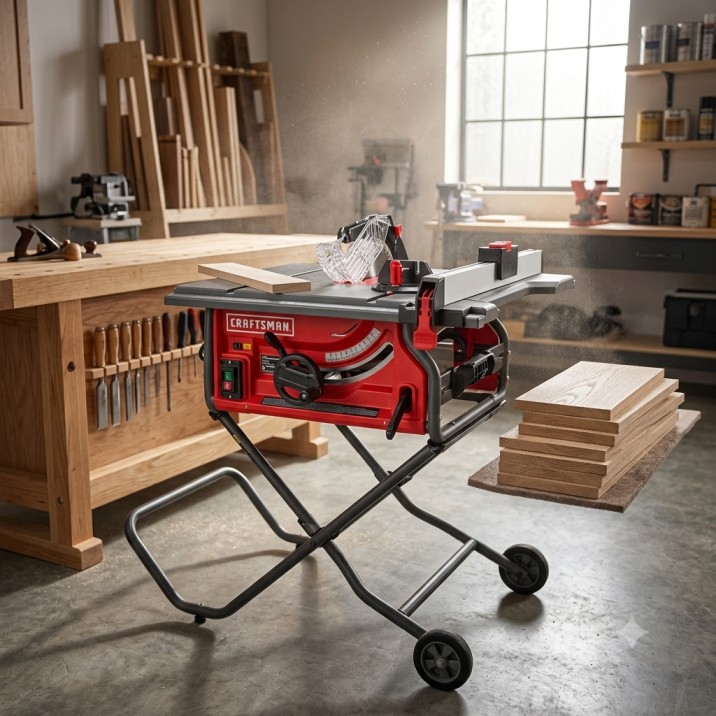
Craftsman sells more than one 10-inch table saw right now, and the name on the box doesn’t tell you nearly as much as it used to. The brand has been through a complete ownership change — sold by Sears, acquired by Stanley Black & Decker in 2017 — and the saws that carry the Craftsman name today are built to different standards, sourced from different factories, and aimed at different buyers than the bench saws that made the brand’s reputation in the first place. That matters more than most reviews acknowledge.
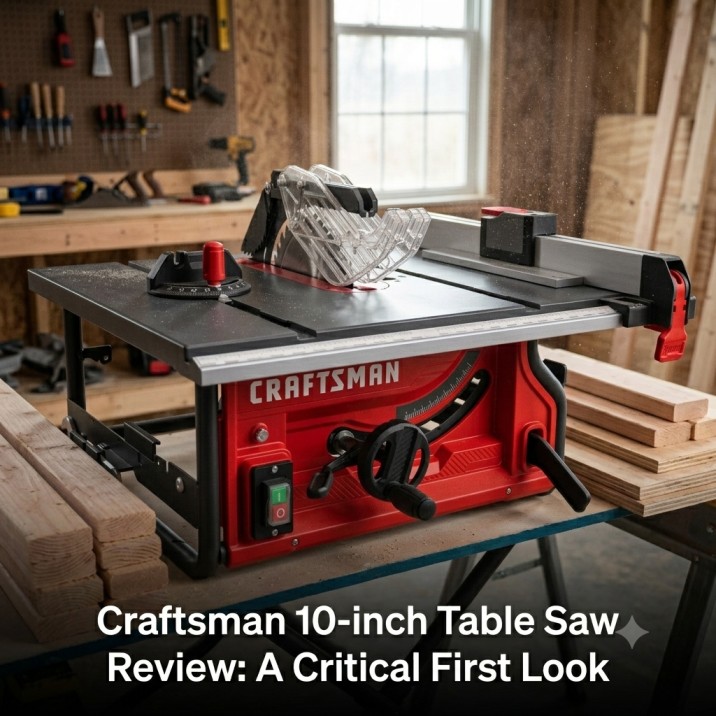
The current Craftsman 10-inch table saw lineup clusters around two main models worth discussing: the CMXETAX69434502 (also marketed simply as the Craftsman 10-inch table saw with folding stand) and the CMXETAX69434503, a slight variant that appears in different retail channels. For the purposes of this review, I’m covering the standard current-production 10-inch contractor/jobsite saw — the one most people are actually searching for when they type ‘Craftsman 10-inch table saw review.’ If specs between what you’re looking at and what’s listed here differ, the manufacturing date matters: pre-2017 Craftsman and post-2017 Craftsman are genuinely different products.
The short answer on the current saw: it’s a competent entry-level jobsite saw that does what it’s supposed to do at a price most people can justify. The fence is its weakest point. The motor does its job. The build quality is adequate without being impressive. And if you’re comparing it to what Ridgid, Metabo HPT, or DeWalt sell at a similar price, Craftsman isn’t the obvious winner — but it’s not the obvious loser either.
What You’re Actually Buying in the Current Craftsman Lineup
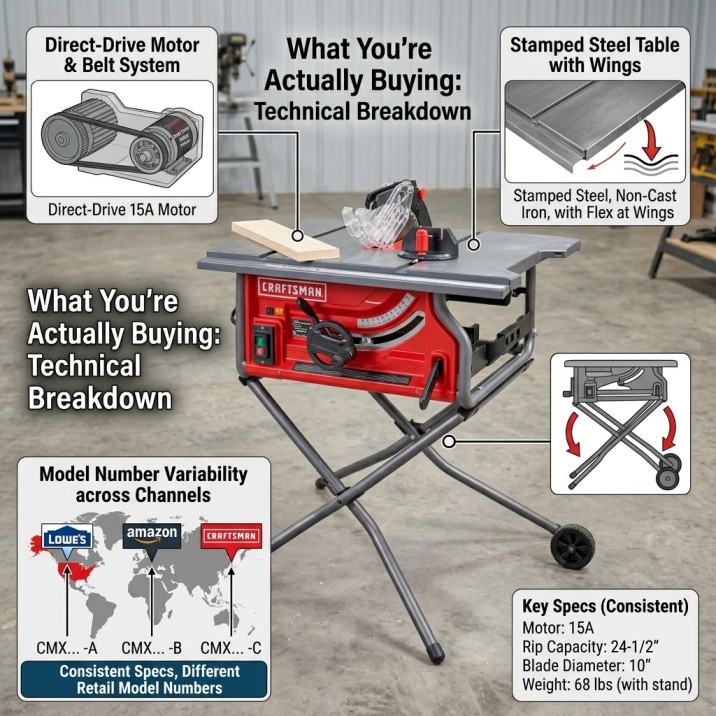
The current Craftsman 10-inch table saw is a direct-drive contractor-style saw. The motor sits below and behind the table, driving the arbor through a belt. Table surface is stamped steel — not cast iron, which would be the upgrade you’d find on saws from Ridgid’s R4512 or the older Craftsman models that enthusiasts still reference. The table wings are also stamped steel, and they flex more than you’d like if you’re doing anything that requires outfeed support close to the blade.
The saw ships with a folding stand that’s actually one of its better features. The stand folds and unfolds reasonably smoothly, the legs are stable enough for shop use, and the whole rig rolls on two wheels when you need to reposition. At approximately 68 pounds with the stand, it’s portable in the same way any contractor saw is portable — which is to say, it moves between locations but isn’t something you’ll carry up stairs casually.
One thing worth knowing before you buy: the Craftsman table saw appears in multiple retail channels — Lowe’s, Amazon, Craftsman’s own site — and the model numbers sometimes differ between channels even for what is functionally the same saw. The specs that matter (motor amperage, rip capacity, blade diameter) are consistent across current production, but don’t be surprised if the model number string doesn’t match perfectly across listings.
Specs
| Specification | Current Craftsman 10″ Details |
| Blade Diameter | 10 inches |
| Motor | 15 amps, universal |
| No-Load Speed | 5,000 RPM |
| Rip Capacity (right of blade) | 29 inches |
| Rip Capacity (left of blade) | 10 inches |
| Depth of Cut @ 90° | 3-1/8 inches |
| Depth of Cut @ 45° | 2-1/4 inches |
| Bevel Capacity | 0–45 degrees (left tilt) |
| Table Surface | Stamped steel with cast extensions |
| Miter Gauge | Single-bar, T-slot |
| Dust Port | 2-1/2 inches |
| Stand Included | Yes, folding with wheels |
| Weight (saw + stand) | ~68 lbs |
| Current Street Price | ~$299–$379 |
The Motor: 5,000 RPM and What That Actually Means
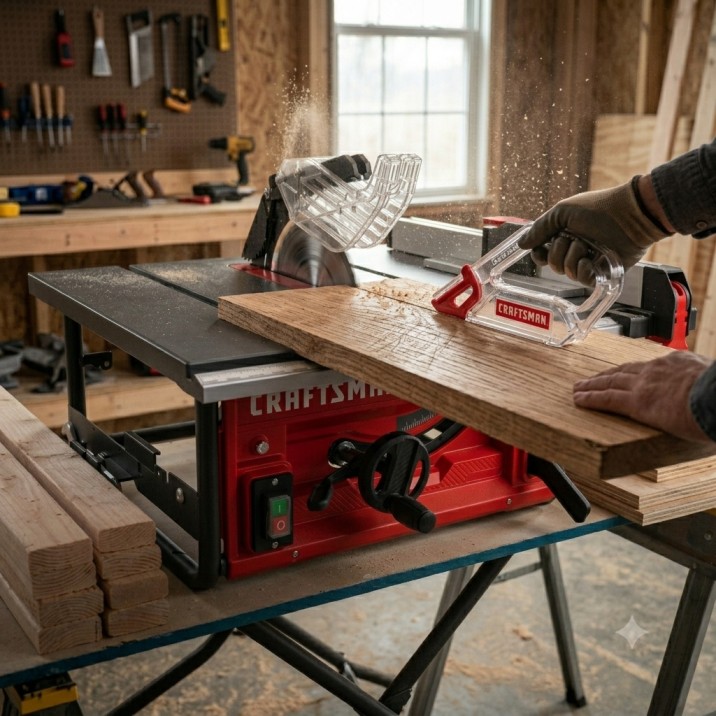
The 15-amp universal motor rated at 5,000 RPM no-load is the most aggressive RPM figure in this class of saw — for comparison, the DeWalt DW745 ran at 3,850 RPM and the Metabo HPT C10RJS sits at 4,500 RPM. Higher RPM on a table saw blade isn’t automatically better. Blade tip speed is a product of RPM and blade diameter, and at 5,000 RPM with a 10-inch blade, the Craftsman is pushing blade tips faster than most of its competitors.
In practice this means cleaner surface finish on crosscuts through softwood and sheet goods — faster blade speed means more tooth passes per inch of cut, which reduces the roughness you’d feel with a slower saw. It also means the motor generates more heat under load and the blade runs hotter in sustained hardwood ripping. Universal motors at this RPM level are tuned for cutting speed rather than torque recovery, which shows when the blade encounters significant resistance from dense or thick stock.
For the work this saw is realistically going to do — dimensional lumber, plywood, MDF, light hardwood — the motor is adequate. Ripping 3/4-inch oak: no issue. Ripping 8/4 hard maple continuously: you’ll feel the motor work and it will run warm. That’s the envelope of the saw, and staying within it means the motor holds up fine. Expecting cabinet saw performance from a 15-amp universal motor in a $300 package is the setup for disappointment regardless of brand.
The 5,000 RPM figure can actually work against you on thin veneers and delicate hardwoods — blade speed that high can cause more tearout on cross-grain if the blade isn’t sharp. Keep a sharp 40-tooth combination blade on it and the motor’s speed works for you rather than against you.
The Fence: Where This Saw Shows Its Price
The rip fence on the current Craftsman 10-inch saw is the most frequently criticized component in owner reviews, and the criticism is legitimate. The fence uses a front-locking cam mechanism without independent rear engagement, which means getting it to sit perfectly parallel to the blade requires more attention than the fence systems on comparable saws from Ridgid or Metabo HPT.
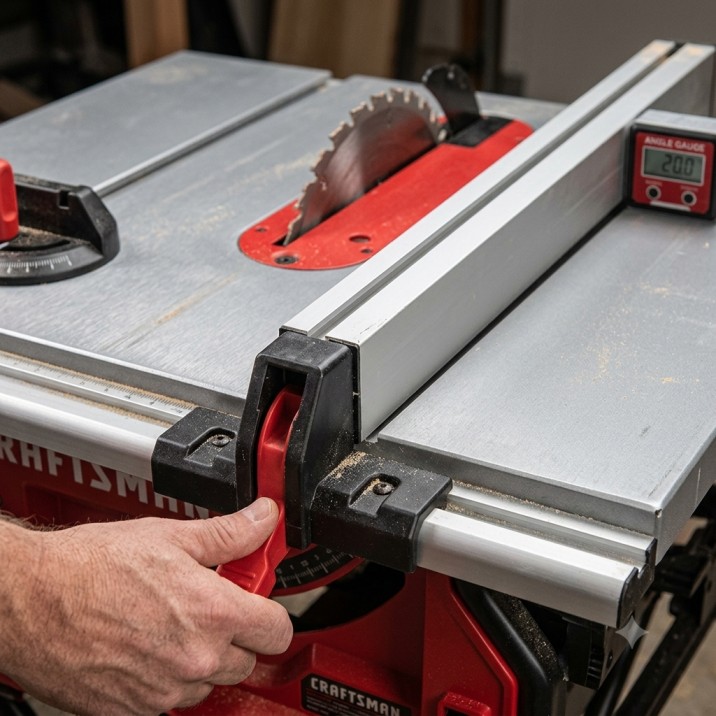
Out of the box, the fence may sit slightly non-parallel to the blade — a condition called ‘toe-in’ or ‘toe-out’ depending on which direction it runs. Some toe-in (the fence’s far end angling very slightly toward the blade) is acceptable and actually reduces the risk of the workpiece binding against the back of the blade. Toe-out is a kickback risk. The Craftsman fence is adjustable at the mounting bracket to correct this, but it requires setup time that the fence systems on better saws don’t demand.
The 29-inch rip capacity to the right of the blade is genuinely useful — it puts this saw ahead of the old DeWalt DW745’s 20-inch limit and in the same range as the Metabo HPT C10RJS’s 35-inch capacity at a lower price. You can rip most standard sheet goods with a full first pass rather than requiring two passes or repositioning. At this price, that rip capacity is a genuine selling point.
Where the fence disappoints most: locking pressure. When you engage the front cam lock, the fence can shift slightly as the lever reaches full engagement. On cuts where you’re trusting the scale reading rather than measuring with a tape, that shift is enough to take you outside tolerance on anything that needs to be tight. The workaround is to set the fence, lock it, then measure the actual distance from blade to fence before cutting. This is good practice on any saw, but the Craftsman fence makes it non-optional.
Table Flatness and Surface Quality
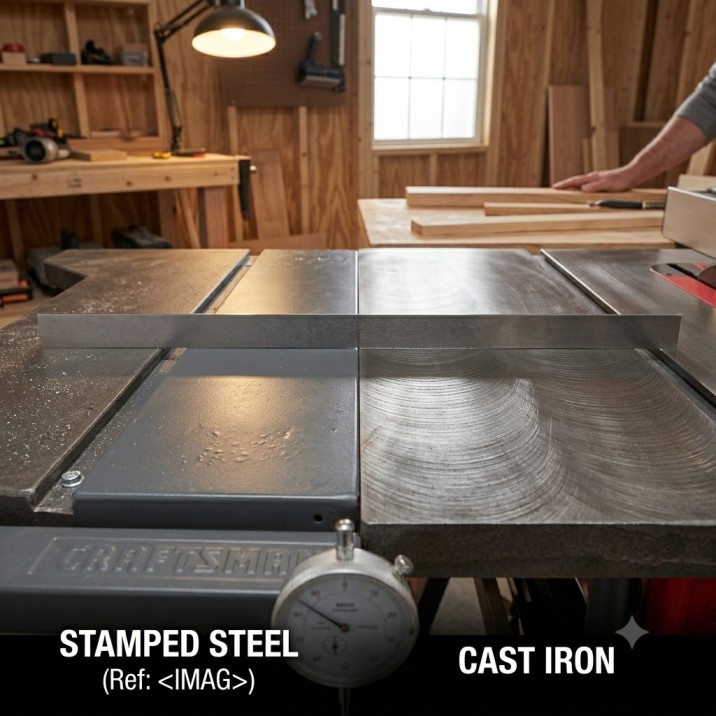
Stamped steel tables are a cost-reduction measure, and the Craftsman’s table shows it in two ways. First, flatness: cast iron tables hold their geometry over time and resist warping from humidity and temperature cycles. Stamped steel is more susceptible to both. A new Craftsman table out of the box should be reasonably flat — within a few thousandths across the width — but units that have lived in unconditioned garages through temperature swings can develop a slight bow across the table surface that affects cut accuracy.
Second, feel: cast iron has a mass and damping quality that stamped steel doesn’t replicate. On a cast-iron saw, vibration from the motor and blade dissipates through the table mass. On stamped steel, you feel more of that vibration in the workpiece and in the table surface under your hands. For rough work it doesn’t matter. For furniture or any work where surface finish quality from the saw matters, the difference between a cast-iron table saw and a stamped steel one is noticeable.
The table extensions on the Craftsman are cast iron, which partially compensates — they add mass and stability at the edges where you’re often supporting wider stock during ripping. It’s an unusual combination (stamped steel main table, cast iron wings) but it’s a legitimate cost optimization rather than a pure compromise.
Dado Cutting: The Arbor Situation
The current Craftsman 10-inch table saw has a 5/8-inch arbor with enough thread length to accommodate a standard 8-inch stacked dado set. This is worth confirming because some compact saws at this price have shorter arbors that physically won’t fit a full dado stack — the nut can’t engage after the chippers are stacked.
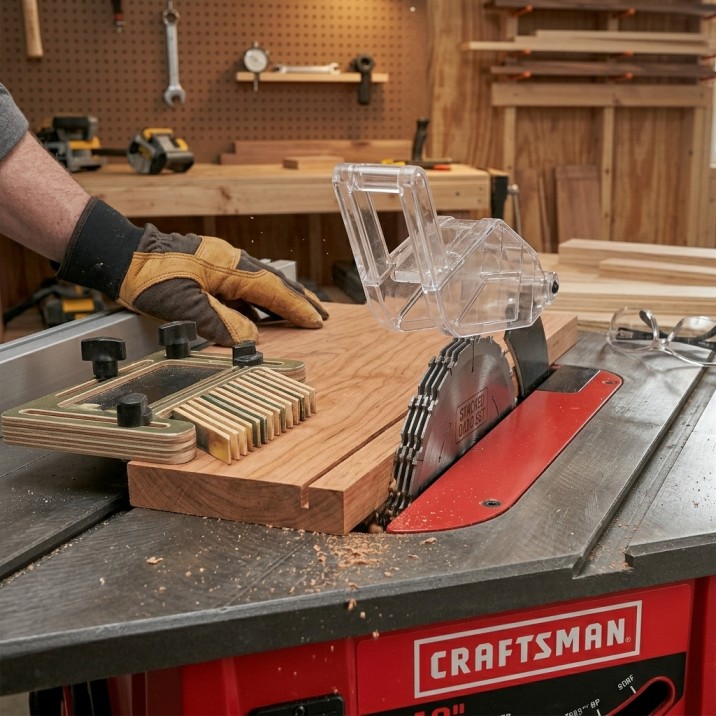
In practice, running a dado set on the Craftsman requires a dado throat plate, which does not come with the saw. You’ll need to source or make one. The T-slot throat plate opening accepts standard aftermarket dado inserts for this saw class, and making a zero-clearance version from 1/4-inch Baltic birch is straightforward. For a full rundown on how dado setup affects cut quality on saws like this, the dado set guide for table saws covers the stack selection and setup process in detail.
The saw handles dado cuts in softwood and plywood cleanly. In hardwood, the motor labors more noticeably than on a higher-torque saw — dado cutting removes more material per pass than a standard rip, and the Craftsman’s universal motor feels that load. Feed rate matters: pushing too fast produces a rough bottom cut and stresses the motor; feeding at a controlled pace gives you clean results.
The Miter Gauge and Crosscut Accuracy
The included miter gauge is a standard single-bar design that fits the T-slot in the table. It works. It’s not precise, the angle markings are approximate rather than exact, and the bar has noticeable slop in the slot that makes it unreliable for any angled work requiring repeatability. This isn’t unique to Craftsman — the miter gauge on almost every saw under $500 is a compromise — but it’s worth stating clearly because people assume a $350 saw comes with a usable miter gauge and are disappointed when it doesn’t.
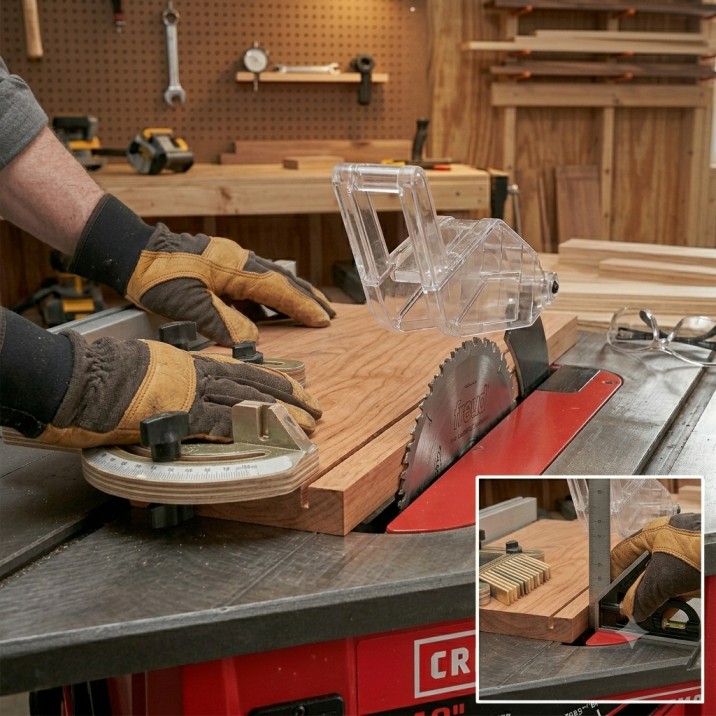
For square crosscuts on dimensional lumber — ripping boards to rough length, construction work, basic shop cuts — the stock gauge is adequate. For furniture joinery, picture frames, or anything where angle precision matters, you’ll want an aftermarket option. The T-slot accepts standard aftermarket gauges, and the difference between the stock Craftsman gauge and even a mid-range aftermarket option is significant. This is one of the better table saw accessory upgrades you can make on any budget saw.
Dust Collection: Below Average and It Shows
The 2-1/2-inch dust port below the blade captures a fraction of what the saw produces. The below-table enclosure is reasonably well-sealed for this class, so most of the below-table debris routes to the port when you connect a shop vac. What doesn’t get captured: the significant volume of fine dust that exits from the blade above the table, particularly on rip cuts through MDF or particleboard.
Running a shop vac on the port during cutting noticeably reduces floor-level debris and keeps the table cleaner. It does essentially nothing for airborne fine dust in the shop. If you’re working in an enclosed space and cutting MDF regularly, an overhead air filtration unit is worth the investment regardless of which saw you’re using. The Craftsman is not worse than most competitors at this price on dust collection, but the category as a whole underperforms compared to premium contractor saws that include better blade-level shrouding.
Safety: The Blade Guard and Riving Knife
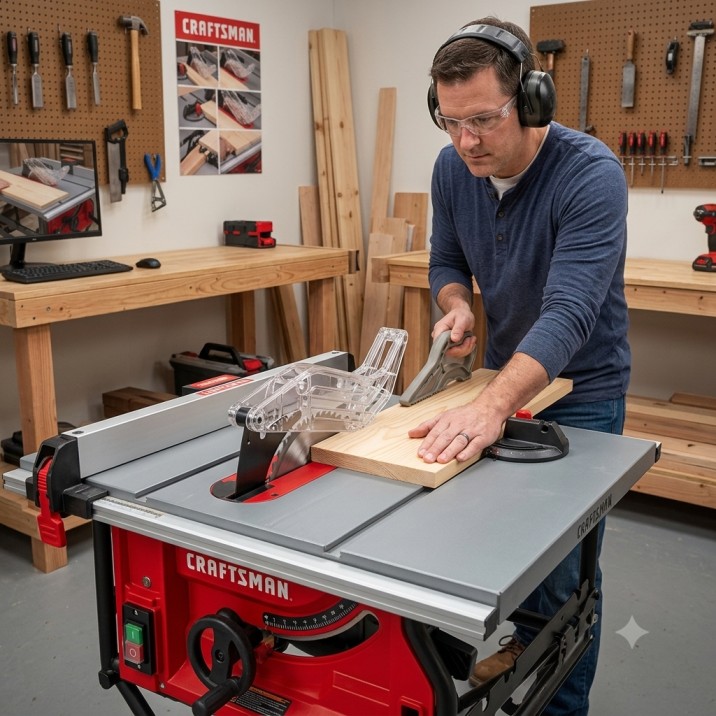
The current Craftsman 10-inch table saw ships with a blade guard assembly that includes a splitter — a thin plate behind the blade that keeps the kerf open and prevents the workpiece from pinching back against the blade. The splitter is integrated with the guard, not an independent riving knife. This is the same limitation that drew criticism on the DeWalt DW745: removing the guard for non-through cuts (rabbets, dadoes) also removes the anti-kickback protection of the splitter.
A true riving knife — which moves with the blade during bevel adjustments and can stay in place without the guard — would be the upgrade. At this price point, the Craftsman doesn’t have one. What it does have is a functional guard for standard through cuts and an anti-kickback pawl that engages the surface of the workpiece to prevent backward movement. For straight-through rip cuts, the setup is adequate. For dados, rabbets, and non-through work, you’re removing both the guard and the splitter.
Always support the offcut side of a rip cut on this saw — the stamped steel table and moderate-weight stand are more susceptible to workpiece movement mid-cut than a heavier cabinet saw. A featherboard on the fence side and outfeed support on the rear keeps the cut controlled.
How It Sits Against the Competition
| Saw | Rip Cap. | Table | Fence Quality | Arbor Speed | Weight | Price |
| Craftsman 10″ (current) | 29″ | Stamped steel | Adequate | 5,000 RPM | ~68 lbs | ~$329 |
| Ridgid R4520 | 30″ | Cast iron | Good | 4,800 RPM | ~56 lbs | ~$499 |
| Metabo HPT C10RJS | 35″ | Cast iron | Good (R&P) | 4,500 RPM | ~53 lbs | ~$449 |
| DeWalt DWE7480 | 24.5″ | Roll-formed steel | Adequate | 4,800 RPM | ~48 lbs | ~$329 |
| SKILSAW SPT99-11 | 30.5″ | Aluminum | Good | 5,300 RPM | ~49 lbs | ~$399 |
The Ridgid R4520 and Metabo HPT C10RJS both outclass the Craftsman on table quality and fence precision, but they cost $120–$170 more. The DeWalt DWE7480 is similarly priced but gives up rip capacity (24.5 inches vs 29 inches). The SKILSAW SPT99-11 is an interesting comparison — aluminum wormdrive table saw technology at a slightly higher price, significantly lighter, with better fence and worm-drive torque characteristics.
At the Craftsman’s price, the most direct competition is the DeWalt DWE7480. The Craftsman wins on rip capacity; the DeWalt wins on brand reputation and parts availability. That’s genuinely close, and either is a defensible choice at the same price. The moment the budget stretches to $450+, the Metabo HPT or Ridgid become more compelling.
The Old Craftsman Saws vs What’s Sold Now
This is worth addressing directly because searches for ‘Craftsman 10-inch table saw’ pull up reviews, forum threads, and discussions about pre-2017 Craftsman bench saws alongside the current product — and they’re not the same category of tool.
The Craftsman bench saws from the 1990s and early 2000s — particularly the 113-series saws that were Sears staples for decades — were heavier, had cast-iron tables and wings, and were built to a standard that the current product doesn’t match. Those saws still circulate on the used market, and a clean 113-series Craftsman in working condition is a genuinely capable shop saw that many hobbyist woodworkers prefer to the current product.
If you encounter a used Craftsman bench saw with a cast-iron table and a 5/8-inch or 1-inch arbor, that’s a different animal from what Lowe’s sells today. Parts are still available from aftermarket suppliers for most of those saws. Arbor bearings, switches, guards, and blade inserts for the 113-series can be found through suppliers like Repair Clinic or direct replacement parts search. A 113-series Craftsman in good condition for $150–$250 is often better value than the current new product, assuming you’re comfortable with a saw that old.
The current Stanley Black & Decker-era Craftsman is a different positioning entirely — a mass-market contractor saw built for the Lowe’s customer who wants a recognizable brand at a competitive price. It competes on price and availability, not on heritage or build quality.
Who Gets the Most From This Saw
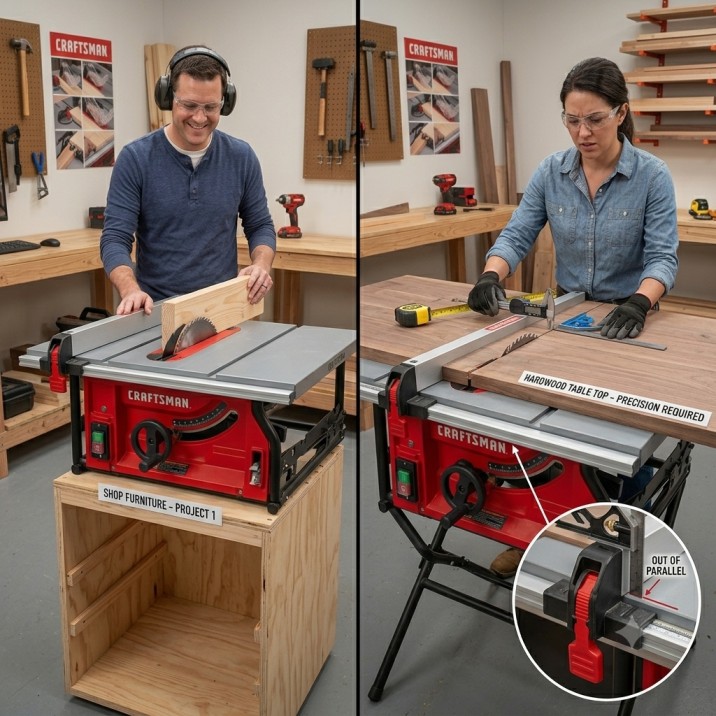
The woodworker this saw suits: someone doing home improvement work, building shop furniture, handling renovation cuts, or getting started in woodworking without wanting to spend $500+ on a first table saw. It handles dimensional lumber without drama. The 29-inch rip capacity covers most common sheet good operations. The folding stand is genuinely convenient. At the $299–$329 street price, it’s accessible enough that a buyer can justify it for occasional use without the purchase feeling disproportionate to the work.
Where it starts to feel limited: hardwood furniture making, production work, any application requiring consistent precision from the fence without manual verification. A furniture maker who expects the fence scale to be trustworthy without measuring, or who needs the saw to perform equally well on its fiftieth rip cut as its first, will hit the Craftsman’s ceiling faster than the price suggests they should.
The specific buyer I’d steer away from this saw: anyone planning to use it as a primary shop saw for cabinet making, anyone who will be processing lots of hardwood above 4/4 thickness regularly, and anyone who wants dado capability without the motor labor concern. Those buyers should stretch to the Metabo HPT C10RJS or look at the full portable table saw roundup where the tradeoffs at each price point are laid out in detail.
Setup Out of the Box: What to Do Before Your First Cut
The Craftsman ships requiring assembly of the stand and fence rail. Neither is complicated, but the fence rail alignment deserves attention: the rail must be parallel to the blade for the fence to track accurately. There’s adjustment built into the rail mounting — don’t skip this step and assume the factory alignment is correct. Set a straightedge against the blade (with the blade at 90 degrees and raised to full height) and verify the fence rail is parallel before you cut anything.
Check blade alignment to the miter slot next. A blade that’s not parallel to the miter slot produces slight angled cuts even when the fence is set correctly. Use a reliable square or a dial indicator if you have one — a piece of scrap in the miter slot and a mark on a tooth checked front and back tells you whether the arbor is parallel. Adjustment requires loosening the trunnion bolts under the table and shifting the arbor assembly — it’s doable and documented in the manual.
Finally, verify the 90-degree bevel stop. The bevel stop at zero degrees should put the blade perfectly perpendicular to the table. Check it with a machinist’s square against the blade body (not the teeth — place the square against the flat of the blade). If it’s off, adjust the stop screw. This takes five minutes and prevents every bevel cut you make from being subtly wrong.
Don’t skip the setup steps. The Craftsman’s tolerances out of the box are adequate, not excellent — the adjustments exist because the factory doesn’t dial them in precisely. Ten minutes of setup work at the start produces noticeably better results on every cut after.
Blade Upgrade: The First Thing Worth Spending Money On
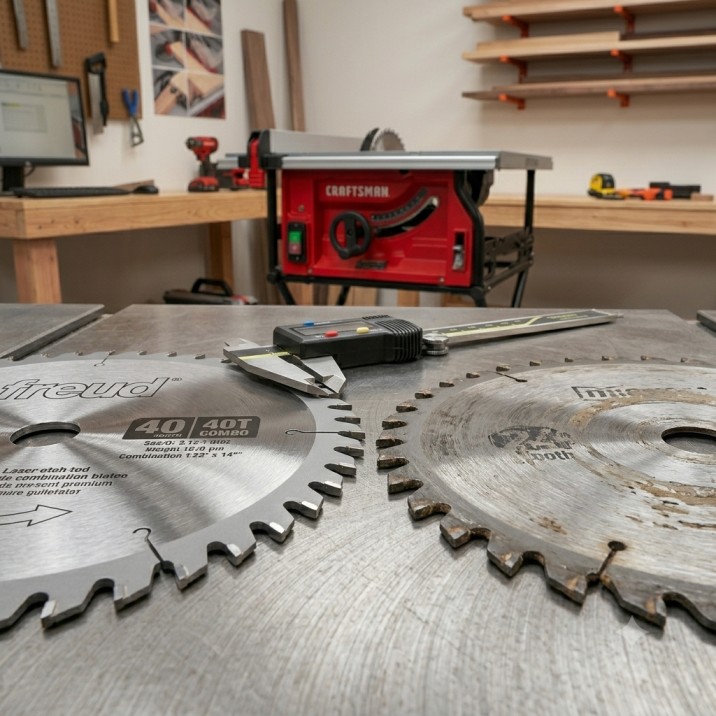
The blade included with the Craftsman is a 24-tooth combination blade. It’s functional for rough crosscuts and ripping framing lumber. It’s not the blade to use for furniture, cabinet-grade plywood, or anything where surface quality matters. The tooth count is too low for clean crosscuts in hardwood and the carbide grade on included blades at this price is average.
The upgrade that makes the most difference: a quality 40-tooth combination blade for general work (Freud Diablo D1040X, Irwin 14080, CMT 10-inch combo) at $30–$50, or an 80-tooth thin-kerf crosscut blade if your work is primarily crosscutting hardwood and sheet goods. The Craftsman’s table saw platform performs noticeably better with a sharp quality blade than with the included one — better surface finish, less tearout on plywood, easier feed through hardwood.
Thin-kerf blades (1/8-inch kerf vs standard 3/32-inch) are worth considering on a 15-amp universal motor saw. Less material removed per pass means less load on the motor, which helps in hardwood and sustained ripping. The tradeoff is slightly more blade deflection under hard lateral pressure, but for the work this saw is realistically doing, thin-kerf is a net positive.
The Bottom Line on the Current Craftsman
The Craftsman 10-inch table saw is a solid entry-level jobsite saw that earns its price and doesn’t try to be more than it is. The 29-inch rip capacity is genuinely competitive at this price. The motor handles the expected workload. The stand is convenient. These are real virtues.
The fence and table surface are the honest compromises. They work, but they require more user attention than what you get on a Ridgid or Metabo HPT at $150 more. If the budget stretch to $450 is possible, it’s worth making. If the Craftsman’s price is where the decision actually lives — and for a lot of buyers it is — go in knowing what the fence demands from you and do the initial setup properly, and the saw will serve you well for the work it’s built for.
And if you’re seeing a used Craftsman 113-series bench saw for a fair price and the cast iron is in decent shape, that’s a different calculation entirely — and usually the better one.

Finlay Connolly is a woodworking enthusiast and power tool specialist with over a decade of hands-on experience in the workshop. As the founder and lead writer at ProTableSawReviews.com, Finlay combines expert knowledge with real-world testing to help woodworkers, DIYers, and professionals choose the best tools for the job. With a sharp eye for detail and a passion for precision, Finlay is committed to providing trustworthy, practical advice backed by years of experience and research in the field. Whether you’re cutting dados or comparing fence systems, you can count on Finlay for honest, reliable reviews that make your next cut your best one.