Before You Buy DeWalt DWE7491RS… Read This
 Finlay Connolly
11 min read
Finlay Connolly
11 min read
By Finlay Connolly · ProTableSawReviews.com · April 2026 · ~12 min read
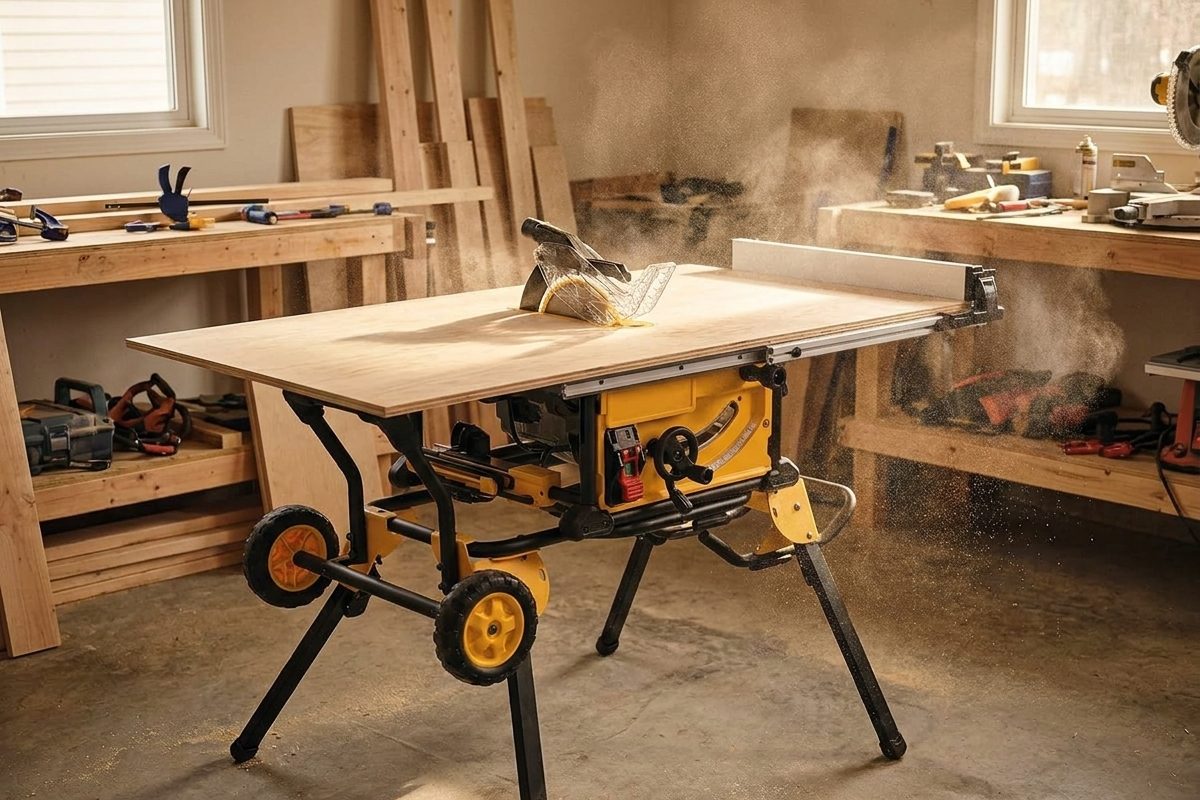
The DeWalt DWE7491RS is genuinely one of the best jobsite table saws you can buy in 2026. The rack-and-pinion fence is class-leading at this price, and the 32.5-inch rip capacity is the widest available on any portable saw. The rolling stand is solid, and the motor delivers true 15-amp power that can handle real work.
Where it falls short: the stock miter gauge is nearly useless, dust collection is only average, and blade-to-miter-slot alignment can drift on some units if the rear pivot bracket isn’t properly tightened.
Bottom line — this saw absolutely deserves a spot on most people’s short list.
I’ve been watching this saw dominate the jobsite table saw conversation for years now and it’s worth asking why. There are newer saws. There are cheaper saws. Bosch makes a compelling competitor. Skilsaw makes a strong case with their worm drive. But the DWE7491RS keeps coming up because it sits in this specific sweet spot where the fence is genuinely good, the rip capacity is genuinely wide, and the whole package holds together across real use rather than just initial impressions.
This review isn’t going to tell you it’s perfect. It isn’t. I’m going to tell you exactly what works, what’s disappointing, what the forums have found through collective experience, and — critically — what the first-week problems are that some buyers hit that make them regret the purchase before they’ve actually dialled the saw in properly.
The short version: most of the negative reviews this saw gets are alignment and calibration issues that are solvable. Once it’s properly set up, it’s a different saw. Let’s go through all of it.
The Numbers
| Specification | DeWalt DWE7491RS |
|---|---|
| Motor | 15A / 120V, 4,800 RPM |
| Blade Size | 10 inch, 5/8″ arbor |
| Rip Capacity (right) | 32-1/2 inches |
| Rip Capacity (left) | 22 inches |
| Cut Depth @ 90° | 3-1/8 inches |
| Cut Depth @ 45° | 2-1/4 inches |
| Bevel Range | 0°–45° (right tilt) |
| Table Surface | Cast aluminum, 26″ × 22″ |
| Fence System | Rack & pinion telescoping — flip-over design |
| Dado Capacity | Up to 13/16″ wide |
| Dust Port | 2-1/2 inch (single) |
| Safety | Riving knife + anti-kickback pawls + blade guard |
| Weight | ~90 lbs with rolling stand |
| Warranty | 3-year limited + 1-year free service + 90-day money back |
| Price (2026) | ~$599–$649 |
The Fence — Start Here Because It’s the Main Reason to Buy This Saw
The rack-and-pinion telescoping fence is what separates this saw from competitors at similar prices. Tool Box Buzz — a publication that doesn’t tend toward hyperbole — called it the best overall jobsite and mobile stand option available, largely because of the fence. That assessment still holds.
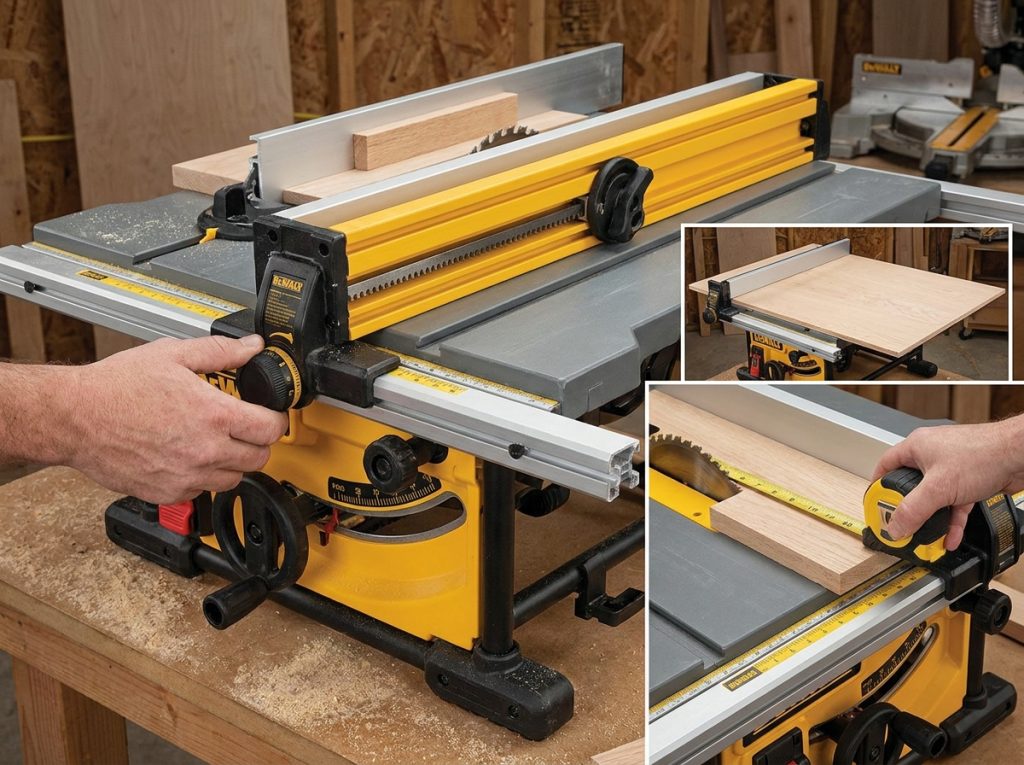
The mechanism works like this: you unlock the fence, slide it roughly to position using the rack, then use a dial to fine-adjust it exactly. It locks with a single lever. The fence rides on rails at both the front and back of the saw, which eliminates the drift problem that plagues single-rail fences — where the outfeed end wanders away from the blade even after locking. On the DWE7491RS, what you set at the front is what you get at the back.
The flip-over fence attachment is genuinely clever and I’m surprised more saws don’t copy it. Flip it one way and it acts as a low fence for narrow rip cuts — you can make a 1/2-inch rip without the fence interfering with the blade guard. Flip it the other way and it becomes a wide support that stabilises sheet goods as they exit the cut. Two separate problems solved with one aluminum attachment.
One thing worth saying: the fence is accurate right out of the box for most users, but it does need checking. DeWalt includes a high-visibility measurement scale on the rail, and while it’s close, the only way to know if you’re actually cutting at the dimension the scale shows is to measure the actual cut. Cut a test piece, measure it. If it’s off by more than 1/32″ from what the scale says, adjust accordingly. Every saw needs this — it’s not a DeWalt problem, it’s a table saw reality.
What the 15-Amp Motor Actually Does
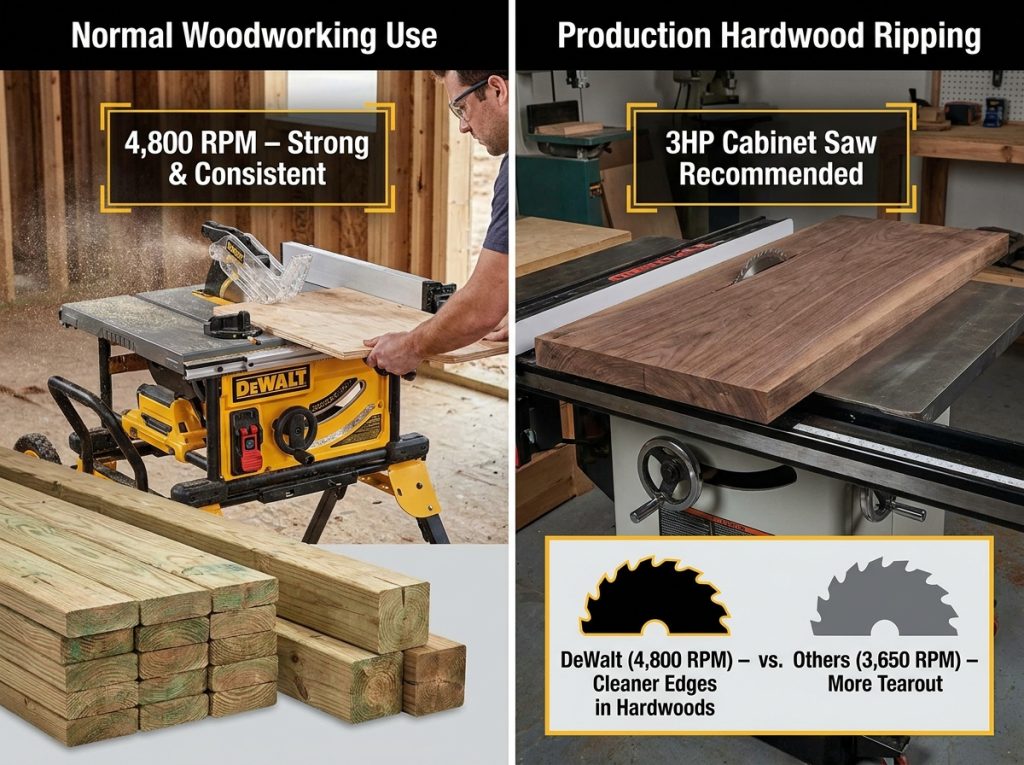
4,800 RPM. One of the higher blade speeds in this class. And in normal woodworking use — ripping plywood, cutting dimensional lumber, crosscutting boards — the motor is strong and consistent.
One reviewer ripped 340 cuts through pressure-treated joists, 2×6 decking, and 4×4 posts over two weeks. The motor didn’t bog, didn’t trip breakers, didn’t complain. Another ran it through 1x maple repeatedly and found it “kept its speed without needing to stop for the blade to catch up.” That’s the honest real-world picture for the work this saw is designed to do.
The place where you feel the motor’s limits is in aggressive hardwood ripping over extended sessions — 8/4 walnut, thick hard maple repeatedly, the kind of work a cabinet shop does in volume. The DWE7491RS handles single passes through heavy hardwood without drama. For production hardwood ripping, you want a 3HP cabinet saw on 240V. This isn’t that saw, and it doesn’t pretend to be.
The higher RPM — 4,800 vs the Bosch 4100XC’s 3,650 — does make a measurable difference on cut quality in hardwoods. Faster blade speed means each tooth takes a smaller bite, which means less tearout and cleaner edges. On soft lumber and plywood you won’t notice. On cherry or maple where the exit face matters, the DeWalt’s extra RPM shows up in slightly cleaner results without as much sanding needed afterward.
One thing most reviews skip: this saw is loud — really loud. Louder than the Bosch, and louder than most saws in this price range.
It’s not a dealbreaker, but it’s something to keep in mind if you’re working in a shared space or a residential area where noise matters.
Ear protection is non-negotiable either way, but the Bosch runs noticeably quieter thanks to its lower RPM.
The Rolling Stand — Better Than Most, Not Perfect
The rolling stand is one of the better ones available on a jobsite saw. It sets up with a sequence of actions — stand it upright, legs swing out and lock, step on foot pedals to extend the bottom legs — and once you’ve done it twice it takes maybe 30 seconds. The stand stores in a compact vertical position.
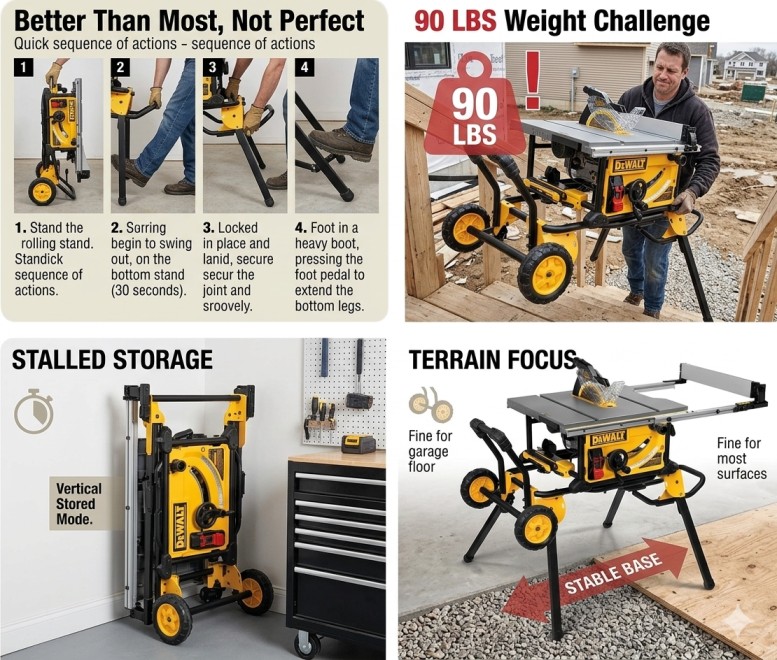
The wheels are smaller than the Skilsaw SPT99’s 16-inchers but handle most jobsite terrain without trouble. Up a ramp, across gravel, through a doorway with a threshold — it manages. The Skilsaw’s wheels are better for genuinely rough outdoor terrain. For most garage shops and normal jobsite conditions, the DeWalt stand is fine.
Stability once set up is good. The wider base keeps the saw planted when you’re feeding heavy material through, and the legs don’t flex the way some lightweight stands do. At 90 lbs with the saw on it, it’s not going anywhere unless you want it to.
The weak point is weight. 90 pounds is a meaningful load to manage solo on stairs or into a truck bed. The Skilsaw at 60 lbs is 30 pounds lighter. If you’re loading and unloading this saw daily — real contractor use, every day — that weight difference compounds over months. For a shop that mostly stays put or moves occasionally, it’s not an issue.
The Actual Problems — Not Just the Marketing Cons
The Miter Gauge
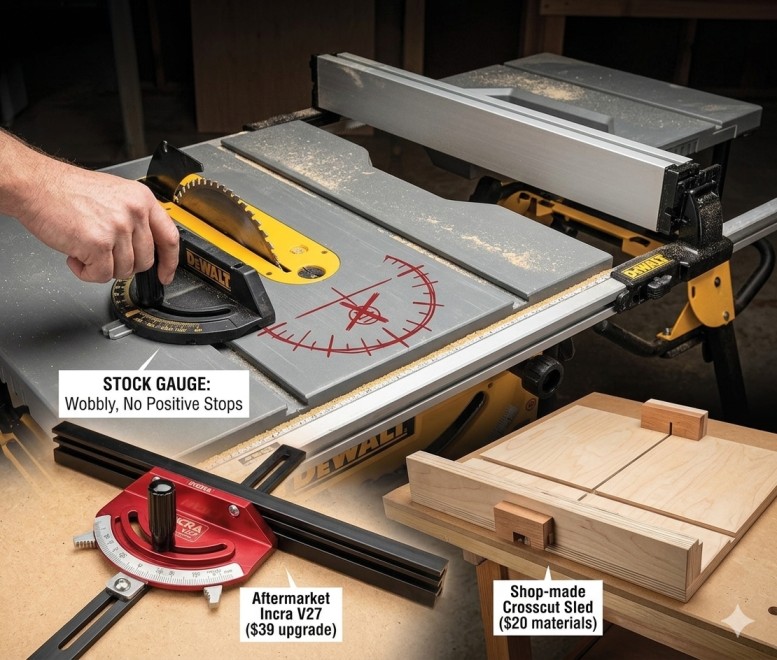
It’s bad. Every honest review says so and I’m not going to soften it. The stock miter gauge has play in the slots, no positive stops beyond 90°, and doesn’t inspire confidence in any crosscut where accuracy matters. One user replaced it immediately with an aftermarket Incra V27 and said he stopped using his miter saw because the table saw crosscuts were now accurate enough for everything. The Incra V27 costs about $39 and is absolutely worth it. A shop-made crosscut sled costs about $20 in materials and is arguably better still.
Budget for one or the other from the start. Don’t expect the stock miter gauge to do precision crosscutting, because it won’t.
The Blade-to-Miter-Slot Alignment Issue
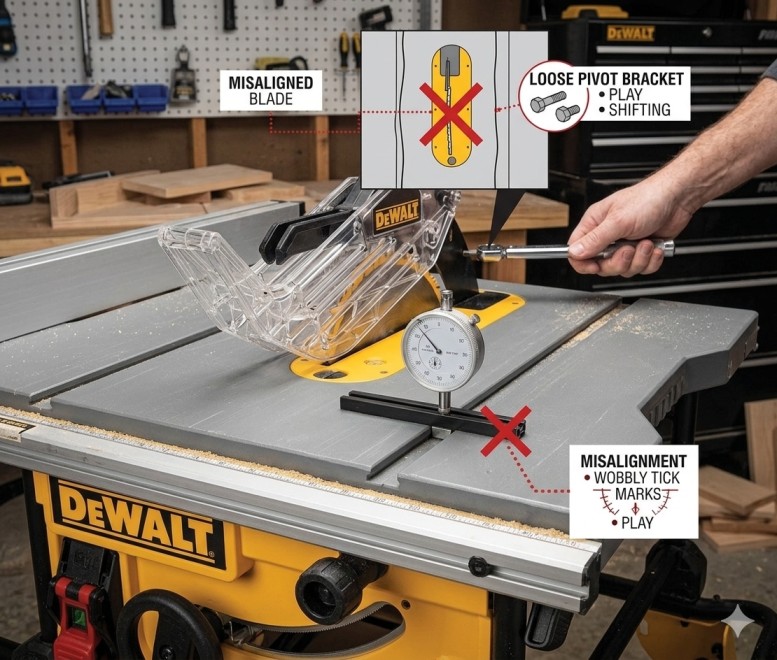
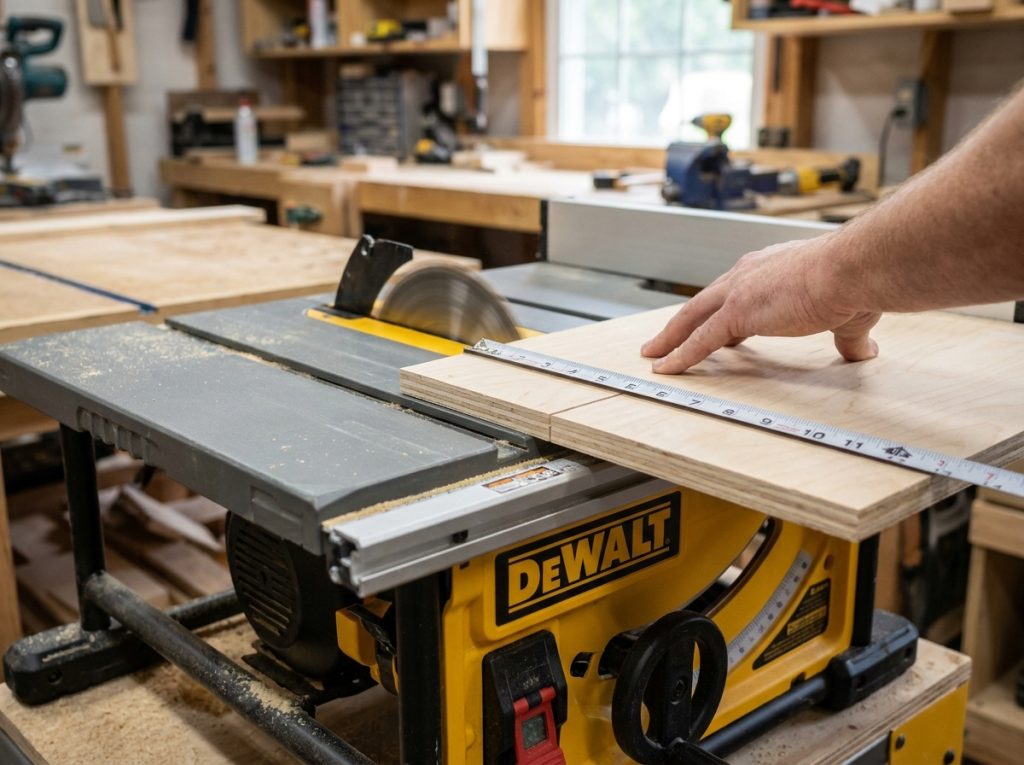
This is the one that generates the most forum discussion and the most confused negative reviews. The DWE7491RS has a rear pivot bracket that holds the blade assembly relative to the table. On some units — particularly if the saw has been transported or stored on its side — this bracket can shift slightly, causing the blade to be slightly off-parallel to the miter slot.
When that happens, crosscuts using the miter gauge produce cuts that aren’t square, and rip cuts leave a slightly rough surface. One user on Woodworking Talk described having to recalibrate before every use — loosening the rear pivot bolts, aligning the blade, tightening again — only to find it shifted back with use. That’s a real problem that some units have.
The fix: when you first set up the saw, check blade-to-miter-slot alignment with a quality dial indicator or a reliable machinist square. If it’s off, adjust the rear pivot bracket per the manual. Then torque those bolts properly — not just snug, actually tight — before use. Most of the “DWE7491RS won’t stay aligned” complaints come from people who adjusted but didn’t torque properly. Once the bracket is locked down firmly, it holds.
If you’re getting repeated drift after proper torquing, that’s a legitimate warranty issue. DeWalt’s 3-year warranty covers it. Call them.
Dust Collection: Fine, Not Great
Single 2.5-inch port underneath. Connect a shop vac and it captures a decent amount of what the blade throws downward. It won’t capture what comes off the top of the cut, won’t stop chips from landing on your workpiece, and won’t keep the table surface clear without regular brushing. It’s what it is for a jobsite saw without an enclosed cabinet. The Laguna F2 at $2,300 has better dust collection. That’s a different product for a different purpose.
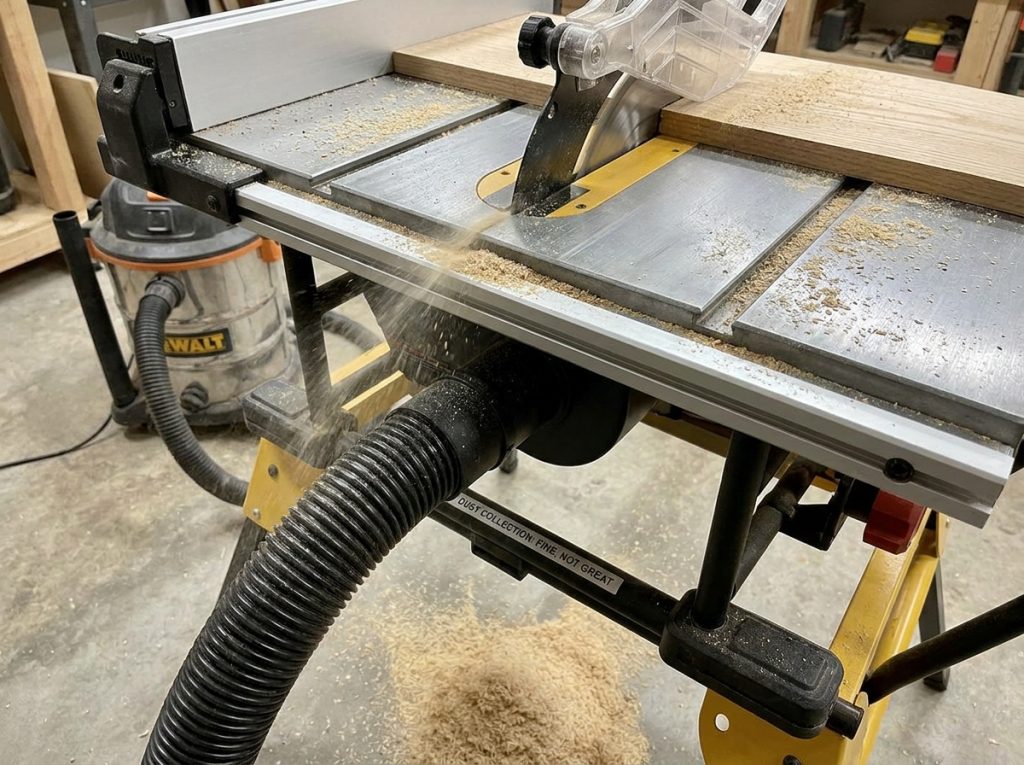
Some users run an additional dust pickup from the blade guard area using a small hose adapter. It helps. But fundamentally, if shop air quality is a priority, a jobsite saw with one port is never going to be the answer.
The Stock Blade
The included 24-tooth carbide blade is adequate and nothing more. One tester found it burning through pressure-treated lumber by cut 150. Upgrading to a Freud 40-tooth blade solved the burning entirely. Don’t judge this saw’s cut quality by the stock blade — swap it first. A Diablo D1050X (50T) or Freud Premier Fusion at $80-100 transforms the output.
Who This Saw Is For
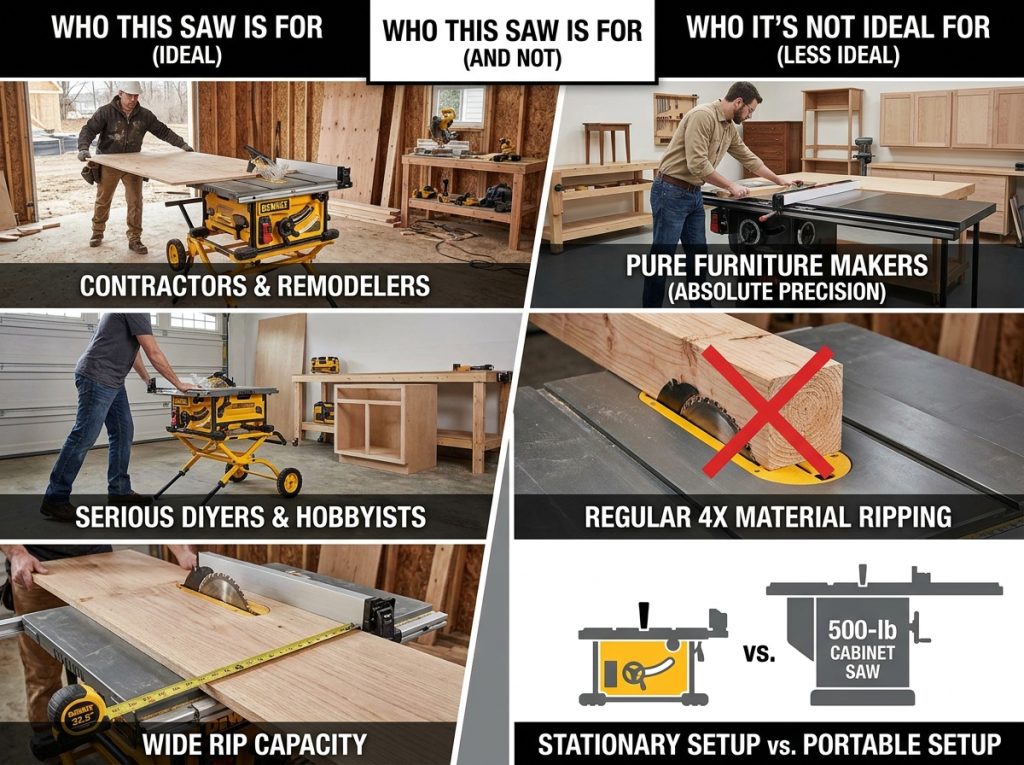
Contractors who need a portable saw on jobsites. Remodelers who move between sites regularly. Serious DIYers and hobbyists whose shop is a garage and who need to roll the saw out, use it, and roll it back in. Anyone who rips a lot of sheet goods and wants the widest rip capacity available in a portable package.
Who it’s not ideal for: pure furniture makers who need absolute precision on every cut without dialling in the saw repeatedly. For that use case, spend more and get a stationary hybrid or cabinet saw with cabinet-mounted trunnions. The DWE7491RS is a jobsite saw. It cuts well and accurately when properly set up. But “properly set up” for a portable saw is a relative standard, not the same as a 500-lb cabinet saw that was factory aligned and hasn’t moved since.
It’s also not the saw if you need to rip 4x material regularly — the 3-1/8″ cut depth falls just short of getting through 4x lumber in one pass. The Skilsaw SPT99-11’s 3-5/8″ cut depth is the correct tool for that.
Is It Worth the Money in 2026?
At $599-$649 — which is roughly where it lands on Amazon and Home Depot most of the time — yes. Without much hesitation.
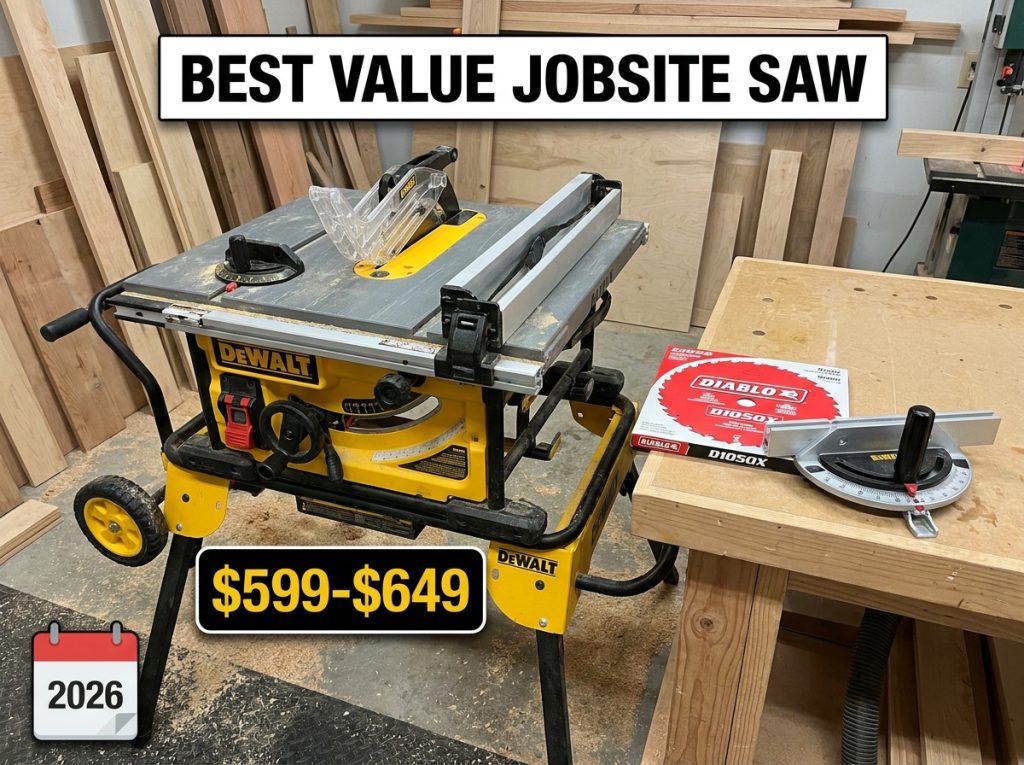
The fence alone at this price point is better than what you get on most competitors. The rip capacity at 32.5 inches is a genuine practical advantage for sheet goods work. The rolling stand is one of the better ones in this class. The 3-year warranty with one free service year is the best in the jobsite saw category by a significant margin.
You’re not getting a cabinet saw. You’re getting the best all-around jobsite table saw available in 2026. Those are different things and the DWE7491RS knows exactly which one it is.
Two upgrades worth doing immediately: a quality blade (Diablo D1050X or Freud Premier Fusion), and an aftermarket miter gauge or crosscut sled. Budget $80-$120 for those two things alongside the saw and you have a genuinely complete, capable setup that will handle most woodworking work accurately and reliably.
DEWALT DWE7491RS 10″ Jobsite Table Saw with Rolling Stand
One of the most popular jobsite table saws with a powerful 15-amp motor, large 32-1/2″ rip capacity, and rack & pinion fence system for fast, accurate cuts.
🔥 Buy Now on AmazonOne More Thing
I want to address something that comes up in reviews where people say the saw “keeps going out of alignment” or “won’t hold a square cut” — because I’ve followed enough of these threads to know what’s usually happening.
Portable table saws need to be treated like portable table saws. You can’t align one, throw it in a truck, and expect it to still be aligned when you set it up at the next site without checking. The alignment procedure before use — not every use, but whenever the saw has been transported — takes about five minutes with a good square. Build that into your workflow and you’ll have a saw that performs consistently. Skip it and blame the saw and you’ll write a one-star review about alignment drift that’s actually about not managing a portable tool like a portable tool.
The DWE7491RS earns its reputation. It’s not perfect. But for what it costs and what it does, it’s very hard to beat.
ProTableSawReviews.com · Finlay Connolly · April 2026

Finlay Connolly is a woodworking enthusiast and power tool specialist with over a decade of hands-on experience in the workshop. As the founder and lead writer at ProTableSawReviews.com, Finlay combines expert knowledge with real-world testing to help woodworkers, DIYers, and professionals choose the best tools for the job. With a sharp eye for detail and a passion for precision, Finlay is committed to providing trustworthy, practical advice backed by years of experience and research in the field. Whether you’re cutting dados or comparing fence systems, you can count on Finlay for honest, reliable reviews that make your next cut your best one.