

Six years ago, I tried cutting a decorative arch for a garden trellis using my cheap$40 jigsaw from a discount bin. The blade wandered so badly the curve looked like a drunk squirrel had chewed through it. Worse, the vibration was so aggressive my hands went numb after three minutes, and the motor burned out halfway through the project. That frustrating failure taught me something crucial: the best jigsaw for woodworking isn’t about having the highest horsepower—it’s about blade control, vibration management, and the ability to follow a pencil line accurately without fighting the tool every inch of the way.

If you’re serious about woodworking—especially curves, scrollwork, interior cutouts, or decorative details—a quality jigsaw is non-negotiable. Band saws can’t make interior cuts starting from drilled holes. Circular saws can’t navigate curves. The jigsaw does both, making it one of the most versatile saws in any workshop.
| Model | Type | Max SPM | Key Advantage | Price |
|---|---|---|---|---|
| Bosch JS470E | Corded | 3,100 | Best vibration control | $119–144 |
| DeWalt DCS334B | Cordless | 3,200 | Best cordless performance | $149–179 |
| Makita XVJ03Z | Cordless | 2,600 | Smoothest cordless | $119–149 |
| Black+Decker BDEJS600C | Corded | 3,000 | Budget friendly | $49–69 |
I’ve been woodworking for eleven years across furniture making, cabinetry, and decorative projects. I’ve tested budget jigsaws that quit after 20 hours, mid-range models that surprised me, and premium saws that justify their cost. This guide identifies the best jigsaws for woodworking based on real projects—not marketing specs.
What Makes a Great Woodworking Jigsaw Different
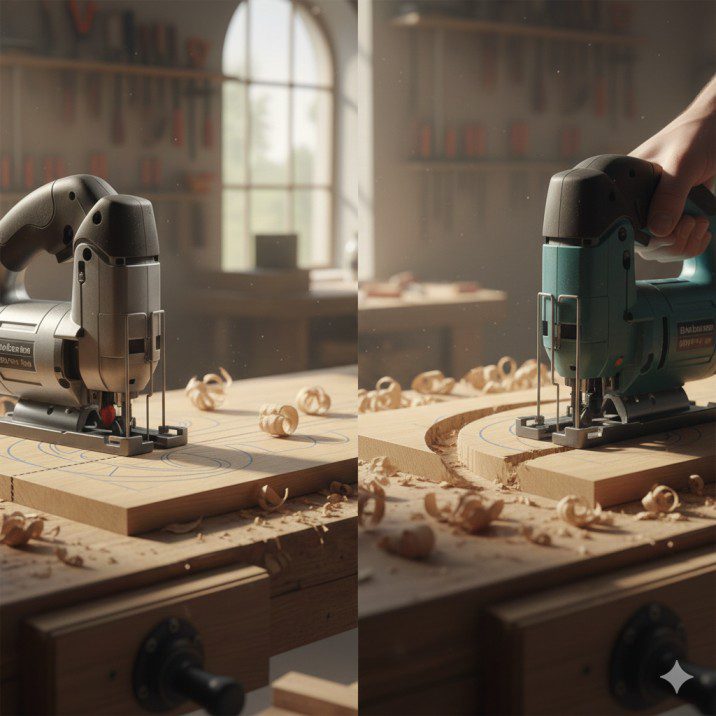
Jigsaws seem simple—reciprocating blade, handle, trigger. But the difference between a frustrating tool and a precision instrument comes down to specific features.
Blade Control: The #1 Performance Factor
Cheap jigsaws let blades deflect and wander during cuts. You follow a line perfectly, but the blade exits 1/8 inch off your mark because it bent mid-cut.
Quality jigsaws control blade deflection through:
- Roller guides that support the blade near the cutting surface
- Precision blade clamps that hold without allowing play
- Rigid base shoes that don’t flex during cutting
- Proper blade tension systems that keep blades straight
I tested this by cutting identical curves in 3/4-inch oak with a $45 jigsaw and a $140 jigsaw. The cheap saw’s blade deflected enough that the cut exited 3/16 inch off my line. The quality saw tracked within 1/32 inch across the entire cut.
For curved cuts defining your project’s appearance, this accuracy difference is massive.
Vibration Control: The Fatigue Killer
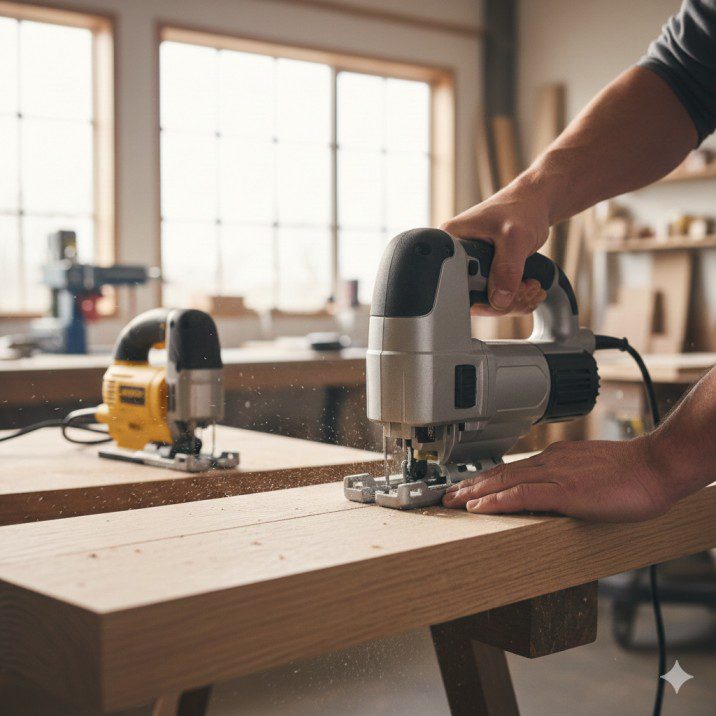
Jigsaws vibrate—it’s the nature of a reciprocating blade. But excessive vibration causes:
- Hand numbness after 10-15 minutes
- Reduced cutting accuracy as the vibrating saw fights your control
- Faster user fatigue
- Rougher cut surfaces
Premium jigsaws use counterbalancing systems that dramatically reduce felt vibration. I can use my Bosch jigsaw for 45+ minutes before hand fatigue sets in. My old cheap jigsaw? 10 minutes maximum before my hands felt like they were buzzing.
Orbital Action: Speed vs Smoothness Trade-Off
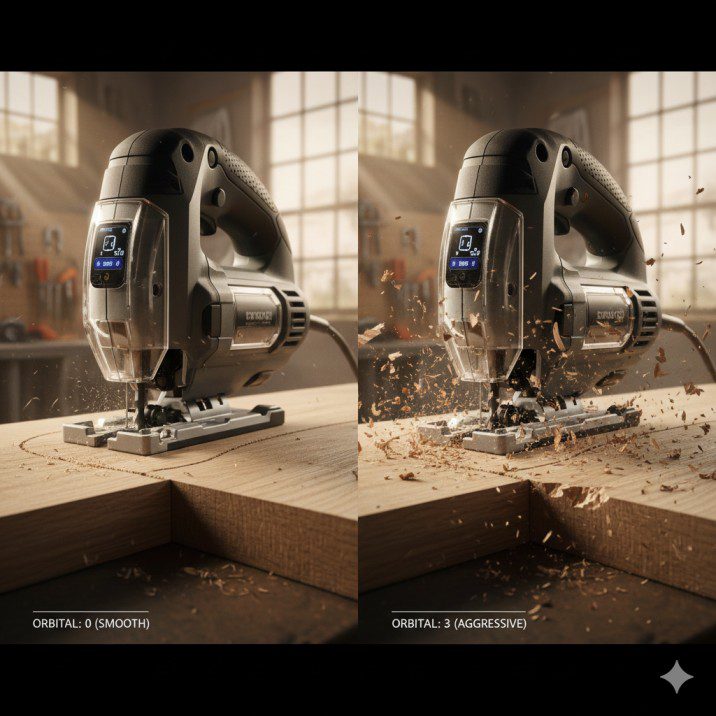
Modern jigsaws offer orbital action settings (typically 0-4). Higher orbital settings make the blade move in an elliptical pattern—cutting more aggressively but leaving rougher edges.
Setting 0 (no orbital action): Blade moves straight up and down. Slowest cutting but smoothest finish. Use for scrollwork, tight curves, and finish cuts where edges show.
Settings 1-2: Moderate orbital action. Good balance for general woodworking. Cuts faster than setting 0 while maintaining acceptable edge quality.
Settings 3-4: Maximum orbital action. Fast, aggressive cutting for rough work. Leaves rougher edges requiring sanding.
I use setting 0 for decorative furniture cuts, setting 2 for general work, and setting 4 for cutting rough shapes that’ll be routed or sanded anyway.
Top Jigsaws for Woodworking [2026 Reviews]
These jigsaws deliver the blade control, vibration reduction, and features that matter for serious woodworking.
1. Bosch JS470E 7.0 Amp Top-Handle Jigsaw – Best Overall for Woodworking
Price: ~$119-144 | Type: Corded | Motor: 7.0 amp | SPM: 500-3,100 | Stroke Length: 1 inch
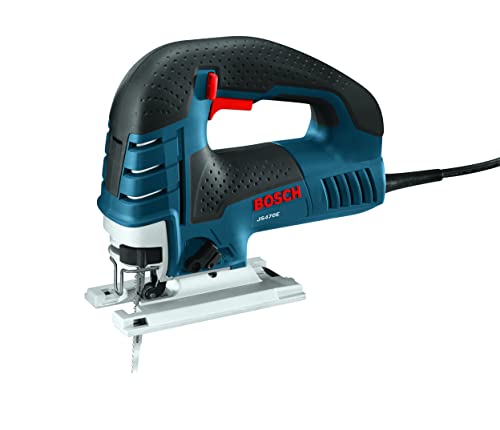
BOSCH Top-Handle Jig Saw 7.0 Amp, 3,100 SPM, 45 Degree Beveled Cuts, Variable-Speed Control, Ergonomic Design, Corded (JS470E)
- ERGONOMIC TOP-HANDLE: soft-grip areas supply a solid, comfortable grip
- CONVENIENT: featuring a tool-less blade change system and fast insertion with a blade ejection lever that eliminates need to touch hot saw blade
- 4-IN-1: 4 orbital action tool settings provide different blade strokes for smooth to aggressive cuts for taking on the toughest cutting tasks
New starting from: 189.00 $
Go to AmazonThis is the jigsaw I recommend most often for serious woodworkers, and it’s been my go-to saw for five years.
Why it excels for woodworking:
- Exceptional vibration control through Bosch’s precision-machined counterbalance system—feels smoother than any jigsaw in this class
- Constant Response circuitry maintains blade speed under load for consistent cutting through hardwoods
- Tool-less blade change system actually works smoothly (some designs are terrible)
- Four-position orbital action from precision scrollwork (setting 0) to aggressive rough cutting (setting 4)
- Variable speed trigger plus dial control for exact speed selection
- Built-in dust blower keeps cut line visible—critical for following pencil marks on curves
- Ambidextrous lock-on button for extended cutting sessions
Real woodworking testing: I’ve used this jigsaw to cut decorative arches in oak cabinet doors, scrollwork in maple, complex curves in walnut, and countless interior cutouts for sinks and electrical boxes. The saw has logged probably 150+ hours of cutting without any performance degradation.
The vibration control is genuinely exceptional. After cutting curves for 30-40 minutes, my hands feel normal—not numb and buzzing like with cheaper saws. This matters enormously when you’re doing detailed work requiring steady control.
Blade tracking accuracy is excellent. When cutting tight curves, the blade follows my line within 1/32 inch consistently. The roller guide supports the blade near the cutting surface, preventing deflection even in 2-inch thick hardwood.
Honest limitations: It’s corded, limiting mobility (though corded power means unlimited runtime). The top-handle design takes adjustment if you’re used to barrel-grip saws. Stock blade is mediocre—upgrade immediately to Bosch T-shank blades for best results.
Best for: Serious woodworkers doing furniture, cabinetry, or detailed work. Anyone who values vibration control and precision over cordless convenience. Scrollwork and decorative cutting.
2. DeWalt DCS334B 20V MAX XR Cordless Jigsaw – Best Cordless for Woodworking
Price: ~$149-179 tool only | Type: Cordless | Motor: Brushless | SPM: 0-3,200 | Stroke Length: 1 inch
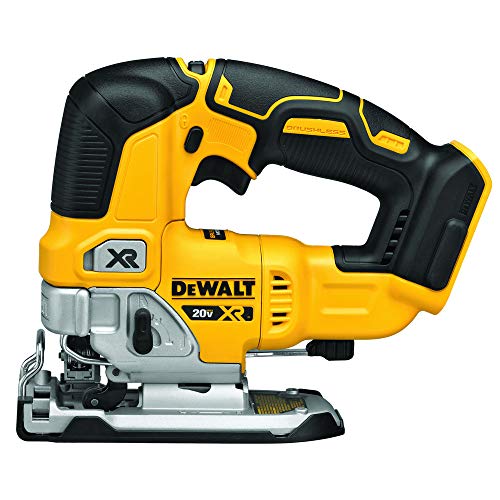
DEWALT 20V MAX XR Jig Saw, 3,200 Blade Speed, Cordless, Brushless Motor, LED Light, Bare Tool Only (DCS334B)
- Brushless motor of the cordless jigsaw delivers efficient performance for longer runtime (vs. DCS331 Jig Saw)
- Compact size for easy grip and maximum control of the jig saw
- Bright LED on the jigsaw tool helps illuminate dimly lit work surfaces
List Price :
Offer: 128.49 $
Go to AmazonFor cordless convenience without sacrificing woodworking performance, this DeWalt dominates.
Why it works for woodworking:
- Brushless motor delivers consistent power and longer runtime than brushed competitors
- 3,200 SPM maximum speed cuts through hardwood efficiently
- Four-position orbital action provides flexibility from smooth to aggressive cutting
- LED light illuminates cut line in dim shops or early morning work
- Variable speed dial plus trigger control for precise speed management
- Tool-free blade change with all-metal lever system
- Dust blower clears sawdust from cut line
Real woodworking testing: I borrowed this saw from a friend for a week to test against my corded Bosch. We built identical curved components in cherry—decorative shelf brackets with tight radius curves.
The DeWalt performed admirably. Blade control was nearly as good as the Bosch (slight deflection on very tight curves, but nothing affecting final results after sanding). The cordless freedom meant I could work anywhere in the shop without managing extension cords.
Battery runtime with a 5.0Ah battery was impressive—probably 45-60 minutes of continuous cutting before needing a swap. For furniture projects where I’m measuring, cutting, fitting, repeat, one battery lasted entire work sessions.
Honest limitations: Vibration is slightly higher than the Bosch (though still better than budget saws). The notched shoe for cut line indication feels less intuitive than wire guides. Tool-only pricing means $150+ additional for batteries if you’re not in DeWalt’s 20V system.
Best for: DeWalt 20V battery users. Woodworkers who value cordless mobility. Jobsite work or shops without convenient outlets. Anyone doing mobile furniture repairs or installations.
3. Makita XVJ03Z 18V LXT Cordless Jigsaw – Best Vibration Control (Cordless)
Price: ~$119-149 tool only | Type: Cordless | Motor: Brushed | SPM: 0-2,600 | Stroke Length: 1 inch
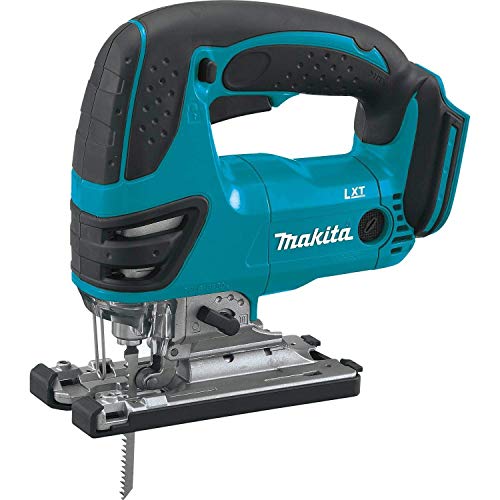
Makita XVJ03Z-R 18V LXT Brushed Lithium-Ion Cordless Jig Saw (Tool Only) (Renewed)
- Makita-built variable speed motor delivers 0-2,600 strokes per minute for faster and more efficient cutting
- 3 orbital settings plus straight cutting for use in a wide range of materials
- “Tool-less” blade change lever allows for faster blade installation and removal for increased productivity
List Price :
Offer: 129.99 $
Go to AmazonMakita’s reputation for smooth, quiet tools extends perfectly to this jigsaw.
Why it’s excellent for woodworking:
- Industry-leading vibration control for a cordless saw—rivals corded models
- Remarkably quiet operation reduces noise fatigue during extended use
- Three orbital settings provide adequate range for most woodworking
- Tool-less blade change system is quick and reliable
- Variable speed control for material-specific adjustments
- Lightweight at just 5.5 pounds (tool only) reduces arm fatigue
- Dust blower keeps cut line clear
Real woodworking testing: A furniture maker I know uses this saw exclusively for all jigsaw work. He’s built probably 50+ pieces of furniture with it over three years—everything from curved table aprons to decorative headboard shapes.
The vibration control really is exceptional for a cordless saw. It’s noticeably smoother than the DeWalt and approaches Bosch territory. The quiet operation is a bonus—you can have normal conversations while cutting instead of shouting over motor noise.
The 2,600 SPM maximum is slower than some competitors, but for woodworking (where control matters more than speed), it’s perfectly adequate. Cuts through hardwood without struggling.
Honest limitations: It’s a brushed motor, not brushless (shorter lifespan, less efficient). The 2,600 SPM feels slow if you’re used to 3,000+ SPM saws. Blade changes require more force than some tool-less systems. Makita 18V batteries cost more than budget brand alternatives.
Best for: Makita 18V battery users. Woodworkers prioritizing vibration control and quiet operation. Furniture makers doing detailed curved work. Anyone sensitive to tool vibration.
4. Black+Decker BDEJS600C 5.0 Amp Jigsaw – Best Budget for Beginners
Price: ~$49-69 | Type: Corded | Motor: 5.0 amp | SPM: 0-3,000 | Stroke Length: 3/4 inch

BLACK+DECKER Jig Saw, 5-Amp, 3,000 Blade Speed, 45 Degree Beveled Cuts, ¾-Inch Orbital Blade, 4 Curve Settings, Corded (BDEJS600C)
- HIGH PERFORMANCE ELECTRIC JIG SAW – 5 amp electric jig saw with a 3⁄4” blade orbital action for increased precision
- CURVE CONTROL TECHNOLOGY – Four curve settings for maximum control over rounded cuts
- BEVELED CUTS – Makes beveled cuts up to 45 degrees
List Price :
Offer: 59.99 $
Go to AmazonFor beginners or occasional users on tight budgets, this Black+Decker delivers surprising capability.
Why it works for basic woodworking:
- Incredibly affordable at under $70 complete
- Curve Control technology (orbital action by another name) with four settings
- Variable speed trigger provides adequate control
- Wire cut line guide helps follow marks
- Tool-free blade change system
- Compatible with both U-shank and T-shank blades (versatility advantage)
- 45-degree bevel capacity for angled cuts
Real woodworking testing: I recommended this saw to a neighbor starting woodworking as a hobby. He built a decorative outdoor planter box with curved sides and a small wall-mounted shelf with scrolled brackets.
The saw handled softwood curves fine. Edge quality was acceptable with moderate sanding. Blade deflection was noticeable on tight curves—probably 1/16 inch off-line on 2-inch radius curves.
Vibration is significant compared to premium saws. After 15-20 minutes of cutting, hand numbness becomes noticeable. For someone doing short cutting sessions, it’s manageable.
Honest limitations: The 5-amp motor struggles in hardwoods thicker than 1 inch. Vibration is high. Blade control is adequate but not precision-level. Build quality is basic plastic—expect 2-4 years of casual use, not 10+. Noise level is high.
Best for: Absolute beginners unsure if they’ll use a jigsaw regularly. Ultra-tight budgets under $70. Occasional users making simple curved cuts in softwood. Anyone wanting to test jigsaw woodworking before investing in premium tools.
Blade Selection: The Performance Multiplier
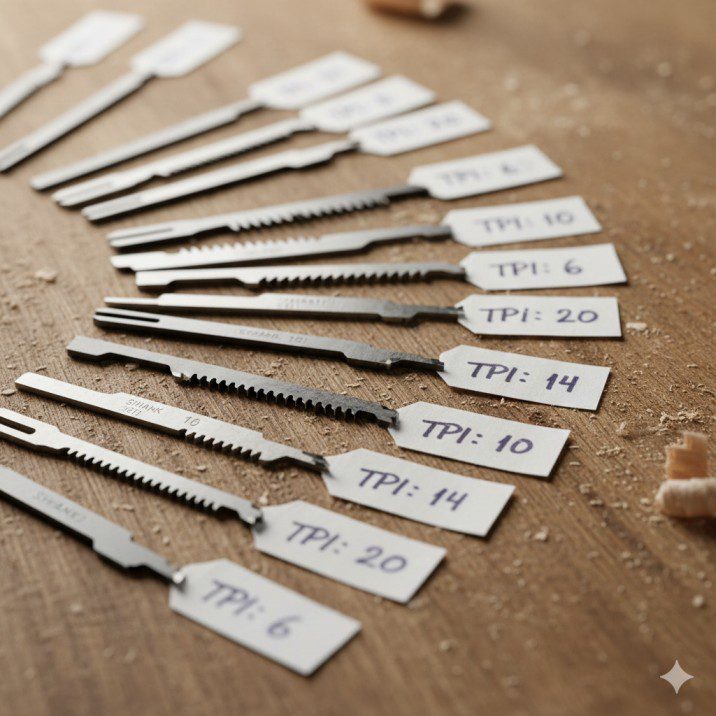
The jigsaw blade matters as much as the saw itself for woodworking results.
T-Shank vs U-Shank Blades
T-Shank blades: Modern standard. Tool-less quick-change systems. Better blade retention. Widely available. This is what you want.
U-Shank blades: Older design. Requires set screws or Allen wrenches for changes. Still available but fading. Only relevant if you own an older jigsaw.
All modern jigsaws (2015+) use T-shank blades. Don’t buy a saw that requires U-shank unless you’re getting a screaming deal on a used quality saw.
Tooth Count and Configuration
For woodworking, tooth count determines finish quality:
6-10 TPI (teeth per inch): Rough, fast cutting. Use for quick shaping that’ll be routed or heavily sanded. Leaves rough edges.
10-12 TPI: General woodworking sweet spot. Decent speed, acceptable finish. Use for most curves in solid wood.
14-20 TPI: Fine finish blades. Slow cutting but very smooth edges. Use for scrollwork, decorative details, and plywood where edges show.
I keep a variety pack of Bosch T-shank blades (10-pack with various tooth counts) and grab the appropriate blade for each task.
Blade Recommendations by Material
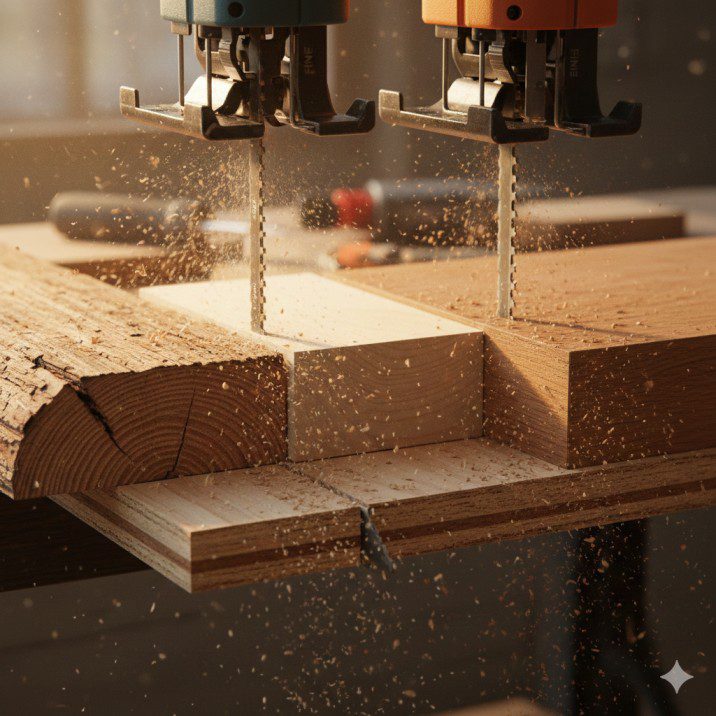
- Softwood (pine, cedar): 10 TPI general wood blade
- Hardwood (oak, maple, walnut): 10-12 TPI wood blade
- Plywood: 14-20 TPI fine finish blade (reduces tearout)
- Scrollwork/tight curves: Narrow 10-14 TPI blade (easier to turn tight radii)
- Fast rough cutting: 6 TPI aggressive blade
| Cut Type | Recommended TPI | Blade Type | When to Use |
|---|---|---|---|
| Rough shaping | 6–8 TPI | Aggressive wood | Fast material removal |
| General curves | 10–12 TPI | Standard wood | Most solid wood work |
| Plywood / veneer | 14–20 TPI | Fine finish | Minimize tearout |
| Scrollwork | 10–14 TPI | Narrow blade | Tight radius curves |
Pro Tip: Buy a blade variety pack (10-15 blades with different tooth counts) for $15-20. Having the right blade immediately available saves trips to the store and improves results dramatically.
Essential Jigsaw Techniques for Woodworking
Starting Interior Cuts
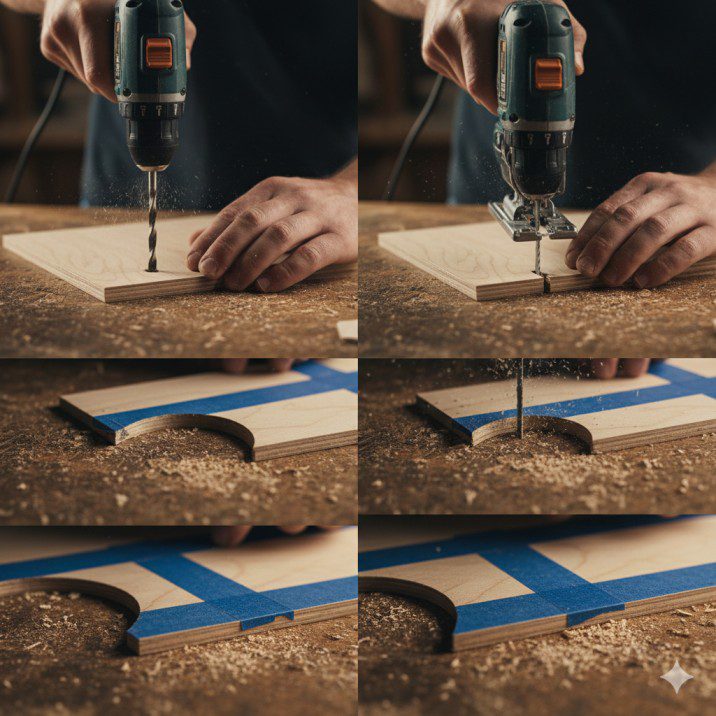
For cutouts that don’t start from an edge (sink openings, electrical boxes, decorative interior shapes):
- Drill a starter hole slightly larger than your jigsaw blade width (usually 3/8 to 1/2 inch)
- Insert the blade through the hole
- Start cutting with the saw fully against the material (no plunge cutting unless your saw specifically supports it)
- Follow your cut line, turning gradually to avoid binding
I drill starter holes in the waste area near corners, insert the jigsaw, and cut to the line. This gives clean corners without over-cutting.
Following Tight Curves
For curves tighter than your blade width can navigate:
- Cut a series of relief cuts from the curve toward the waste area
- These cuts allow waste pieces to fall away as you navigate the curve
- The blade can turn more sharply without binding
When cutting very tight scrollwork, I sometimes make multiple passes—rough cut close to the line, then final pass right on the line for precision.
Preventing Tearout on Plywood
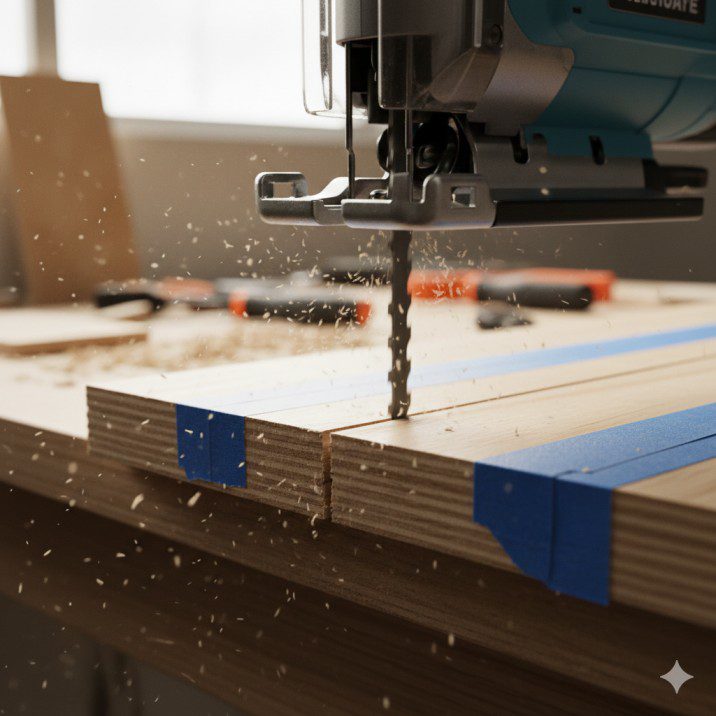
Plywood veneer tears easily on the bottom surface (where the blade exits). To minimize tearout:
- Use a fine-tooth blade (14-20 TPI)
- Place the good side facing down (blade exits through the back)
- Apply painter’s tape along the cut line (supports veneer fibers during cutting)
- Use zero orbital action (setting 0) for smoothest cut
- Cut slowly—rushing increases tearout
For furniture-quality plywood cuts, all five techniques combined produce near-perfect edges requiring minimal sanding.
Want to master more woodworking techniques? Check out our comprehensive how-to guide section for jigsaw techniques, blade selection, and advanced cutting methods.
The Honest Bottom Line: Which Jigsaw Should You Buy?
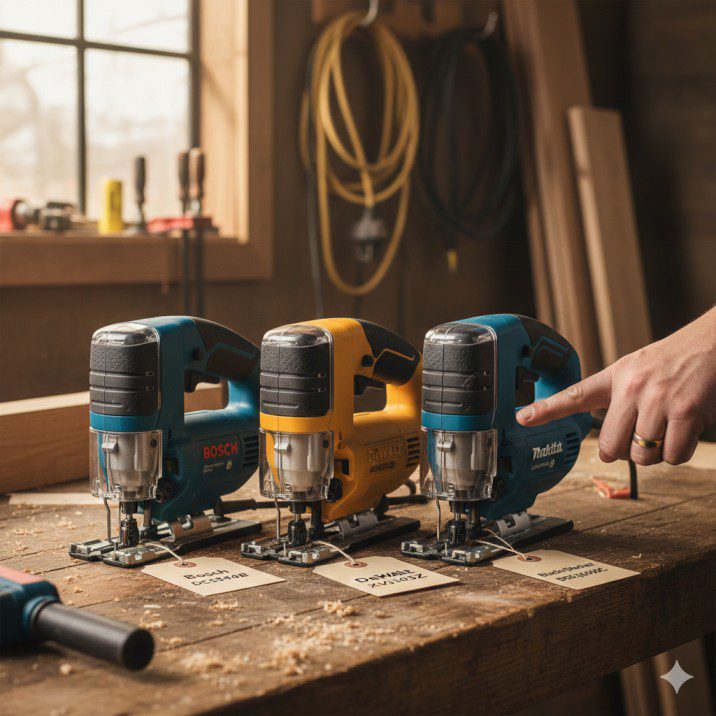
After eleven years of woodworking with various jigsaws, here’s my straight recommendation on the best jigsaw for woodworking:
If you’re doing regular woodworking with curves and details: Buy the Bosch JS470E ($119-144). It’s the best overall jigsaw for woodworking—exceptional vibration control, precise blade tracking, and features that matter. This is the saw I’d buy again if mine died tomorrow.
If you’re already invested in DeWalt 20V batteries: The DeWalt DCS334B ($149-179 tool-only) delivers professional cordless performance. Blade control is excellent, runtime is adequate, and you avoid buying into a new battery platform.
If you prioritize smooth, quiet operation and own Makita batteries: The Makita XVJ03Z ($119-149 tool-only) is the smoothest cordless jigsaw available. Vibration control rivals corded saws, making it ideal for extended cutting sessions.
If you’re a beginner with under $70 to spend: The Black+Decker BDEJS600C ($49-69) gets you cutting curves immediately. It’s not precision-grade, but it works for learning and basic projects. Upgrade when your skills outgrow it.
My personal setup: I use the Bosch JS470E for all serious furniture and cabinet work. The vibration control and blade precision matter enormously when cutting decorative curves that define a piece’s appearance. I’ve owned it for five years and it’s never let me down on projects ranging from Arts & Crafts furniture to contemporary cabinets.
Don’t make the mistake of thinking any cheap jigsaw will work for woodworking. The difference between a $50 budget saw and a $130 quality jigsaw is literally the difference between fighting the tool constantly and having it follow your lines precisely.
| Your Situation | Recommended Jigsaw | Why It Fits |
|---|---|---|
| Serious furniture / cabinet work | Bosch JS470E | Best vibration control & precision |
| DeWalt 20V battery user | DeWalt DCS334B | Excellent cordless performance |
| Value, smooth, quiet cutting | Makita XVJ03Z | Exceptional vibration control |
| Beginner on tight budget | Black+Decker BDEJS600C | Functional at lowest cost |
Ready to expand your woodworking toolkit? Visit our complete buying guide for saw selection criteria across all types, or check our comparison section for side-by-side testing results.
Frequently Asked Questions
What is the best jigsaw for cutting curves in wood?
The Bosch JS470E is the best jigsaw for cutting curves in wood, delivering exceptional blade control through precision roller guides and counterbalanced vibration reduction. Its 7.0-amp motor with Constant Response circuitry maintains consistent blade speed through hardwoods, while four orbital settings provide flexibility from ultra-smooth scrollwork to aggressive rough cutting. The tool-less blade change, dust blower, and variable speed control make it ideal for furniture makers and woodworkers doing decorative curved work. At $119-144, it offers professional-grade performance at mid-range pricing.
Should I buy a corded or cordless jigsaw for woodworking?
For shop-based woodworking with convenient power access, corded jigsaws like the Bosch JS470E offer unlimited runtime, consistent power, and typically better vibration control at lower prices ($120-150 vs $150-200+ for cordless). Cordless jigsaws like the DeWalt DCS334B or Makita XVJ03Z provide mobility for jobsite work and eliminate cord management but require battery investment and periodic charging. Choose corded if you work primarily in one location and value maximum vibration control; choose cordless if you already own compatible batteries or need mobility for installations and repairs. For serious woodworking, corded delivers better value unless you’re already invested in a cordless platform.
How many teeth per inch (TPI) blade is best for woodworking?
For general woodworking, 10-12 TPI (teeth per inch) blades provide the best balance of cutting speed and finish quality on solid wood. Use 6-8 TPI aggressive blades for fast rough shaping that will be sanded heavily, 14-20 TPI fine-finish blades for plywood and scrollwork where edges are visible, and narrow 10-14 TPI blades for tight-radius curves. Plywood requires higher TPI (14-20) to minimize tearout on delicate veneers. Most woodworkers benefit from owning a blade variety pack ($15-20) containing different tooth counts for material-specific applications rather than using one blade for everything.
Why does my jigsaw blade wander and not cut straight?
Jigsaw blades wander due to blade deflection caused by dull blades, excessive feed pressure, inadequate blade support systems, or low-quality saws lacking proper roller guides. To fix: use sharp, high-quality blades designed for your material, reduce feed pressure and let the saw cut at its own pace, ensure blade is properly seated in the clamp, cut with zero orbital action for maximum accuracy, and consider upgrading to a better jigsaw if your current saw lacks roller guides or precision blade support. Cheap jigsaws under $50 often lack adequate blade control mechanisms and will always wander regardless of technique.
What causes jigsaw blade breakage and how do I prevent it?
Jigsaw blades break from excessive feed pressure (pushing too hard), blade binding in tight curves without relief cuts, using dull blades that require excessive force, cutting radius curves tighter than the blade width allows, or blade deflection in thick materials. Prevent breakage by: reducing feed pressure and letting the blade cut naturally, making relief cuts before attempting tight curves, replacing dull blades promptly, using narrower blades for tight-radius work, supporting material properly to prevent binding, and selecting appropriate blade length for material thickness. Quality blades break less frequently than cheap blades even under identical conditions.
Is the Bosch JS470E worth the extra money over budget jigsaws?
Yes, for anyone doing regular woodworking requiring curves, scrollwork, or precision cuts. The Bosch JS470E at $119-144 delivers dramatically better vibration control (reducing hand fatigue during extended use), superior blade tracking accuracy (following cut lines within 1/32 inch), consistent power delivery through Constant Response circuitry, and significantly longer lifespan (10+ years vs 2-4 years for budget saws). The $70-90 premium over budget jigsaws pays for itself through better results, less rework from inaccurate cuts, and avoided replacement costs. For occasional basic cutting, budget saws work; for furniture making or detailed work, the Bosch is absolutely worth the investment.
Affiliate Disclosure: This article contains affiliate links to products available on Amazon and other retailers. If you purchase through these links, we may earn a small commission at no additional cost to you. This helps support our website and allows us to continue providing honest, detailed jigsaw reviews based on real woodworking projects and extensive hands-on testing.

Finlay Connolly is a woodworking enthusiast and power tool specialist with over a decade of hands-on experience in the workshop. As the founder and lead writer at ProTableSawReviews.com, Finlay combines expert knowledge with real-world testing to help woodworkers, DIYers, and professionals choose the best tools for the job. With a sharp eye for detail and a passion for precision, Finlay is committed to providing trustworthy, practical advice backed by years of experience and research in the field. Whether you’re cutting dados or comparing fence systems, you can count on Finlay for honest, reliable reviews that make your next cut your best one.