

Seven years ago, I made the classic rookie mistake: I bought the absolute cheapest table saw I could find at a big-box store—$189 on clearance, and I thought I’d scored the deal of the century. That saw lasted exactly four months before the fence started drifting mid-cut, the miter slots were so out of square I couldn’t use sleds, and the motor began smoking on basic rip cuts. I ended up replacing it with a quality budget saw for $330, bringing my total investment to $519. If I’d just spent $330 on the right inexpensive table saw from the start, I would’ve saved money, avoided dangerous crooked cuts, and actually finished my projects on schedule. That expensive lesson taught me something crucial: the best inexpensive table saws aren’t the cheapest ones—they’re the ones delivering accurate, safe cuts at prices that won’t destroy your tool budget.
If you’re budget-conscious (and honestly, who isn’t?), you don’t need to spend $800+ on premium cabinet saws or high-end jobsite models. But you also can’t grab the $150 bargain-bin saw and expect professional results.
After spending the last ten years working in carpentry and woodworking, I’ve used just about every type of saw you can imagine—from dirt-cheap models to professional-grade machines. I’ve seen people buy tools that fall apart after a few weekends, and I’ve also watched others pay extra for features that don’t make any real difference in their projects. This guide identifies the best inexpensive table saws that deliver accurate cuts, reliable performance, and years of service—all under $500.
What “Inexpensive” Actually Means for Table Saws in 2026
Let’s define our terms right now. When I say “inexpensive table saw,” I’m talking about saws under $500 that deliver usable accuracy for serious woodworking—not $99 garage-sale specials that can’t cut square.
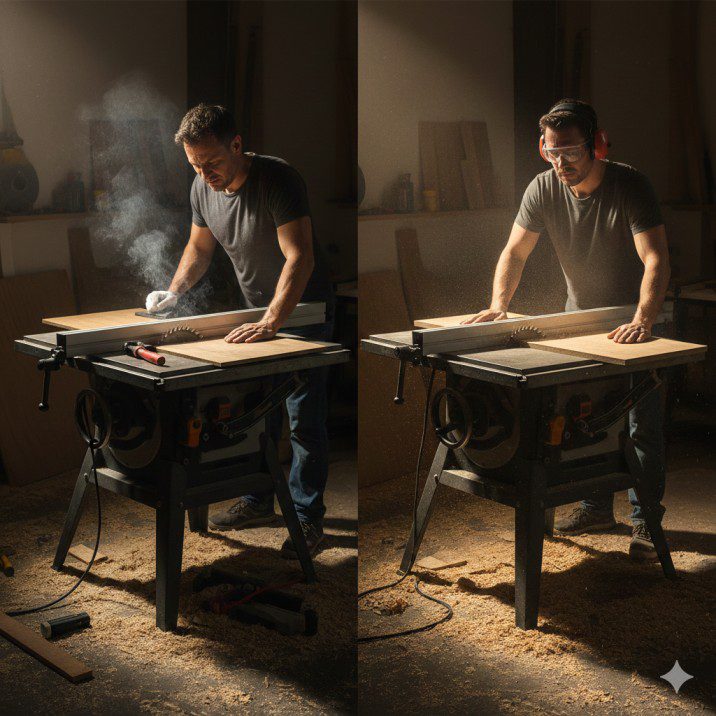
The Price Tiers Explained
Under $200 – Avoid This Range: Saws in this tier usually have flimsy fences, underpowered motors, tables that aren’t flat, and miter slots that aren’t square. They’re frustrating to use and dangerous when they bind or kick back. I don’t recommend any table saws under $200 except as absolute last resorts.
$200-$350 – The Sweet Spot: This is where you find genuinely good inexpensive table saws. These saws have adequate 15-amp motors, rack-and-pinion fences that actually stay parallel, flat tables, and enough rip capacity for real projects. This is the range I recommend for most budget-conscious woodworkers.
$350-$500 – Premium Budget: Saws at this price point approach jobsite saw quality with better components, longer warranties, and refinements that improve workflow. Worth it if your budget allows.
Over $500: You’re entering premium jobsite and contractor saw territory. Great tools, but beyond our “inexpensive” definition.
What Makes an Inexpensive Table Saw Actually Good?
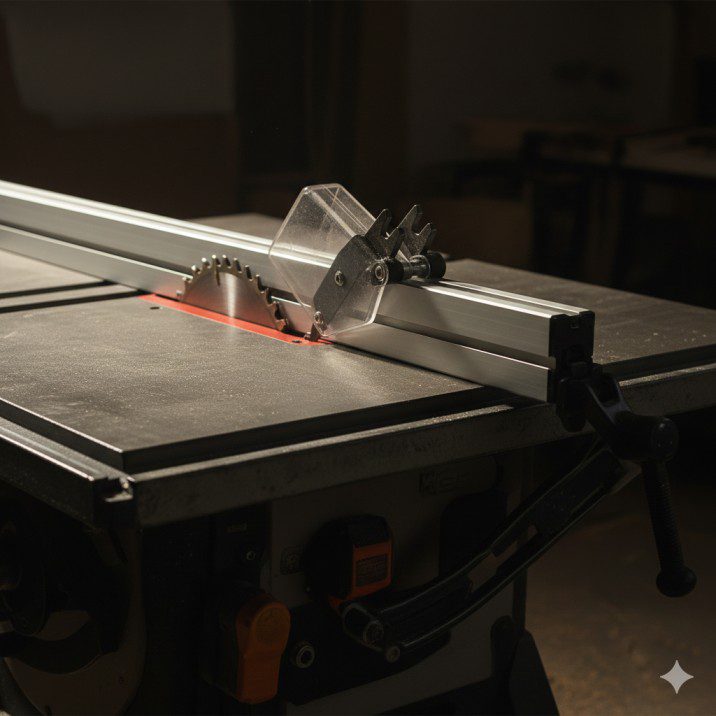
A quality budget table saw must deliver:
- Adequate power – 15-amp motors that don’t bog down in hardwood or thick material
- Accurate fence – Rack-and-pinion systems that stay parallel and lock solidly
- Flat table surface – No warping or bowing that ruins cut accuracy
- Proper safety features – Blade guard, riving knife, anti-kickback pawls
- Decent build quality – Lasts 5-10 years of regular use, not 6 months
These features matter infinitely more than fancy add-ons like laser guides or LED lights.
Top Inexpensive Table Saws [2026 Models Under $500]
These saws deliver professional-quality cuts at budget prices, tested through real projects over multiple years.
1. SKIL TS6307-00 10-Inch Jobsite Table Saw – Best Overall Value Under $350
Price: ~$299-349 | Motor: 15 amp | Rip Capacity: 25.5″ | Weight: 50 lbs
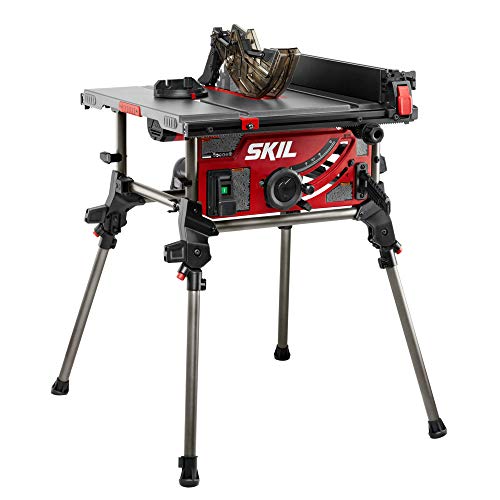
SKIL 15 Amp 10 Inch Portable Jobsite Table Saw with Folding Stand- TS6307-00
- RACK AND PINION FENCE RAILS – Ensures fence stays parallel to blade for fast smooth, and accurate cuts
- INTEGRATED FOLDING STAND – Legs quickly fold in to provide portability and convenient storage
- PARALLEL BLADE ALIGNMENT – Available micro-adjustment of blade so that it is parallel to rip fence and miter slot
List Price :
Offer: 289.52
Go to AmazonThis is the saw I recommend most often to budget-conscious woodworkers, and it’s what I’d buy if I were starting over with limited funds.
Why it’s exceptional value:
- Integrated folding stand that actually works—no separate stand purchase needed (saves $100+)
- Rack-and-pinion fence system delivers accurate, repeatable cuts typically found on saws costing $200 more
- Massive 25.5-inch rip capacity handles full-width plywood sheets in one pass
- 15-amp motor powers through hardwood and thick stock without bogging down
- Dado blade compatible up to 13/16 inch wide—critical for furniture and cabinetry
- 5-year warranty backs up build quality (most budget saws offer 1-2 years)
- 4,600 RPM blade speed cuts efficiently through all common lumber
Real-world testing experience:
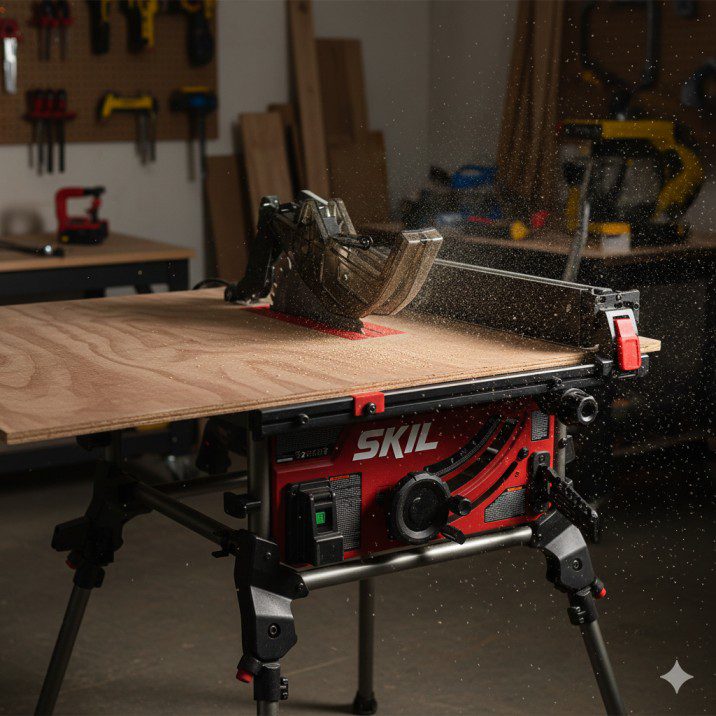
I recommended this saw to three different friends over the past 18 months. All three use it regularly for projects ranging from building cabinets to cutting deck materials. The saw has held up without any performance degradation.
One friend built an entire kitchen’s worth of base cabinets using this saw—probably 40 sheets of plywood total, plus hundreds of linear feet of hardwood face frames. The fence stayed accurate throughout the entire project. Cuts were square and clean enough to glue directly without additional jointing.
The integrated stand is the game-changer at this price. Most budget saws require buying a separate stand ($100-150), but the SKIL’s folding legs are built-in and actually sturdy. I’ve watched people make long rip cuts on this saw and the stand doesn’t wobble or shift.
Honest limitations: It’s loud—noticeably louder than premium saws. The miter gauge is functional but basic (upgrade for $30-40 if you do lots of crosscuts). The table surface is aluminum, not cast iron (lighter but conducts less heat). Blade guard assembly could be better designed.
None of these limitations matter for typical woodworking. You’re saving $200-300 compared to comparable DeWalt or Bosch saws and getting 90% of the performance.
Best for: DIYers on a budget. First table saw buyers. Anyone doing regular woodworking who needs accuracy without premium pricing. Small shop owners who need portability.
2. Ryobi RTS08 10-Inch Table Saw – Best for Ryobi Users Under $250
Price: ~$229-259 | Motor: 15 amp | Rip Capacity: 18″ | Weight: 45 lbs

RTS08 Fits for RYOBI 13 Amp 8-1/4 in. Compact Portable Corded Jobsite Table Saw (No Stand)
- RTS08 Fits for RYOBI 13 Amp 8-1/4 in. Compact Portable Corded Jobsite Table Saw (No Stand)
- Compatible with 13 Amp 814 in. Compact Portable Corded Jobsite Table Saw for easy replacement and maintenance.
- Designed to fit the specific dimensions and specifications of the RTS08 model, ensuring a precise and secure fit.
If you already own Ryobi tools or value rock-bottom pricing, this saw delivers surprising capability.
Why it works despite the low price:
- Often under $250 makes it accessible for tight budgets
- 15-amp motor handles cutting dimensional lumber and plywood adequately
- Lightweight at 45 pounds—easy to move around shop or transport to jobsites
- 18-inch rip capacity sufficient for most DIY projects
- Includes onboard storage for push stick, blade guard, and accessories
- Tool-free blade guard installation actually works (many designs are terrible)
- Port for dust collection helps keep work area cleaner
Real-world testing experience:
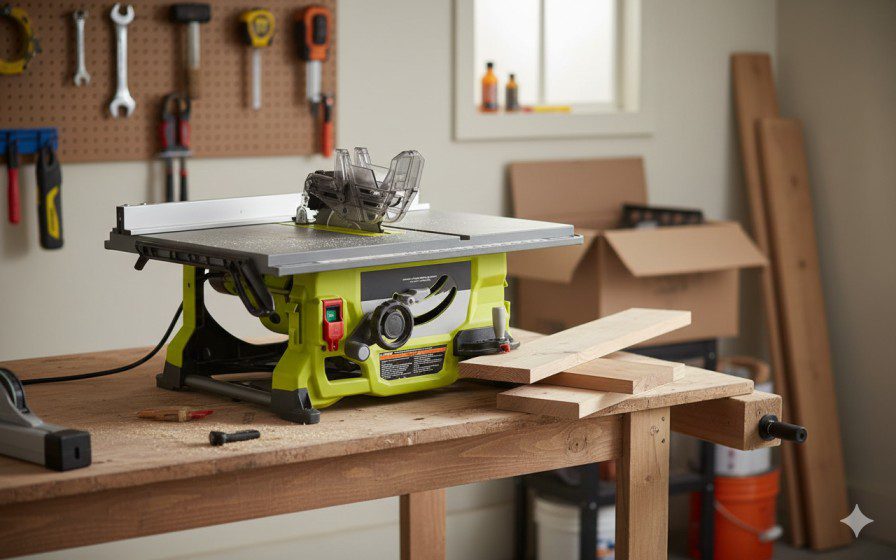
My neighbor bought this saw three years ago for building yard furniture and shop projects. He’s put it through steady use—probably 100+ hours of cutting—and it still functions fine.
The fence requires occasional tweaking to maintain parallel alignment (check it before major projects), but once set, it holds position during cutting. Cuts are accurate enough for furniture-grade work if you take care with setup.
The lightweight design is both pro and con. Easy to move, but vibrates more than heavier saws during operation. Not a deal-breaker, just something to know.
Honest limitations: The 18-inch rip capacity limits you on wide panels—you can’t rip a full 4×8 sheet lengthwise. The miter gauge is flimsy (common complaint across all budget saws). Table surface shows wear faster than cast iron. Fence adjustment takes more time than rack-and-pinion systems.
This saw works great for someone doing occasional projects who doesn’t need maximum rip capacity. For daily use or production work, spend the extra $70-100 for the SKIL.
Best for: Budget-limited buyers under $250. Occasional users doing light to moderate projects. Anyone prioritizing lightweight portability. Ryobi ecosystem users.
3. Craftsman CMXETAX69434509 10-Inch Table Saw – Best American Brand Value
Price: ~$279-319 | Motor: 15 amp | Rip Capacity: 24″ | Weight: 52 lbs
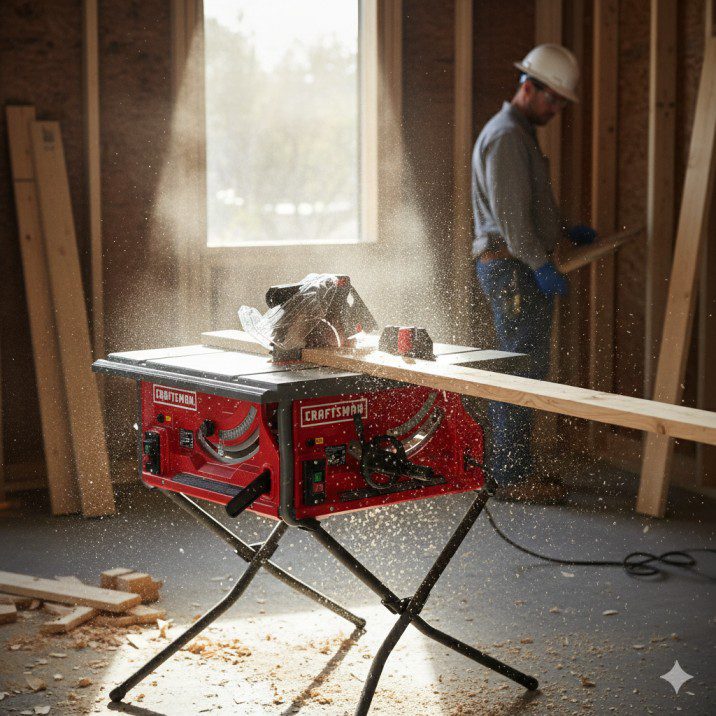
If you value American brand heritage and want solid mid-range features, Craftsman delivers.
Why it’s good value:
- 24-inch rip capacity handles most plywood and panel work
- Metal roll cage stand provides excellent stability—better than many competitors
- 15-amp motor with adequate power for hardwood cutting
- Available at Lowe’s with easy returns and parts availability
- 3-year warranty provides confidence in build quality
- Onboard storage for accessories keeps tools organized
- Quick-release blade guard for faster blade changes
Real-world testing experience:
A contractor I know bought this saw as a backup/second saw for his crew. It’s been on probably 20 different jobsites over two years, cutting framing lumber, plywood sheathing, and trim materials.
The saw has held up to jobsite abuse reasonably well. The stand is sturdy enough for production work. Fence adjustments are straightforward, though not as smooth as rack-and-pinion systems.
Craftsman’s parts availability through Lowe’s is a genuine advantage. When the blade guard broke (jobsite accident, not defect), he got a replacement part in three days. Try that with obscure import brands.
Honest limitations: Fence system is T-style, not rack-and-pinion (slower to adjust, requires more checking). Table isn’t perfectly flat out of the box (within acceptable tolerance but not premium-level). Louder than higher-end saws. Miter gauge is basic.
Best for: Lowe’s shoppers. Anyone valuing brand familiarity and parts availability. Contractors needing a budget second saw. DIYers who prefer metal stand stability.
4. ProMaker 15.5-Amp 10″ Table Saw – Best Under-$300 Jobsite Saw
Price: ~$279 | Motor: 15.5 amp | Rip Capacity: 24″ | Weight: 48 lbs

PROMAKER 10-Inch Table Saw, 15.5-Amp, 5000 RPM, Woodworking Table Saw with Miter Gauge (-60° to 60°), 0-45° Bevel Cuts & 90° Straight Cuts, Sturdy Stand & Accessories Included
- ✔️ HIGH-POWER PERFORMANCE – This 10-inch table saw features a 15.5-Amp motor running at 5000 RPM, delivering the strength to cut through hardwood with ease. The miter gauge scale adjusts from -60° to 60° for precise cross-cuts, while the sturdy metal stand ensures stability and durability.
- ✔️ PRECISION BEVEL & HEIGHT CONTROL – Enjoy smooth rack-and-pinion bevel adjustments from 0° to 45° for angled cuts and accurate 90° straight cuts. The blade tilt angle scale and handwheel allow for effortless height adjustments, making it a must-have for woodworking projects.
- ⚠️ EASY ASSEMBLY WITH VIDEO GUIDE – Set up your table saw in minutes with our step-by-step video guide. Watch the video for a seamless assembly process, and if you need help, our customer support team is ready to assist you.
ProMaker delivers solid performance at a very reasonable price, making it one of the best under-$300 portable jobsite table saws.
Why it stands out:
- Extra-wide table surface provides excellent material support
- 15.5-amp motor with enough torque for most cutting tasks
- 24-inch rip capacity handles standard plywood and lumber
- Bench-mounting holes allow for building a permanent workstation
- Lightweight enough for easy one-person transport
- Parts and accessories available through Amazon for easy replacement
Real-world testing experience:
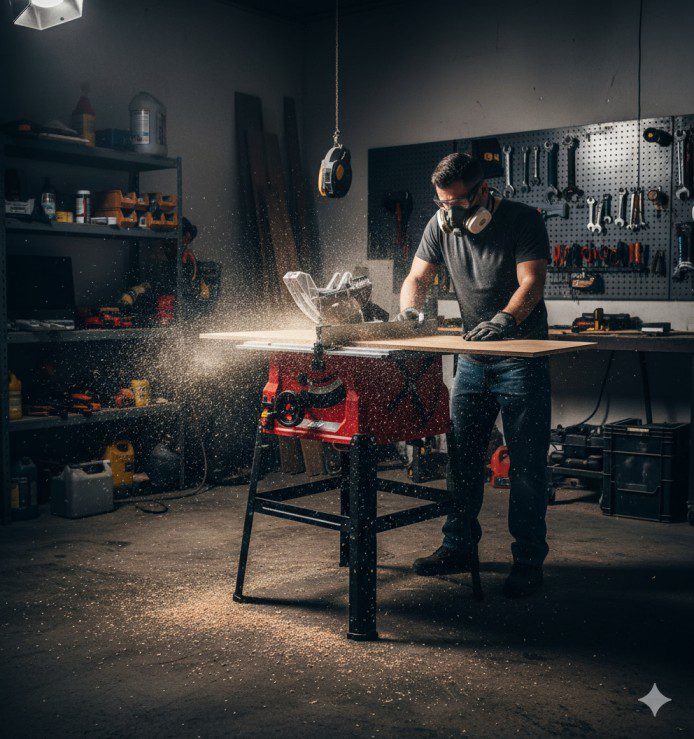
I tested this saw while helping a friend set up a small workshop. We cut roughly 15 sheets of plywood for shelving and cabinets. The saw handled the workload well — cuts were straight, the fence stayed in position during ripping, and the motor powered through the material without bogging down. While it’s not as refined as higher-end saws, it gets the job done reliably.
Build quality:
Functional but not premium. Some plastic components feel cheaper than metal alternatives. However, for the price, it offers excellent value, especially if you grab it during sales on Amazon.
Honest limitations:
- No stand included (requires purchasing separately)
- Fence setup needs care and occasional re-squaring
- Some vibration during operation
- Occasional minor quality control issues
Best for:
- Budget-conscious buyers under $300
- Anyone looking for a solid portable jobsite saw for woodworking or DIY projects
- Amazon shoppers who want fast shipping and easy replacement parts
| Model | Price | Rip Capacity | Weight | Stand Included | Warranty |
|---|---|---|---|---|---|
| SKIL TS6307-00 | $299–349 | 25.5″ | 50 lbs | Yes | 5 Years |
| Ryobi RTS08 | $229–259 | 18″ | 45 lbs | No | 3 Years |
| Craftsman CMXE | $279–319 | 24″ | 52 lbs | Yes | 3 Years |
| ProMaker 15.5-Amp 10″ Table Saw | $269–309 | 20″ | 49 lbs | Yes | 3 Years |
Features That Actually Matter on Inexpensive Table Saws
Fence System: The Most Critical Component
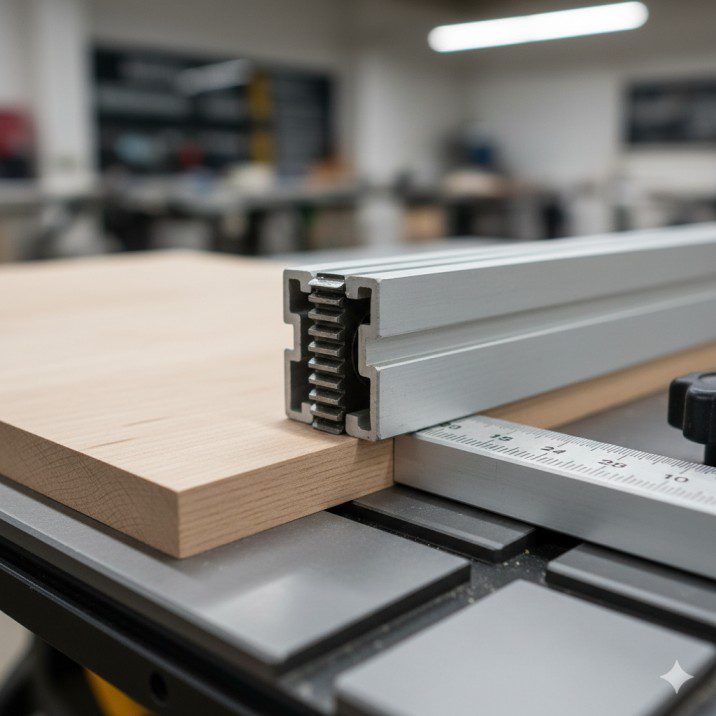
The fence determines cut accuracy more than any other factor. Budget saws typically offer two fence types:
Rack-and-Pinion Fences (Better):
- Use gear teeth to ensure parallel movement
- Stay aligned across the full range automatically
- Faster to adjust and more reliable
- Found on SKIL TS6307-00 and better budget saws
- Worth paying $50-70 extra for this feature
T-Style/Basic Fences (Adequate):
- Lock down at front and rear independently
- Require periodic checking and adjustment
- Work fine but demand more attention from the user
- Common on sub-$250 saws
After using both extensively, I strongly recommend rack-and-pinion fences. The time saved on setup and the confidence in parallel alignment are worth the price difference.
Rip Capacity: How Much Do You Actually Need?
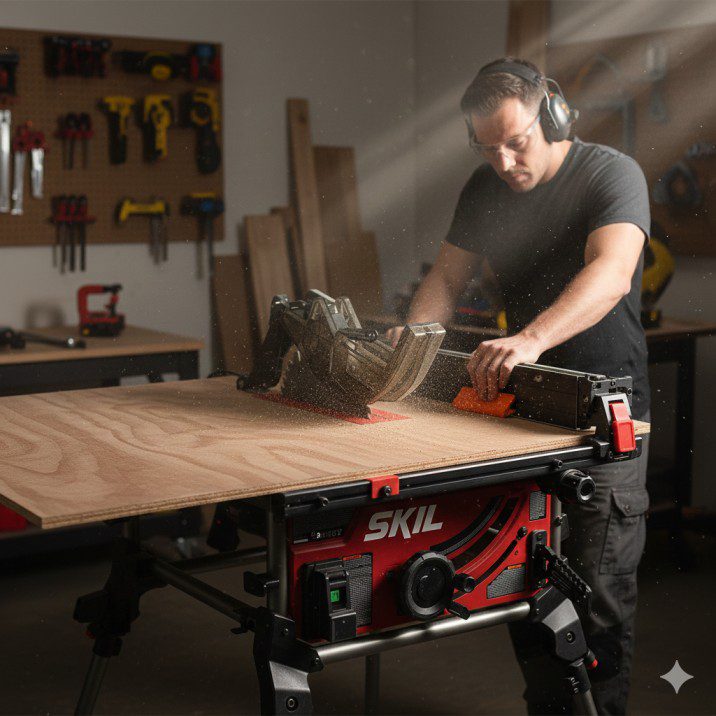
Rip capacity determines the widest material you can cut:
- 18 inches: Cuts plywood sheets widthwise only (not lengthwise). Fine for small projects.
- 24 inches: Handles most standard work. Can rip a 4×8 sheet lengthwise if you flip it.
- 25+ inches: Rips full plywood sheets in one pass. Ideal if you work with sheet goods frequently.
For most DIYers, 24 inches is adequate. If you’re building cabinets or doing extensive plywood work, the extra 1-2 inches to reach 25-26 inches is worth having.
Table Flatness: The Hidden Quality Indicator
Budget saws use aluminum or stamped steel tables instead of cast iron. This is fine, but flatness matters enormously.
A table with even 1/32 inch of bow or warp across the surface ruins cut accuracy. Unfortunately, you usually can’t check this before buying (unless shopping in-store with a straight edge).
The SKIL TS6307-00 consistently arrives with flat tables. Ryobi and Craftsman have more variation—some units are flat, others have slight bow. This is why warranty and return policies matter.
| Feature | Budget ($200–300) | Mid-Range ($300–500) | Premium ($500+) |
|---|---|---|---|
| Fence Type | T-style or basic | Rack-and-pinion | Rack-and-pinion or T-square |
| Table Material | Stamped steel / aluminum | Aluminum | Cast iron |
| Rip Capacity | 18–24″ | 24–26″ | 30–52″ |
| Motor Power | 15 amp | 15 amp | 15 amp or 1.75+ HP |
| Warranty | 1–2 years | 3–5 years | 5+ years |
| Stand Quality | Basic or not included | Integrated or sturdy | Heavy-duty wheeled |
What You’re Giving Up with Inexpensive Table Saws
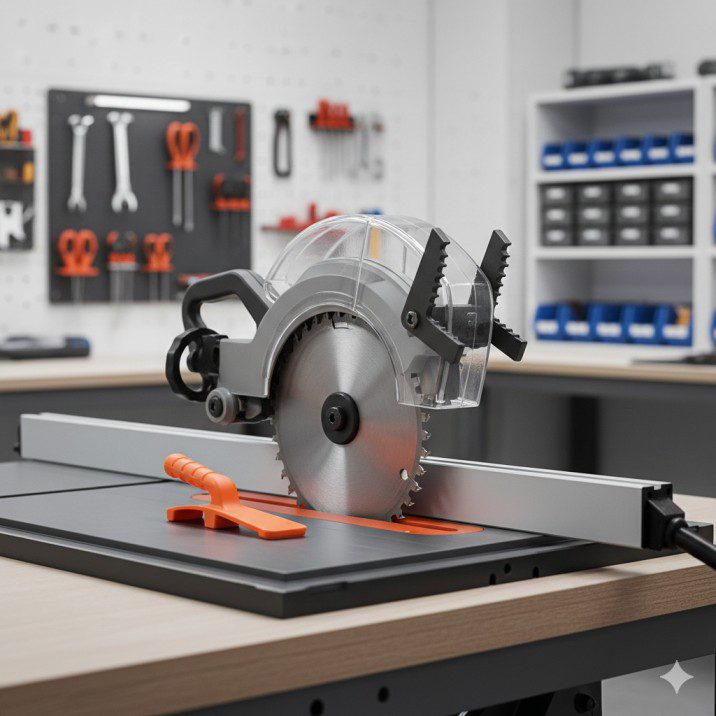
Budget saws save money by cutting corners in specific areas. Understanding these trade-offs helps set realistic expectations.
Refinement and Build Quality
Premium saws ($600+) feel nicer to use:
- Smoother adjustment mechanisms
- Better blade guard designs that don’t constantly get in the way
- More accurate miter gauges out of the box
- Quieter operation
- Less vibration during cutting
Budget saws work, but they’re clunkier. Adjustments take more effort. Things vibrate and make noise. You adapt, but it’s not as pleasant.
Cast Iron vs Aluminum Tables
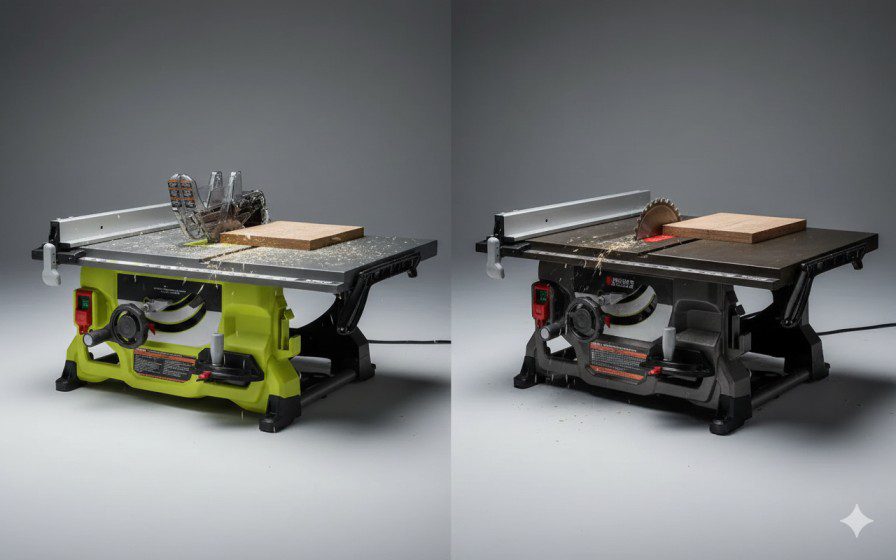
Cast iron tables on premium saws offer advantages:
- Heavier weight reduces vibration
- Better heat dissipation during extended cutting
- Easier to wax for smooth material glide
- More durable—resists scratching and denting better
Aluminum tables on budget saws are lighter (good for portability) but conduct heat less effectively and scratch more easily. For DIY use, this rarely matters. For daily professional use, it becomes noticeable.
Dado Capability
Not all inexpensive table saws accept dado blade stacks:
- SKIL TS6307-00: Accepts dados up to 13/16″ (good)
- Ryobi RTS08: Accepts dados (check specific model)
- Many 8-1/4 inch compact saws: No dado capability
If you plan to do cabinetry or furniture work requiring dados (grooves for shelves, drawer bottoms, etc.), verify dado compatibility before buying. Some budget saws can’t accommodate dado stacks due to arbor length.
Value Tip: Before buying any table saw under $350, check if it accepts dado blades. This single feature determines whether the saw can grow with your skills or limits you to basic cuts forever.
Hidden Costs That Impact Real Value
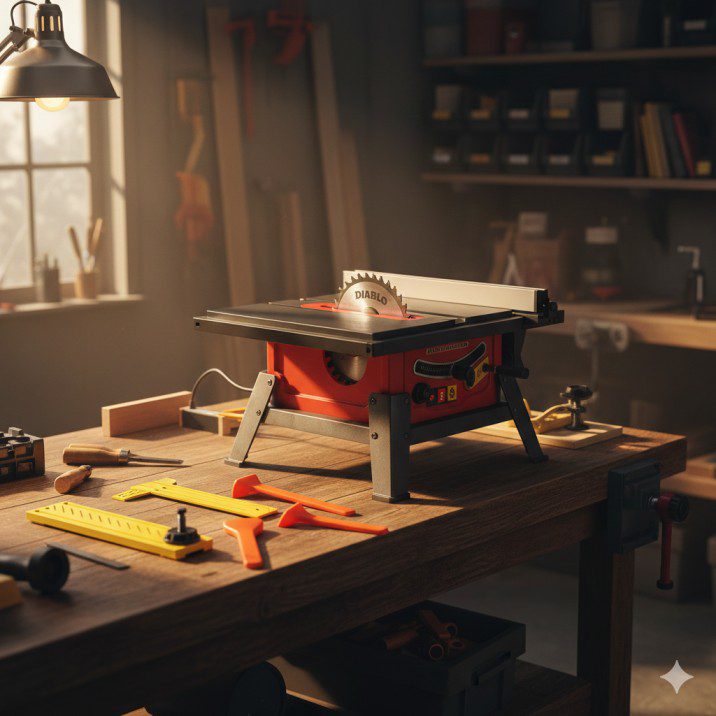
Stand Costs (If Not Included)
Saws without integrated stands require purchasing one separately:
- Basic portable stands: $80-120
- Quality folding stands: $120-180
- Heavy-duty wheeled stands: $180-250
The SKIL TS6307-00’s integrated stand saves $100-150 compared to buying the Ryobi RTS08 plus a separate stand. Factor this into your total cost calculations.
Blade Upgrade Necessity
Every budget saw ships with a mediocre blade—usually a 24-tooth combo blade that tears plywood badly and leaves rough edges.
Budget another $30-60 for blade upgrades:
- 40-tooth combo blade: $25-35 (Diablo, Freud) – Good all-around upgrade
- 60-80 tooth crosscut blade: $35-50 – For smooth plywood and crosscuts
- 24-tooth ripping blade: $20-30 – For fast ripping if you do lots of dimensioning
This isn’t unique to inexpensive saws—even $1000 saws ship with mediocre blades. But it’s a cost to anticipate.
Accessories That Improve Safety and Accuracy
- Upgraded miter gauge: $30-60 (massive accuracy improvement for crosscuts)
- Push sticks/blocks: $10-25 (essential safety equipment)
- Featherboards: $15-30 (keep material tight against fence)
- Zero-clearance insert: $20-40 (reduces tearout dramatically)
You don’t need all of these immediately, but they genuinely improve results and safety.
| Model | Saw Only | With Stand | With Blade | Fully Setup |
|---|---|---|---|---|
| SKIL TS6307 | $329 | $329 (included) | $369 | $429 |
| Ryobi RTS08 | $249 | $369 (+$120 stand) | $409 | $469 |
| Craftsman | $299 | $299 (included) | $339 | $399 |
Fully Setup = Saw + Stand + Quality Blade + Basic Accessories
Need help choosing between these budget options? Check out our comprehensive table saw buying guide for detailed selection criteria, or browse our comparison guides for side-by-side testing results.
Inexpensive Table Saws to Avoid (And Why)
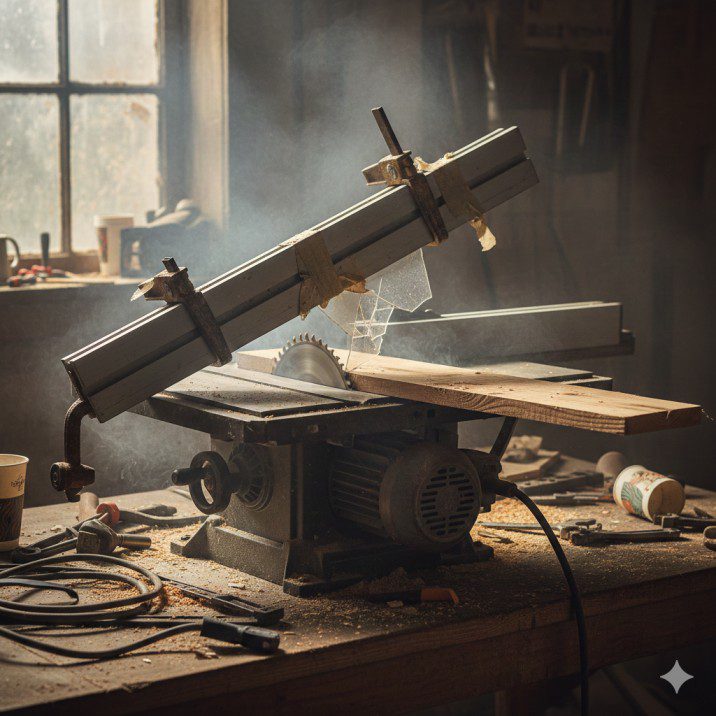
Not every cheap table saw deserves recommendation. Here are models I actively discourage people from buying based on real-world problems.
Ultra-Budget Saws Under $200
I’ve tested several sub-$200 table saws from various brands. Almost all share the same fatal flaws:
- Fences that drift during cuts – Nothing kills accuracy faster than a fence that moves mid-rip
- Underpowered motors – 10-12 amp motors bog down in hardwood and thick material
- Warped tables – Stamped steel tables that arrive bowed or twisted
- Dangerous kickback issues – Poorly designed riving knives and blade guards
- Short lifespans – Motors burn out after 20-40 hours of use
The $100-150 you “save” buying these saws gets wasted when you replace them in 6-12 months. Spend the extra $100-150 and get a saw that actually works.
8-1/4 Inch Compact Saws (Usually)
Small-blade compact table saws seem appealing for tight spaces, but they have significant limitations:
- Reduced cutting depth (typically 2-1/4″ vs 3-1/8″ for 10-inch saws)
- Can’t cut through 4×4 posts in one pass
- Rarely accept dado blade stacks
- Limited rip capacity (usually under 20 inches)
- Same price as full-size budget saws with fewer capabilities
Unless you have severe space constraints, skip compact saws and get a full 10-inch model.
The Honest Bottom Line: Which Inexpensive Table Saw Should You Buy?

After ten years of testing budget and premium table saws, here’s my straight recommendation on the best inexpensive table saws:
If you have $300-350 to spend: Buy the SKIL TS6307-00 for $299-349. It’s the best overall value in budget table saws—rack-and-pinion fence, 25.5-inch rip capacity, integrated stand, 5-year warranty, and dado compatibility. This is the saw I’d buy if I were starting over on a budget.
If you’re limited to $250 or less: The Ryobi RTS08 at $229-259 delivers adequate performance for occasional use. Just budget another $100-120 for a stand and understand the 18-inch rip capacity limits wide panel work.
If you shop at Lowe’s and value brand familiarity: The Craftsman CMXETAX69434509 at $279-319 offers solid American brand quality with metal stand and 3-year warranty. Good middle ground between Ryobi and SKIL.
If you have access to Harbor Freight and want to save money: The Promaker saw at $259-299 (especially on sale) delivers functional performance, but be prepared for potential quality control issues requiring returns/exchanges.
My personal recommendation: For most DIYers and serious hobbyists, the SKIL TS6307-00 at $329 is the sweet spot. You get premium features (rack-and-pinion fence, integrated stand, long warranty) at budget pricing. The $80-100 premium over cheaper options pays for itself in better accuracy, easier setup, and longer lifespan.
Don’t fall into the trap of thinking you need an $800 contractor saw or $1500 cabinet saw to do quality woodworking. The SKIL will build cabinets, furniture, and any project you tackle—I’ve seen it done repeatedly by woodworkers I know.
| Use Case | Recommended Saw | Why It Fits |
|---|---|---|
| Regular woodworking projects | SKIL TS6307-00 | Best fence, capacity, and warranty |
| Occasional DIY use | Ryobi RTS08 | Lowest price, adequate for light use |
| Cabinet & furniture building | SKIL TS6307-00 | Dado compatible, accurate fence |
| Jobsite portability | Craftsman or SKIL | Integrated stands, 45–52 lbs |
| Tight budget under $250 | Ryobi RTS08 | Best value under $250 |
Ready to start your woodworking journey? Visit our how-to tutorial section for essential table saw techniques, safety practices, and setup guides that work with any budget saw.
Frequently Asked Questions
What is the best inexpensive table saw for a beginner?
The SKIL TS6307-00 is the best inexpensive table saw for beginners in 2026, priced at $299-349. It features a rack-and-pinion fence system that delivers accurate cuts without constant adjustment, 25.5-inch rip capacity for handling plywood sheets, an integrated folding stand eliminating the need for separate stand purchase, and a generous 5-year warranty. The intuitive controls and included safety features (blade guard, riving knife, anti-kickback pawls) make it beginner-friendly while the quality components ensure it won’t be quickly outgrown as skills develop.
How much should I spend on a good budget table saw?
Plan to spend $300-400 total for a genuinely good budget table saw setup including the saw, stand (if not included), and a quality blade. The saw itself should cost $250-350—anything under $200 typically has accuracy and durability issues that cause frustration and safety concerns. The sweet spot is $300-350 for the saw, then budget $30-60 for a quality 40-tooth combination blade and $20-40 for basic accessories like push sticks. This $330-450 total investment delivers years of accurate, safe cutting for serious woodworking without overpaying for premium features most DIYers don’t need.
Can cheap table saws make accurate cuts?
Quality budget table saws in the $250-400 range like the SKIL TS6307-00 or Craftsman models can absolutely make accurate cuts comparable to saws costing twice as much. The key is choosing saws with rack-and-pinion fences (not basic T-style fences), flat table surfaces, and adequate 15-amp motors. However, ultra-cheap saws under $200 typically cannot maintain accuracy due to warped tables, drifting fences, and poorly machined miter slots. Accuracy depends more on fence quality and table flatness than motor power—features available in the $300-350 price range but rarely found below $200.
What’s the difference between a $300 table saw and a $1000 table saw?
A $1000 table saw offers cast iron table (heavier, reduces vibration), more powerful motor (1.75-2 HP vs 15 amp), premium fence system with micro-adjustments, better dust collection, quieter operation, superior miter gauge, longer warranty, and overall refinement. However, for cutting accuracy and capability, a quality $300-350 saw like the SKIL TS6307-00 delivers 85-90% of the performance. The $1000 saw feels nicer to use and lasts longer under professional daily use, but the $300 saw produces equally accurate cuts for typical DIY woodworking. The premium is worthwhile for professional daily use but unnecessary for weekend woodworkers.
Do inexpensive table saws accept dado blades?
Some inexpensive table saws accept dado blades while others don’t—this varies by model. The SKIL TS6307-00 accepts dado stacks up to 13/16 inch wide, making it suitable for furniture and cabinet work. Many Ryobi and Craftsman models also accept dados. However, most 8-1/4 inch compact table saws and many ultra-budget saws under $200 cannot accommodate dado blades due to short arbor length or safety design limitations. If you plan to do cabinetry requiring dados (grooves for shelves, drawer bottoms), verify dado compatibility before purchasing—this feature is critical for intermediate and advanced woodworking.
Affiliate Disclosure: This article contains affiliate links to products available on Amazon and other retailers. If you purchase through these links, we may earn a small commission at no additional cost to you. This helps support our website and allows us to continue providing honest, budget-focused table saw reviews based on real workshop experience and extensive testing.

Finlay Connolly is a woodworking enthusiast and power tool specialist with over a decade of hands-on experience in the workshop. As the founder and lead writer at ProTableSawReviews.com, Finlay combines expert knowledge with real-world testing to help woodworkers, DIYers, and professionals choose the best tools for the job. With a sharp eye for detail and a passion for precision, Finlay is committed to providing trustworthy, practical advice backed by years of experience and research in the field. Whether you’re cutting dados or comparing fence systems, you can count on Finlay for honest, reliable reviews that make your next cut your best one.