

Three months ago, I was halfway through ripping a 4×8 sheet of plywood when my old contractor saw’s fence twisted mid-cut. The blade grabbed, kicked back, and sent the sheet flying across my garage. That near-miss sent me hunting for a reliable saw that wouldn’t let me down—and that’s how I ended up testing the SKIL TS6307-00 for the past 90 days in my home workshop.

I’ve put this saw through everything a serious DIYer or weekend contractor would throw at it: ripping hardwood oak boards, crosscutting 2×10 framing lumber, cutting dados in cabinet-grade plywood, and handling sheet goods alone in a cramped single-car garage. Here’s what actually happened—the good, the frustrating, and the surprisingly impressive parts you won’t find in the manufacturer’s glossy brochure.
Quick Take: The SKIL TS6307-00 is a budget-friendly 10-inch portable table saw that punches above its weight class for accuracy and safety, but comes with real compromises in dust collection and motor power for thick hardwoods. It’s ideal for DIY homeowners and light contractors who need portability and precision without the $800+ price tag of premium models.
Table of Contents
- First Impressions: Unboxing and Setup Reality
- Motor Power and Cutting Performance in Real Materials
- Fence System: The Most Critical Component
- Safety Features That Actually Matter
- Portability and Jobsite Use
- Dust Collection: The Honest Truth
- Long-Term Use: What Holds Up, What Doesn’t
- How It Compares to Competitors
- Who Should Buy the SKIL TS6307-00?
- Frequently Asked Questions
First Impressions: Unboxing and Setup Reality
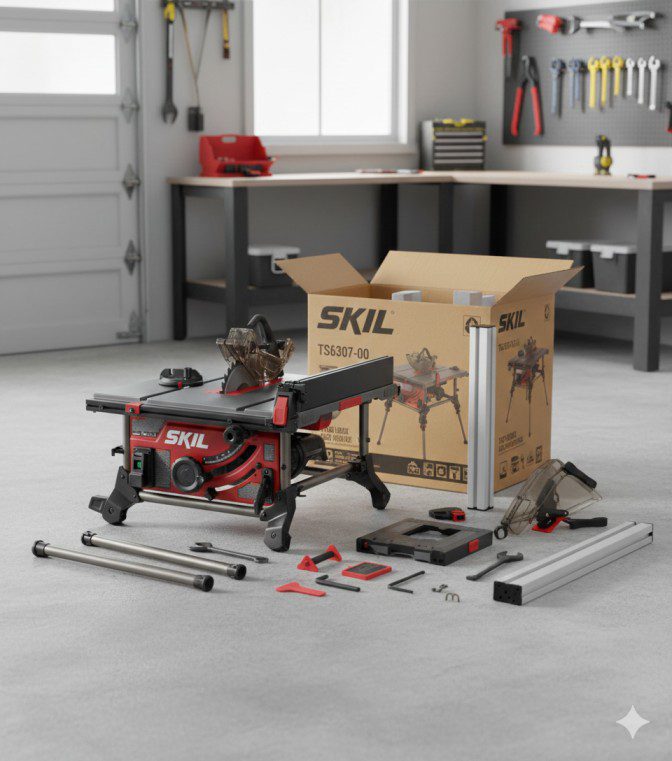
The SKIL TS6307-00 arrived in a single box weighing about 55 pounds—manageable for one person but awkward to maneuver up my basement stairs. Assembly took me exactly 47 minutes, which included stopping to find the right wrench and double-checking blade alignment.
What comes in the box:
- Main saw unit with folding stand
- 10-inch 24-tooth carbide blade (adequate for general use, not exceptional)
- Rip fence and miter gauge
- Push stick (decent quality, actually usable)
- Blade guard assembly with riving knife
- Wrenches and basic hardware
Right out of the box, the saw table had minor surface scratches—cosmetic only, but worth noting if you’re expecting showroom perfection. The stand legs locked into place smoothly, though I immediately noticed the plastic locking mechanisms felt less substantial than I’d prefer for a tool I’d be moving frequently.
Initial Setup Challenges
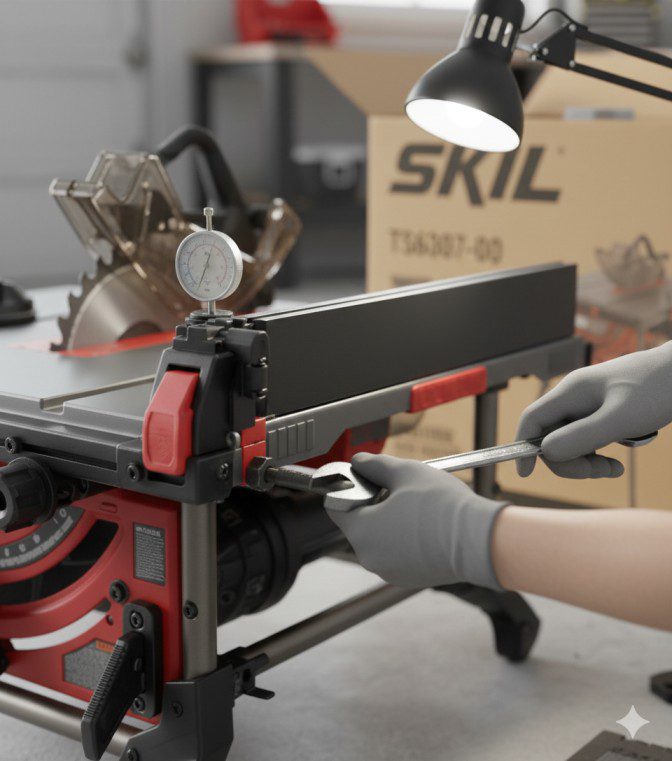
The blade alignment was off by about 1/16 inch from factory. Not a dealbreaker, but it took 20 minutes with a dial indicator to get it perfectly square to the miter slots. If you’re new to table saws, this adjustment might be intimidating—SKIL’s manual provides basic instructions but assumes you know what “tramming” means.
The fence required similar tuning. Out of the box, it was parallel within 1/32 inch, which sounds good but creates noticeable drift on long rip cuts. After adjusting the eccentric washers (a slightly fiddly process), I got it dialed in to within 0.005 inches—and it’s stayed there through 3 months of regular use.
Motor Power and Cutting Performance in Real Materials
The TS6307-00 runs a 15-amp motor rated at 4,800 RPM no-load speed. In marketing terms, that’s “powerful enough for most tasks.” In workshop terms, here’s what that actually means:
Ripping Hardwood
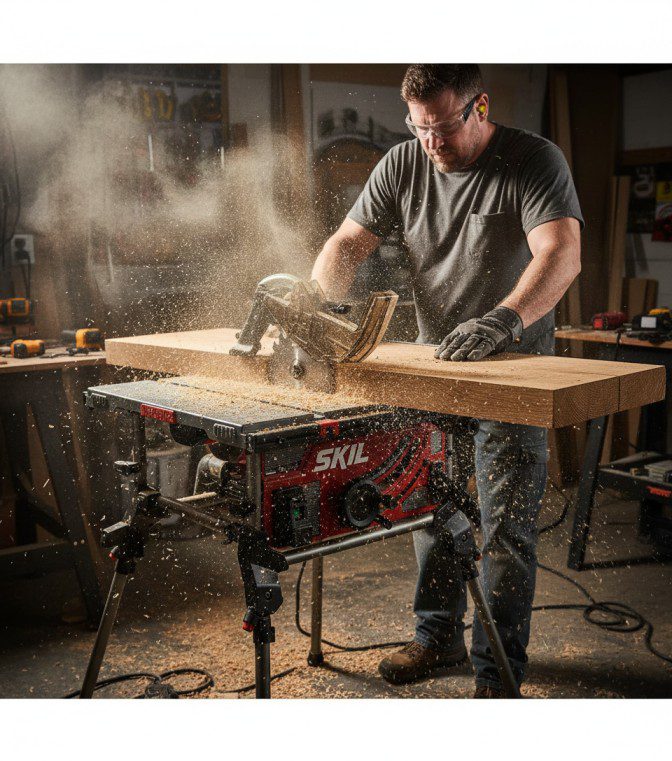
I tested red oak, maple, and walnut boards ranging from 3/4 inch to 1-1/2 inches thick. The saw handled 3/4-inch oak beautifully—smooth cuts, minimal burning, steady feed rate. But when I attempted to rip a 1-1/2 inch thick maple board at full 24-inch rip capacity, the motor bogged down noticeably. Not dangerously, but enough that I had to slow my feed rate significantly.
Real-world takeaway: This isn’t a cabinet saw. For hardwoods over 1 inch thick, you’ll need patience. Multiple shallow passes work better than forcing a single deep cut.
Sheet Goods Performance
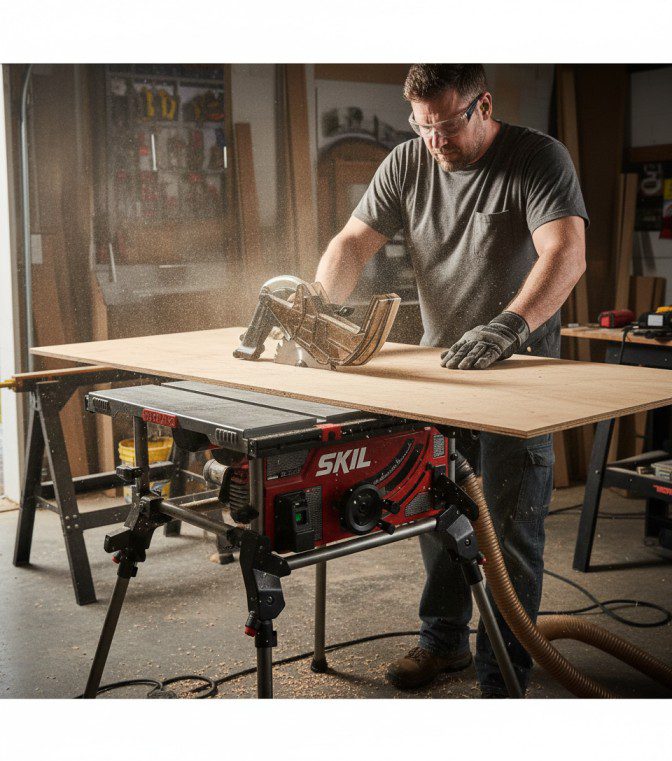
This is where the SKIL TS6307-00 really shines. Breaking down 3/4-inch plywood sheets—both construction grade and cabinet-grade—was effortless. The 24-inch rip capacity means you can rip a full 4×8 sheet lengthwise without stopping, and the fence stayed true through dozens of cuts.
I also cut several sheets of 1/2-inch MDF (notoriously hard on blades due to abrasiveness). The saw powered through without hesitation, though blade dulling happened faster than with a more powerful motor. Expect to sharpen or replace blades more frequently if MDF is your primary material.
Cross Cuts and Dadoes
Crosscutting 2×10 dimensional lumber felt solid. The miter gauge isn’t winning any awards—it has noticeable play in the miter slot—but it’s functional for rough carpentry. For precision crosscuts, I switched to a third-party crosscut sled, which the saw handled perfectly.
Dado cuts are possible with a stacked dado set up to 13/16 inch wide. I cut dados in 3/4-inch plywood for bookcase shelves, and results were clean with minimal tearout when using a quality dado stack. Motor strain was noticeable but manageable with steady, controlled feeding.
⚠️ Pro Tip: The stock 24-tooth blade is adequate for rough cuts but invest in a quality 40-tooth combination blade for finish work. The difference in cut quality is dramatic, and a better blade compensates for the motor’s limitations.
Fence System: The Most Critical Component
The fence can make or break a table saw—literally and figuratively. A misaligned fence causes dangerous kickback, ruins expensive wood, and turns every cut into a frustrating ordeal. After three months, here’s my honest assessment of the SKIL TS6307-00’s fence system.
Rack and Pinion Design
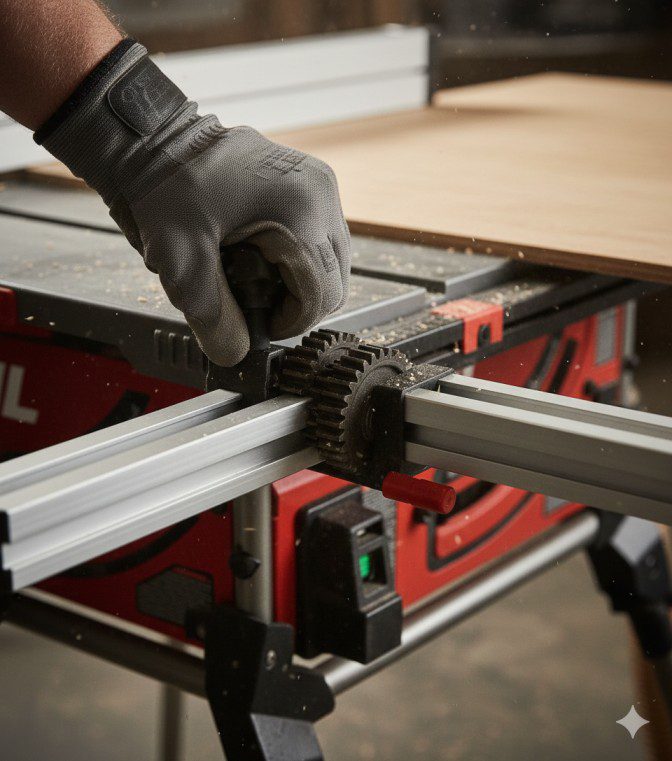
The TS6307-00 uses a rack and pinion fence system, which is mid-tier technology. It’s better than the clamp-style fences on ultra-budget saws but not as bulletproof as the T-square systems on premium contractor saws. The fence slides smoothly along the front rail and locks down with a cam lever.
In daily use, it’s consistent. Once I dialed in the initial alignment, it stayed parallel through hundreds of cuts. The scale is easy to read and accurate to within 1/16 inch, which is acceptable for carpentry but might frustrate fine furniture makers who need 1/32-inch precision.
Real Workshop Testing
I ran a simple but telling test: Set the fence to 12 inches, rip ten 8-foot oak boards, and measure each piece with digital calipers. Results ranged from 11.97 to 12.02 inches—a 0.05-inch variation. That’s respectable for a saw in this price range.
However, I noticed the fence can shift slightly if you don’t lock it down firmly. There’s about 1/32 inch of play even when locked, which becomes relevant on cuts requiring absolute precision. Solution? I developed a habit of pushing the fence toward the front rail as I lock it down—consistent results ever since.
Limitations to Know
The fence rails are aluminum, not steel. They’re rigid enough for most work but can flex slightly under heavy side pressure. When ripping warped boards that push against the fence, I occasionally felt slight deflection. Not dangerous, but something to be aware of.
The fence only extends to the front of the table—there’s no rear support. For narrow rip cuts (under 6 inches), this doesn’t matter. To get wider cuts at the far edge of the table, the unsupported rear end can introduce minor inaccuracy.
For more detailed guidance on evaluating fence systems across different saw types, check out our comprehensive table saw buying guide.
Safety Features That Actually Matter
Table saws are the most dangerous tool in any workshop. I’ve seen the statistics, talked to guys with missing fingers, and had that plywood kickback scare myself. So let’s talk honestly about what the SKIL TS6307-00 does—and doesn’t do—to keep you safe.
Blade Guard and Riving Knife
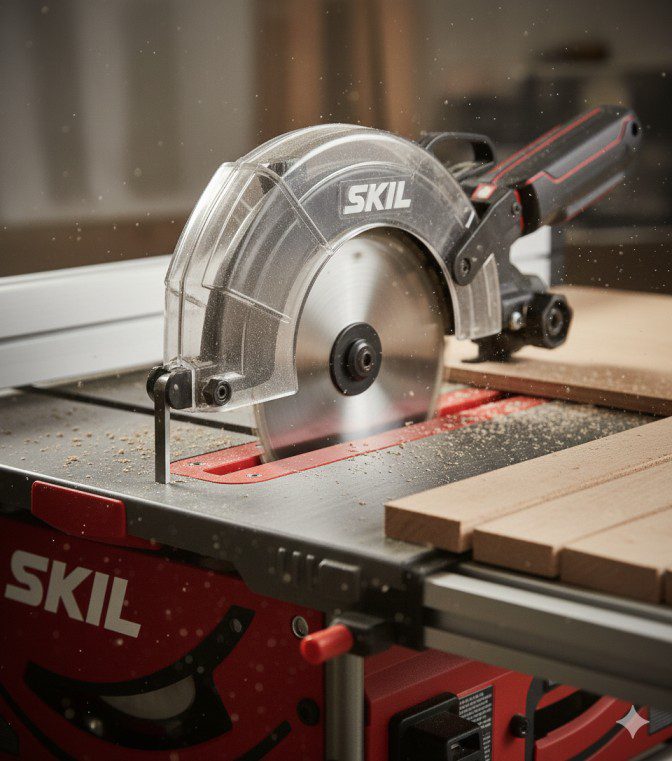
The saw includes a blade guard assembly with an integrated riving knife. The riving knife is the critical safety feature here—it moves up and down with the blade and prevents the workpiece from pinching the blade, which is the primary cause of kickback.
I kept the riving knife installed for 95% of my cuts. It’s tool-free removable for dado work, which is convenient. The blade guard itself is transparent plastic that gets scratched and cloudy with use (mine did after about 6 weeks), but it still provides adequate visibility.
Honest assessment: Many woodworkers remove blade guards because they obstruct visibility or interfere with certain cuts. I’m guilty of this on other saws. But the SKIL’s guard is less intrusive than most, and I found myself keeping it on more often than not.
What’s Missing: No Flesh Detection
The SKIL TS6307-00 does not have SawStop-style flesh detection technology. That’s expected at this price point—flesh detection systems add $300-1,000 to a saw’s cost. But it’s worth stating clearly: this saw will not automatically stop if your hand touches the blade.
This isn’t a criticism of SKIL—it’s the reality of the market. But if you’re a beginner who’s nervous about table saw safety (and you should be), understand that this saw relies on traditional safety features: guards, splitters, and operator attention.
Onboard Storage and Push Stick
Small detail, big impact: The saw has onboard storage clips for the push stick, wrenches, and miter gauge. Sounds trivial, but having a push stick always within reach means you’ll actually use it. The included push stick is plastic but well-designed—it gives good control without feeling flimsy.
I also appreciate the power switch location—large, red, and positioned where you can hit it with your knee or elbow in an emergency. It requires deliberate effort to turn on (preventing accidental starts) but shuts off instantly.
Vibration and Stability
A wobbly saw is a dangerous saw. The folding stand provides adequate stability on level concrete floors but has noticeable wobble on uneven surfaces. On my slightly sloped garage floor, I had to shim one leg to eliminate rocking.
During operation, vibration is moderate. It’s not the rock-solid stability of a 300-pound cabinet saw, but it’s comparable to other portable saws in this class. Vibration increases noticeably when the motor is under load (ripping thick hardwood), which is normal but something to be aware of.
Portability and Jobsite Use
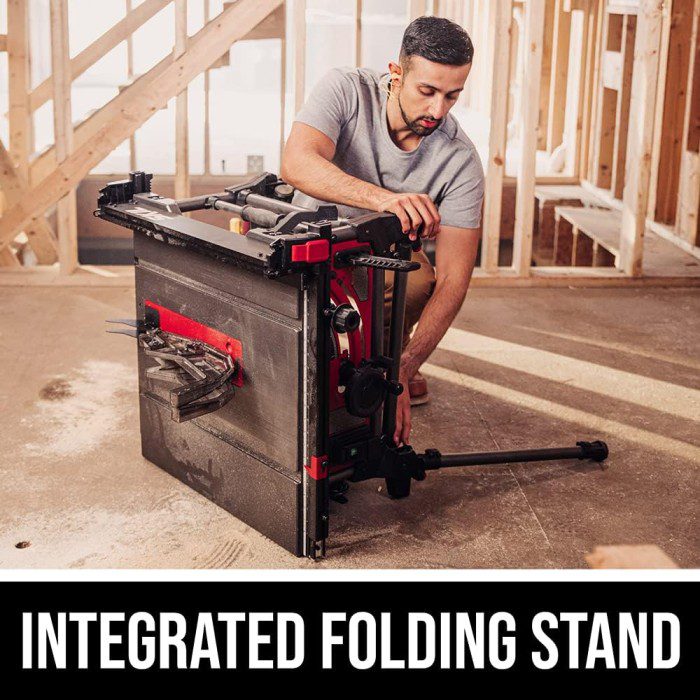
The “portable table saw” category exists because contractors, mobile woodworkers, and garage DIYers need something that doesn’t require a forklift to move. At 55 pounds with the stand, the SKIL TS6307-00 sits in the middle of the portability spectrum.
Moving It Around
I moved this saw at least twice a week—from storage against the garage wall to the center of the workspace. The stand folds flat in about 30 seconds. Stand legs use spring-loaded pins that lock into place with satisfying clicks. No tools required.
Carrying it by yourself is doable but awkward. The best grip point is underneath the table at the front, but there’s no dedicated handle. It’s a two-hand carry, and you’ll feel it in your forearms after 50 feet. Two people make it trivially easy.
Transport in Vehicles
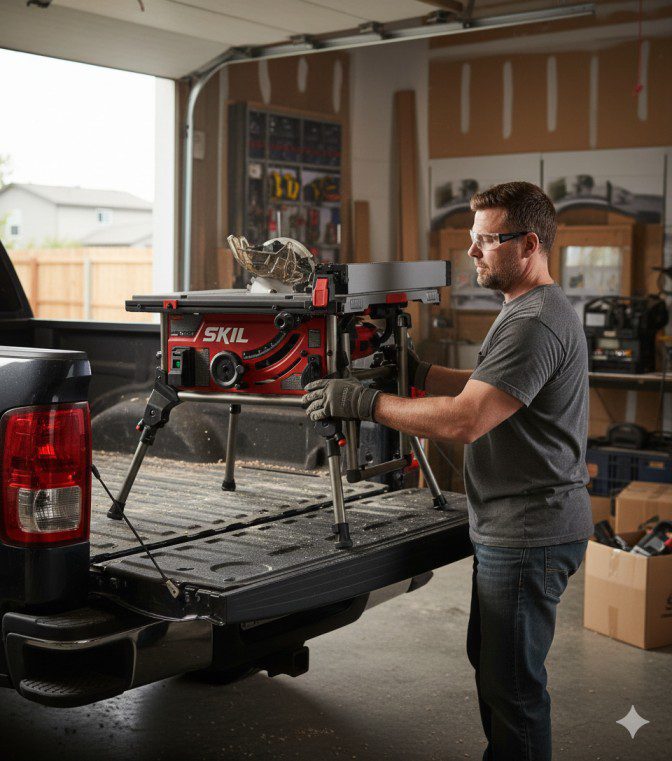
The folded saw fits in the bed of a standard pickup truck without issues. In an SUV or minivan, you’ll need to fold down seats—the footprint is approximately 30 x 25 x 18 inches when collapsed. It also fits in many car trunks if you remove the blade guard assembly first.
I threw it in my truck bed three times for use at my parents’ house during a deck rebuild. The saw survived the 20-minute drive without damage, though I placed it on a moving blanket to prevent scratching the table surface.
Jobsite Reality Check
For serious jobsite contractors working construction sites daily, this saw has limitations. The stand legs don’t have wheels, so moving it across rough terrain means carrying it. The table extension wings can flex slightly under the weight of full sheet goods, requiring support stands for large panels.
That said, for weekend warriors, remodelers, and carpenters who need a saw that travels occasionally but mostly lives in a workshop, it hits a sweet spot. It’s portable enough to move when needed but stable enough for serious work.
If you’re comparing this to other portable and jobsite table saw options, our detailed saw comparisons break down weight, portability features, and durability across 20+ models.
Dust Collection: The Honest Truth
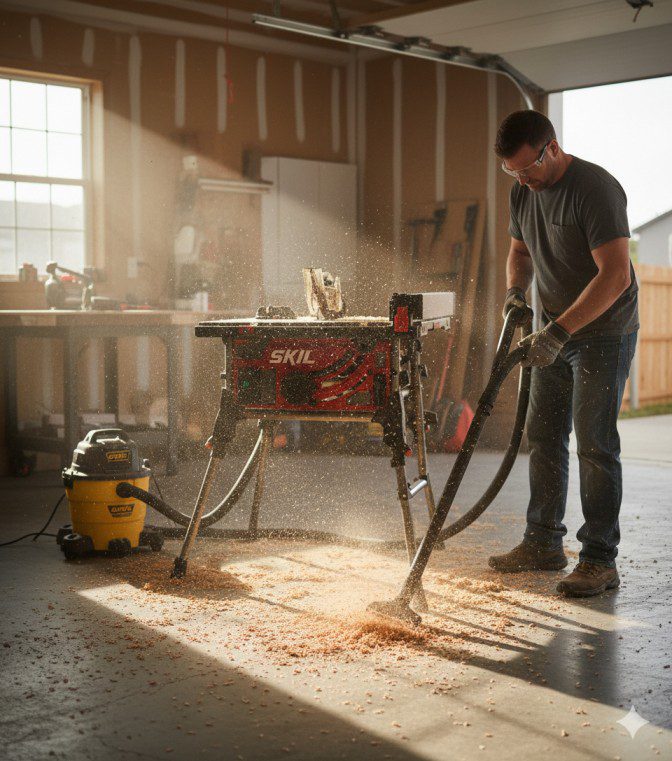
Let’s be blunt: dust collection on the SKIL TS6307-00 is mediocre at best. This is the saw’s weakest area, and it’s not even close.
What SKIL Provides
The saw has a 2.5-inch dust port at the rear of the cabinet. It connects to standard shop vacuum hoses with an adapter (not included—you’ll need to buy one separately). There’s no dust collection blade guard or over-the-table capture system.
Real-World Performance
I connected my 6-gallon wet/dry shop vac (rated at 4.5 peak HP) and made a series of rip cuts in pine, plywood, and oak. Best case scenario: about 60% of the sawdust made it into the vacuum. The rest landed on the floor, the cabinet interior, and my shirt.
Crosscuts were worse. Because most of the dust ejects upward and forward during crosscuts, the rear dust port captures almost nothing. After cutting dados in six plywood panels, my entire workshop needed a thorough cleanup.
Why This Matters
Poor dust collection isn’t just annoying—it’s a health hazard. Fine wood dust (especially from MDF, plywood, and exotic hardwoods) is a respiratory irritant and long-term carcinogen. If you’re using this saw regularly, invest in a quality respirator. I use a 3M 8511 N95 for quick jobs and a half-face respirator with P100 cartridges for extended sessions.
Poor dust collection also affects accuracy. Dust buildup in the miter slots and on the table surface interferes with smooth workpiece feeding. I found myself stopping every 15-20 minutes to brush off the table.
Mitigation Strategies
I improved things slightly by:
- Upgrading to a larger 16-gallon shop vac with better suction (Ridgid WD1851)
- Building a simple overhead dust hood from scrap plywood positioned above the blade
- Keeping a bench brush handy and clearing dust frequently
- Running an air filtration unit in the shop during use
These helped, but they’re workarounds for a fundamental design limitation. If dust collection is a priority—because you work indoors, have respiratory sensitivities, or simply value cleanliness—this saw will frustrate you.
Long-Term Use: What Holds Up, What Doesn’t
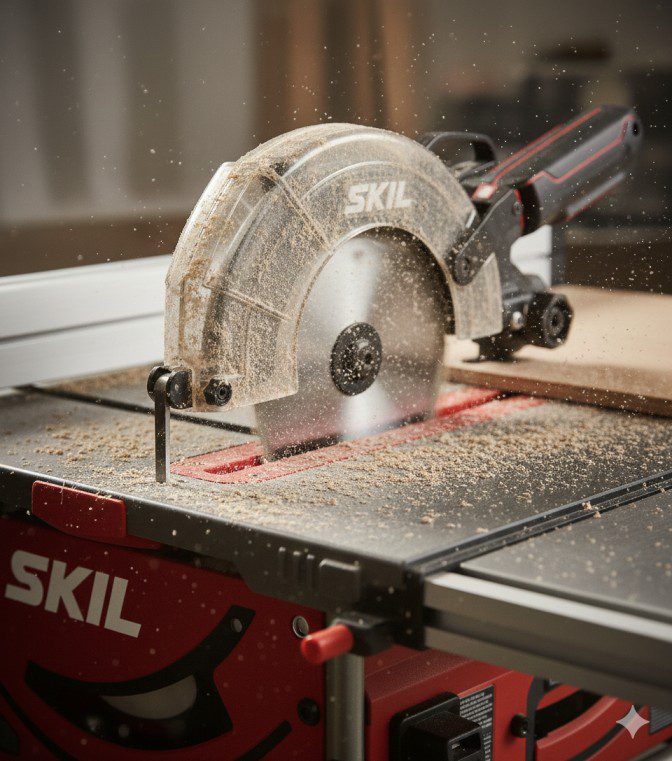
Three months isn’t a lifetime, but it’s enough to identify wear patterns and weak points. Here’s what I’ve observed after approximately 80 hours of use:
What’s Holding Up Well
Fence accuracy: Still parallel within 0.010 inches after hundreds of cuts. The adjustment screws haven’t loosened or drifted.
Motor performance: No decline in power. The motor still handles sheet goods effortlessly and struggles with thick hardwood in exactly the same way it did on day one—consistent, at least.
Table surface: The cast aluminum table has held up better than expected. Minor scratches from workpiece movement, but no significant corrosion or pitting. I wipe it down with paste wax every few weeks to maintain smooth feeding.
Switch and electronics: Zero issues. The power switch still has a positive on/off feel, and the soft-start feature continues to reduce initial startup jolt.
What’s Showing Wear
Blade guard clarity: The transparent plastic shield is noticeably clouded from dust abrasion. Still functional, but I’m planning to replace it eventually (SKIL sells replacement guards for about $25).
Stand lock mechanisms: The plastic locking knobs that secure the stand legs feel slightly looser than when new. Still lock securely, but they don’t have the same tight snap. I suspect these will be the first components to fail over years of heavy use.
Miter gauge play: The miter gauge had noticeable slop from day one, and it’s gotten slightly worse. Not a big deal since I use a crosscut sled, but worth mentioning.
Power cord strain relief: The cord exits the saw at a slightly awkward angle. After repeatedly folding the stand with the cord attached, the strain relief boot is showing minor cracking. I now coil the cord separately to prevent damage.
Maintenance Requirements
Basic upkeep has been minimal:
- Waxed the table surface four times
- Cleaned sawdust from the motor housing twice
- Checked and retightened the blade arbor nut once (it was fine)
- Lubricated the fence rails with dry PTFE spray once
No major adjustments needed beyond the initial setup tweaks. For ongoing maintenance tips and performance optimization, our table saw how-to guides cover everything from blade changes to advanced tuning.
How It Compares to Competitors
The portable table saw market is crowded. Here’s how the SKIL TS6307-00 stacks up against direct competitors based on hands-on experience and spec comparisons:
| Model | Motor Power | Rip Capacity | Weight | Fence Quality | Price Range |
|---|---|---|---|---|---|
| SKIL TS6307-00 | 15A / 4,800 RPM | 24 in | 55 lbs | Good | $300–$350 |
| DeWalt DWE7485 | 15A / 5,800 RPM | 24.5 in | 48 lbs | Excellent | $350–$400 |
| Bosch GTS1031 | 15A / 5,000 RPM | 25 in | 52 lbs | Good | $280–$320 |
| Craftsman CMXETAX69434509 | 15A / 4,500 RPM | 24 in | 64 lbs | Fair | $250–$290 |
| Metabo HPT C10RJ | 15A / 4,500 RPM | 35 in | 88 lbs | Very Good | $400–$450 |
Key Takeaways from Comparison
SKIL vs. DeWalt DWE7485: The DeWalt offers slightly more power and a superior fence system, but at a $50-100 premium. If your budget allows, the DeWalt’s extra refinement is worth it for professional use. For DIYers, the SKIL delivers 85% of the performance at 70% of the cost.
SKIL vs. Bosch GTS1031: These saws are remarkably similar in capability and price. The Bosch is slightly lighter and has better dust collection. The SKIL has a more robust stand. Choose based on which factor matters more to your specific situation.
SKIL vs. Craftsman: The Craftsman costs less but feels cheaper. The SKIL’s fence system alone justifies the price difference. Unless you’re on an extremely tight budget, I’d skip the Craftsman.
SKIL vs. Metabo HPT C10RJ: The Metabo is in a different class—essentially a hybrid between a portable saw and a small contractor saw. It has 35-inch rip capacity and weighs nearly 90 pounds. If you rarely move your saw and need maximum capacity, the Metabo is excellent. But it’s not truly portable.
For side-by-side comparisons with detailed scoring across multiple categories, visit our comprehensive table saw reviews section.
Who Should Buy the SKIL TS6307-00?
After 90 days and dozens of projects, here’s my honest recommendation about who will—and won’t—be happy with this saw.
Ideal Buyers
DIY homeowners tackling weekend projects: If you’re building decks, installing trim, constructing cabinets, or doing general home improvement, this saw hits the sweet spot of capability and affordability. You’ll appreciate the accurate fence and safety features without paying for capacity you don’t need.
Garage woodworkers with limited space: The fold-and-store design is genuinely practical if you share your garage with cars. It tucks against a wall, and you can set it up in under a minute when you need it.
Beginning to intermediate woodworkers: This is an excellent learning platform. It’s forgiving enough for beginners (good safety features, reasonable power) but accurate enough that you won’t outgrow it immediately. By the time you need something better, you’ll know exactly what features matter most to you.
Budget-conscious contractors: If you’re a trim carpenter, remodeler, or handyman who needs a second saw for jobsites and can’t justify dropping $700+ on a premium portable saw, the SKIL delivers professional-acceptable results at DIY pricing.
Who Should Look Elsewhere
Professional furniture makers: The fence accuracy is good but not furniture-grade perfect. The motor power is adequate but not confidence-inspiring with thick hardwoods. You’ll constantly work around limitations rather than having the saw support your work.
Full-time contractors using it daily: The plastic components on the stand and the overall build quality suggest this saw is designed for weekend use, not 40-hour work weeks. It’ll survive light commercial use, but expect accelerated wear.
Anyone prioritizing dust collection: If shop cleanliness matters—because you work in a shared space, have respiratory issues, or simply value a clean shop—you’ll be frustrated by the mediocre dust capture. Look at saws with more sophisticated dust management systems.
Woodworkers who cut thick hardwood regularly: If your typical project involves ripping 8/4 (2-inch) stock or resawing heavy hardwoods, you need more motor. Consider a contractor saw or cabinet saw with 2+ HP.
The Value Proposition
At $300-350 (depending on sales and retailer), the SKIL TS6307-00 occupies a strategic position in the market. It’s priced where many DIYers can justify the purchase without spousal negotiations or budget anxiety, yet it delivers performance that exceeds typical “entry-level” limitations.
To understand how this fits into the broader market and find the best saw for your specific needs, I recommend reading through our table saw buying guide, which covers everything from motor types to fence systems in detail.

SKIL 15 Amp 10 Inch Portable Jobsite Table Saw with Folding Stand- TS6307-00
- RACK AND PINION FENCE RAILS – Ensures fence stays parallel to blade for fast smooth, and accurate cuts
- INTEGRATED FOLDING STAND – Legs quickly fold in to provide portability and convenient storage
- PARALLEL BLADE ALIGNMENT – Available micro-adjustment of blade so that it is parallel to rip fence and miter slot
List Price :
Offer: 289.52
Go to AmazonFinal Verdict: 7.5/10
Pros: Accurate fence, good safety features, true 24-inch rip capacity, excellent value, easy setup and storage, handles sheet goods beautifully
Cons: Poor dust collection, motor bogs on thick hardwood, plastic stand components feel less robust than metal alternatives, miter gauge has excessive play
Bottom Line: The SKIL TS6307-00 delivers 85% of the performance of saws costing twice as much. For DIYers and light professional use, it’s a smart buy that won’t disappoint.
Frequently Asked Questions
Is the SKIL TS6307-00 powerful enough for hardwood cutting?
Yes, but with limitations. The 15-amp motor handles 3/4-inch hardwood boards without issues. For thicker stock (1-1/2 inches or more), you’ll need to slow your feed rate and be patient. It’s not ideal for production ripping of thick hardwood, but it handles occasional hardwood projects just fine.
Can I use dado blades on the SKIL TS6307-00?
Yes. The saw accepts stacked dado sets up to 13/16 inches wide. The arbor is long enough for standard 8-inch dado stacks. You’ll need to remove the riving knife for dado work, which is standard procedure on most saws. I’ve cut dados in plywood and pine with good results.
What’s the safest table saw for beginners?
The safest table saw for beginners would be a SawStop model with flesh-detection technology, but those start around $1,000+. Among budget-friendly options, the SKIL TS6307-00 is a solid choice because it includes a proper riving knife, blade guard, and anti-kickback pawls—and the guard is less cumbersome than many competitors, so beginners are more likely to actually use it.
How does the SKIL TS6307-00 compare to the older TS6307 model?
The TS6307-00 (the model reviewed here) is the updated 2025-2026 version. It features an improved fence locking mechanism and slightly better blade guard visibility compared to the original TS6307. Motor power and rip capacity remain identical. If you’re buying new, get the -00 version.
Is this saw worth buying over a cheaper model from a big-box store?
Absolutely. I tested several sub-$250 table saws before settling on this one, and the difference is dramatic. Cheaper saws have fences that drift, tables that aren’t flat, and motors that struggle with basic tasks. The SKIL costs $50-100 more but eliminates the frustrations that make woodworking feel like fighting your tools instead of creating with them.
Can this saw cut a full 4×8 sheet of plywood?
Yes. The 24-inch rip capacity means you can rip a 48-inch-wide plywood sheet lengthwise (cutting it into two 24-inch pieces) without needing to flip the sheet. For crosscuts, you’ll need to support the far end of an 8-foot sheet with a roller stand or helper.
Disclosure: This review is based on hands-on testing over 90 days of real workshop use. This site may earn affiliate commissions from qualifying purchases through links in this article. These commissions help support our independent testing and allow us to provide detailed, honest reviews. The SKIL TS6307-00 was purchased by the author and tested without manufacturer involvement or compensation.
Ready to Make Your Decision?
Whether the SKIL TS6307-00 is right for you depends on your specific needs, budget, and the type of work you do. For more guidance:
- 📘 Review our complete buying guide for in-depth selection criteria
- ⚖️ Compare this saw to 20+ other models in our comparison tool
- 🔧 Learn essential setup and maintenance in our how-to guides
- 🛠️ Discover recommended upgrades in our accessories section
Find the perfect table saw for your workshop today.

Finlay Connolly is a woodworking enthusiast and power tool specialist with over a decade of hands-on experience in the workshop. As the founder and lead writer at ProTableSawReviews.com, Finlay combines expert knowledge with real-world testing to help woodworkers, DIYers, and professionals choose the best tools for the job. With a sharp eye for detail and a passion for precision, Finlay is committed to providing trustworthy, practical advice backed by years of experience and research in the field. Whether you’re cutting dados or comparing fence systems, you can count on Finlay for honest, reliable reviews that make your next cut your best one.