Best Mini Table Saws for Crafts and Woodworking 2026
 Finlay Connolly
24 min read
Finlay Connolly
24 min read
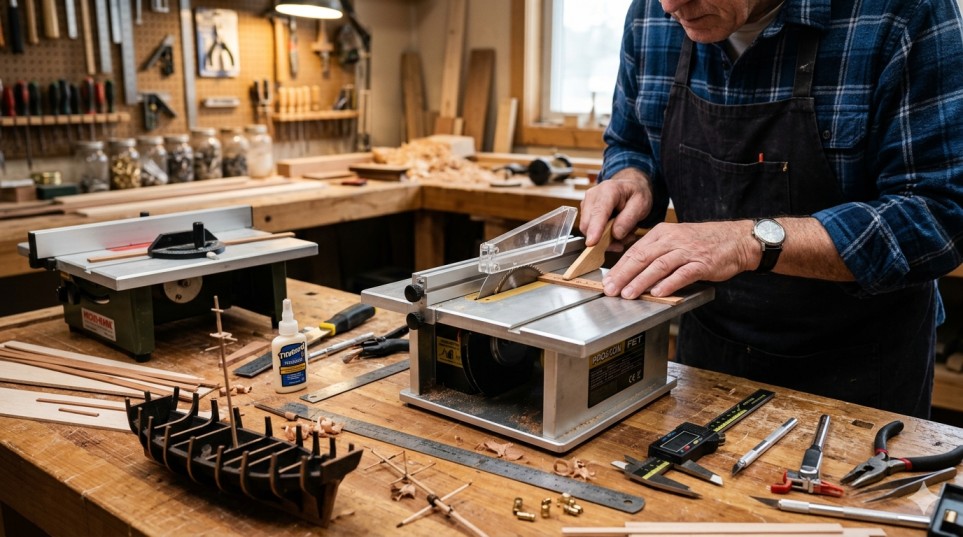
Proxxon • MicroLux • Byrnes • WEN • Rockwell — Honest Picks for Hobbyists, Model Makers and Craft Workers
$100 to $650 • Balsa to Hardwood • Model Builders, Luthiers, Craft Workers, DIYers
Why Mini Table Saws Are a Separate Category
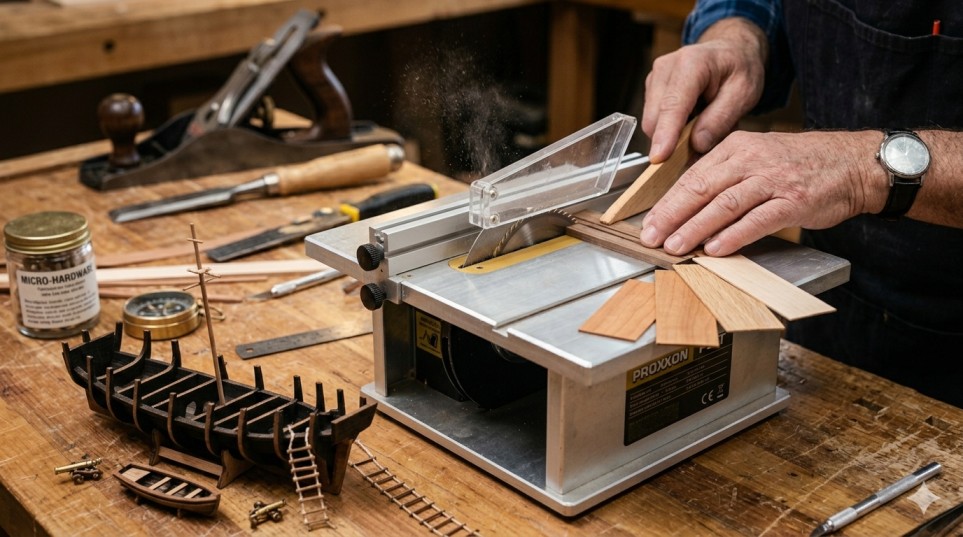
A mini table saw is not a scaled-down contractor saw. It’s a fundamentally different tool designed for work that full-size saws handle badly — cutting 2mm basswood strips for a ship model, slicing 1/8-inch balsa for aircraft ribs, trimming guitar fret slots, dimensioning thin hardwood for marquetry, or cutting small acrylic panels for an electronics enclosure. The blade diameter typically runs 60mm to 100mm. The table surface is measured in square inches, not square feet. And precision at small scale — blade wobble measured in hundredths of a millimeter, fences that hold position on cuts measured in fractions of a millimeter — matters more than the horsepower.
The community that uses these tools seriously — ship model builders, miniaturists, luthiers, pen turners, RC modelers — has been evaluating them honestly for years. The conclusions are well-documented across forums like Ships of Scale, the WoodenBoat Forum, and Model Ship World. I’ve drawn heavily on that collective experience alongside my own testing because these users push mini saws harder and more critically than any product review team would.
This guide sorts the market into tiers that reflect reality, tells you what the community has found wrong with each saw (not just what the marketing says), and gives you a straight recommendation based on what you actually make.
The Three Tiers You Need to Understand
Mini table saws split into three distinct tiers and buying in the wrong one is a common, expensive mistake.
Tier 1: Precision Hobby Saws ($300–$650)
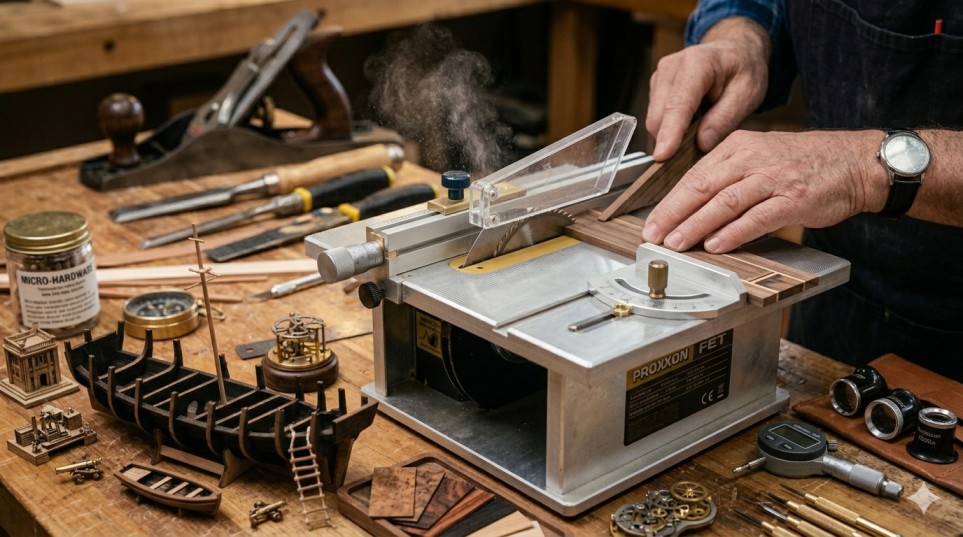
Proxxon FET, MicroLux Mini Tilt Arbor, and Byrnes Model Machines. These are proper instruments — machined aluminum tables, ball-bearing motors, genuine fence systems. They’re designed for model builders, luthiers, and craftspeople who need sub-millimeter accuracy on delicate materials. They’re not fast, they’re not powerful, but they’re precise in a way that cheaper saws cannot match.
Tier 2: Compact Benchtop Saws ($130–$300)
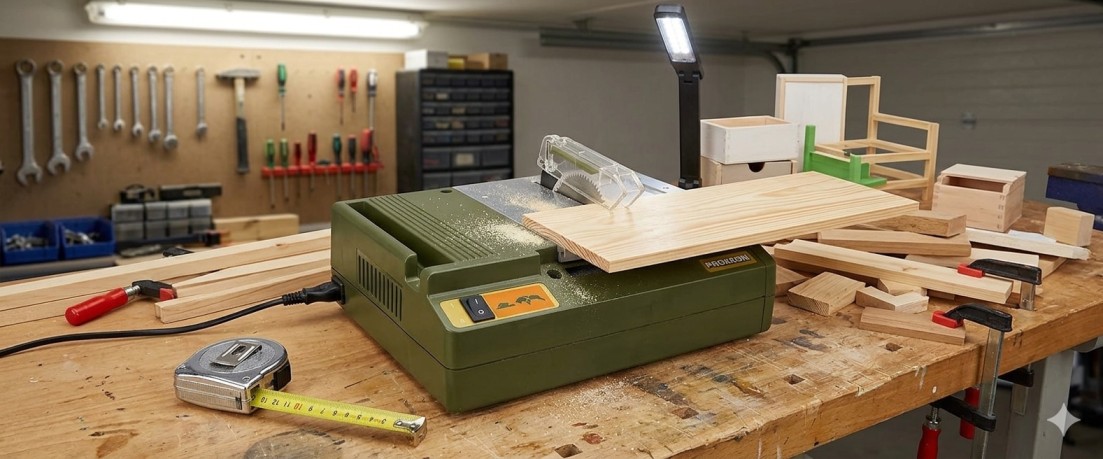
WEN 34035, Proxxon KS 230, smaller benchtop models. These handle light woodworking, DIY projects, thin boards, trim, and occasional craft work. They’re real table saws at smaller scale — not toy-grade, not instrument-grade. For someone who needs a table saw that fits on a workbench and cuts small parts, this is the right tier.
Tier 3: Ultra-Compact and Budget Mini Saws (Under $150)
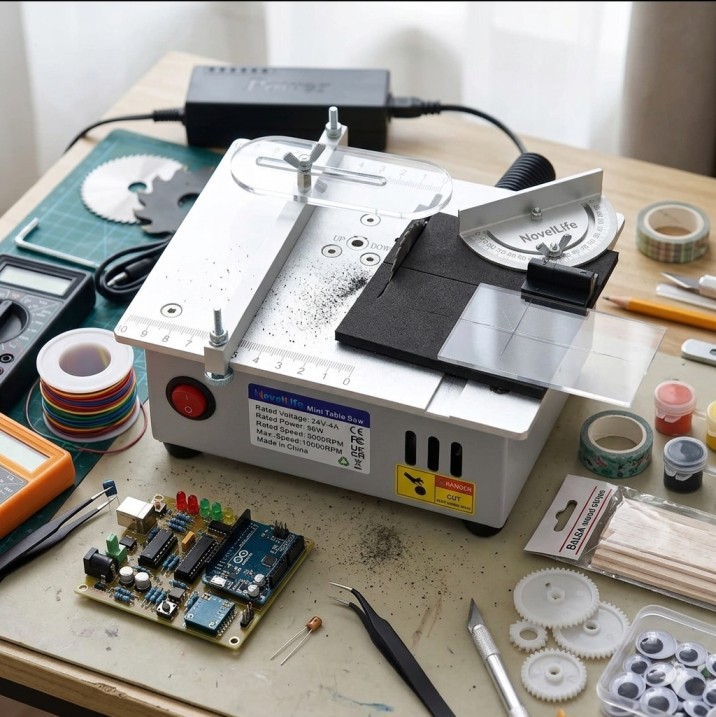
NovelLife, Goplus, and the various generic 100W craft saws from Amazon and Walmart. These work for PCB boards, foam, thin acrylic, and light balsa cutting. They’re not woodworking tools in any meaningful sense. Their motors aren’t powerful enough for anything structural, their tables flex, and their fences are suggestive rather than accurate. Fine for electronics hobbyists and occasional paper/foam cutting. Not fine for anyone expecting wood furniture results.
The most common mistake: Buying a Tier 3 saw expecting Tier 1 results. A $80 mini craft saw and a Proxxon FET are not the same product category. If you’re doing scale model planking, marquetry, or fret slots, the Tier 3 saws will frustrate you immediately. Buy once from the right tier.
1. Proxxon FET — The Benchmark for Precision Hobby Work
| Motor | 100W brushless, 5,000 RPM |
| Blade Size | 80mm (3.15″) — Proxxon-specific sizing |
| Blade Wobble | Under 0.05mm — community verified |
| Max Cut Depth | 20mm at 90°, 12mm at 45° |
| Tilt System | Tilting arbor (blade tilts, table stays flat) |
| Table Size | 200 x 150mm (7.87″ x 5.9″) |
| Variable Speed | No — single speed |
| Price (2026) | $300–$350 (Amazon, Proxxon direct) |
The Proxxon FET has been the community standard for precision hobby sawing for many years, and its position at the top of the tier holds in 2026. The tilting arbor design — where the blade tilts rather than the table — is a genuine advantage for small delicate work because the material stays flat on the table throughout the cut. You’re not fighting gravity on a tilting work surface, which matters when you’re holding a 3mm strip of pear wood at 30 degrees.
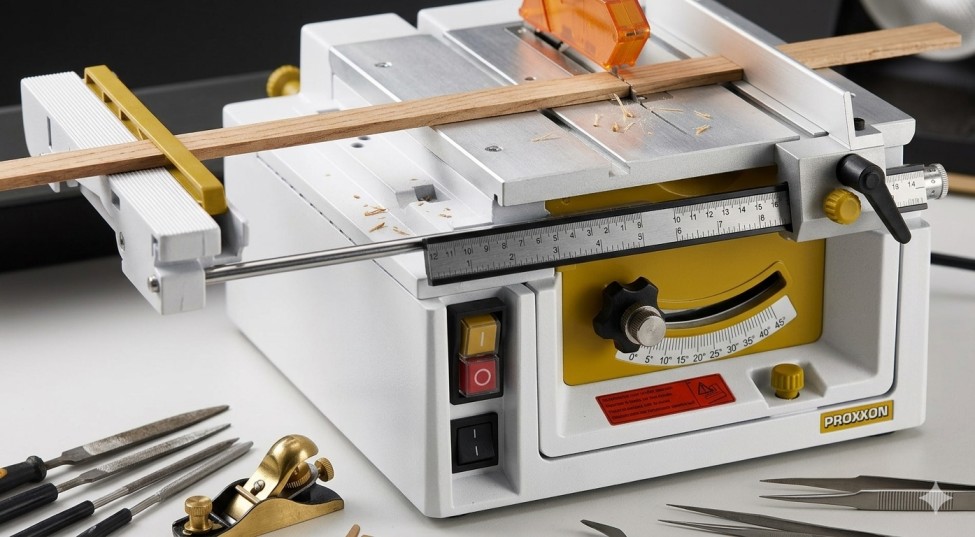
The ball-bearing motor runs at 5,000 RPM and produces less than 0.05mm of blade wobble in community measurements. For plank cutting on ship models, veneer, marquetry, and softwood strips down to 1 or 2mm thickness, that precision is real and immediately visible in the cut quality.
What the Community Says About the Fence
This is where the honest review diverges from the marketing. The Proxxon FET has a fence problem that is universally acknowledged across ship modeling and woodworking forums. One Ships of Scale member describes it directly: Proxxon has a very bad fence which requires modifications to work as intended. A WoodenBoat Forum member confirms: The fence needs some attention if you want more accuracy.
The fix is documented and straightforward — adding a small shim or tensioning mechanism to the fence base eliminates most of the slop. Numerous forum members describe doing this modification within days of receiving the saw and being happy with it afterward. But it is a modification you will likely need to make. Plan for it rather than being surprised.
The Blade Situation
Proxxon’s 80mm blades are proprietary sizing, which means aftermarket options are more limited than for standard-sized saws. The community consensus is clear: the blades that ship with the Proxxon are adequate for balsa and softwood but not optimal for hardwoods or plastics. Multiple forum members specifically recommend third-party 80mm blades for better results on denser materials.
One critical limitation: the Proxxon FET overheats on metals. A Model Engineer forum member tested it on non-ferrous metals and found while the cut quality was acceptable, the motor cut out from thermal protection. The FET is a wood and plastic saw. For metals, look elsewhere.
Who Should Buy the Proxxon FET
- Ship model builders, architectural model makers, and anyone working with thin wood strips daily
- Luthiers cutting fret slots, binding channels, and small inlay pieces
- Marquetry and veneer work where blade wobble directly affects joint fit
- Anyone who can accept the fence modification as part of the setup process
Who Should Look Elsewhere
- Anyone cutting metals regularly — the motor will overheat
- People who need variable speed for plastic cutting — the FET has no speed control
- Woodworkers who need more than 20mm cut depth

PROXXON Precision Saw
The PROXXON Precision Saw is a compact woodworking tool designed for detailed cutting tasks. Its small footprint and accurate cutting performance make it suitable for hobby projects, model making, crafts, and precise work with materials like wood, plastic, and non-ferrous metals.
- Compact design for workshops and hobby spaces
- Precision cutting for detailed projects
- Suitable for wood, plastic, and soft metals
- Stable construction for accurate operation
- Ideal for crafts, models, and fine woodworking
*As an Amazon Associate, we may earn from qualifying purchases.
2. MicroLux Mini Tilt Arbor Table Saw — Best Value Precision Saw
| Motor | Variable speed, ~100W |
| Blade Size | 68mm (2.68″) — Micro-Mark specific |
| Tilt System | Tilting arbor (same advantage as Proxxon FET) |
| Variable Speed | Yes — critical for plastic cutting |
| Table | Cast aluminum, precision milled slots |
| Fence | Simple cam-lock design, more reliable than Proxxon stock fence |
| Price (2026) | $299–$349 (Micro-Mark direct) |
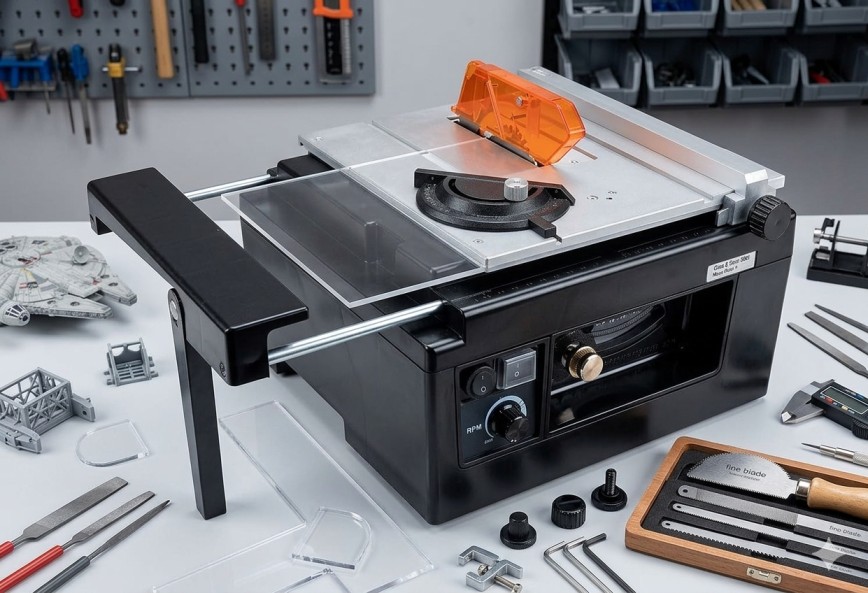
The MicroLux Mini Tilt Arbor saw from Micro-Mark sits at almost exactly the same price as the Proxxon FET and the community debate about which is better is genuinely close. The key differentiators: the MicroLux has variable speed (the Proxxon FET does not) and the fence is reported as more reliable out of the box.
A Ships of Scale forum member who compared them directly noted the MicroLux fence looks simple and reliable, contrasting with the documented fence issues on the Proxxon. Multiple Micro-Mark buyer reviews describe the fence as working well without modification, which is a meaningful advantage over the time investment required to sort the Proxxon fence.
The variable speed control is the decisive feature for anyone cutting plastics. High blade speed on styrene, acrylic, and resin generates friction heat that melts the cut face, welding it back together as the blade passes. Variable speed lets you slow the blade for clean plastic cuts — something the single-speed Proxxon FET cannot do. If plastics are part of your material list, the MicroLux is the right choice.
Known Issues
The blade that ships with the MicroLux has had quality inconsistency reported by buyers. One Micro-Mark review describes receiving a blade with a small warp — Micro-Mark’s customer service sent a replacement immediately, which reflects well on their support. But the stock blade is not the starting point you want for critical precision work. Budget for a quality aftermarket 68mm blade alongside the saw purchase.
The miter gauge has been described by one buyer as requiring significant fiddling to achieve a square cut — squaring the gauge to the blade using standard methods didn’t work and required iterative adjustment. This is consistent with the general mini saw experience that initial calibration takes patience.
MicroLux vs. Proxxon FET — The Direct Comparison
- Variable speed: MicroLux wins clearly — essential for plastic, resin, acrylic
- Fence reliability out of box: MicroLux wins — Proxxon requires modification
- Blade availability: slight edge to Proxxon — 80mm aftermarket blades are more numerous than 68mm
- Motor longevity and precision: considered comparable by the community
- For wood-only work: Proxxon FET is marginally preferred for blade ecosystem
- For mixed wood and plastic: MicroLux is the better choice

MicroLux Mini Tilt Arbor Table Saw
The MicroLux Mini Tilt Arbor Table Saw is a compact precision saw designed for hobbyists, crafters, and small workshop projects. Its space-saving design makes it useful for detailed woodworking, model making, and accurate small-scale cuts.
- Compact size for small workshops and craft spaces
- Precision cutting for detailed projects
- Tilt arbor design for angled cutting tasks
- Suitable for hobby woodworking applications
- Portable design with easy setup and storage
*As an Amazon Associate, we may earn from qualifying purchases.
3. Byrnes Model Machines Table Saw — The Gold Standard (If You Can Get One)
| Construction | Solid aluminum and steel, American-made |
| Blade Size | 4″ (100mm) — larger than Proxxon/MicroLux |
| Tilt | No built-in bevel tilt (attachment available separately) |
| Fence Quality | Exceptional — repeatedly cited as best available |
| Variable Speed | No |
| Availability (2026) | Limited — small production, often waitlisted |
| Price (2026) | $475–$600+ depending on attachments |

The Byrnes table saw occupies a category of its own. It’s not a mass-market product — it’s a boutique instrument made in small quantities by a single operation. The Ships of Scale community describes it as vastly superior in build quality to the Proxxon when comparing them side by side. One member who owned both described the Byrnes as being in a completely different league, and that assessment is consistent across years of forum discussion from serious model builders.
The 4-inch blade is larger than the 60–80mm blades on Proxxon and MicroLux, which gives more usable cut depth for thicker hobby-scale stock. The fence system is consistently cited as the best available at this scale — a machined fence with a micro-adjuster that holds position without modification or shimming. If the Proxxon fence situation frustrates you, the Byrnes fence is what the premium buys.
The Honest Limitations
The Byrnes saw has no built-in bevel tilt capability. Angled cuts require a separate tilting attachment, which adds cost. The Proxxon FET and MicroLux both have tilting arbors as standard. If bevel cuts are part of your regular work, this is a real practical limitation.
Availability is the bigger problem in 2026. The Byrnes operation produces saws in limited quantities. Used units that appear on eBay sell quickly and command prices close to new because demand exceeds supply. If you want one, be prepared to wait or to pay a premium on the used market.
One Ships of Scale member summed up the acquisition math honestly: it was $800 to my door (including shipping) versus $450 for the Proxxon. The quality difference is real and acknowledged — the question is whether your work requires it.
Who Should Buy the Byrnes
- Serious scale ship model builders and fine miniaturists who make precision cuts daily
- Anyone whose Proxxon or MicroLux fence issues have become a production problem
- Woodworkers who primarily cut wood (no plastics) and can accept no built-in bevel
- People willing to wait for availability and pay the premium for build quality
4. Proxxon KS 230 — Best Compact Benchtop Saw for Light Woodworking
| Motor | 100W, 7,200 RPM |
| Blade | Circular blade for wood, plastics, non-ferrous metals |
| Table Size | 330 x 210mm (13″ x 8.3″) |
| Cut Depth | Up to 22mm at 90° |
| Tilt | Table tilts 0–45° (blade stays fixed) |
| Dust Port | Yes, compatible with standard shop vacs |
| Price (2026) | $120–$160 |
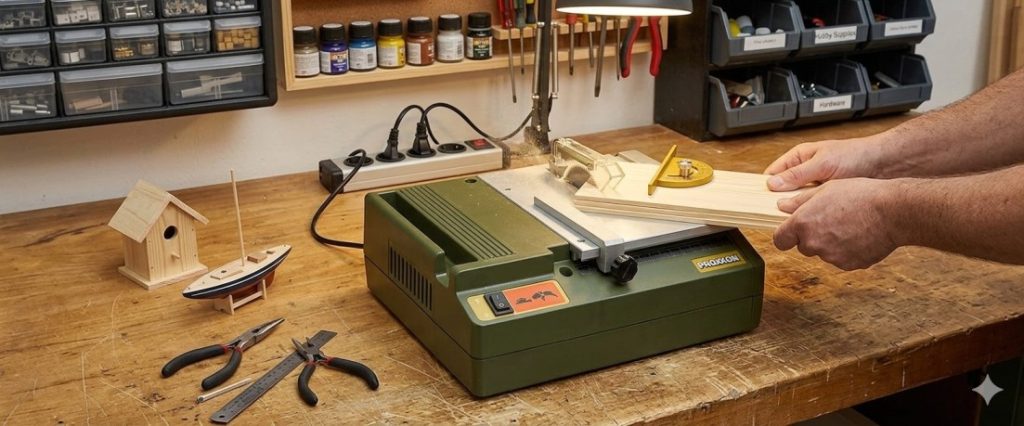
The KS 230 is a different tool from the FET — cheaper, larger table, more accessible price, but the tilting table design rather than tilting arbor. The distinction matters: when the table tilts for bevel cuts, your workpiece slides toward the blade. For large pieces this is manageable. For small delicate strips at acute angles, it’s awkward and imprecise.
For straightforward light woodworking — cutting small dimensional lumber, trimming craft board, dimensioning thin hobby stock at 90 degrees — the KS 230 is a capable and affordable tool. Its 330 x 210mm table gives you more working surface than the FET. The 7,200 RPM motor handles wood and light plastics without the overheating issues documented on metal cutting.
If your work is primarily making 90-degree cuts on wood up to 22mm thick and you don’t need sub-millimeter precision on every cut, the KS 230 at $120 to $160 is better value than the FET at $300 to $350. If you need bevel precision or are doing fine model work where blade wobble affects joint quality, the FET is the right step up.

Proxxon Circular Table Saw
The Proxxon Circular Table Saw is a compact precision cutting tool designed for detailed woodworking, crafting, and hobby projects. Its small footprint and accurate performance make it a practical choice for users who need controlled cuts in a limited workspace.
- Compact design for hobby workshops
- Precision cutting for detailed projects
- Stable table design for accurate work
- Suitable for wood, plastic, and craft materials
- Easy storage with space-saving construction
*As an Amazon Associate, we may earn from qualifying purchases.
5. WEN TT0811 — Best for Compact Workshop Woodworking
| Motor | 11-amp, 4,500 RPM |
| Blade | 8.25″, 24T TCT included |
| Rip Capacity | 25″ right of blade |
| Cut Depth (90°) | 2.75″ |
| Cut Depth (45°) | 2″ |
| Fence | Rack & pinion |
| Weight | ~50 lbs |
| Price (2026) | $230–$260 |
The WEN TT0811 is the odd one out on this list — it’s not really a “mini” saw in the precision hobby sense. It’s a compact benchtop table saw: an 8.25-inch blade, 11-amp motor, rack-and-pinion fence, 25-inch rip capacity. It belongs here because it’s what many craft woodworkers and hobbyists are actually looking for when they search for a mini table saw — something that cuts real wood at real depth in a small footprint.
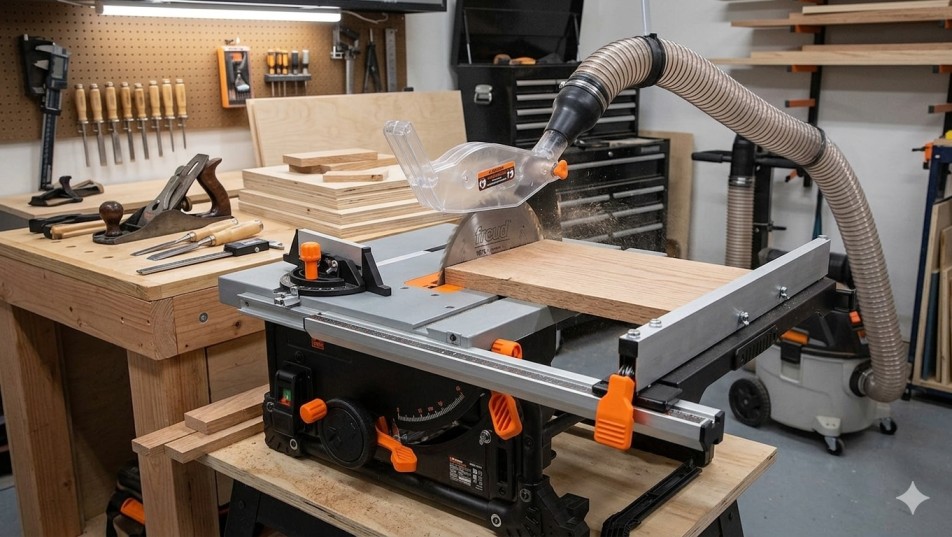
The 11-amp motor handles 1-inch oak without stalling, processes plywood cleanly, and cuts the dimensional lumber that hobby craft projects require. The 25-inch rip capacity handles most sheet goods in a single pass. The rack-and-pinion fence is a genuine step up from the simple locking fences on many compact saws.
Where it falls short for precision craft work: the noise level runs around 82 dB — noticeably louder than the Proxxon models at under 70 dB. The blade at 8.25 inches is not the right tool for 2mm balsa strips or marquetry work. And the stock blade is the typical 24-tooth budget blade that needs replacing for fine finish work.
Who Should Buy the WEN TT0811
- Hobbyist woodworkers who need a real table saw in a small space rather than a specialist precision instrument
- Craft room or apartment workshop setups where a full contractor saw won’t fit
- Anyone cutting real dimensional lumber (1″ thick and up) for craft furniture, shelving, or home decor projects
- DIYers who’ve outgrown the portable jigsaw and circular saw workflow
Who Should Look Elsewhere
- Model builders and precision craft workers who need sub-millimeter accuracy — the WEN is the wrong tool for fine hobby work
- Noise-sensitive environments — 82 dB is noticeably loud

WEN TT0811 Compact Benchtop Table Saw
The WEN TT0811 Compact Benchtop Table Saw is a space-saving option for DIY projects, small workshops, and hobby woodworking. It delivers convenient cutting performance while keeping a portable design that fits smaller work areas.
- Compact benchtop design for limited spaces
- Portable build for easy movement and storage
- Suitable for DIY and woodworking projects
- Adjustable cutting settings for versatility
- Practical choice for beginners and hobby users
*As an Amazon Associate, we may earn from qualifying purchases.
6. Rockwell RK7323 BladeRunner X2 — Most Versatile for Mixed-Material Crafts
| Blade Type | 4″ T-shank jigsaw blades (tool-free swap) |
| Rip Capacity | Adjustable up to 18″ |
| Max Cut Depth | ~0.75″ in wood |
| Special Feature | Cuts curves using jigsaw blade range |
| Multi-Material | Wood, ceramic tile, metal, plastic (blade dependent) |
| Noise | Moderate — quieter than the WEN |
| Price (2026) | $145–$160 |
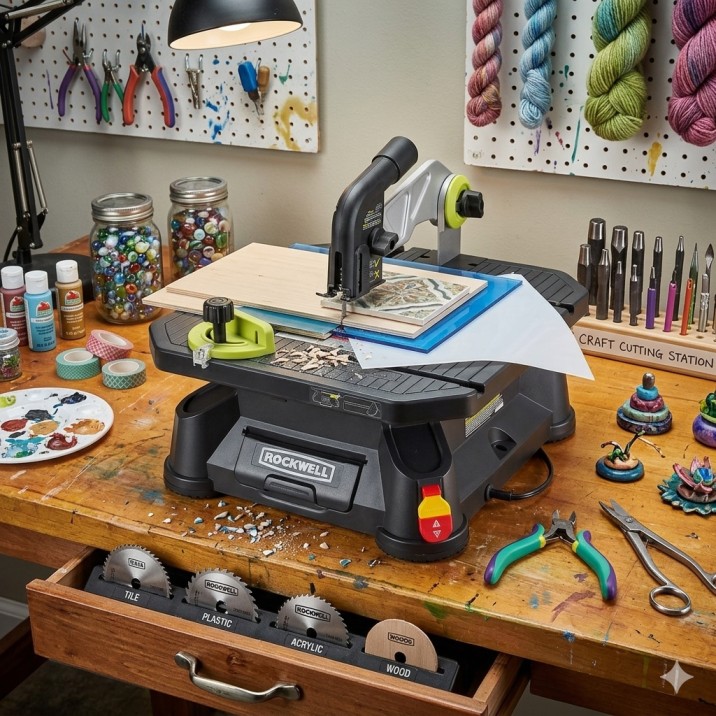
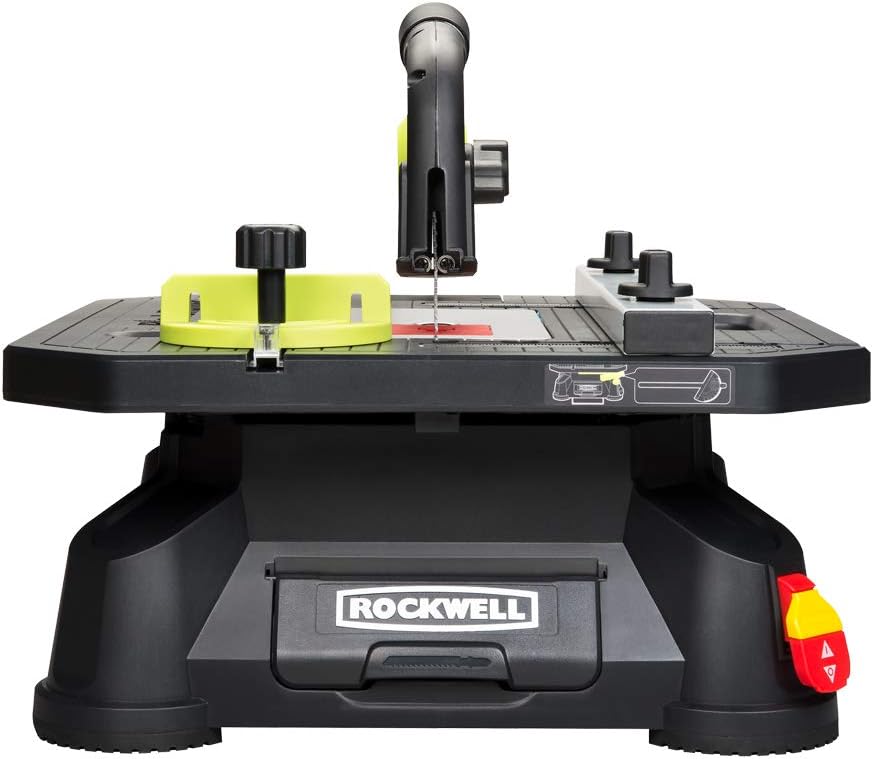
The BladeRunner X2 is not a table saw in the conventional sense — it uses 4-inch T-shank jigsaw blades rather than a circular saw blade, which fundamentally changes what it does. The upside: it cuts curves, changes blades in 22 seconds without tools, handles ceramic tile, aluminum, and plastic with the right blade, and stores flat on a shelf. The downside: 0.75-inch maximum cut depth in wood, and the fence system lacks measurement markings.
For mixed-media crafts — mosaic work involving ceramic tile, mixed wood and plastic projects, scrollwork that needs curves and straight cuts from the same tool — the BladeRunner’s versatility is genuine and useful. It does things no conventional table saw does.
For furniture making, hardwood work, or anything requiring more than 3/4-inch depth, the BladeRunner hits its limit quickly. It struggles with hardwoods over 3/4 inch and the fence imprecision is an issue for repeatable rip cuts.
DEWALT Compact Table Saw
The DEWALT Compact Table Saw is a portable woodworking solution designed for DIY users and professionals who need reliable cutting performance in a smaller package. It offers a practical balance of portability, power, and everyday jobsite convenience.
- Compact portable design for easy transport
- Durable construction for jobsite use
- Accurate cutting performance for projects
- Space-saving design for smaller workshops
- Easy setup and convenient operation
*As an Amazon Associate, we may earn from qualifying purchases.
Think of it as a versatile craft cutting station rather than a precision woodworking tool. In that context — mixed-media artists, DIY puzzle makers, tile mosaic workers, foam and acrylic crafters — it earns its place on the bench.
7. NovelLife and Budget Mini Saws — What They’re Actually Good For
The NovelLife Mini Hobby Table Saw and similar products (Goplus 4-inch, various 100W Amazon mini saws) work well for a specific, narrow use case: PCB boards, thin acrylic sheets, foam board, soft balsa under 5mm, and light hobby cutting where a full saw is overkill.
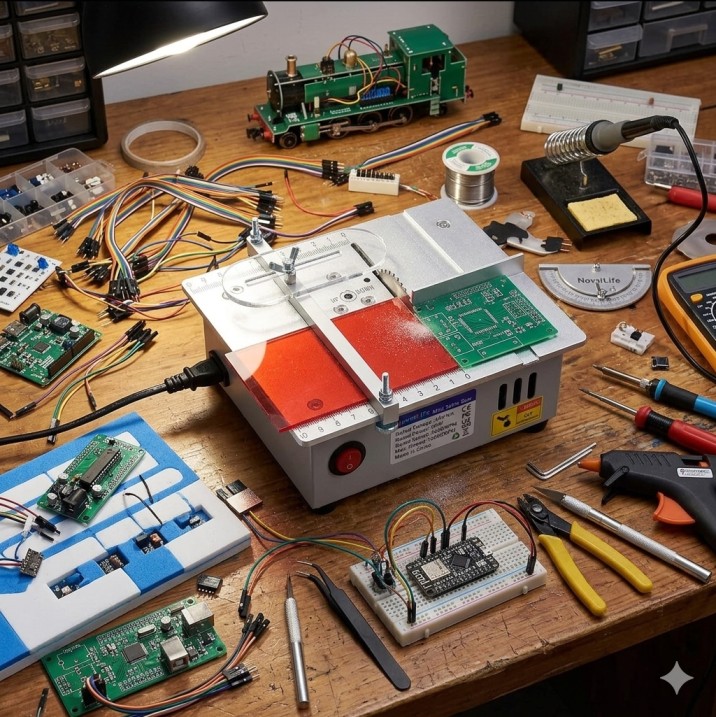
One testing source put 80 test cuts through materials including 1/4-inch plywood, thin PVC, 5mm MDF, and copper-coated PCB boards and found consistently clean edges with minimal blade chatter. That’s a fair assessment — these saws do what they’re designed for.
What they’re not designed for: anything requiring a fence you trust to hold position, cutting wood over 5mm thick reliably, or producing joints that need to fit precisely. Their tables flex. Their fences are suggestive. Their motors struggle on anything denser than soft balsa at serious depth.
When budget saws make sense: Electronics hobbyists cutting PCB boards and acrylic enclosures, papercraft and foam artists, anyone who primarily cuts materials under 5mm and has no fine woodworking requirements. At $40 to $90, they’re the right tool for that job. Don’t expect more.

NovelLife Mini Circular Table Saw
The NovelLife Mini Circular Table Saw is a compact precision cutting tool designed for crafts, DIY projects, and detailed woodworking. Its small size makes it a practical option for hobbyists who need accurate cuts without taking up much workspace.
- Compact design for craft and DIY workspaces
- Adjustable cutting depth for different projects
- Suitable for wood, plastic, and lightweight materials
- Precision-focused design for detailed cuts
- Easy storage and portable construction
*As an Amazon Associate, we may earn from qualifying purchases.
Full Comparison — All Seven Saws
| Saw | Price | Blade | Max Depth | Variable Speed | Tilt | Best For |
| Proxxon FET | $300–350 | 80mm | 20mm | No | Tilting arbor | Ship models, marquetry, veneers |
| MicroLux Tilt Arbor | $299–349 | 68mm | ~20mm | Yes | Tilting arbor | Plastics, resin, mixed materials |
| Byrnes Model Saw | $475–600+ | 100mm | ~25mm | No | Attachment only | Fine model work, best fence |
| Proxxon KS 230 | $120–160 | Circular | 22mm | No | Tilting table | Light woodworking, craft board |
| WEN TT0811 | $230–260 | 8.25″ | 70mm | No | Standard | Real woodworking in small space |
| Rockwell BladeRunner X2 | $145–160 | 4″ T-shank | ~19mm | No | None | Mixed materials, curves, tile |
| NovelLife / Budget | $40–90 | 60mm+ | ~10mm | Some models | Basic | PCB, foam, thin acrylic |
Buying Guide — The Questions That Actually Matter
Tilting Arbor vs. Tilting Table — Why It Matters More Than Blade Size
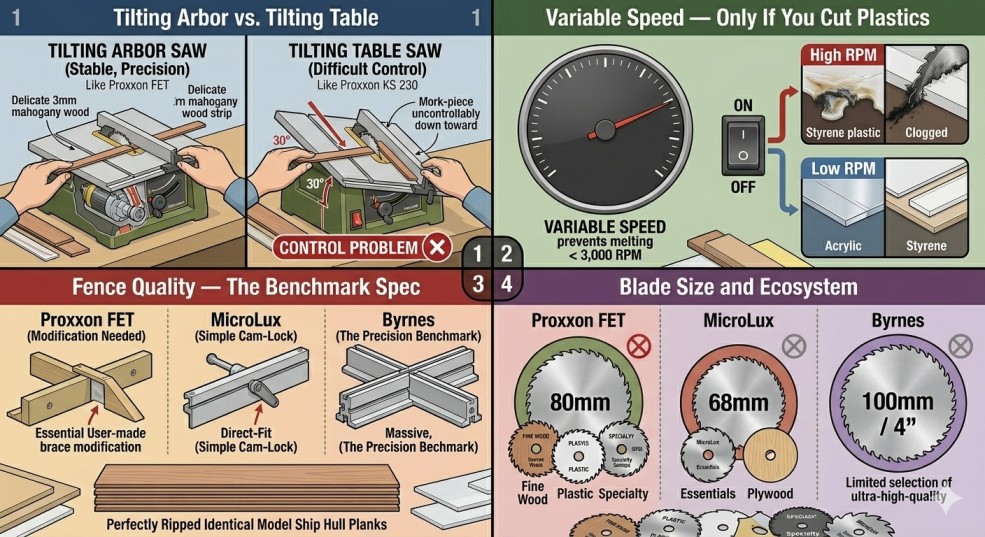
On a tilting arbor saw (Proxxon FET, MicroLux, Byrnes), the blade tilts while the workpiece lies flat on the table. Gravity keeps your material stable throughout the bevel cut. On a tilting table saw (Proxxon KS 230, many cheaper saws), the table tilts and your material slides toward the blade. For a full-size piece of wood, this is manageable. For a 3mm strip of mahogany at 30 degrees, it’s a control problem.
The community guidance on this point is consistent: tilting table design is difficult to use because your material slides down the table into the blade. If bevel cuts are part of your regular work at small scale, pay for the tilting arbor design.
Variable Speed — Only Matters If You Cut Plastics
At high RPM, blades generate friction heat in plastic materials that melts the kerf closed behind the blade. Variable speed lets you slow the blade to a point where heat doesn’t build up — typically under 3,000 RPM for styrene and acrylic. Of the precision saws, only the MicroLux has variable speed as standard. If your work involves cutting plastic components, that feature alone determines the right saw.
Fence Quality — The Spec That Specs Don’t Cover
Every mini saw manufacturer claims their fence is accurate. The community has tested this claim exhaustively over years of real use. The Proxxon FET requires fence modification. The MicroLux fence works out of the box but has a simpler cam-lock mechanism. The Byrnes fence is the benchmark. Budget saws have fences that are directional guides rather than precision references.
If your work involves ripping identical strips repeatedly — plank cutting for ship models, cutting identical hardwood pieces for a furniture project — fence quality is the most important specification and the one least revealed by manufacturer data.
Blade Size and Ecosystem
Proxxon FET uses 80mm blades. MicroLux uses 68mm. Byrnes uses 100mm (4 inch). These are not interchangeable. Before committing to a platform, verify the blade ecosystem supports what you need — aftermarket blades for fine wood cutting, plastic cutting, and specialty materials in that blade size. Proxxon’s 80mm ecosystem is the most developed of the three. MicroLux’s 68mm has fewer options but covers the essentials. The Byrnes 100mm ecosystem is narrower but the quality of available blades is high.
Noise — More Important Than Most Guides Admit
The Proxxon FET and KS 230 run under 70 dB — quieter than a standard vacuum cleaner. The WEN TT0811 runs around 82 dB. The difference isn’t just about neighbors: extended sessions at 82 dB cause cumulative hearing damage without protection. For apartment workshops, craft rooms, or anyone doing evening work near sleeping family, the quiet operation of the Proxxon-tier saws is a quality of life issue that becomes a daily factor.
Who Is This Saw Actually For?
| User Type | Best Saw | Why |
| Ship model / miniature builder | Proxxon FET or Byrnes | Blade wobble and fence precision matter most |
| Cuts plastic, resin, acrylic | MicroLux Tilt Arbor | Variable speed is essential |
| Luthier (fret slots, binding) | Proxxon FET or Byrnes | Sub-mm accuracy, clean face cuts |
| Pen turner / segmenter | MicroLux or Proxxon FET | Angle cuts, small stock control |
| Craft woodworker (small furniture) | WEN TT0811 | Real cutting depth and rip capacity |
| Mixed media (tile, metal, curves) | Rockwell BladeRunner X2 | T-shank versatility |
| PCB and electronics hobby | NovelLife / budget tier | Thin material only, no wood furniture |
| Budget, occasional craft cuts | Proxxon KS 230 | Affordable, real build quality |
Common Problems and Community-Proven Fixes
Proxxon FET Fence Slop
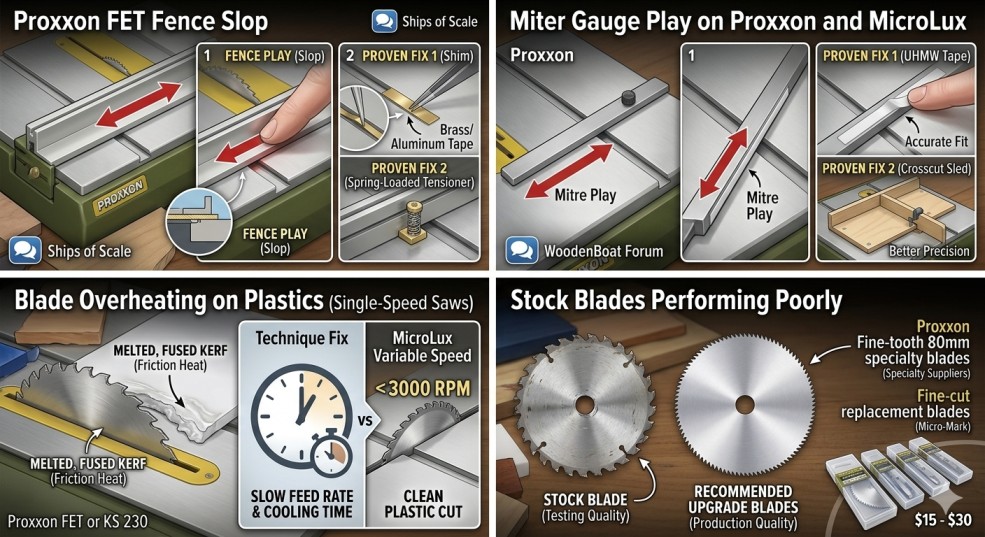
The standard fix documented across multiple forums: add a small shim of brass or aluminum tape to the fence base to take up the lateral play. A more permanent fix involves adding a small spring-loaded tensioner to keep the fence pressed against the front rail. Both are documented on the Ships of Scale forum with photos. Plan 30 to 60 minutes and expect to do this within the first week of ownership.
Miter Gauge Play on Proxxon and MicroLux
The miter slots on both saws have more play than ideal for precise crosscuts. The WoodenBoat Forum fix: apply a thin strip of self-adhesive UHMW tape to one face of the miter bar to take up the slack. This is a five-minute modification that multiple owners confirm produces a meaningful accuracy improvement. Alternatively, build a small crosscut sled from 3mm ply — even at mini saw scale, a sled outperforms the stock gauge.
Blade Overheating on Plastics
If you’re using the single-speed Proxxon FET or KS 230 on acrylic or styrene and getting melted, fused cuts: the fix isn’t technique, it’s the tool. These saws don’t have variable speed. Slow the feed rate dramatically and allow cooling time between cuts. Alternatively, switch to the MicroLux with variable speed for plastic work and use the Proxxon for wood.
Stock Blades Performing Poorly
Both Proxxon and MicroLux include stock blades that are adequate for initial testing but not for production quality work. For the Proxxon FET, the community recommends fine-tooth 80mm blades from specialty suppliers — Albrecht and Byrnes-spec blades in 80mm have been discussed favorably. For the MicroLux, Micro-Mark’s own fine-cut replacement blades are the standard upgrade. Budget $15 to $30 per blade and buy at least one upgrade blade with the saw.
Safety at Small Scale — What’s Different
Mini table saws are not inherently safer than full-size saws just because the blades are smaller. A 60mm blade spinning at 7,000 RPM will still cut a finger significantly. The differences in risk are mostly about scale: the smaller table makes it easier to reach close to the blade, and the small workpieces involved in hobby work increase the temptation to use fingers as guides.
- Push sticks at mini scale: standard push sticks are too large for hobby-scale work. Make or buy thin push sticks from 3mm ply or purchase specialist micro push sticks that Micro-Mark sells. Holding 2mm strips by hand near a spinning blade is how accidents happen.
- Featherboards for strip cutting: when ripping identical thin strips, a small featherboard made from 3mm ply with cut fingers holds the strip against the fence consistently and keeps your fingers away from the blade path.
- Eye protection: mandatory and not optional on any saw regardless of blade size. Proxxon FET blades can throw chip fragments at significant velocity. Wear safety glasses on every cut.
- Blade guards: the guards on precision hobby saws are often removed by users to improve visibility on fine work. If you remove the guard, understand you’re accepting increased risk and compensate with push sticks and deliberate hand placement.
- Ventilation: cutting certain plastics (PVC, ABS) produces toxic fumes at the friction heat generated even by small blades. Cut these materials with ventilation or outdoors.
Quick Blade Guide by Material
| Material | Tooth Count | Speed | Notes |
| Balsa, soft woods | Fine (60–100T equivalent) | High | Grain tear-out risk on soft balsa; zero-clearance insert helps |
| Hardwoods (pear, cherry, box) | Fine (60–100T) | High | Sharp blade essential; feed rate moderation on dense species |
| Plywood, MDF | Fine (60–100T) | High | Zero-clearance insert prevents tear-out on face veneer |
| Acrylic, styrene | Fine (60–100T TCG) | Low (variable speed) | Melts at high speed; MicroLux or variable speed saw required |
| Resin | Fine (TCG tooth geometry) | Low to medium | Brittle — slow feed rate, score pass recommended |
| Brass, aluminum | Carbide fine tooth | Low | Proxxon FET overheats on metals — use Proxxon KS 230 or dedicated metal saw |
| Fiberglass / PCB board | Fine carbide, 0.5mm kerf | Low to medium | Generates toxic dust; ventilate and wear N95 minimum |
Frequently Asked Questions
Can a mini table saw replace a full-size table saw for hobby work?
For the materials and cut sizes typical in hobby woodworking — strips under 20mm thick, small board dimensions, precision at small scale — yes completely. A Proxxon FET or MicroLux handles everything a ship model builder, luthier, or craft furniture maker needs at their scale. For furniture construction with dimensional lumber, trim work, or anything requiring more than 20 to 25mm of cut depth, mini saws hit their limit and a compact benchtop saw like the WEN TT0811 or a full portable contractor saw is the right tool.
Is the Proxxon FET worth the price over the KS 230?
For precision bevel work and fine hobby sawing: yes. The tilting arbor design, lower blade wobble, and higher-quality motor at 5,000 RPM deliver noticeably better accuracy on small, precise cuts. For light woodworking with primarily straight 90-degree cuts, the KS 230 at half the price does the job well. Decide based on whether bevel cuts and sub-millimeter accuracy are requirements for your work.
Is the Byrnes saw worth $500+ over the Proxxon at $300?
The community consensus: if you’re doing fine-scale model work professionally or as a serious long-term hobby and the fence imprecision of the Proxxon is a production problem, the Byrnes is worth every dollar. The build quality difference is immediately apparent. If you’re starting out or doing occasional hobby work, start with the Proxxon or MicroLux and decide whether the Byrnes gap matters to your actual work. The Proxxon fence modification solves most fence issues for significantly less money.
Can mini saws cut metal?
With the right blade and the right saw, yes. The Proxxon KS 230 handles non-ferrous metals (aluminum, brass) with a fine carbide blade. The Proxxon FET overheats on metals and should not be used for that purpose. The MicroLux with variable speed and an appropriate blade handles soft non-ferrous metals. For any significant metal cutting, a dedicated metal-cutting solution is safer and produces better results than a wood-focused mini saw.
What’s the best mini table saw for cutting acrylic and plastics?
The MicroLux Mini Tilt Arbor saw with variable speed. Acrylic and styrene require slow blade speed to prevent heat buildup that melts the kerf closed. The MicroLux’s variable speed control is essential for clean plastic cuts. Use a fine-tooth blade with a triple-chip grind tooth geometry for the cleanest edges. The Proxxon FET’s single speed is too fast for most plastics to cut cleanly.
How do I reduce tear-out on thin veneer and plywood?
Three techniques in combination: first, use a zero-clearance throat plate insert that supports the wood fibers right up to the blade — this is the most impactful single change. Second, apply painter’s tape along the cut line on the face veneer before cutting. Third, cut with the good face down (blade exits through the good face on the downstroke). All three together produce clean-faced cuts that need no cleanup.
Final Verdict
Mini table saws are a specialized category where the right choice depends entirely on what you make — more so than in almost any other tool category. A ship model builder and a craft woodworker cutting small furniture pieces have almost nothing in common in terms of what their saw needs to do.
For fine model work and precision hobby cutting: Proxxon FET at $300 to $350. Accept the fence modification as part of setup and you have a capable precision instrument for years. The MicroLux is the better choice if plastics are part of your material list.
If the fence problem matters and budget allows: Byrnes Model Machines is the community gold standard. It’s expensive, sometimes hard to get, and has no built-in bevel — but the build quality and fence precision are in a different league.
For compact workshop woodworking (real cutting depth required): WEN TT0811 at $230 to $260. It’s a real compact table saw, not a precision hobby instrument, but it cuts actual lumber properly.
The honest starting point advice: Be clear about what you’re making before you buy. The Proxxon FET is the wrong tool for cutting 1-inch oak for a craft shelf. The WEN TT0811 is the wrong tool for 2mm ship planking. Matching the saw to the actual work is more important than any spec comparison.

Finlay Connolly is a woodworking enthusiast and power tool specialist with over a decade of hands-on experience in the workshop. As the founder and lead writer at ProTableSawReviews.com, Finlay combines expert knowledge with real-world testing to help woodworkers, DIYers, and professionals choose the best tools for the job. With a sharp eye for detail and a passion for precision, Finlay is committed to providing trustworthy, practical advice backed by years of experience and research in the field. Whether you’re cutting dados or comparing fence systems, you can count on Finlay for honest, reliable reviews that make your next cut your best one.