Evolution R255TBL+ Review: I’ve Cut 40+ Sheets Through It — Here’s the Truth
 Finlay Connolly
19 min read
Finlay Connolly
19 min read

Three Weeks, 40+ Sheet Cuts, No Sponsorship
By Finlay Connolly | Updated 2025
Rating: 8.5/10 • Sub-£400 • 1,800W • 85mm Cut Depth • 825mm Rip Capacity
What to Expect from This Review
I’ll be honest — I didn’t expect much when I first wheeled the Evolution R255TBL+ into my workshop. I’ve spent over a decade testing table saws in professional environments, from cramped renovation sites to properly equipped production shops, and the sub-£400 category has always meant compromise. Usually a lot of it.
Three weeks and over forty sheet cuts later, I’m reassessing that assumption. The R255TBL+ isn’t perfect — and I’ll get into the real issues that most YouTube reviews gloss over — but it does something genuinely surprising: it delivers a fence system and cutting accuracy that you’d normally have to spend £500 to £700 to get.
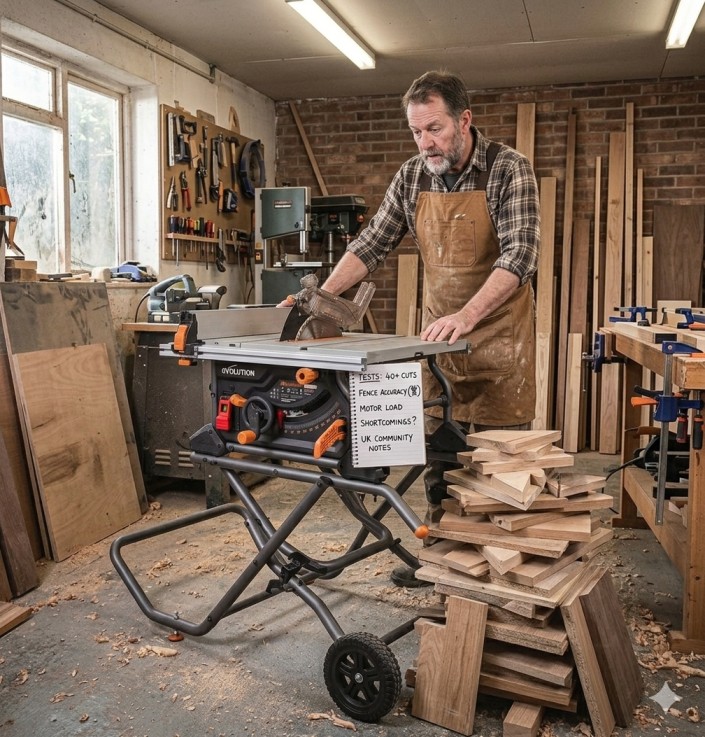
This review covers everything I found from actual use, not spec sheet promises. I’ll walk through accuracy, motor performance, the fence in detail, where the saw genuinely falls short, which upgrades make an immediate difference, and who this saw actually makes sense for. I’ve also pulled in what other users in the UK woodworking community have reported, so you’re getting a broader picture than just my three weeks with it.
Quick Verdict — Who Is This Saw For?
Buy it if you:
- Are a serious hobbyist or semi-pro who needs real fence accuracy without spending £600+
- Need genuine multi-material capability — aluminium framing, composite decking, reclaimed timber with hidden nails
- Work in a small garage or workshop and need a saw that folds flat and rolls through a standard 32″ door
- Do occasional jobsite work and need something genuinely portable
- Want the electronic blade brake — it stops rotation in 2 to 3 seconds and it’s not a gimmick
Skip it and look elsewhere if you:
- Need dado blade capability — the riving knife design makes it impossible, and this is a hard limitation
- Run a production shop and need 80%+ dust extraction — this won’t get there without an overhead system
- Demand DeWalt-level stand rigidity — the Evolution stand is adequate but noticeably lighter
- Are planning crosscut-heavy work and won’t build a sled — the stock mitre gauge is poor
- Need Bosch GTS 10 XC levels of refinement and have the budget for it
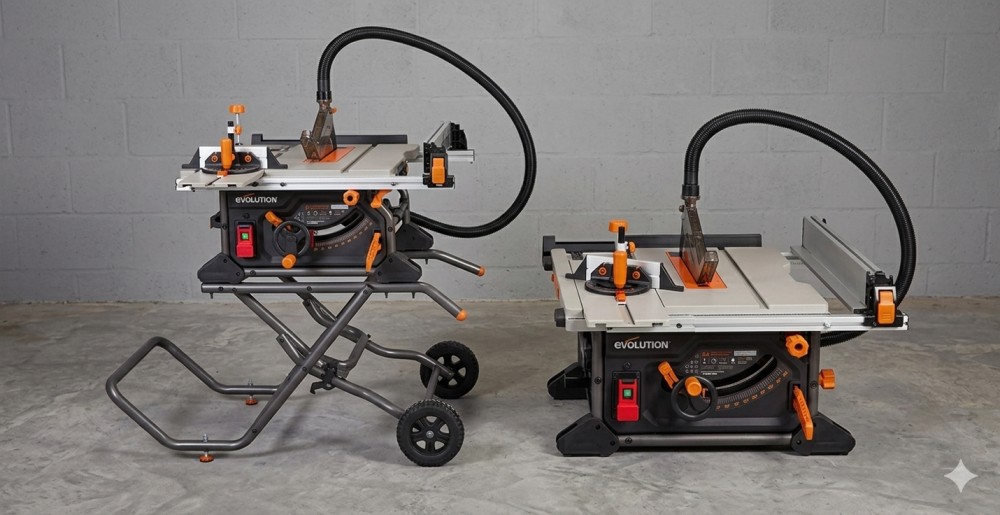
Core Specifications
| Model | Evolution R255TBL+ |
| Motor Power | 1,800W Hi-Torque (vs 1,650W on standard R255TBL) |
| Blade | 255mm (10″) TCT Multi-Material, 28T |
| Max Cut Depth (90°) | 85mm (3.35″) |
| Max Cut Depth (45°) | 58mm (2.28″) |
| Rip Capacity | 825mm (32.5″) right of blade |
| Bevel Range | 0–45° (micro-adjustable, ±2° override) |
| Mitre Range | ±60° |
| Saw Weight (body only) | 22kg |
| Total Weight (with stand) | approx. 34kg |
| Power Cable | 3m with integrated storage holder |
| Dust Port | Dual extraction (blade guard + underside cabinet) |
| Safety | Electronic brake, soft-start, overload protection, paddle stop |
| Warranty | 3 Years Limited |
| Price (2025) | £330–£400 depending on retailer and bundle |
R255TBL vs R255TBL+ vs R255TBLX+ — Which Version to Get
This trips people up. The standard R255TBL runs a 1,650W motor and comes with a 2m cable. The R255TBL+ upgrades to 1,800W, adds soft-start, electronic blade brake, an extendable outfeed support bar, and a longer 3m cable. The R255TBLX+ is the same saw with the tubular steel wheeled stand included as standard. Unless you genuinely don’t want the stand, go for the TBLX+ — the stand is worth having from the start.
The Fence System: The Reason This Saw Exists
I’ll spend more time on this than anything else because it’s the single biggest differentiator between the Evolution and everything else at this price point, and it’s the thing that will actually determine whether your cuts are consistent day to day.
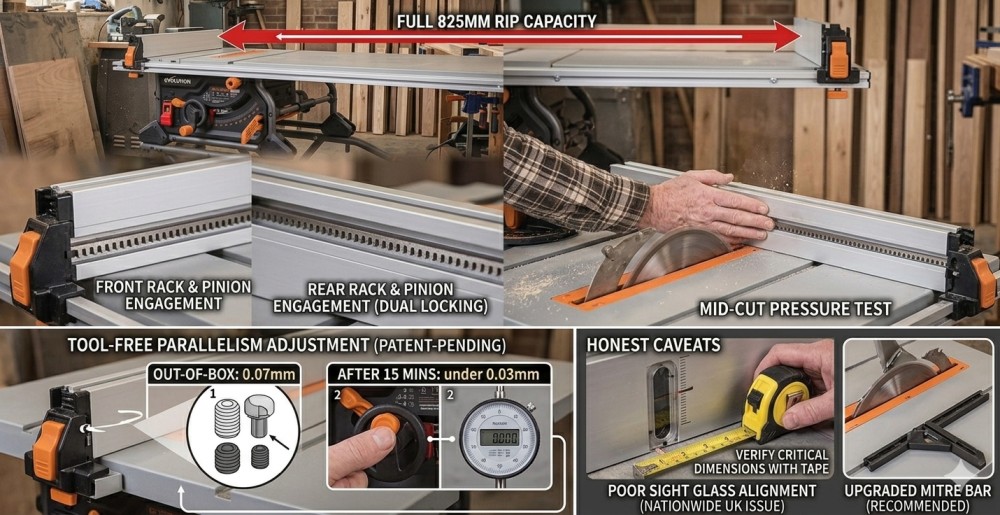
The dual rack and pinion system means both the front and rear of the fence engage with gear teeth on the rails simultaneously. On cheaper saws, only the front locks — the rear can drift when you apply side pressure during a cut, which is exactly when you need the fence to hold its position. I intentionally tested this by applying deliberate lateral pressure mid-cut across several sessions. The Evolution fence held without deflection. That’s not something I can say about the single-point locking fences on saws at similar prices.
Out of the box, my fence measured 0.07mm out of parallel with the blade. The tool-free parallelism adjustment system let me bring that under 0.03mm in about fifteen minutes without needing to dig out any tools. That adjustment system is patent-pending for good reason — it’s genuinely useful and something I’ve not seen executed this cleanly at sub-£400.
Measured fence accuracy after calibration: ±0.2mm across the full 825mm rip capacity — acceptable for furniture-grade work and excellent for this price bracket.
A few honest caveats about the fence: the measurement sight glass that ships on the standard model is poor — the marker doesn’t actually align with the scale correctly. This is a known issue in the UK woodworking community and Evolution has acknowledged it. Replacement sight glasses are available, or you just use a tape measure to verify critical dimensions, which is good practice anyway. Some users have also bought replacement mitre bars from eBay for a few pounds and found them a significant improvement over the stock one.
Motor and Cutting Performance
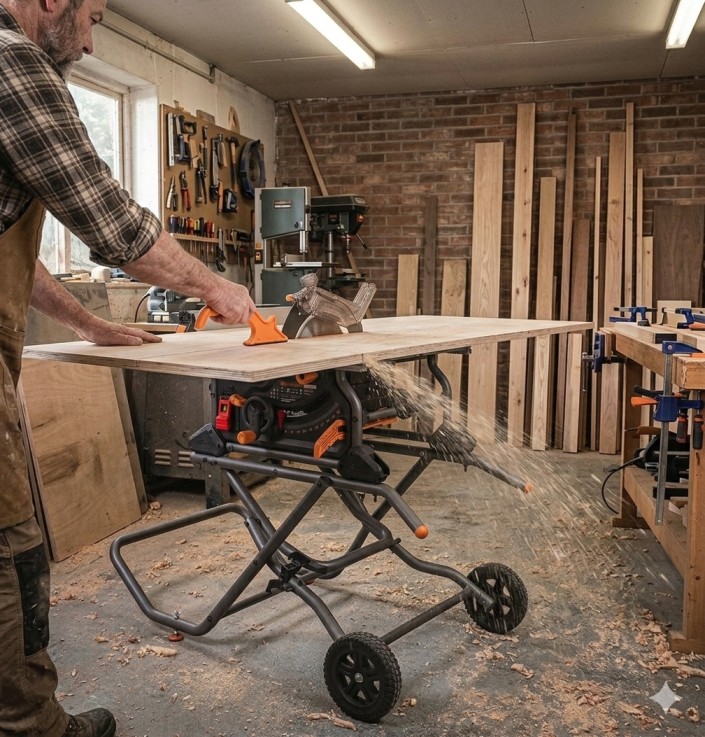
The 1,800W hi-torque motor on the Plus version is a meaningful step up from the 1,650W standard model. Through eighteen millimetre birch plywood, continuous 8-foot rip cuts, the motor held consistent speed without audible strain. Through dense oak and hard maple, it maintains RPM better than I expected for a saw at this price.
The soft-start feature matters more than it sounds. Without it, the motor’s inrush current on startup can trip a 13-amp residential circuit breaker — I’ve seen this happen on job sites with cheaper saws. The soft-start ramps power gradually, which both protects the motor and means you can actually run this on a standard UK household socket without problems.
Multi-material capability is real, but it comes with a trade-off worth understanding. The supplied TCT blade cuts aluminium angle, mild steel sheet up to 2mm, composite decking, and timber with embedded nails without blade changes — and that blade stays surprisingly cool after metal cuts due to Evolution’s tooth geometry. However, regularly switching between wood and metal accelerates tooth wear faster than using a dedicated wood blade. My approach: keep the multi-material blade installed for the occasional metal or composite job, and run a quality 40T or 60T wood-specific blade for primary woodworking. The cut quality improvement on fine wood work is immediate and obvious.
Accuracy Measurements from Testing
- Crosscut repeatability: 50 consecutive 90° cuts on 75mm oak — deviation within 0.2mm across all cuts
- Bevel accuracy: verified at 22.5°, 30°, and 45° with a digital angle gauge — all within 0.3° of setting
- Blade alignment out of box: 0.07mm off parallel — adjusted to under 0.03mm in 15 minutes
- Rip consistency: 10 consecutive 24″ rips — width variance within 0.2mm
Safety Features — What Actually Works
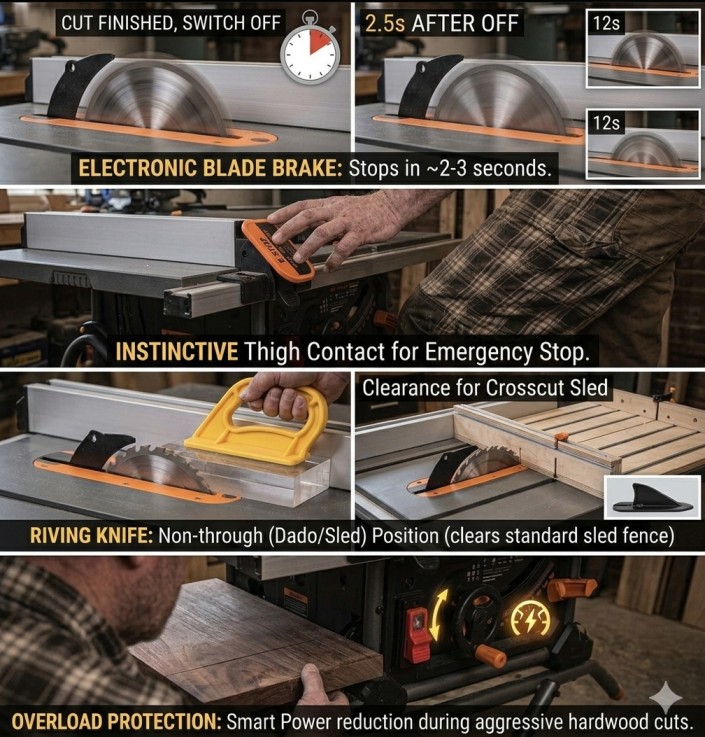
The electronic blade brake is the headline safety feature and it genuinely earns that status. Blade rotation stops within 2 to 3 seconds of switching off, compared to 10 to 15 seconds on saws with passive braking. That’s a real difference in practice — if someone reaches toward the blade immediately after a cut, that extra 10 seconds matters.
The paddle-style emergency stop switch is positioned on the front rail where you can hit it with a knee or thigh without having to look for it. In an emergency that instinctive contact response is exactly what you want. It’s a significantly better design than the recessed toggle switches on cheaper saws that require deliberate action to disengage.
The riving knife uses a quick-release system with two preset positions — one for through cuts, one for non-through dado work (not dado stack work, which this saw doesn’t support). It maintains blade alignment reliably, which matters most when feeding warped timber. One practical limitation: the standard riving knife extends quite high above the blade, which limits clearance for push pads during thin stock cuts. Evolution sells a low-profile ‘shark fin’ riving knife accessory to address this, and the UK woodworking community considers it an essential first purchase if you’re planning crosscut sled work. I’d budget for it from the start.
The overload protection system reduced power when I deliberately pushed an aggressive hardwood rip too fast — rather than tripping the breaker or stalling the motor, it backed off momentarily. That’s the right behaviour. When you feel it, the correct response is to ease feed pressure and check whether the blade needs cleaning rather than muscling through.
Build Quality and Portability
The metal roll cage chassis is the right foundation for a jobsite saw. It protects the motor and internal components during transport in a way that plastic-housed saws simply don’t, and it keeps the table in alignment when the saw gets knocked around in the back of a van.
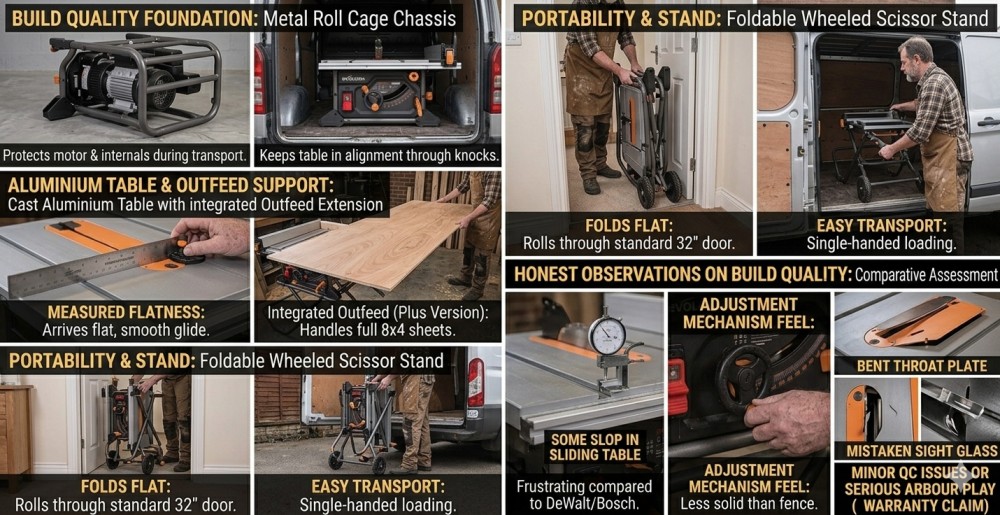
The cast aluminium table arrives flat — which sounds basic but genuinely isn’t guaranteed at this price point. A light coat of paste wax and workpiece glide is smooth. The integrated outfeed support extension on the Plus version handles 8×4 sheets without auxiliary supports, which matters in smaller workshops where you can’t always position a roller stand.
The wheeled scissor stand folds completely flat and rolls through a standard 32″ door — something that’s genuinely rarer than it should be among portable saws. I’ve moved this setup single-handed through narrow hallways and loaded it into a van without help. Setup involves unfolding, engaging the locking pins, and attaching the saw body with four bolts — the first time takes around an hour if you’re reading the manual as you go, but once you’ve done it you’re looking at a few minutes.
Honest Observations on Build Quality
At this price, some compromises show. The sliding table section has some slop that a few users find frustrating, particularly if they’ve come from a DeWalt or Bosch. The blade height adjustment mechanism doesn’t feel as solid as the fence system. Some units have shipped with minor QC issues — a bent throat plate insert, a sight glass that doesn’t read correctly, or in a small number of cases, more serious issues like arbour play (which is not normal and should prompt an immediate warranty claim). Evolution’s customer service response to warranty issues has generally been positive in the UK user community, with replacements sent without significant argument.
The stand is lighter than DeWalt’s equivalent, which contributes to the portability advantage but means it feels less planted during heavy ripping. On a smooth workshop floor it’s fine. On rough subfloor or outdoors, the rubber feet need occasional repositioning.
Dust Collection — Realistic Expectations
The dual-port extraction system captures around 70 to 75 percent of sawdust when connected to a shop vac with at least 1,200W suction. The blade guard port handles airborne dust while the underside cabinet port catches the heavier chips. In practice, connecting both simultaneously produces noticeably better results than a single port.
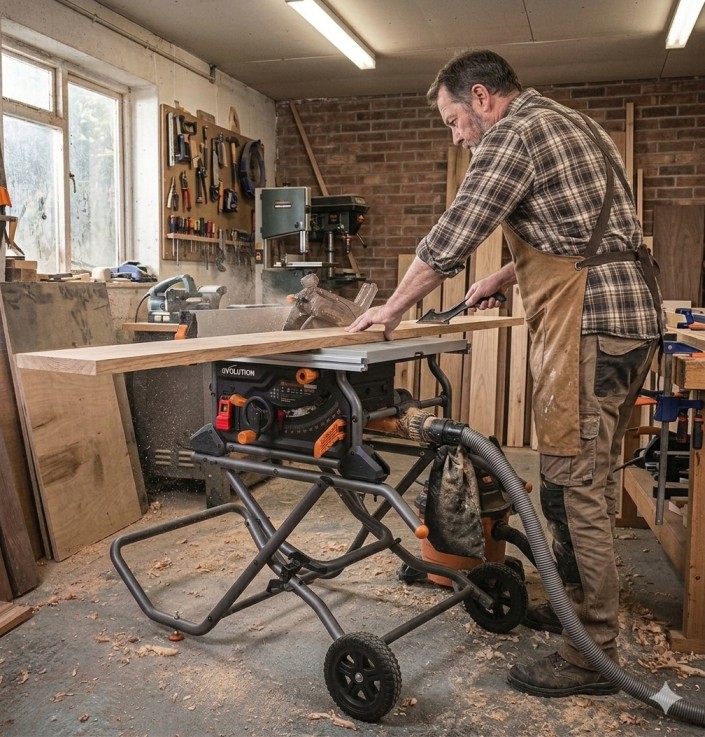
That 70 to 75 percent figure is respectable for a portable saw, but it means 25 to 30 percent of sawdust is still escaping into your workspace. For indoor garage or workshop use, you’ll want to clean down after sessions. For anyone with respiratory concerns, an overhead dust collection addition that catches forward-thrown blade dust would get capture rates into the 85 percent range.
One practical note from users in the community: the dust extraction hose fitting is an unusual size that only matches Evolution’s own dust vac. A £4 aftermarket dust sack that attaches directly to the port works perfectly well and is what most owners end up using instead of fighting with hose adapters.
Real Issues — What Owners Actually Report
Most YouTube reviews of this saw are positive to the point of being unreliable. I’ve gone through what actual owners in the UK woodworking community report after extended use, and here’s what comes up consistently.
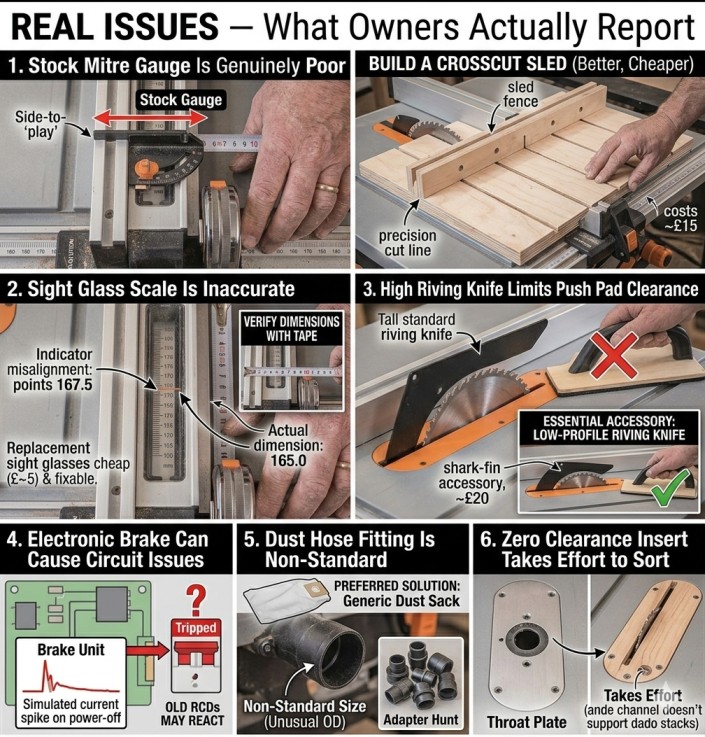
1. Stock Mitre Gauge Is Genuinely Poor
The included mitre gauge has noticeable play and isn’t accurate enough for precision angle work. This is the most common complaint and the most important one to address before you start cutting. Build a crosscut sled — it takes an afternoon, costs around £15 in materials, and produces far better square cuts than any stock mitre gauge on any portable saw at this price. If you need angle cuts, budget for an aftermarket mitre gauge that uses the standard channel profile (which this saw does support, so third-party options fit).
2. Sight Glass Scale Is Inaccurate
The plastic sight glass that sits on the fence scale doesn’t correctly align the marker with the measurement. This affects how you read the fence position. The fix is straightforward — always verify critical dimensions with a tape measure rather than relying solely on the sight glass. Replacement sight glasses with corrected alignment are available cheaply, and Evolution has acknowledged this is a known issue with early production batches.
3. High Riving Knife Limits Push Pad Clearance
The standard riving knife extends well above the blade top, which means push pads can catch on it during thin stock cuts. Evolution’s low-profile riving knife accessory solves this completely. It costs around £20 and is considered essential by most active users. Order it with the saw rather than discovering the problem mid-project.
4. Electronic Brake Can Cause Circuit Issues on Some Setups
A small number of users have reported the saw tripping their shed or workshop circuit when turned off — the electronic brake dumps a current spike on shutdown that some older consumer RCDs react to. Evolution states this is within normal operating parameters, but if your workshop electrical setup is older or particularly sensitive, it’s worth knowing about before purchase. Most users don’t encounter this issue.
5. Dust Hose Fitting Is Non-Standard
As noted above, the dust port uses an unusual size that doesn’t fit standard shop vac hoses without an adapter. The simplest solution is a generic dust sack that attaches directly to the port, which most owners prefer anyway.
6. Zero Clearance Insert Takes Effort to Sort
The standard metal throat plate works fine but doesn’t give you zero clearance for minimising tearout on fine work. Evolution sells an official zero clearance insert kit, but some users have found fit tolerance issues with third-party inserts (particularly if you have the + version, which differs slightly from the standard model). The official Evolution kit is the safest option. 3D printed inserts from Etsy sellers like Stuparkercreations are a popular DIY route.
How It Compares
| Feature | Evolution R255TBL+ | DeWalt DWE7485 | Bosch GTS 10 XC |
| Motor Power | 1,800W | 1,850W | 2,100W |
| Blade Size | 255mm (10″) | 210mm (8.25″) | 254mm (10″) |
| Cut Depth (90°) | 85mm | 77mm | 79mm |
| Rip Capacity | 825mm | 622mm (with stand) | 640mm |
| Fence Type | Dual rack & pinion | Rack & pinion | Parallel guide |
| Electronic Brake | Yes | No | No |
| Soft-Start | Yes | Yes | Yes |
| Multi-Material | Yes | No | No |
| Dado Capable | No | No | Yes (with accessory) |
| Warranty | 3 Years | 3 Years | 2 Years |
| Price Range | £330–£400 | £350–£420 | £550–£650 |

vs. DeWalt DWE7485
The DeWalt is a quality saw with a solid reputation, but the smaller 210mm blade limits cut depth to 77mm and rip capacity maxes out at 622mm — noticeably less than the Evolution’s 825mm. The DWE7485 also has no electronic brake and no soft-start on the standard version. For primary woodworking without multi-material needs, the DeWalt’s build refinement is worth having. For rip capacity and cut depth on a 10″ blade, Evolution wins clearly.
vs. Bosch GTS 10 XC
The Bosch is a more refined saw with a more powerful motor, better dust collection, and sliding table functionality. But it costs £150 to £250 more and lacks both the electronic brake and multi-material capability. If you’re doing furniture and cabinet work primarily and budget isn’t tight, the Bosch is worth the premium. If you’re on a budget and need multi-material versatility and genuine portability, the Evolution is the better choice.
Upgrades Worth Doing — In Priority Order
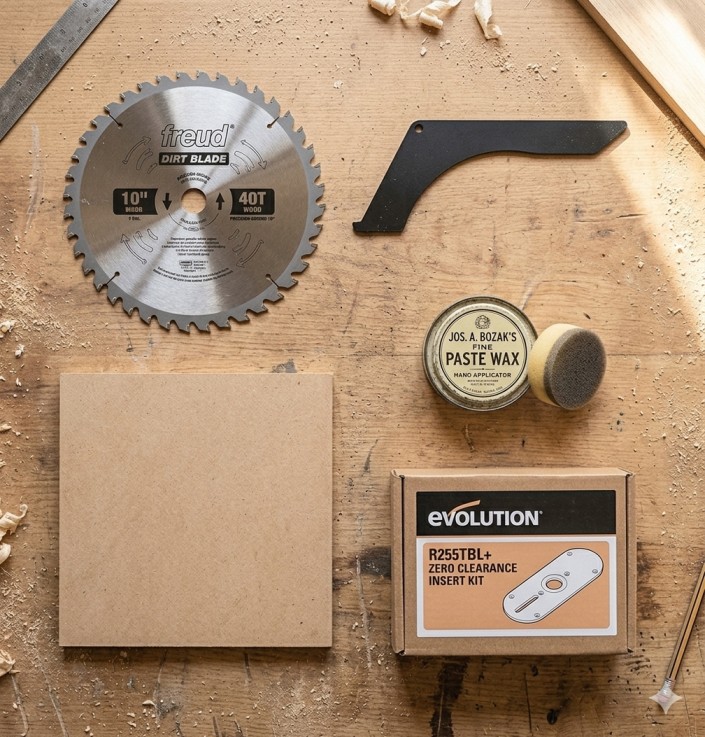
1. Low-Profile Riving Knife (Essential, ~£20)
Order this with the saw. The standard riving knife extends too high for comfortable push pad use and prevents crosscut sled work. Evolution’s official low-profile ‘shark fin’ knife is the cleanest solution and fits in minutes.
2. Dedicated Wood Blade (High Impact, £25–£45)
The stock 28T multi-material blade is competent but not optimal for wood-only work. A quality 40T or 60T wood blade (CMT, Freud, or Diablo) transforms cut quality on hardwoods and plywood immediately — less tearout, cleaner edges, less burning. Keep the multi-material blade for when you actually need it.
3. Crosscut Sled (Essential for Accuracy, ~£15 in Materials)
Don’t fight the stock mitre gauge. Build a sled from scrap MDF or plywood — the standard T-track channel accepts industry-standard runners — and you’ll have accurate, repeatable crosscuts that no stock mitre gauge can match. There are dozens of free plans available online.
4. Aftermarket Mitre Bar (£5–10 from eBay)
If you want to improve the stock mitre gauge rather than build a sled, a replacement mitre bar from eBay fits the channel and removes most of the play in the stock gauge. Users in the UK woodworking community report this as a worthwhile cheap fix.
5. Zero Clearance Insert Kit (£30 from Evolution)
For clean cuts on fine work without tearout, the official Evolution zero clearance kit is the most reliable option. Third-party inserts vary in fit quality between the standard R255TBL and the + version, so verify compatibility before ordering.
6. Table Wax (Ongoing)
A monthly application of paste wax to the aluminium table and fence surfaces reduces friction, improves workpiece control, and prevents resin buildup. Use paste wax only — silicone-based products contaminate wood surfaces and cause finishing problems.
Setup Guide — What the Manual Doesn’t Emphasise

Initial Calibration (Do This Before Your First Cut)
Factory calibration is a starting point, not a finished setup. Spend 30 minutes checking these before you cut anything:
- Blade-to-fence parallelism: measure at the front and rear of the blade. Should be within 0.3mm. Adjust using the tool-free parallelism system under the table.
- Blade square to table: place a reliable square against the blade body (not the teeth) at 0° bevel. Adjust the bevel stop if not exactly 90°.
- Bevel stops at 45°: verify with a digital angle gauge. Adjust the physical stop if out.
- Throat plate flush: adjust the corner screws until the plate sits exactly flush with the table surface.
- Fence scale: verify the sight glass alignment with a tape measure at a known dimension. Mark the offset if there is one.
Blade Installation Notes
The arbour uses a standard right-hand thread — turn the nut clockwise to tighten when looking at the arbour face. Some users have encountered wobble issues due to an incorrectly seated reducing washer — if you’re using an aftermarket blade with a different bore, verify the reducing ring thickness matches the blade. If the arbour itself shows side-to-side movement, that’s a warranty issue, not a user error.
Dust Connection
Connect a shop vac (minimum 1,200W) to the underside cabinet port. The blade guard port adds meaningful capture when both are connected. The non-standard fitting size means you’ll likely need an adapter or use a direct-fit dust sack — sort this before your first cutting session rather than during it.
Tips That Actually Improve Results
- Approach fence micro-adjustments from the same direction each time — advance to the final dimension rather than backing off from it. This removes mechanical backlash from the rack and pinion and gives you consistent positioning.
- Mark your most common cut depths (19mm, 38mm, 50mm) on the saw body with a paint pen. Eliminates measuring for repeated setups.
- Clean the blade every 8 to 10 hours of use with blade cleaner and a brass brush. Pitch and resin buildup causes burn marks and increased cutting resistance before the blade is actually dull.
- Run the saw unloaded once a month and listen for any pitch change or grinding from the bearings. Bearing failure is gradual — catching it early prevents motor damage.
- For cuts over 600mm rip width, use the integrated outfeed support and if possible add a roller stand. Cantilevered sheet weight at the far end of a wide rip causes flex that affects cut quality.
- Force the bevel lock completely off before adjusting the bevel wheel. If you feel resistance mid-adjustment, check for debris in the gearing rather than applying force. The geared mechanism is precise but not invulnerable.
- Seasonal temperature changes expand and contract the aluminium components. Recalibrate blade-to-fence parallelism at the start of each season, especially if you store the saw in an unheated space.
Frequently Asked Questions
Can the R255TBL+ cut aluminium and metal?
Yes, and this is one of the saw’s genuine differentiators. The supplied TCT blade cuts 3mm aluminium angle, mild steel up to 2mm, and non-ferrous metals without blade changes. The tooth geometry keeps the blade surprisingly cool after metal cuts. That said, alternating between wood and metal regularly accelerates tooth wear compared to using dedicated blades for each material. Keep the multi-material blade for occasional metal work and run a wood-specific blade for primary woodworking.
How does fence accuracy compare to DeWalt?
The Evolution’s dual rack and pinion fence holds its own against the DeWalt DWE7485 and in some respects outperforms it, particularly for rip widths over 400mm where single-point locking fences on comparable saws show rear drift. After calibration I measured consistent fence positioning within 0.2mm across the full 825mm capacity. The DeWalt DWE7491RS at higher price points offers more refined overall build, but on fence precision specifically, the Evolution punches above its price.
Can it do dado cuts?
No. The riving knife design and blade guard assembly prevent dado stack installation, and the arbour shaft length limits stacked blade width. This is a hard limitation of the design, not something that can be worked around. If dado and rabbet cuts are a core part of your workflow, either pair this saw with a router table for that work or look at a different saw. The Bosch GTS 10 XC supports dado cutting with the right accessory if that’s a dealbreaker.
Is it worth buying the Plus version over the standard R255TBL?
Yes, for most buyers. The 150W motor upgrade, soft-start, electronic blade brake, longer 3m cable, and extended outfeed support all add meaningful value. The electronic brake alone is worth the difference for workshop safety. If you’re buying the stand version, go for the R255TBLX+ to get everything in one purchase.
How effective is the dust collection?
Around 70 to 75 percent with a 1,200W+ shop vac connected to both ports. Respectable for a portable saw but not enough for enclosed spaces without additional management. The non-standard dust port fitting means you’ll need an adapter for standard hoses — most owners use a direct-fit dust sack instead. For heavier indoor use, an overhead dust collection addition gets overall capture to around 85 percent.
What are the most common problems reported by owners?
Based on UK woodworking forum discussions: poor stock mitre gauge (build a crosscut sled instead), inaccurate fence sight glass (verify with a tape measure and get a replacement), high riving knife limiting push pad clearance (buy the low-profile version), and occasional unit-to-unit QC variation on items like the throat plate insert. Evolution’s warranty support has generally been responsive for genuine defects. Arbour wobble, if you see it, is a warranty issue not a user setup problem.
Is it suitable for professional workshop use?
For renovation contractors, deck builders, and trim carpenters who need genuine portability and multi-material capability, yes. The 3-year warranty supports commercial use. For dedicated production workshops where the saw runs all day every day, I’d want something with heavier-duty stand construction and better dust extraction. The Evolution sits in the semi-professional category — more capable than its price suggests, but not a replacement for a £1,000+ contractor saw under sustained heavy use.
Final Verdict
After three weeks of testing and research into real owner experiences, here’s where I land: the Evolution R255TBL+ is probably the best fence you can buy at this price in a portable saw. That alone carries the recommendation for anyone where accurate rip cuts are the priority.
The multi-material capability is genuinely useful rather than a marketing gimmick — if you work with composite decking, aluminium section, or reclaimed timber with nails, eliminating blade changes saves real time. The electronic blade brake is better than passive braking by enough to matter in a real workshop. And it’s portable enough for solo handling in ways that heavier contractor saws aren’t.
The honest limitations: the stock mitre gauge is poor and needs addressing immediately (sled or upgrade), the dust extraction won’t satisfy anyone working in a sealed indoor space without additional measures, and the stand is lighter than what DeWalt or Bosch offer at similar prices. None of these are dealbreakers — they’re trade-offs you make for the fence quality and rip capacity you’re getting at this price.
Buy it for: Serious hobbyists, semi-pro woodworkers, renovation contractors, and anyone upgrading from an entry-level benchtop saw who needs real fence accuracy without spending £600.
Look elsewhere if: Dado capability is essential, you need industrial dust extraction, or you’re running it in a production environment where stand rigidity under sustained heavy use matters.

Finlay Connolly is a woodworking enthusiast and power tool specialist with over a decade of hands-on experience in the workshop. As the founder and lead writer at ProTableSawReviews.com, Finlay combines expert knowledge with real-world testing to help woodworkers, DIYers, and professionals choose the best tools for the job. With a sharp eye for detail and a passion for precision, Finlay is committed to providing trustworthy, practical advice backed by years of experience and research in the field. Whether you’re cutting dados or comparing fence systems, you can count on Finlay for honest, reliable reviews that make your next cut your best one.