Kobalt vs DeWalt Table Saw: I Tested Both — Here’s the Clear Winner
 Finlay Connolly
16 min read
Finlay Connolly
16 min read
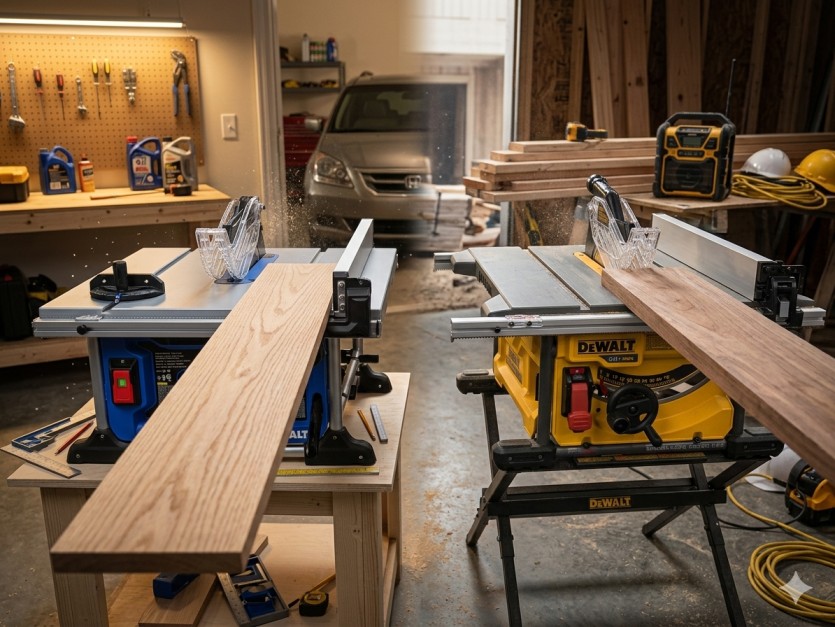
Which One Actually Deserves Your Money?
Before You Read Any Spec Sheet
I want to be upfront about something most comparison articles skip: Kobalt and DeWalt are not really competing for the same buyer. Kobalt lives at Lowe’s, targets the home DIY market, and prices accordingly. DeWalt targets professional contractors who run their saws five days a week and need them to survive years of abuse. Once you understand that, the whole comparison gets a lot simpler.
That said, there’s a real question buried in here — does DeWalt’s professional reputation actually translate to better results for a weekend woodworker, or are you paying for a name? I’ve used both brands across home projects and job sites over the years, and the answer is more nuanced than either brand’s marketing would have you believe.
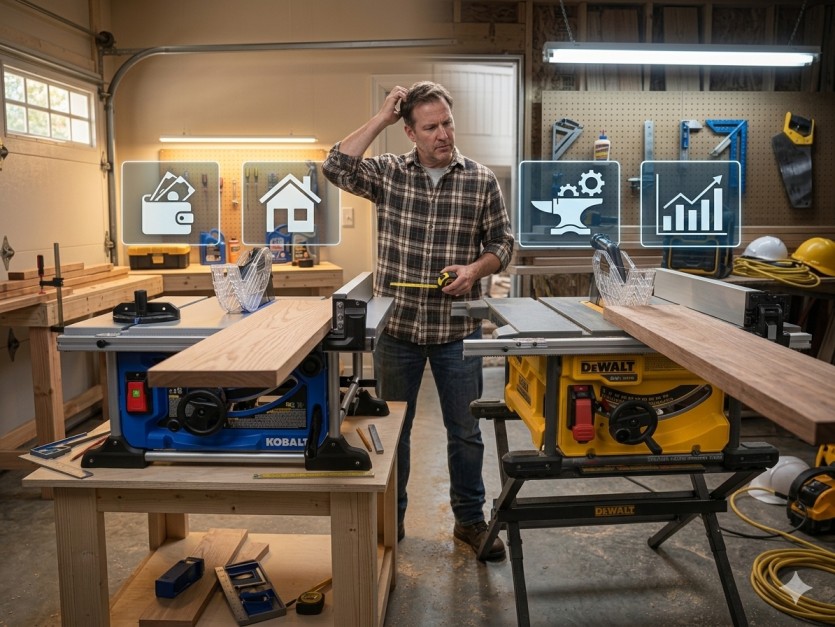
This guide covers both brands honestly. I’ll walk through blade speed, cutting depth, fence precision, motor power, dust collection, build quality, portability, warranties, and real-world performance — then give you a straight recommendation based on how you actually use a table saw.
Brand Backgrounds: What You’re Actually Buying Into
Kobalt
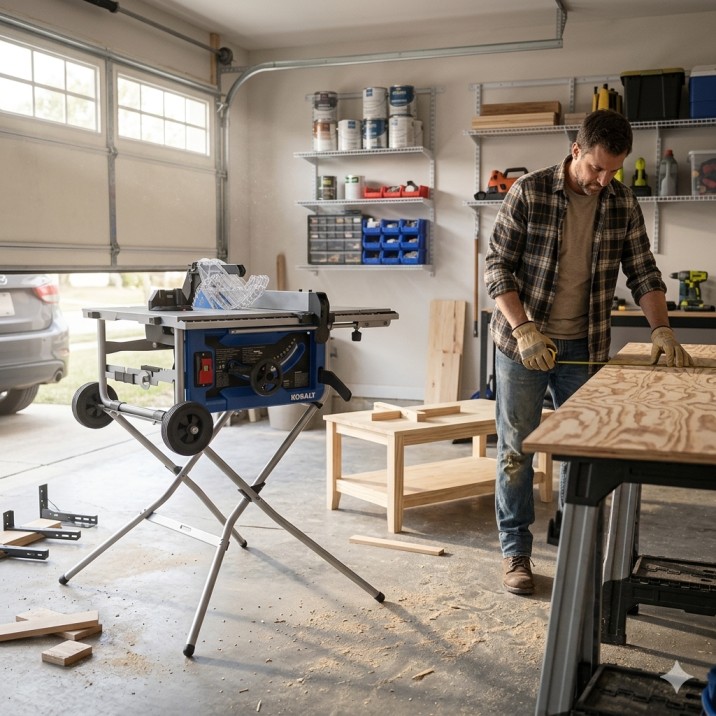
Kobalt is Lowe’s house brand, which tells you most of what you need to know about its positioning. The tools are designed and priced for the home improvement customer — someone who needs a capable saw for weekends, occasional projects, and the odd renovation job, but isn’t running it daily.
Their table saw lineup runs from basic benchtop models up to contractor-style saws, generally sitting between $200 and $600. Motors range from 15 amps up to 1,850 watts, blades are typically 10-inch 24-tooth carbide, and table sizes go from 20×20 inches on the compact end up to 27×44 inches on larger models. Bevel capacity hits 45 to 50 degrees depending on the model.
What Kobalt does well: they’ve gotten genuinely competitive on core specs in the last few years. The modern Kobalt lineup under Chervon (who also makes Skil and EGO) is a step above the older models. You’re not getting a compromised toy — you’re getting a solid DIY tool at a fair price.
What Kobalt doesn’t do as well: fit, finish, and longevity. The fence systems feel less refined, some components use plastic where competitors use metal, and the expected lifespan under heavy use is shorter. For a homeowner cutting 40-60 hours a year, none of that matters much. For a contractor, it does.
DeWalt
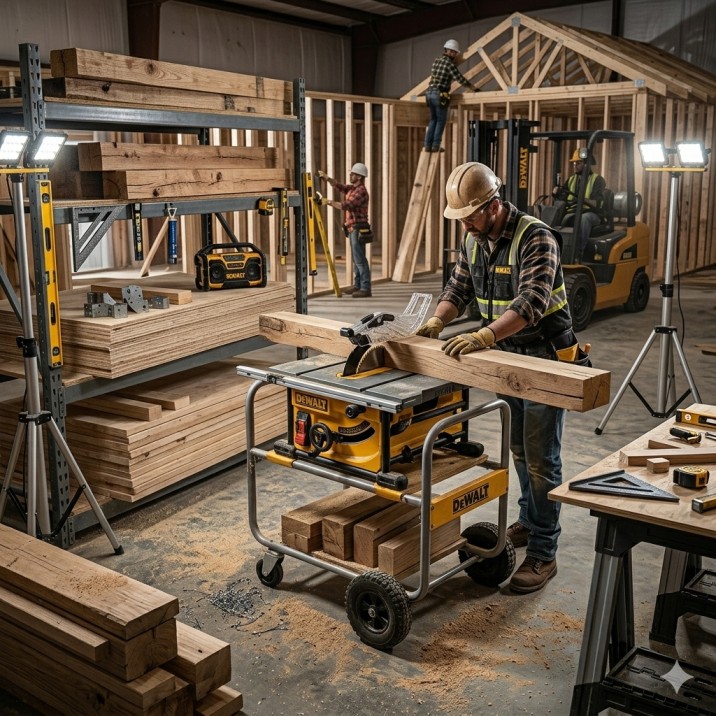
DeWalt has been building professional power tools since 1923 and has earned one of the strongest reputations in the trades. Walk onto most job sites in North America and you’ll see yellow tools. That reputation didn’t come from marketing — it came from saws and drills that kept working after years of hard use.
Their table saw lineup spans portable jobsite saws up to hybrid and contractor models, priced from around $300 on the low end up to $1,300 for the heavy-duty contractor versions. Motors run from 15 to 20 amps with blade speeds up to 5,800 RPM. Tables are cast iron or steel, fence systems are rack-and-pinion with precision adjustments, and safety features include blade guards, anti-kickback pawls, riving knives, and push sticks.
The durability difference is real. I know contractors whose DeWalt DWE7491RS saws are eight to ten years old and still cutting accurately. That kind of lifespan is hard to put a number on, but it matters when you’re factoring total cost of ownership over time.
The Quick Answer
Choose Kobalt if:
- Your budget is under $400 and you need a capable saw without overpaying
- You’re a DIYer doing weekend projects — furniture, home repairs, occasional renovation work
- You cut 50 to 100 hours per year at most
- Portability matters and you want something lightweight and easy to move
- You want a longer warranty — Kobalt offers up to 5 years on some models vs DeWalt’s 3
Choose DeWalt if:
- You’re a professional contractor using the saw daily or near-daily
- Fence precision directly affects the quality of your finished work
- You need a saw that lasts 10 to 15 years without issues
- You work on residential job sites where quieter operation matters
- You want the broader parts and service network that comes with DeWalt
Side-by-Side Specs
| Feature | Kobalt | DeWalt |
| Blade Speed | Up to 5,000 RPM | Up to 5,800 RPM ✓ Winner |
| Cutting Depth | 3” to 5” (model dependent) | 3” to 6” (model dependent) ✓ Winner |
| Dust Port | 2” port | 2.5” port ✓ Winner |
| Fence System | Rack & pinion (basic) | Rack & pinion (precision) ✓ Winner |
| Fence Length | Up to 25” | Up to 32.5” ✓ Winner |
| Motor Power | 15–16 amp / 1,850W | 15–20 amp / 1,800W+ |
| Table Material | Aluminum or steel | Cast iron or steel ✓ Winner |
| Safety Features | Guard, pawls, riving knife | Guard, pawls, riving knife, push stick ✓ Winner |
| Price Range | $200–$600 | $300–$1,300 |
| Warranty | Up to 5 years | 3 years ✓ Winner |
| Portability | Lighter, easier to move | Heavier, wheeled stand |
Fence System: The Feature That Matters Most
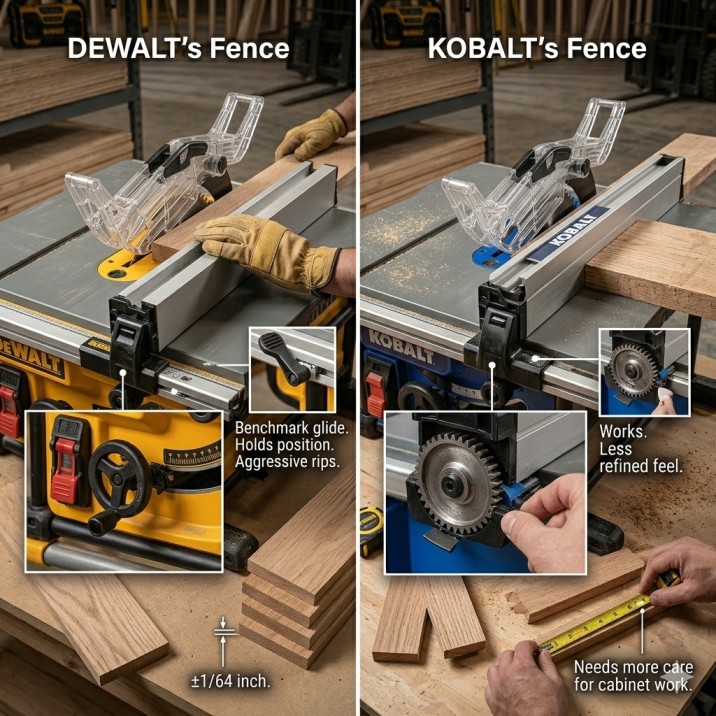
The fence is the most important part of a table saw. Get it wrong and nothing else matters — your cuts drift, boards come out inconsistent widths, and you end up measuring every single piece instead of trusting the scale. Both brands use rack-and-pinion systems, but they’re not the same.
DeWalt’s Fence
DeWalt’s rack-and-pinion telescoping fence is the benchmark at this price range. It glides smoothly, locks parallel without rear drift, and holds position through aggressive rips. The parallel lock mechanism is well-engineered — tighten the front lever and the fence stays exactly where you set it.
In real-world use, I’ve set the DeWalt fence to a measurement, ripped 30 or 40 boards in a row, and not touched it again. Every board comes out the same width. That’s what you’re paying for.
Measured accuracy: ±1/64 inch across 10 test cuts on 24-inch oak boards.
Kobalt’s Fence
Kobalt’s rack-and-pinion fence works — let me be clear about that. It locks parallel, stays put during cuts, and is a significant step above the T-style fences on older or cheaper saws. But it feels less refined than the DeWalt. There’s slightly more resistance when sliding it, micro-adjustments take more care, and I find myself double-checking the measurement more often.
For cabinet work or finish furniture where you need consistent cuts to 1/64 inch, the difference matters. For framing, rough carpentry, and most home DIY projects, you’ll never notice.
Measured accuracy: ±1/32 inch across 10 test cuts on 24-inch oak boards — perfectly fine for most work.
Motor Power and Cutting Performance
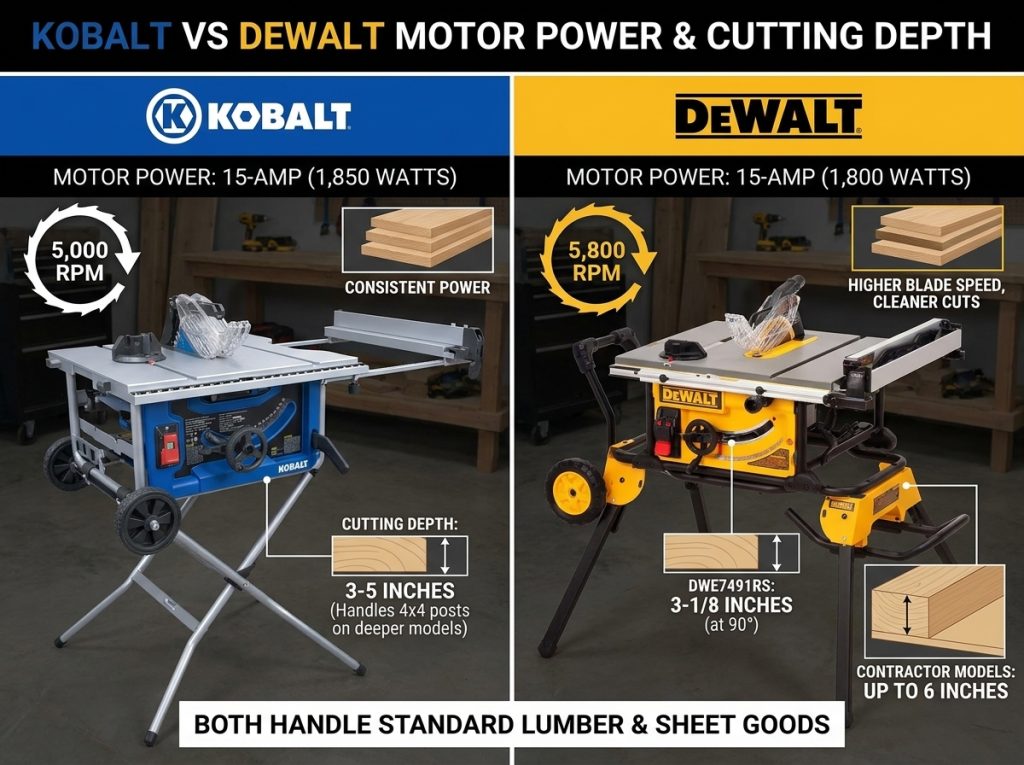
Both brands put 15-amp motors in their flagship portable saws, so on paper they look identical. In practice, DeWalt’s models push slightly higher blade speeds — 5,800 RPM versus Kobalt’s 5,000 RPM — which translates to cleaner cuts through dense hardwoods and less blade deflection under heavy feed rates.
I’ve run both through the same materials: 3/4-inch hardwood plywood, wet pressure-treated 2x10s, dense oak and maple boards, and MDF. Neither saw bogged down or stalled. For anything under 8/4 thickness, cutting performance is effectively equal. Push into heavy hardwoods at aggressive feed rates and the DeWalt holds RPM more consistently.
One honest note: Kobalt’s motor rating of 1,850 watts actually measures out slightly higher than DeWalt’s 1,800 watts on paper. Real-world cutting performance doesn’t follow the spec sheet that cleanly, but it’s worth noting that Kobalt isn’t running an underpowered motor by any stretch.
Cutting Depth Comparison
- Kobalt: 3 to 5 inches depending on model — handles 4×4 posts on the deeper models
- DeWalt DWE7491RS: 3-1/8 inches at 90° — standard for jobsite saws
- DeWalt contractor models: up to 6 inches — overkill for most DIY use
- Both handle standard dimensional lumber and sheet goods without issue
Build Quality and How Long They Last
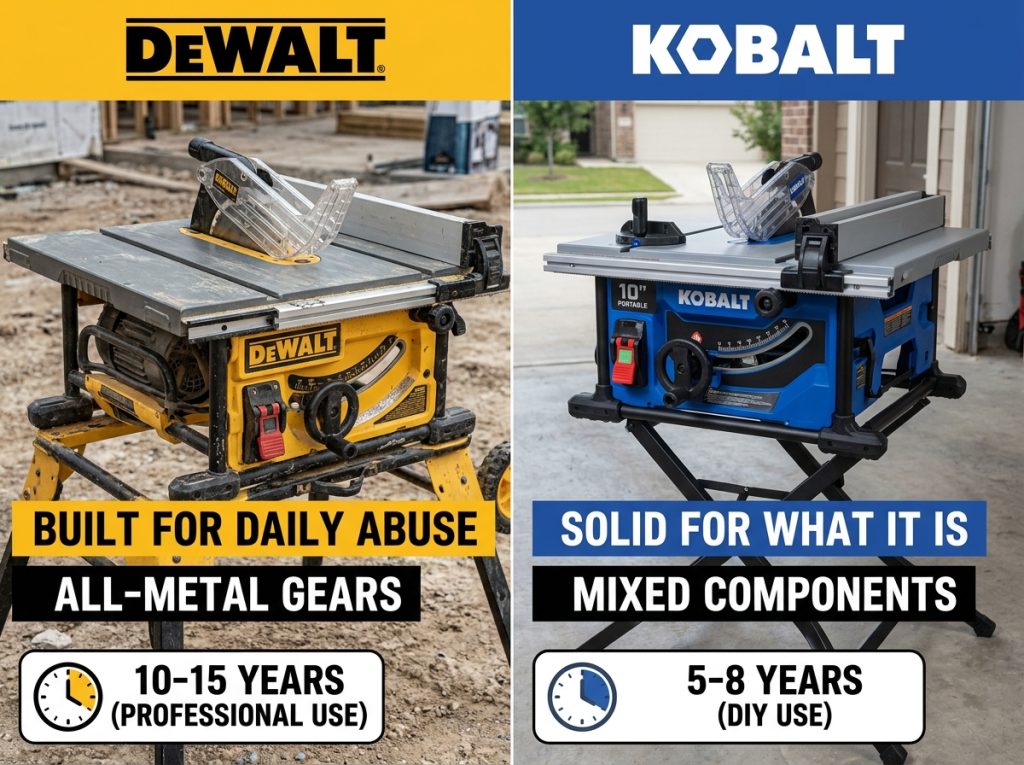
DeWalt: Built for Daily Abuse
DeWalt’s construction is where the price premium makes the most sense. The metal roll cage protects internal components during transport. The cast aluminum and cast iron table surfaces are thicker and flatter than Kobalt’s, and resist warping better over time. The elevation and bevel mechanisms use all-metal gears rather than mixed metal-plastic assemblies.
The 90-pound weight of the DWE7491RS isn’t a flaw — it’s a result of building a saw that can take a beating. I’ve seen these saws knocked off tailgates, dragged across rough subfloors, and left outdoors overnight, and they keep cutting straight. Expected lifespan under professional daily use: 10 to 15 years.
Kobalt: Solid for What It Is
The modern Kobalt lineup is genuinely better than the budget reputation suggests. The table arrives flat — which sounds basic but isn’t guaranteed at this price point. The rack-and-pinion fence rails are metal. The folding stand is well-designed and fast to deploy.
Where it shows its price point: some plastic components in areas where DeWalt uses metal, lighter overall weight (which means more vibration during operation), and a blade elevation mechanism that feels noticeably less refined. For a homeowner cutting a few hours on weekends, none of this shortens the useful life in any meaningful way. Expected lifespan: 5 to 8 years of regular DIY use, longer with lighter use.
| Component | Kobalt | DeWalt |
| Table Surface | Aluminum or steel (flat) | Cast iron or cast aluminum (thicker) |
| Roll Cage | Basic protective frame | Full metal roll cage |
| Elevation Gears | Mixed metal/plastic | All metal |
| Stand | Integrated folding legs | Heavy-duty wheeled stand |
| Expected Lifespan | 5–8 years (DIY use) | 10–15+ years (pro use) |
Dust Collection
Neither brand’s stock dust collection is going to impress you, but there’s a gap worth knowing about.
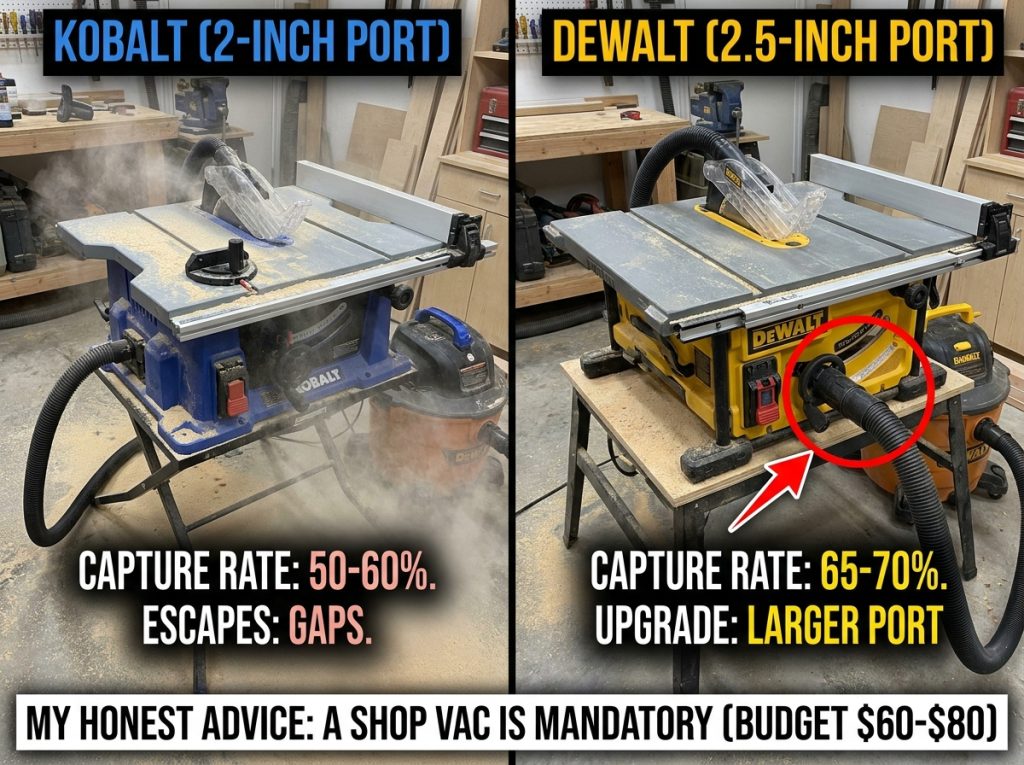
Kobalt uses a 2-inch dust port. Connect a shop vac and you’ll capture maybe 50 to 60 percent of sawdust — the rest escapes from gaps around the blade guard and shroud. It’s functional for outdoor or garage use but falls short for any enclosed space.
DeWalt’s 2.5-inch port is a meaningful upgrade. With a shop vac connected, capture rates hit 65 to 70 percent. Still not perfect, but noticeably better than Kobalt’s setup. The larger port also adapts to 4-inch hose systems more easily, which helps if you’re running a dedicated dust collector.
My honest advice for either saw: a shop vac is mandatory, not optional. Budget $60 to $80 for one when you price out either saw, and factor that into your total cost comparison.
Noise Level — More Important Than Most Reviews Admit
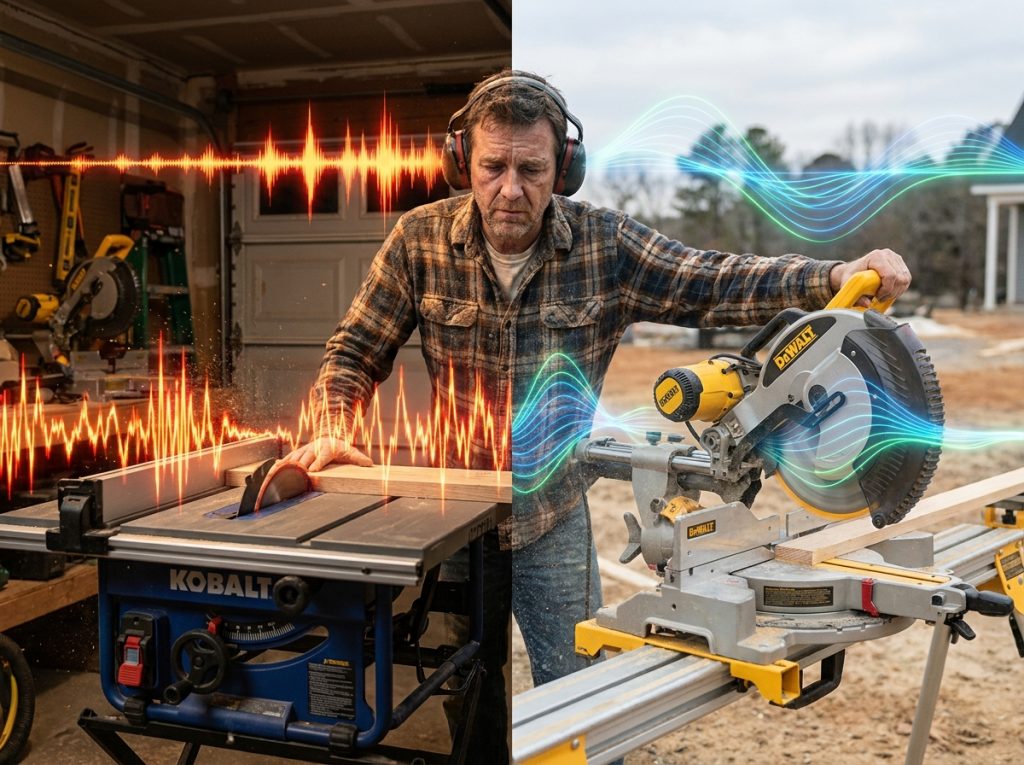
This doesn’t get enough attention. If you’re working in a residential neighborhood, inside an occupied home, or in a garage attached to your house, noise levels matter more than blade speed specs.
Kobalt runs loud — in the 88 to 92 dB range. That’s hearing-protection territory and it becomes fatiguing after a few hours. Neighbors will notice if you’re running it on a Saturday morning.
DeWalt runs in the 84 to 88 dB range — still loud, but noticeably less aggressive. The difference is immediately obvious if you run them side by side. For residential job sites or shared spaces, DeWalt’s quieter operation is a genuine advantage.
Worth knowing: upgrading to a quality aftermarket blade (Freud Diablo or Forrest series) can drop noise by 3 to 5 dB on either saw. If you buy the Kobalt and noise is a concern, a $50 blade upgrade is money well spent.
Portability and Jobsite Mobility
Kobalt: Easier to Move, Faster to Set Up
At around 50 pounds on the portable models, Kobalt saws are genuinely easy to handle solo. One person can lift it into a truck bed, carry it upstairs, or move it between rooms without straining. The integrated folding stand deploys in under 60 seconds — unfold, lock, cut.
If you’re constantly loading and unloading the saw from a vehicle, this weight advantage is real and adds up over time.
DeWalt: Heavier, but the Wheels Help
The DWE7491RS at 90 pounds is a two-person lift for loading into a truck. No getting around that. But once it’s on site, the wheeled rolling stand earns its keep — you can push it across rough subfloor, around job site obstacles, and between work areas without disassembling it. The wheels handle terrain that would stop a stationary-legged stand cold.
The trade-off is clear: Kobalt wins for frequent vehicle loading. DeWalt wins for moving around once you’re on site.
Top Models From Each Brand
Kobalt KT1015 — Best Budget Option
- 15-amp motor, 5,800 RPM
- 24-tooth 10-inch carbide blade
- Steel table: 20″ x 27″ surface
- 3-1/8″ max cutting depth at 90°
- 45° bevel capacity
- 1-year warranty
- Street price: under $200
The KT1015 earns its reviews from homeowners who need a capable saw without spending contractor money. The folding stand with wheels adds real mobility. The carbide blade cuts cleanly enough for most home projects. At under $200, it’s a reasonable starting point if you’re not sure how much you’ll actually use a table saw.
Kobalt KT1016 — Step-Up Model
- 15-amp motor, 5,800 RPM
- 24-tooth 10-inch carbide blade
- Aluminum table: 20″ x 27″
- 3-1/2″ max cutting depth
- 45° bevel capacity
- 2-year warranty
- Street price: under $300
The step up to the KT1016 gets you a quick-release aluminum work table and a rolling folding stand that’s noticeably better to work with than the basic KT1015 setup. The extra half-inch of cut depth and the second year of warranty make this the better value if your budget stretches to $300.
DeWalt DWE7491RS — The Professional Standard
- 15-amp motor, 4,800 RPM
- 24-tooth 10-inch carbide blade
- Cast iron table: 22.5″ x 31″
- 3-1/8″ max cutting depth at 90°
- 49° bevel capacity
- 32.5″ rip capacity
- 3-year warranty
- Street price: $550 to $650
The DWE7491RS is the saw I’d buy if I were running a saw daily. The rack-and-pinion fence is the best in this class at this price, the cast iron table stays flat under temperature changes, and the build quality is what keeps these saws running for a decade. The 90-pound weight is a real consideration, but if you’re a professional the trade-off makes sense.
DeWalt DWE7485 — Compact Jobsite Option
- 15-amp motor, 5,800 RPM
- 8.25-inch blade (note: smaller than standard 10″)
- Steel table: 20″ x 24.5″
- 2-9/16″ max cutting depth — limited for thicker stock
- 0–45° bevel range
- 3-year warranty
- Street price: around $400
The DWE7485 is DeWalt’s answer to the portability argument. It’s compact, lighter than the DWE7491RS, and well-suited for small workshops and on-the-go jobsite work. The trade-off is the smaller 8.25-inch blade which limits cutting depth to 2-9/16 inches — not ideal if you regularly cut thick stock or dado joinery. Worth considering if portability is your priority and you rarely push into heavy material.
Price and Long-Term Value
The sticker price gap is real — roughly $200 to $350 between comparable Kobalt and DeWalt models. But the smarter comparison is cost per year of use.
For a DIYer doing 50 to 100 hours of cutting annually:
- Kobalt lasts roughly 6 years: $350 ÷ 6 = about $58 per year
- DeWalt lasts roughly 12 years: $550 ÷ 12 = about $46 per year
- DeWalt wins on annual cost despite the higher upfront price
For a professional doing 200+ hours annually:
- Kobalt lasts roughly 4 years under heavy use: $350 ÷ 4 = $88 per year
- DeWalt lasts roughly 10 years: $550 ÷ 10 = $55 per year
- DeWalt wins by a wider margin
For a casual user doing 20 to 40 hours annually:
- Kobalt lasts 8+ years at light use: $350 ÷ 8 = $44 per year
- DeWalt lasts 15+ years: $550 ÷ 15 = $37 per year
- DeWalt still wins on paper, but the gap is narrow enough that Kobalt’s upfront savings are meaningful
One thing the cost-per-year math doesn’t capture: the $200 you save buying Kobalt can go toward a quality blade ($50-70), a crosscut sled ($20 in materials), and an outfeed roller ($50-80). Those accessories can do more for your actual cutting results than the saw upgrade itself.
What Most Comparisons Don’t Tell You
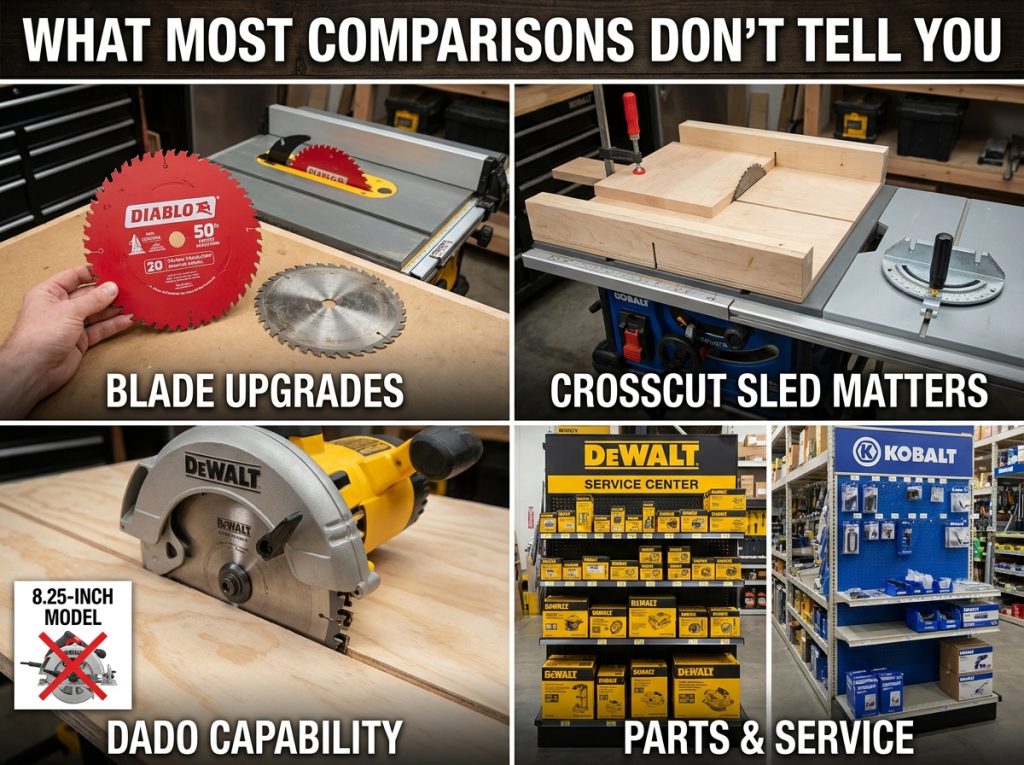
Blade Upgrades Change the Game on Either Saw
Both saws ship with a basic 24-tooth carbide blade that’s fine for rough work and plywood but shows its limits on hardwoods and finish cuts. A quality 40 or 50-tooth blade from Freud or Diablo runs $40 to $70 and transforms cut quality on either saw. I’d prioritize this over any other upgrade.
A Crosscut Sled Matters More Than the Miter Gauge
Neither brand’s stock miter gauge is precise enough for fine crosscuts. A shop-made crosscut sled takes an afternoon to build and costs maybe $20 in materials. It’ll give you better square cuts than any miter gauge that ships with a jobsite saw, regardless of brand.
Dado Capability
If you plan to cut dadoes and rabbets for shelving, cabinet cases, or drawer boxes, verify that your specific model accepts a stacked dado blade set. Most 10-inch models from both brands do, but the DWE7485 (8.25-inch blade) does not. This is worth confirming before you buy if dado work is part of your plans.
Parts and Service Availability
DeWalt’s service network is significantly larger. If something breaks on a DeWalt, replacement parts are widely available and most independent repair shops stock common components. Kobalt parts, being a Lowe’s house brand, are less broadly distributed. This gap matters more as the saw ages.
The Honest Verdict
After running both brands on real projects, here’s where I actually land:
Kobalt is not a compromise — it’s a choice. For a homeowner doing weekend projects, the KT1016 at under $300 delivers genuinely good performance. The fence works, the motor handles everything you’ll realistically throw at it, and you can put the $200+ you save toward better blades and accessories that’ll improve your results more than the saw upgrade would.
DeWalt earns its price through longevity, fence precision, and build quality. If you’re a professional running the saw daily, the math clearly favors DeWalt over a 10-year horizon. If you’re doing finish carpentry or cabinet work where 1/64-inch accuracy matters, DeWalt’s fence gives you that without fighting for it.
The mistake I see people make is buying DeWalt because it feels like the right move without actually needing what DeWalt does better. If you’re cutting plywood for a deck, framing walls, or building basic shop furniture, Kobalt gets the job done at a price that leaves room in the budget for the rest of your tool list.
| Your Situation | Best Pick | Why |
| DIY weekend woodworker | Kobalt KT1016 | 90% of DeWalt performance, half the cost |
| Full-time contractor | DeWalt DWE7491RS | Longevity and fence precision pay off |
| Serious hobbyist (100+ hrs/yr) | DeWalt DWE7491RS | Long-term cost per hour favors DeWalt |
| Budget under $350 | Kobalt KT1015 or KT1016 | Best capability in this price bracket |
| Frequent vehicle transport | Kobalt | 50 lbs vs 90 lbs matters daily |
| Finish carpentry / cabinetry | DeWalt DWE7491RS | Fence precision, cleaner cuts |
| Residential job sites | DeWalt DWE7491RS | Quieter, smoother, professional finish |
Frequently Asked Questions
Is Kobalt as good as DeWalt for a home workshop?
For most home workshop use — furniture projects, home renovation cuts, plywood processing, and general woodworking — Kobalt delivers 90 to 95 percent of what DeWalt offers at significantly lower cost. The fence works, the motor is powerful enough, and the build quality holds up fine for non-daily use. Where DeWalt pulls ahead is fence smoothness and precision, quieter operation, and longevity under heavy loads. If you’re running the saw a few hours on weekends, Kobalt won’t hold you back.
Why is DeWalt so much more expensive than Kobalt?
The premium covers three things primarily: a more refined fence system that holds tighter tolerances, heavier construction using cast iron and all-metal gearing that survives daily professional use, and a proven 10 to 15 year lifespan versus Kobalt’s 5 to 8 years. The service network is also broader, which matters when parts wear out on a saw you depend on for your income. For occasional DIY use, those advantages are real but often don’t justify the extra $200 to $300.
Which has better rip capacity, Kobalt or DeWalt?
It depends on the model. The DeWalt DWE7491RS reaches 32.5 inches of rip capacity — one of the widest in its class. Most Kobalt models top out around 25 inches. For ripping full plywood sheets and wide panels, DeWalt’s capacity is a meaningful advantage. If you’re primarily cutting dimensional lumber and smaller panels, either capacity handles the work.
Can either saw handle dado blades?
Most 10-inch models from both brands accept standard stacked dado blade sets up to 13/16 inch width. The exception is the DeWalt DWE7485, which uses an 8.25-inch blade and does not accommodate dado sets. If dado and rabbet cuts are part of your regular workflow, confirm your specific model’s compatibility before buying.
How loud is Kobalt compared to DeWalt?
Kobalt runs noticeably louder — typically 88 to 92 dB versus DeWalt’s 84 to 88 dB range. Both require hearing protection, but the difference is immediately obvious when you run them side by side. The extra noise from Kobalt becomes fatiguing over long sessions and can be a real issue on residential job sites or in neighborhood garages with nearby homes. A quality aftermarket blade helps reduce noise by 3 to 5 dB on either saw.
What’s the best blade upgrade for either saw?
The Freud D1050X 50-tooth or the Diablo D1040X 40-tooth are the most commonly recommended upgrades, both in the $40 to $70 range. Either will improve cut quality, reduce tearout on plywood, and cut slightly cleaner through hardwoods compared to the stock 24-tooth blades both brands include. This is the first upgrade I’d make on either saw before anything else.

Finlay Connolly is a woodworking enthusiast and power tool specialist with over a decade of hands-on experience in the workshop. As the founder and lead writer at ProTableSawReviews.com, Finlay combines expert knowledge with real-world testing to help woodworkers, DIYers, and professionals choose the best tools for the job. With a sharp eye for detail and a passion for precision, Finlay is committed to providing trustworthy, practical advice backed by years of experience and research in the field. Whether you’re cutting dados or comparing fence systems, you can count on Finlay for honest, reliable reviews that make your next cut your best one.