Best Circular Saw for Cutting Plywood: The Top Picks After Real Research
 Finlay Connolly
13 min read
Finlay Connolly
13 min read
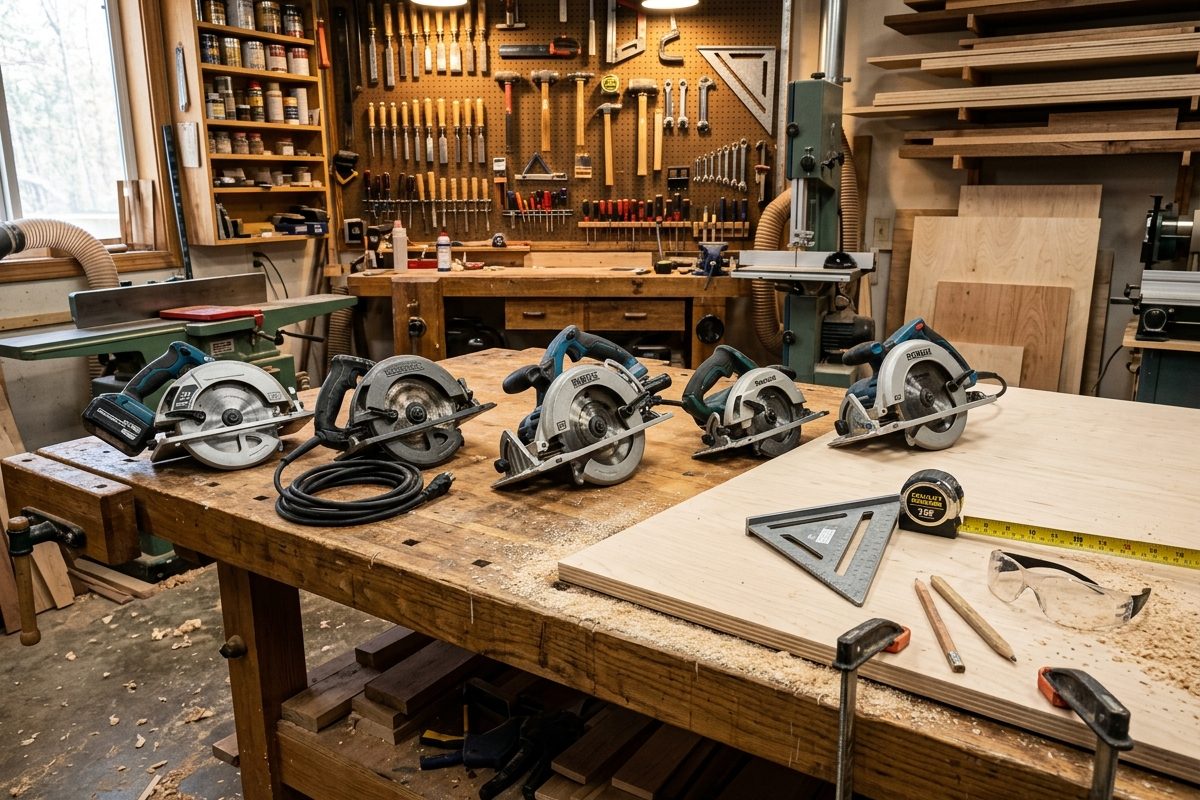
By Finlay Connolly
Quick Answer
The DeWalt DCS570B is the best circular saw for cutting plywood for most people. It’s a cordless 7-1/4 inch sidewinder saw with enough power to rip full sheets cleanly, and independent lab testing has singled it out specifically for crosscutting dimensional lumber and ripping plywood without the weight of a worm drive. If you want a corded option at a lower price, the DeWalt DWE575SB covers the same core job. If edge quality on finish-grade plywood matters more than anything else, the Makita 18V LXT has a reputation among woodworkers for leaving noticeably less chip-out than other saws in its class.

Saw Comparison at a Glance
| Saw | Best For | Type | Power |
| DeWalt DCS570B | Overall best, cordless plywood work | Sidewinder, cordless | 20V Max, 7-1/4″ |
| DeWalt DWE575SB | Best corded, budget-friendly | Sidewinder, corded | 15A, 7-1/4″ |
| Makita 18V LXT (XSS02) | Cleanest edge, minimal chip-out | Sidewinder, cordless | 18V, 6-1/2″ |
| Skilsaw Worm Drive | Ripping plywood, high volume | Worm drive, corded | 15A, 7-1/4″ |
| Bosch CS10 | Budget option, long cuts | Sidewinder, corded | 15A, 7-1/4″ |
What Actually Matters When Cutting Plywood

Plywood isn’t like framing lumber. You’re not fighting through thick, dense material, you’re trying to get a straight, clean line through a thin sheet without tearing the face veneer or wandering off your cut mark. That changes what you should actually be shopping for. Raw power matters less here than it does with framing lumber. Base plate flatness, bevel accuracy, and blade quality matter more.
Most plywood is 3/4 inch or thinner, so almost any circular saw has enough depth capacity. The saws that actually perform well on plywood are the ones with a stable base, a shoe that stays true to the blade at both 90 and 45 degrees, and enough RPM to get through the cut without bogging down and burning the edge.
Top Circular Saws for Cutting Plywood
1. DeWalt DCS570B — Best Overall

This is a cordless 20V Max sidewinder saw with a full-size 7-1/4 inch blade, and it’s built around exactly the kind of work most plywood cutting actually involves. In TechGearLab’s hands-on testing, which put this saw through a full regimen of straight and angled cuts across multiple materials, the DCS570B was specifically noted as a strong fit for jobs that mainly involve crosscutting dimensional lumber and ripping plywood, rather than heavy framing work.
Advantages: cordless mobility without the weight of a worm drive, a full 7-1/4 inch blade that handles plywood and dimensional lumber equally well, and battery compatibility across DeWalt’s broader 20V platform if you already own other tools on it.
Downsides: like most cordless saws, sustained ripping through multiple full sheets will draw down a battery faster than a corded saw’s unlimited runtime, so a spare battery is worth having on hand for a full day of sheet breakdown.
Who should buy it: DIYers and contractors who want one saw that handles both plywood and general framing without needing to switch tools.
2. DeWalt DWE575SB — Best Corded, Budget-Friendly

This corded sidewinder has been a go-to recommendation in woodworking forums for years, largely because it’s affordable, widely available, and does the job without much fuss. In one detailed FineWoodworking forum discussion among woodworkers comparing saws specifically for breaking down sheet goods, the DWE575SB came up as a strong budget pick, with the caveat that a few owners have reported the blade and shoe arriving slightly out of alignment at 90 degrees. DeWalt’s manual includes the adjustment procedure to correct that, so it’s a fixable five-minute check rather than a defect you have to live with.
Advantages: no battery to manage, consistent power through long cutting sessions, and a lower price than most cordless equivalents.
Downsides: check the base plate alignment at 90 degrees out of the box before trusting it on a critical cut, since this is a documented, if occasional, quality control issue.
Who should buy it: buyers who don’t need cordless mobility and want to spend less without giving up cut quality.
3. Makita 18V LXT — Best for Clean, Chip-Free Edges

Makita’s cordless sidewinder has a strong reputation specifically for edge quality on plywood, which is the detail that matters most if you’re cutting anything with a finish-grade face veneer. One woodworker on the Sawmill Creek forum, discussing a saw used specifically for breaking down sheet goods, described being able to cut a full 4x8x3/4 sheet of plywood down into smaller sections on a single battery charge, with minimal chip-out using a fairly new Makita blade. That combination of battery life and edge quality is exactly what most plywood-focused buyers are looking for.
Advantages: consistently clean cuts with less tear-out than several competitors, and enough battery capacity to break down a full sheet or more on a single charge.
Downsides: the 6-1/2 inch blade is slightly smaller than the full 7-1/4 inch standard, which caps maximum cutting depth a bit lower than the DeWalt options above.
Who should buy it: cabinet builders, furniture makers, and anyone cutting finish-grade plywood where the visible edge quality actually matters.
4. Skilsaw Worm Drive — Best for High-Volume Ripping

Worm drive saws trade some weight and balance for torque, and that torque shows up directly in how the saw handles long rip cuts through plywood. One LumberJocks forum member switching from a sidewinder to a worm drive specifically noted that ripping plywood became noticeably easier with the worm drive, alongside good crosscutting performance. Worm drives also tend to run heavier and more nose-forward, which some woodworkers prefer for long, controlled cuts and others find tiring for quick, repetitive work.
Advantages: more torque for sustained ripping, which matters most if you’re breaking down many sheets in one session rather than making occasional cuts.
Downsides: heavier and less maneuverable than a sidewinder, which can be tiring on overhead or awkward-angle cuts.
Who should buy it: contractors and shops doing high-volume sheet breakdown where torque and sustained cutting speed outweigh the extra weight.
5. Bosch CS10 — Best Budget Option

Bosch’s corded sidewinder consistently gets described as strong value rather than a top performer, and that’s a fair characterization. TechGearLab’s testing placed it as well-suited to long, difficult cuts that need cutting power without requiring high precision, which describes a lot of rough plywood breakdown work reasonably well.
Advantages: lower price than the other saws on this list, with power that holds up fine for rough cutting and general use.
Downsides: not the pick for finish-grade cuts where edge precision matters most, since it’s built more for capability than fine accuracy.
Who should buy it: budget-conscious buyers doing rough breakdown work who plan to finish critical cuts on a table saw anyway.
Sidewinder vs. Worm Drive for Plywood

This split shows up constantly in woodworking forums, and it’s partly regional habit as much as it is a technical decision. Sidewinder saws, where the motor sits directly beside the blade, are lighter and more common in the eastern United States. Worm drive saws, where the motor sits behind the blade and drives it through a gear set, are heavier, generally more powerful for sustained cuts, and more common on the West Coast.
For plywood specifically, a sidewinder’s lighter weight makes it easier to control on precise crosscuts and awkward angles, while a worm drive’s extra torque makes long rip cuts through multiple sheets feel less like work. Neither is wrong. If most of your plywood work is breaking down full sheets into rough sections before finishing cuts elsewhere, a worm drive’s torque advantage matters more. If you’re making more varied cuts, including crosscuts and angles, a sidewinder’s lighter weight and easier handling usually wins out.
The Blade Matters as Much as the Saw

A great saw with a cheap, low tooth count blade will still tear up plywood’s face veneer. Blades built for plywood typically run a higher tooth count, somewhere in the 40 to 60 tooth range on a 7-1/4 inch blade, which reduces splintering along the cut line compared to a standard framing blade in the 18 to 24 tooth range. The Freud Diablo Ultra Finish blade is a commonly recommended upgrade specifically for this reason, since its tooth geometry is built around minimizing tear-out on sensitive veneered surfaces rather than maximizing cutting speed through thick lumber.
If you’re building out a blade collection for plywood-heavy work across multiple saws, our Circular Saw Blades for Woodworking guide covers tooth count and grind selection in more depth, and our Table Saw Blades for Plywood guide applies the same core principles if you’re finishing cuts on a table saw after the initial breakdown.
Real-World Workflow: Rough Cut, Then Finish

A pattern that comes up repeatedly among experienced woodworkers is using the circular saw for rough breakdown and a table saw for final, precise dimensions. Full plywood sheets get cut down slightly oversized with a circular saw, often outside the shop or on a cutting table where there’s room to manage an 8-foot sheet, and then trimmed to exact size on a table saw where accuracy is easier to control.
This two-step approach shows up so consistently in forum discussions among people who cut plywood regularly that it’s worth planning around rather than expecting one saw to handle both rough and finish cuts equally well. If your shop doesn’t have room to manage a full sheet indoors, this workflow solves that problem directly. For the finish-cutting side of that workflow, our Best Portable Table Saws for the Money roundup covers saws that pair well with this rough-then-finish approach.
When a Track Saw Makes More Sense

If straight-line accuracy on every single cut matters more than speed, a track saw, sometimes called a plunge saw, is worth considering instead of or alongside a standard circular saw. Track saws ride along a clamped guide rail, which removes the freehand accuracy variable entirely. One Sawmill Creek forum member who owns both a Festool track saw and a standard cordless circular saw described the Festool as producing a slightly more accurate cut with better dust pickup, but also noted the extra cost is difficult to justify for many buyers given how close a good circular saw with a straightedge can get.
That’s a fair summary of the trade-off. A track saw costs more, but it removes guesswork on long, straight cuts in a way a standard circular saw, even a great one, can’t fully match freehand. If that trade-off appeals to you, our Best Cordless Track Saw guide breaks down the current options in more detail.
Common Mistakes People Make
- Using a low tooth count framing blade on finish-grade plywood and being surprised by torn, splintered edges
- Not supporting the sheet properly, which lets it sag and pinch the blade partway through a long rip cut
- Assuming a heavier, more powerful saw is automatically better for plywood, when accuracy and blade quality matter more than raw power
- Skipping the alignment check on a new saw’s base plate before trusting it on an important cut
- Cutting with the good face down on a saw that tears out on the bottom of the cut, or up on a saw that tears out on top, without checking which side your saw favors first
- Trying to make finish-precision cuts freehand with a circular saw instead of rough-cutting oversized and finishing on a table saw or track
Frequently Asked Questions
What blade tooth count is best for cutting plywood?
Most woodworkers recommend a blade in the 40 to 60 tooth range for a 7-1/4 inch circular saw when cutting plywood, especially finish-grade sheets with a visible face veneer. A standard framing blade with 18 to 24 teeth cuts faster through thick lumber but leaves a rougher, more splintered edge on thin plywood. The higher tooth count trades a bit of cutting speed for a noticeably cleaner line, which matters most on cuts that will stay visible in the finished project.
Should I cut plywood face up or face down?
This depends on which direction your specific saw tends to tear out. Most circular saws, where the blade spins up and through the material from underneath, tend to produce a cleaner cut on the underside of the sheet and more tear-out on the top face. Cutting with the good, visible face down usually gives a cleaner result on these saws. It’s worth testing a scrap cut on your specific saw and blade combination before committing to a full sheet, since blade design and saw setup both affect which side tears more.
Is a cordless circular saw powerful enough for plywood?
Yes, for the vast majority of plywood cutting. Plywood is thin and doesn’t demand the sustained power that ripping thick hardwood or framing lumber does, so a quality 18V or 20V cordless saw handles it well. The main consideration with cordless saws is battery life over a long session of breaking down multiple sheets, not raw cutting power for any single cut.
Do I need a worm drive saw to cut plywood?
No. A worm drive’s extra torque is most useful for high-volume ripping across many sheets in one session, but a standard sidewinder saw cuts plywood cleanly and is lighter and easier to control for most users. Choose a worm drive if you’re doing sustained, repetitive ripping, and a sidewinder if your work involves more varied cuts and angles.
Final Recommendation
For most buyers, the DeWalt DCS570B covers plywood cutting well without forcing a trade-off between mobility and cutting quality. If cost matters more than cordless convenience, the DWE575SB gets you the same core performance for less. If you’re cutting finish-grade plywood where edge quality is the whole point, the Makita’s reputation for minimal chip-out makes it worth the look, and if you’re breaking down high volumes of sheet goods regularly, the extra torque of a worm drive earns its added weight.
Whichever saw you choose, remember that the blade you put on it changes the result as much as the saw itself, and a rough-cut-then-finish workflow will get you more accurate results than trying to nail every dimension freehand on the first pass.

Finlay Connolly is a woodworking enthusiast and power tool specialist with over a decade of hands-on experience in the workshop. As the founder and lead writer at ProTableSawReviews.com, Finlay combines expert knowledge with real-world testing to help woodworkers, DIYers, and professionals choose the best tools for the job. With a sharp eye for detail and a passion for precision, Finlay is committed to providing trustworthy, practical advice backed by years of experience and research in the field. Whether you’re cutting dados or comparing fence systems, you can count on Finlay for honest, reliable reviews that make your next cut your best one.