Which Is Better: Table Saw or Miter Saw? (It Depends on This)
 Finlay Connolly
19 min read
Finlay Connolly
19 min read

What I actually reach for — and why it’s not always obvious
By Finlay Connolly • ProTableSawReviews.com
Table saws rip. Miter saws crosscut. Most woodworkers eventually need both. If you’re buying one first and you’re not sure yet — get the table saw. It covers more ground. The miter saw does its thing faster, but that one thing is all it does.
I’ve had this conversation more times than I can count
Usually it starts when someone’s setting up their first real shop, or a contractor friend is figuring out what to throw in the truck. Table saw or miter saw — which one first, which one matters more, do you actually need both.
And I used to give a cleaner answer than I do now. The more time I spend in the shop, the more the answer feels like it depends — not in a vague non-answer way, but in a genuinely situational way that I’ll try to actually explain here.
The table saw is usually what I end up reaching for first. Not always on purpose — it just sort of happens that way depending on what I’m building that day. If I’m starting a project from scratch, I’m almost always at the table saw first. Ripping lumber to width, breaking down sheet goods, getting everything to rough dimension. The miter saw sits there waiting. Then trim work starts, or I need a bunch of pieces cut to the same length fast, and the miter saw suddenly becomes the one running all day.
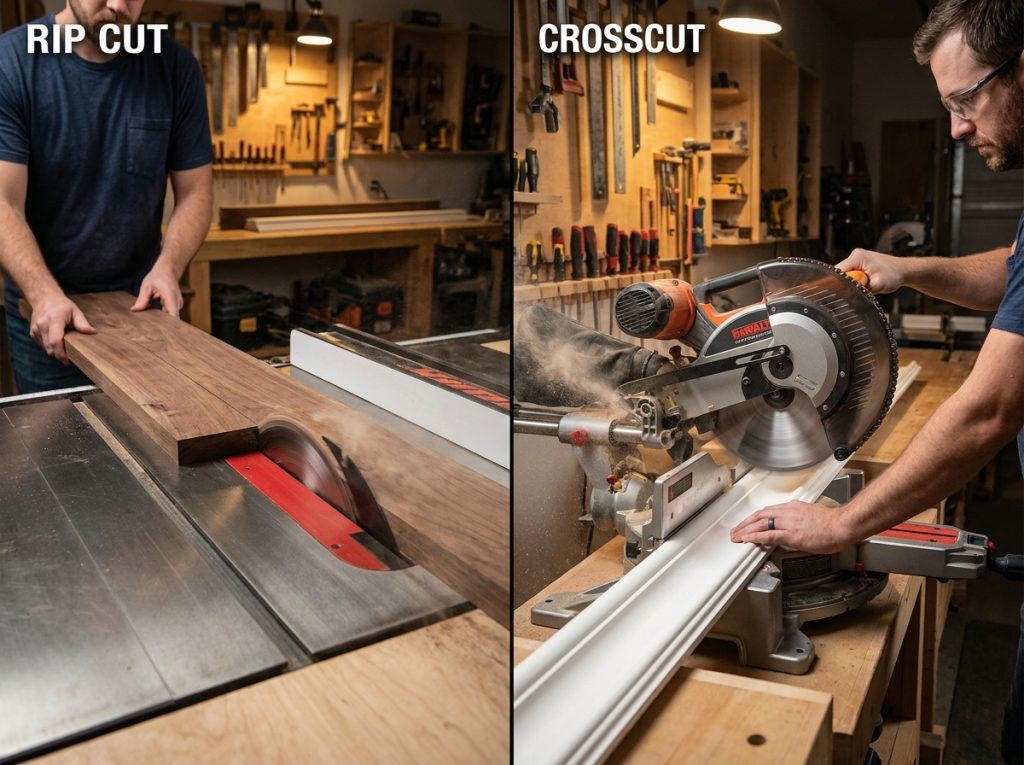
So they trade places a bit depending on the job. Neither one is always the ‘main’ saw. Though if I’m being honest — over the course of a full project, the table saw usually gets more total hours.
I’ve probably changed my mind on how I’d answer this question three or four times over the years. This is where I’ve landed for now — though ask me again after the next big job and maybe I’ll think differently.
The table saw — what it actually does day to day
A table saw rips. That’s the core thing. You’re feeding wood into a spinning blade, you get two pieces out. Ripping boards to width. Breaking down a 4×8 sheet of plywood. Cutting panels to a specific dimension. That’s table saw territory.
But the thing I didn’t fully appreciate when I first got one is how much else it does once you start adding sleds and jigs. Dado cuts for shelves. Tenons if you rig up the right jig. Tapers. Rabbets. Bevels. The table saw starts as a ripping machine and turns into the center of the whole shop pretty quickly. It’s more of a platform than a single tool.
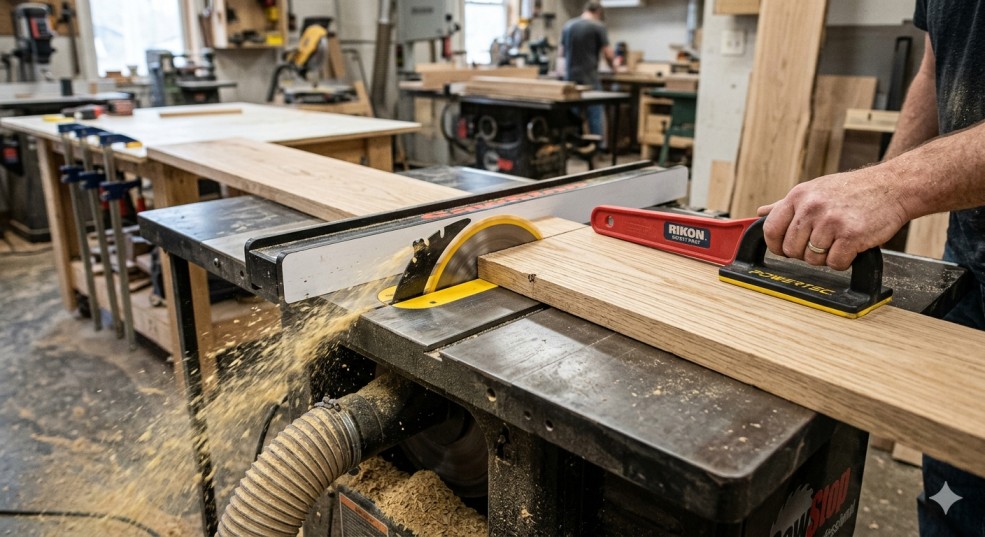
I did a full wall of built-ins for a client a few years back — floor to ceiling, painted MDF carcasses with hardwood face frames. The table saw ran basically all day every day for close to two weeks. Ripping poplar for the frames, cutting MDF panels to size, making the face frame stock. The miter saw got used maybe an hour a day for the pieces that needed clean angle cuts. That’s a pretty typical ratio on that kind of work.
On trim-heavy jobs the ratio flips completely. I did a whole-house renovation — baseboards through every room, crown in the main areas, door casing on something like 22 doors — and the table saw barely came out. The miter saw ran all day. So I don’t want to overstate the table saw’s dominance. It depends on what you’re actually building.
The table saw starts as a ripping machine and turns into the center of the shop pretty quickly. You add sleds and jigs and suddenly it’s doing things you didn’t expect when you bought it.
What makes it annoying in real use
Setup time is the big one. Checking blade alignment, setting the fence parallel, confirming square — every time you set up somewhere new, that’s 15 minutes minimum before you trust the first cut. Probably more if something shifted in transport, which it does. I showed up on a job once and the fence was reading almost half an inch off from where I’d left it. Still have no idea what happened on the drive.
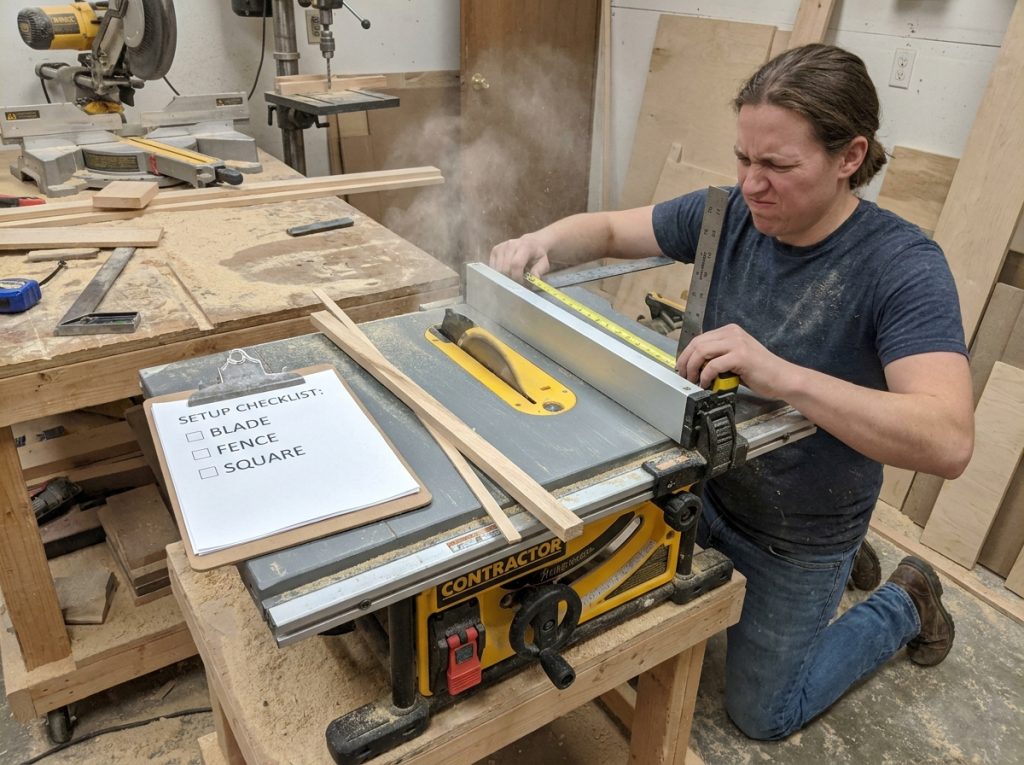
I have a laminated checklist now. Blade to miter slot, fence parallel to blade, blade 90 degrees to table. I go through it every setup. Some guys think that’s overkill. I’ve been burned enough times to not care what they think.
Dust is its own issue and I’ll get into that more. But briefly — the table saw makes more fine dust than anything else in the shop. It coats everything.
And ripping narrow pieces — anything under a couple inches wide — makes me tense every time. You’re getting close to the blade with a push stick, the piece can bind against the fence, kickback is a real thing. I’ve had it happen twice. Both times partly my fault. It doesn’t take much and it happens fast.
The miter saw — one thing, done well
The miter saw does one thing. Crosscuts. Chops boards to length, handles angles and bevels and compound miters. That’s genuinely the whole story.
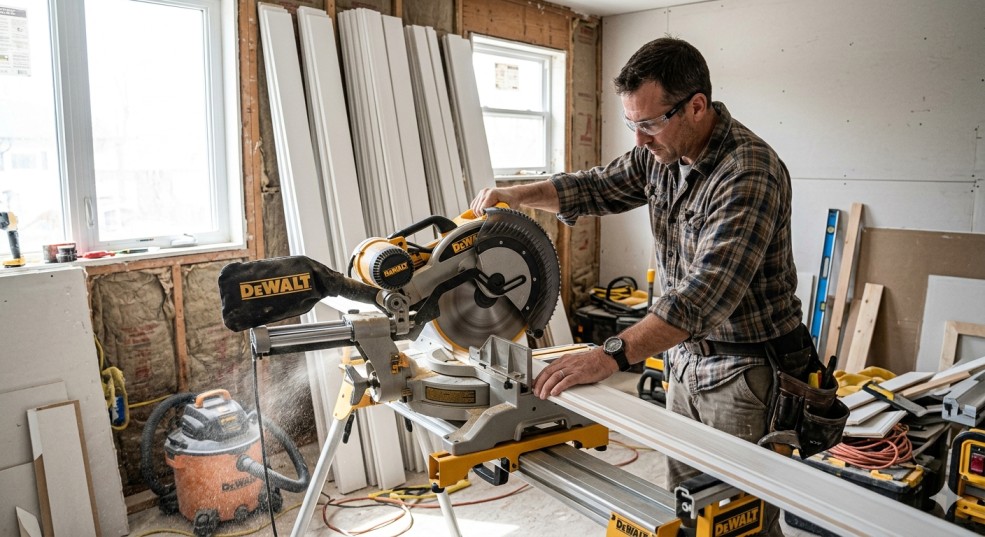
And it does that one thing in a way the table saw can’t really match for speed. Set your angle, mark your piece, push it against the fence and drop the blade. Clean cut. Same angle on the next piece. No real setup between cuts. When you’re installing crown molding or running baseboard through a whole house, that speed matters a lot.
The sliding compound miter saw is worth the extra money if you’re cutting wide boards regularly. Non-sliding 10-inch saw gives you maybe 5 or 6 inches of cut width at 90 degrees. Fine for most trim. Limiting if you’re cutting wider stock. I flip boards and finish cuts when I have to, but every flip introduces a small chance of error and it slows you down. The sliding version mostly eliminates that.
What it can’t do: rip. At all. Can’t cut sheet goods. Can’t dado, can’t rabbet, can’t do anything along the length of a board. I mention this because people get their first miter saw and somehow expect it to take the place of a table saw. It won’t. These are genuinely different tools.
People also ask me whether a miter saw can replace a table saw for crosscutting — like, can you just do your crosscuts there and skip having a table saw? And sort of, yeah, if you’re buying pre-dimensioned lumber and you only need to crosscut. But the moment you need to rip anything to width, you’re stuck.
The stuff that doesn’t come up enough
The dust from a miter saw goes toward you. I don’t know why this surprised me the first time but it did. The chip chute is pointed down and back, the bag catches the visible stuff, and the fine dust still goes everywhere — including at your face. I rigged up a shop vac connection early on and it helped significantly. Without it you’re basically standing in a cloud.
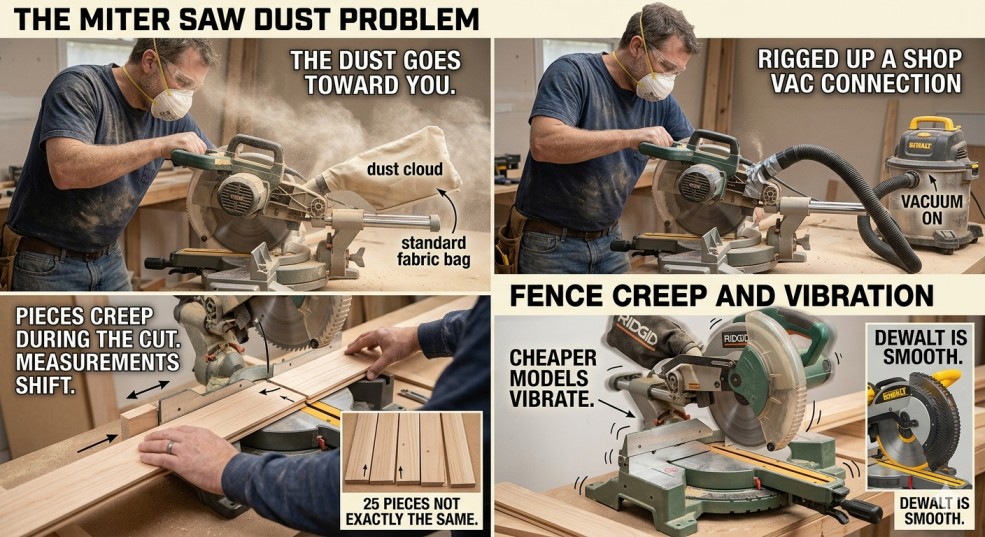
The fence on most miter saws has this thing where long boards want to creep during the cut if you’re not paying attention. You’re holding the piece with one hand and pulling the blade down with the other and if you don’t have a stop block, pieces shift. On a one-off cut it doesn’t matter. When you’re trying to cut 25 pieces of baseboard to the exact same length, any shift throws your measurement.
Also — and maybe this is just the saws I’ve been around — the vibration on cheaper models gets old fast. The blade guard rattles, the whole thing shudders when you drop the blade. My current DeWalt is smooth. An older Ridgid I had before it used to shake like something was loose inside. I never figured out what.
If I strip all the explanations away, here’s how they actually break down
I might be simplifying some of these. There are edge cases where a table saw crosscut is actually better than a miter saw — wide sliding sled for really controlled work, for instance. But for how most people use these saws day to day, this is roughly accurate.
Setup time — this sounds boring but it actually changes how you work
Miter saw: set it down, plug it in, confirm your 90-degree stop with a speed square, make a cut. You’re running in maybe two minutes. That’s why every contractor brings one to every job — fast to deploy, fast to pack up.
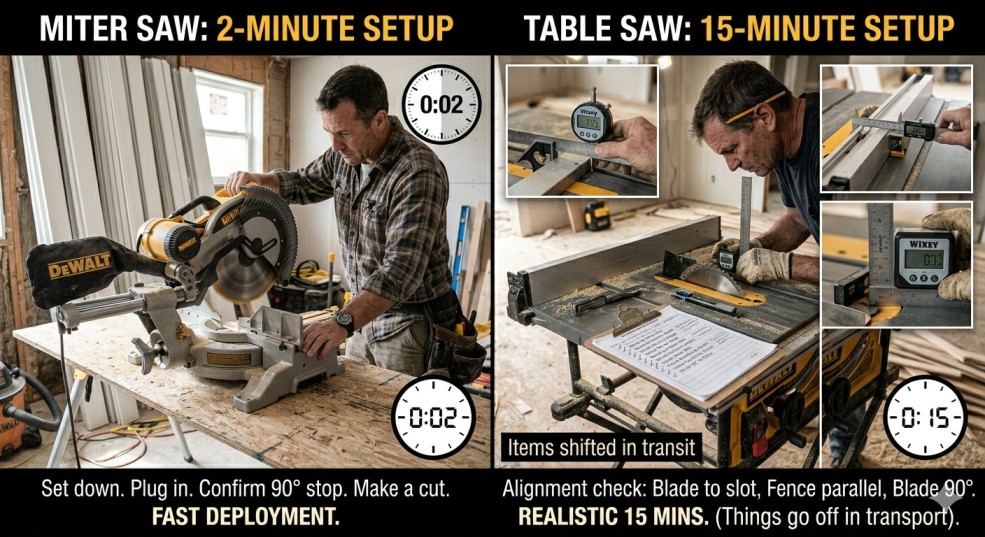
Table saw: longer. Noticeably longer if you care about the first cut being right. I go through alignment every time I set up on a new site. Blade to miter slot, fence parallel, blade perpendicular to table. That’s realistically 15 minutes before I’m confident. More if something’s off. Things do go off in transport — I don’t know if it’s vibration or bumps or what, but I’ve stopped assuming the saw is dialed in just because I set it right yesterday.
On a job where I’m setting up once and working for a week, that 15 minutes doesn’t really matter. On a job where I’m moving between sites or between parts of a building, the setup overhead adds up.
I’ve watched guys skip the alignment check and just start cutting. And usually it’s fine — saws hold calibration reasonably well. But when it’s not fine, you don’t always notice right away. You get through half a day of cuts and then something doesn’t fit together the way it should and you have to figure out why. That’s its own kind of time-wasting.
The miter saw has its alignment things too — bevel detents, miter detents, blade square to fence. But that check takes a couple minutes. It’s just less involved.
Motor behavior — under real load, not spec numbers
Both saws have 15-amp motors on most models. That number tells you something but not everything. The way a motor behaves under sustained load is different from what the amp rating implies.
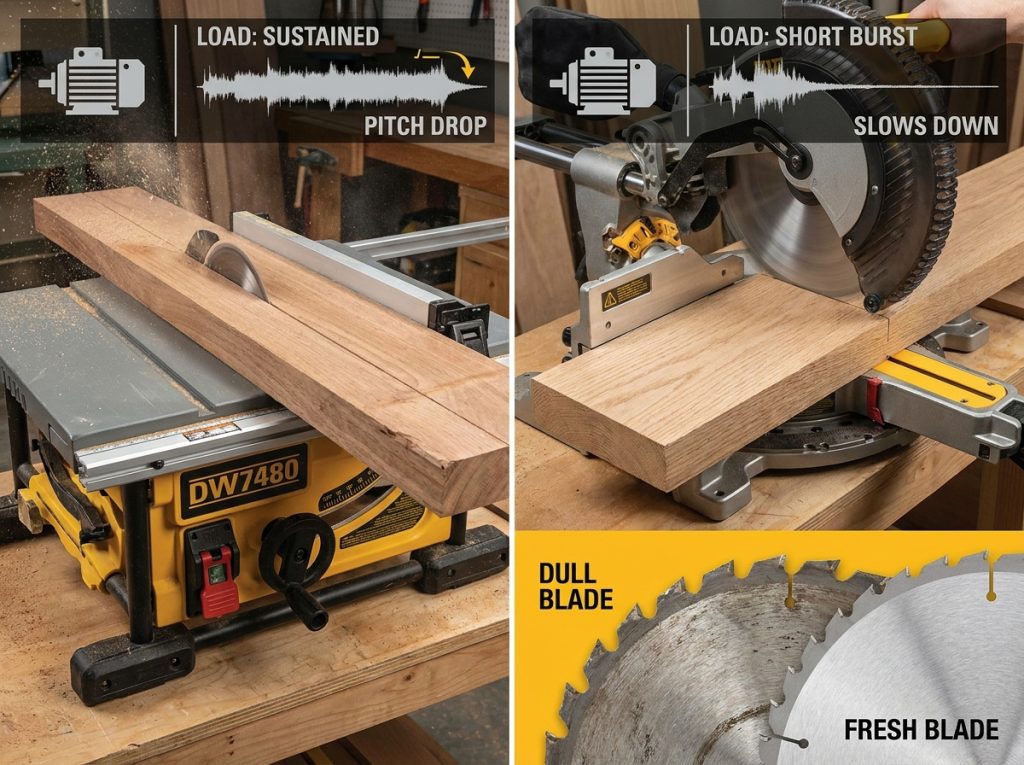
On the table saw, you’re asking the motor to hold speed continuously for the length of a rip cut. Through 8/4 hard maple, a decent jobsite saw like the DW7480 will audibly drop in pitch — you can hear it working. It recovers, but you learn to feed slower on the dense stuff. I had a cheaper saw earlier in my career, I won’t name it, that would bog down badly on anything thicker than 3/4-inch hardwood. It wouldn’t die cleanly either — it would stall with the blade still in the wood. That’s a dangerous situation. That saw got replaced fast.
The miter saw motor is under full load for maybe a second or two per cut. Even hard materials don’t stress it much. The one time I remember a miter saw struggling was cutting 4-inch thick oak stair treads — the blade noticeably slowed and the cut quality suffered. But that’s not really what a miter saw is built for, so I’m not sure that’s a fair complaint.
Blade condition matters more than most people account for. A dull blade makes any motor work harder. I track blade use now, which I didn’t used to do. Swapping in a fresh blade on the table saw sometimes feels like getting a new saw — it just sails through stuff that was laboring it the week before. That’s probably obvious but it took me longer than it should have to internalize.
One thing I’d add: thin-kerf blades take noticeably less motor effort. If your jobsite saw is struggling, swap to a thin-kerf blade before concluding the motor isn’t enough. It helped me a lot.
Cut quality — what you actually get off the saw
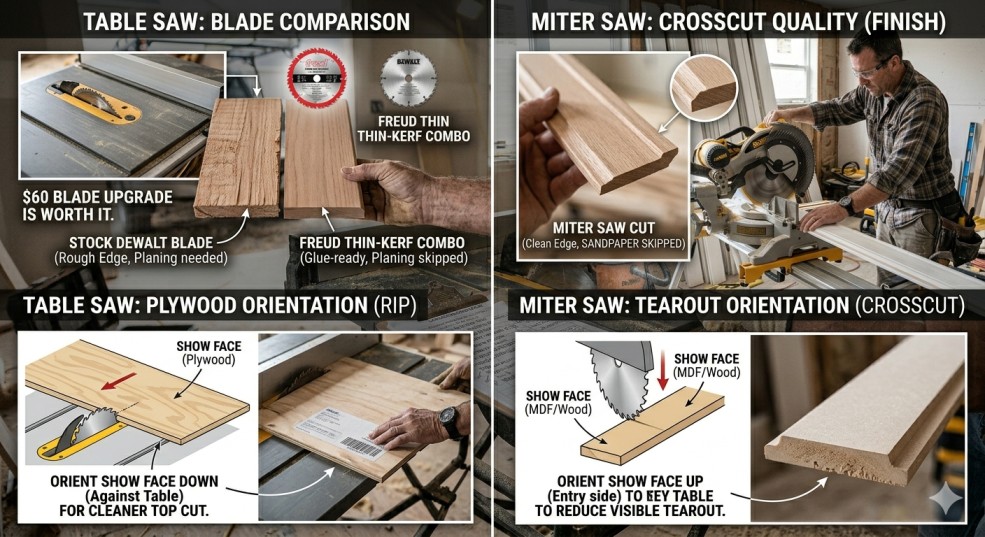
Table saw cut quality varies a lot depending on blade choice. The stock blade that comes with most saws is adequate for rough work and not much more. I ran the stock DeWalt blade for about a month and then swapped in a Freud thin-kerf combination blade and the difference was more than I expected. Not dramatic on rough rips — but on hardwood crosscuts, the surface went from needing a pass with the plane to being close to glue-ready. That’s a $60 blade. I should’ve done it immediately.
For ripping, a 24-tooth rip blade chews through quickly and leaves a rough edge. Fine if you’re jointing afterwards. A 40-tooth combination blade is more versatile — decent rips and decent crosscuts. An 80-tooth blade is for fine crosscutting and slows you down noticeably on rips. Most people who ask about blade choice end up landing on a good 40-tooth combination blade for general use.
Something I figured out from cutting a lot of plywood: put the show face down on the table saw. The bottom face (against the table insert) has cleaner surface quality than the top. So if one side of your panel is going to show, orient it down. Basic thing but it wasn’t obvious to me at first.
Miter saw crosscuts, with a good blade, are often cleaner than table saw crosscuts. The drop-cut motion leaves a nicer surface. I’ve cut trim pieces on the miter saw and gone straight to installation without touching them with sandpaper. That almost never happens with table saw crosscuts.
Opposite deal for tearout: on the miter saw, the show face goes up. The blade descends into the top face and if there’s tearout it’s there. Put the good side up and let it be the entry face.
I’ve mixed these up more than once and ruined pieces I didn’t want to re-cut. Worth remembering.
Portability — the real version, not the marketing version
Both saws call themselves portable on the box. Here’s what that actually means.
A jobsite table saw at 45-50 lbs is manageable. You can get it out of the truck solo, set it up on a stand, roll it between rooms. But it’s not grab-and-go. You’re planning it. Extension table, fence, power cord — there’s a production to it. I’ve never once picked up a table saw mid-job and just moved it. I commit to where it’s going and it stays there.
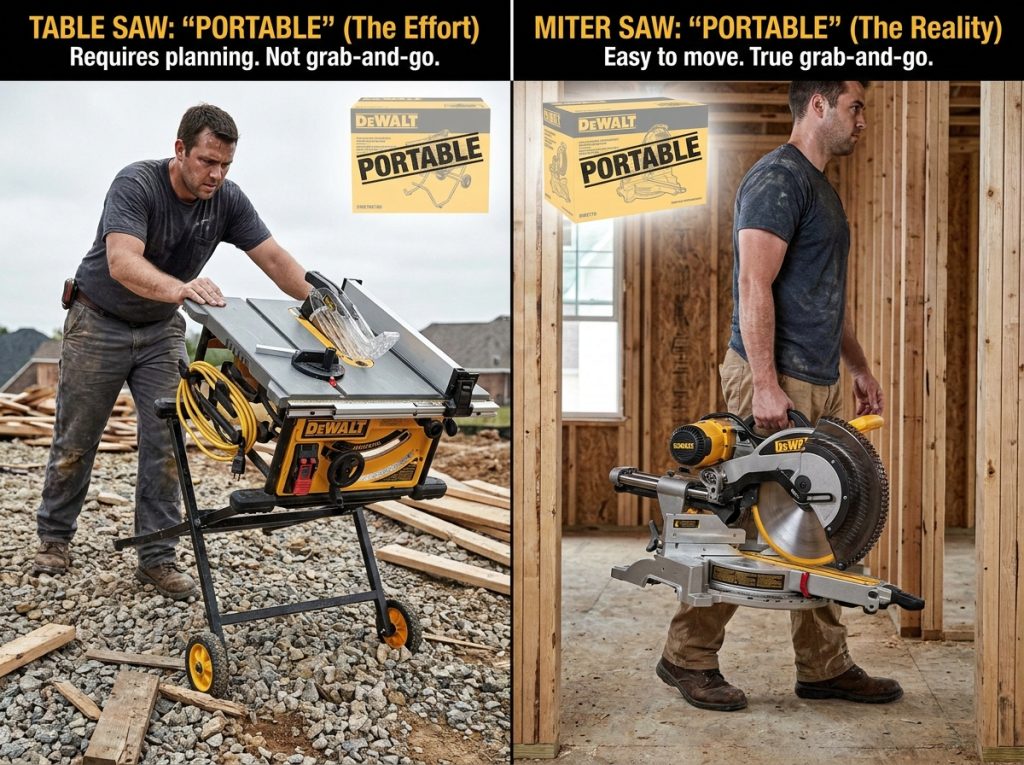
A miter saw at a similar weight feels more portable in practice because of the form factor. Compact, dense, handle on top. You pick it up and move it. I’ve moved a miter saw between rooms on a trim job probably 50 times without thinking about it. Never done that with a table saw.
The rolling stand on the DeWalt jobsite saws changed this somewhat. Within a building on a smooth floor it rolls fine. Take it outside on rough ground and the small wheels catch on everything. I’ve had the saw nearly tip on me on uneven pavement. Frustrating.
The sliding compound miter saw changes the miter saw’s portability story too. Mine’s 65 lbs and awkward to carry solo. Still more portable than a table saw, but it’s not the light quick-deploy tool a small 10-inch non-slider is.
For pure jobsite mobility — moving between rooms, between floors, loading in and out of the truck multiple times a day — the miter saw wins clearly. On a shop setup where everything has a permanent spot, portability barely matters and the comparison gets less interesting.
Dust — I’ll try to be honest here because most reviews aren’t
Both saws make a lot of dust. Different kinds, different directions, both a problem.
The table saw puts out fine dust that goes everywhere — below the table, above the table, into the air, into everything in the shop. The visible sawdust on the floor is the easy part. It’s the airborne fine particles you can’t see that are the real issue over time. The 2.5-inch port at the back connects to a shop vac and captures maybe 60-70% of what the saw produces. The rest escapes from the blade area above the table and from gaps in the cabinet and just goes wherever it wants.
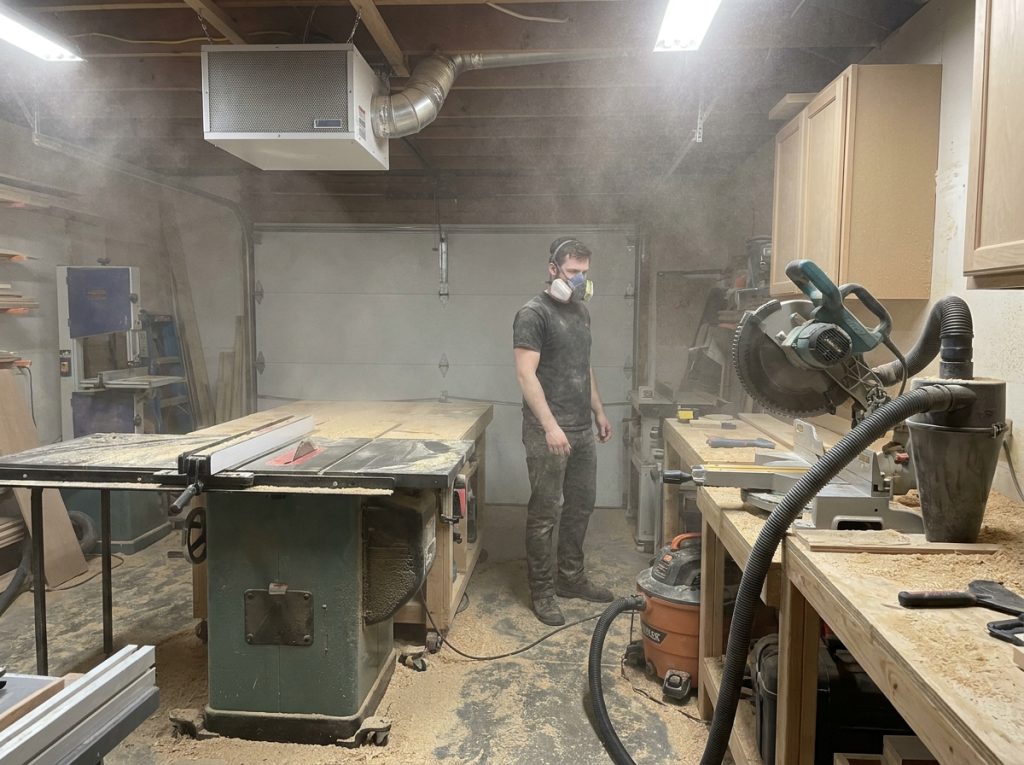
I ended up with a cyclone separator between the saw and the vac so the vac doesn’t fill up every 20 minutes, and I run an ambient air filter whenever the saw’s on. Still not perfect. But manageable enough that I’m not finding dust on my coffee mug across the shop.
Miter saw dust goes more toward you, in my experience. The chute sends coarser chips down into the bag, and fine dust goes forward and up. Connecting a shop vac to the port helps significantly — probably more than on the table saw, actually, because the geometry captures dust better. Without the vac, the dust bag is mostly decorative.
Long-term lung stuff: fine hardwood dust is genuinely bad and I didn’t take it seriously enough for the first few years. I wear a P100 respirator now for any extended session on either saw. A paper dust mask isn’t doing what you think it’s doing. I know that sounds dramatic but I’m not being dramatic.
The dust bag on a miter saw is mostly decorative. Connect a shop vac or accept that you’re just relocating the dust.
Safety — no easy way to write this section
The table saw sends more woodworkers to the emergency room than any other tool. I’m not saying that to scare anyone. It’s just the actual statistics, and they exist for a reason.
Kickback is the main thing. Board gets pinched between the blade and the fence — usually because the wood moves as you cut or you’re ripping something that wants to close on the kerf — and it comes back at you hard and fast. I’ve had it happen twice in my career. Once ripping wet lumber that hadn’t dried properly and closed on the blade mid-cut. Once when I was distracted and didn’t have the splitter in place. Both times I walked away fine. Both times I was partly careless. Both times felt like a reminder.
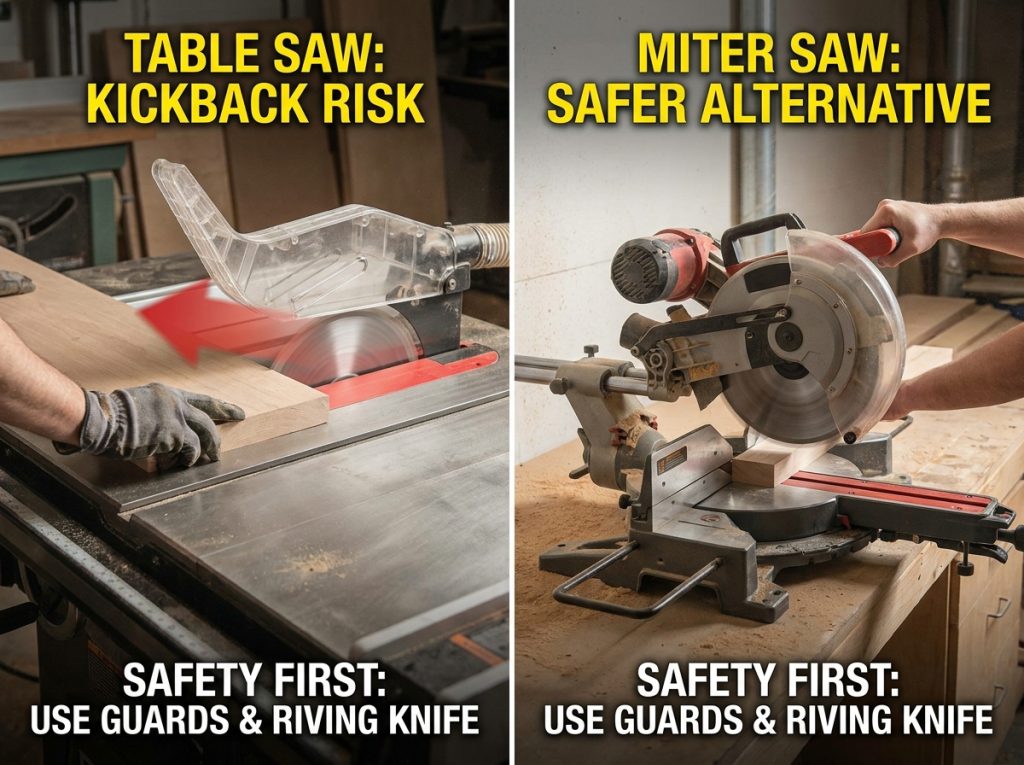
A riving knife or splitter behind the blade is not optional in my shop. It keeps the kerf open so the wood can’t pinch. Modern saws have them. Some older saws have had them removed because people find them inconvenient. If yours doesn’t have one — stop, get one, put it back. I won’t run a table saw without it.
The miter saw is genuinely safer in day-to-day use. The blade goes down, cuts the wood, comes back up. You’re not feeding material against a spinning blade. Kickback as a concept doesn’t apply the same way. The main risk is hand placement — people get comfortable and complacent and put fingers closer to the blade than they should. That’s its own thing, but it’s a different kind of hazard than the table saw’s.
I’d steer a beginner toward the miter saw first, honestly. Learn how power saws behave, understand what the blade is doing, get comfortable with the whole experience. Then step up to the table saw with that foundation. The table saw demands more awareness from the start.
That said — the safety equipment exists on both saws for a reason. I’ve worked alongside experienced guys who strip off every guard because they find it in the way. Their choice. I’ve kept mine. Slower sometimes, yes. Fingers still attached, also yes.
Who actually needs which saw — based on real usage, not generic advice
Here’s how I think about it.
If you’re building things — furniture, cabinets, shelving, built-ins, anything that starts from rough or dimensional lumber — you need a table saw first. The work requires ripping, and nothing else rips. The miter saw becomes useful once you’re cutting parts to final length and doing angle work, but it’s the second tool in that workflow, not the first.
If you’re doing trim and finish carpentry — baseboard, casing, crown, molding — and you’re buying pre-dimensioned stock, the miter saw might actually be more useful day to day. You’re crosscutting and mitering constantly, you’re not ripping, and the table saw might sit there more than it runs. I’ve had weeks like that.
Framing and site carpentry work: miter saw, no question. Cutting studs, plates, rafters to length — you want fast crosscuts on site, portability, minimal setup. Table saw doesn’t make much sense in that context.
Deck work, fence work, any outdoor structure: depends, but usually the miter saw gets more use. You’re cutting a lot of boards to length. Occasionally ripping something — maybe — but not enough to justify hauling out the table saw if you don’t already have one.
The ‘get both’ answer is real but I know it’s not always available. If you’re choosing one: table saw for woodworkers and shop work, miter saw for trim contractors and site work.
I might be overthinking the line between these, honestly. Plenty of guys do fine with just one and figure out workarounds. I just keep finding situations where having both is obviously the right tool for that moment, and the workaround is clearly slower or worse.
A few things people keep asking
Can a miter saw replace a table saw — this one comes up a lot. Short answer is no, and the reason is simple: it doesn’t rip. The moment you need to cut a board along its length, you need a table saw. That happens constantly in actual woodworking.
Can a table saw replace a miter saw — technically yes, but slowly. You can make miter cuts with the blade tilted and a miter gauge, or using a crosscut sled with an angled stop. But setting up a 22.5-degree miter on a table saw takes a few minutes. On a miter saw it takes ten seconds. For one cut, sure. For a trim job with 60 angle cuts, doing it on a table saw will drive you crazy.
What about track saws — I get this one more now. Track saws are genuinely good for breaking down sheet goods on site, especially for one person working without outfeed support. I have one and I like it. But it doesn’t replace the table saw for ripping solid lumber, or for dadoes, or for any of the jig-based work. It’s a complement, not a replacement.
Sliding vs non-sliding miter saw — for most trim work, a non-sliding 10-inch or 12-inch is completely sufficient. The sliding version matters if you’re cutting wide boards regularly — stair treads, wide stock, anything over 5 or 6 inches. If you’re mostly running baseboard and casing, you might not notice the difference enough to justify the extra cost. I went sliding because I wanted the flexibility. Not sure I use it as much as I expected to on that specific feature.
What I’m actually running right now
Table saw is a DeWalt DWE7491RS on the rolling stand. Replaced the DW7480 after I needed more rip capacity for wider panels. The fence on this is noticeably better than the DW7480’s — less slop when micro-adjusting. The rolling stand is excellent on site. I’ve had it a couple years and the only complaint is the dust port, which is the complaint I always have.
Miter saw is a DeWalt DWS779, 12-inch sliding compound. This is the saw I’ve been telling people to buy for a while. Accurate detents, smooth cut motion, good for a miter saw on dust. It replaced a Ridgid that gave me probably 4 years of good service before the detents got sloppy and I stopped trusting the angles.
I ended up at DeWalt on both largely by accident — just upgrading over time and landing there through the process. I’ve run Bosch, Makita, Ridgid, Milwaukee at various points. They all have things to recommend. DeWalt’s jobsite durability is what kept me there.
One last thing
If I had to start over and buy only one first, I’d still go table saw. But I also know guys who started with a miter saw and didn’t regret it either. One of them does exclusively trim and finish work and honestly the table saw might be less useful to him than the miter saw is. It really depends on what kind of work you end up doing more of — and when you’re starting out you don’t always know that yet.
What I’d say is: whichever you get first, learn it properly. Alignment, blade selection, safety habits. A well-dialed-in cheap saw beats a poorly-set-up expensive one. I’ve seen enough of both to feel confident about that.
The comparison between these two saws sounds like a simple question. The longer you work with both of them the more the answer feels like it depends on the week.

Finlay Connolly is a woodworking enthusiast and power tool specialist with over a decade of hands-on experience in the workshop. As the founder and lead writer at ProTableSawReviews.com, Finlay combines expert knowledge with real-world testing to help woodworkers, DIYers, and professionals choose the best tools for the job. With a sharp eye for detail and a passion for precision, Finlay is committed to providing trustworthy, practical advice backed by years of experience and research in the field. Whether you’re cutting dados or comparing fence systems, you can count on Finlay for honest, reliable reviews that make your next cut your best one.