SawStop Compact Table Saw Review: The Honest Case For and Against $974
 Finlay Connolly
10 min read
Finlay Connolly
10 min read
That number is worth sitting with for a second. The SawStop CTS-120A60 — the Compact Table Saw, SawStop’s most affordable model — currently retails at $974 after a July 2025 price increase. The DeWalt DWE7491RS sits at $649. The Ridgid R4514 is $549 with a Lifetime Service Agreement.
The $325–$425 gap between the SawStop and its nearest competitors is the entire conversation here. Not specs. Not fence quality. Not dust collection. The question is whether the flesh-detection brake system — the thing that has physically saved fingers, hands, and careers since SawStop’s first saw shipped in 2004 — is worth that premium for the way you work.
For some woodworkers, it obviously is. For others, it honestly isn’t. Most reviews won’t say that second part out loud. This one will.
What the Brake System Actually Does (And What It Doesn’t)
The Active Injury Mitigation system works by passing a small electrical signal through the blade constantly while the saw is running. Human tissue is conductive enough to change that signal. When the signal shifts — which happens within milliseconds of skin contact — an aluminum brake block fires into the spinning blade, stops it, and drops the whole assembly below the table. The process takes under 5 milliseconds. The typical outcome is a small cut rather than an amputation. SawStop has documented hundreds of activations and the injuries are consistently minor.
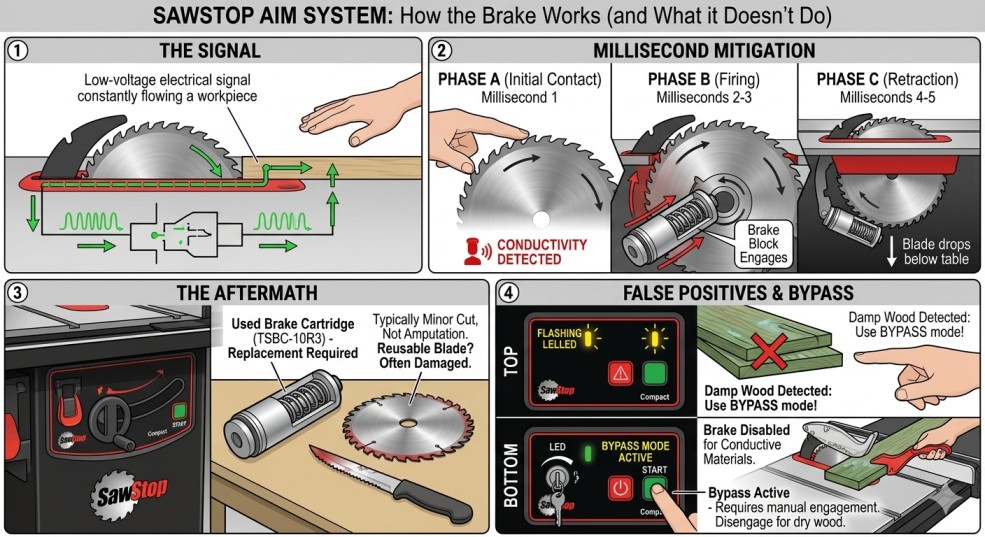
That’s real. It’s not marketing. The physics works, the documented outcomes are genuine, and the technology has been independently verified enough times that there’s no serious debate about whether the brake functions as described.
What the system doesn’t do: distinguish between skin and anything else that’s electrically conductive. Wet wood triggers it. Green lumber triggers it. Pressure-treated lumber straight from the yard will trigger it. Highly resinous wood can trigger it under some conditions. A member on FineWoodworking’s forum described a false activation while cutting slightly damp wood — hands nowhere near the blade, guards fully in place, saw just fired mid-cut. Each false activation costs you the brake cartridge ($95 replacement, model TSBC-10R3) and the blade if it’s damaged in the stop.
SawStop’s answer to this is Bypass Mode — a deliberate override that disables the brake for conductive materials. It works, and the saw’s detection system will actually warn you before a cut if the material you’re testing would trigger a false positive. But Bypass Mode requires you to actively remember to engage it for every suspect board, then remember to disengage it afterward. In a workflow where you’re mixing kiln-dried hardwood with construction lumber off a jobsite, that cognitive overhead adds up.
This isn’t a reason not to buy the saw. It’s a reason to know your workflow before you buy it. Furniture makers working exclusively with kiln-dried hardwoods will rarely if ever touch Bypass Mode. Contractors cutting whatever lumber is on site that day will use it constantly.
The Specs That Matter on a $974 Saw
The CTS-120A60 runs a 15-amp direct-drive motor at 4,000 RPM. SawStop notably doesn’t publish an HP rating for this saw — they’ve stated publicly that HP ratings at this class of saw are inconsistently measured across brands and often misleading. What they say instead is that the 15-amp motor is comparable to top competitors in this class. In practice, the saw handles 8/4 hardwoods (oak, maple, walnut) without bogging under reasonable feed rates, though dense 8/4 at full depth requires slowing down.
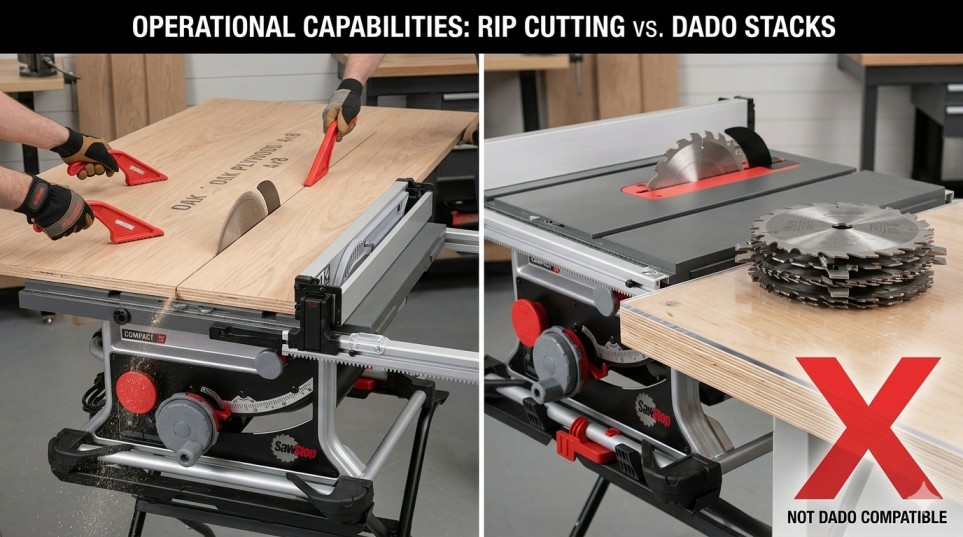
Rip capacity: 24.5 inches to the right, 9.5 inches to the left. This covers ripping full sheet goods — standard plywood is 48 inches wide, so a 24.5-inch rip capacity means you can cut 4×8 panels in half in a single pass. It’s narrower than the DeWalt DWE7491RS (32.5 inches) and only marginally smaller than the SawStop Jobsite Saw Pro (25.5 inches, $1,899). For most furniture and trim work this is adequate. For contractors regularly breaking down sheet goods into thirds or ripping wide stair stringers, you’ll feel the limitation occasionally.
Cut depth: 3.125 inches at 90 degrees, 2.125 inches at 45. That handles 4×4 lumber at 90 and 2×6 at 45 — sufficient for most construction and furniture applications.
The saw cannot use dado blades. This is a hard limitation, not a workaround situation. The forces required to stop a dado stack are greater than the CTS chassis can manage safely. SawStop directs dado users to the Jobsite Saw Pro. If dado work — drawer boxes, shelving dadoes, rabbets — is part of your regular workflow, the CTS is the wrong saw and stepping up to the JSS Pro adds roughly $900 to your budget.
Weight: 68 lbs for the saw body. The folding stand (model CTS-FS) is sold separately at $139–$150 and adds 18 lbs. Total operating weight with stand is about 86 lbs. That’s heavier than a Ridgid R4514 on its rolling stand (~52 lbs) and lighter than a fully equipped DeWalt DWE7491RS setup. Manageable for one person on flat terrain, awkward on stairs or loading into a truck bed.
The Fence Is Legitimately Good
Most reviews spend all their time on the brake and gloss over the fence. That’s a mistake, because the rack-and-pinion fence on the CTS is one of the things that genuinely separates it from lower-cost competitors.
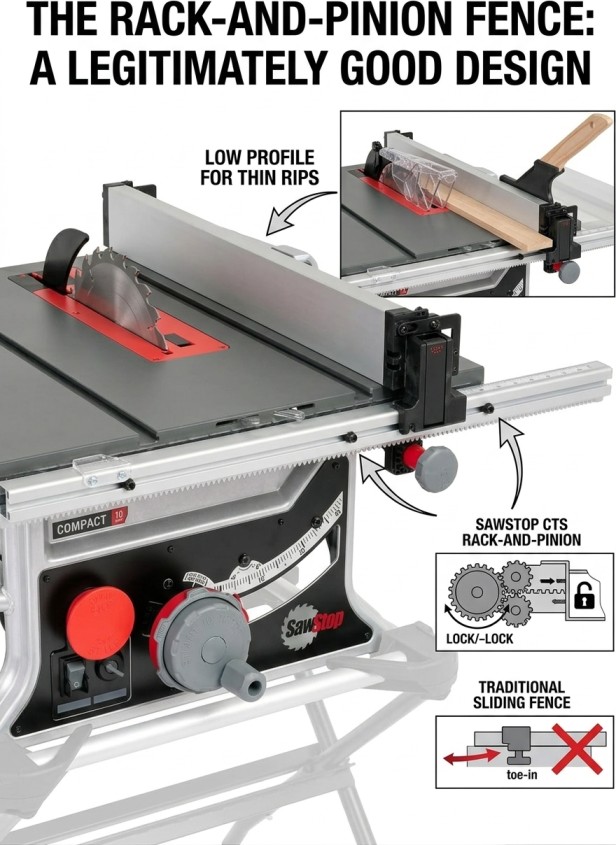
The rack-and-pinion mechanism means the fence moves via a gear system rather than sliding friction. You turn a dial, the fence moves to exactly where you set it, and it locks there. No push-and-clamp, no checking whether the fence drifted a hair when you locked it down. The aluminum fence face locks at both front and rear, which is what keeps it parallel to the blade without requiring a separate check each time.
For comparison: the Ridgid R4514’s stock fence is a known problem (front-and-back clamp with a plastic rear guide that can flex and allow toe-in). The DeWalt DWE7491RS’s rack-and-pinion fence is good — arguably the best fence at its price point in the jobsite class. The SawStop CTS’s fence is in the same tier as DeWalt’s, and meaningfully better than Ridgid’s stock setup.
One thing worth knowing: the CTS has a high/low fence profile (the face can be flipped to a lower position for thin rips), which the Jobsite Saw Pro’s T-style fence doesn’t offer in the same way. For narrow rip cuts where your push stick needs to clear the fence, the low fence position is a practical safety aid that SawStop’s own documentation recommends using.
What the True Cost Looks Like
The $974 saw price is the starting point, not the ending point.
A fully operational CTS setup that you’d actually want to use looks like this:
| Item | Cost |
|---|---|
| CTS-120A60 saw body | $974 |
| CTS-FS folding stand | ~$139 |
| Spare brake cartridge (smart to have one) | ~$95 |
| Total | ~$1,208 |
That’s before a blade upgrade. The stock 24-tooth combination blade is adequate for rough ripping but produces tear-out on finish cuts. A Freud or Diablo 40–60-tooth blade appropriate for the work adds another $50–80.

SawStop CTS Compact Table Saw
A compact table saw designed for workshop and jobsite use. It offers a space-saving design with reliable cutting performance for woodworking projects.
Check Price on AmazonFully equipped with stand, spare cartridge, and a decent blade: $1,280–1,300. Against a fully equipped DeWalt DWE7491RS (~$649 + blade) or Ridgid R4514 (~$549 + blade + aftermarket fence), the SawStop premium is real and it’s larger than the $974 sticker implies.
The counterargument — and it’s a legitimate one — is that a single table saw injury costs tens of thousands of dollars in medical bills, lost income, and quality of life. Several Slickdeals community members have posted exactly that math, noting that a hospitalized finger amputation in the US runs $25,000+ before rehabilitation. One activation of the system that saves a finger covers the price difference 25 times over. That math is correct. Whether it applies to your risk tolerance and work situation is something only you can assess.
CTS vs. SawStop Jobsite Saw Pro: The Comparison That Matters More Than CTS vs. DeWalt
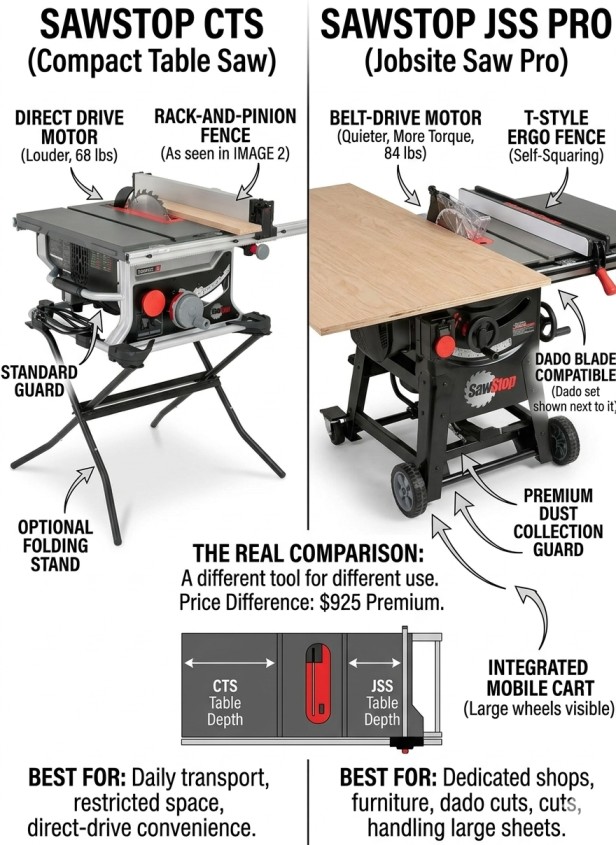
Most articles compare the CTS to the DeWalt or Bosch. I’d argue the more important comparison is between the CTS and SawStop’s own Jobsite Saw Pro (JSS, currently $1,899).
The JSS Pro has a belt-drive motor instead of direct drive — quieter, slightly better torque delivery under heavy load. It has a self-squaring T-style ergo fence that many experienced users prefer to the rack-and-pinion for high-volume rip work. It supports dado blades (with the appropriate cartridge). Its dust collection blade guard is better than the CTS’s standard guard. And critically, the table is physically larger and deeper, which means more support surface in front of the blade — a real safety factor when guiding 4×8 sheets through a cut.
The JSS Pro is 84 lbs versus the CTS’s 68 lbs. It has a built-in mobile cart rather than an optional folding stand. And it costs $925 more.
For a contractor who moves the saw between job sites daily and does occasional sheet-good work: the CTS is the right SawStop. For a woodworker in a dedicated shop who builds furniture, cuts dadoes, and wants the best SawStop experience without going to the full contractor saw: the JSS Pro is worth the premium. The CTS is not the “good enough” version of the JSS — it’s a different tool for different use.
The Things Most Reviews Mention Too Quickly
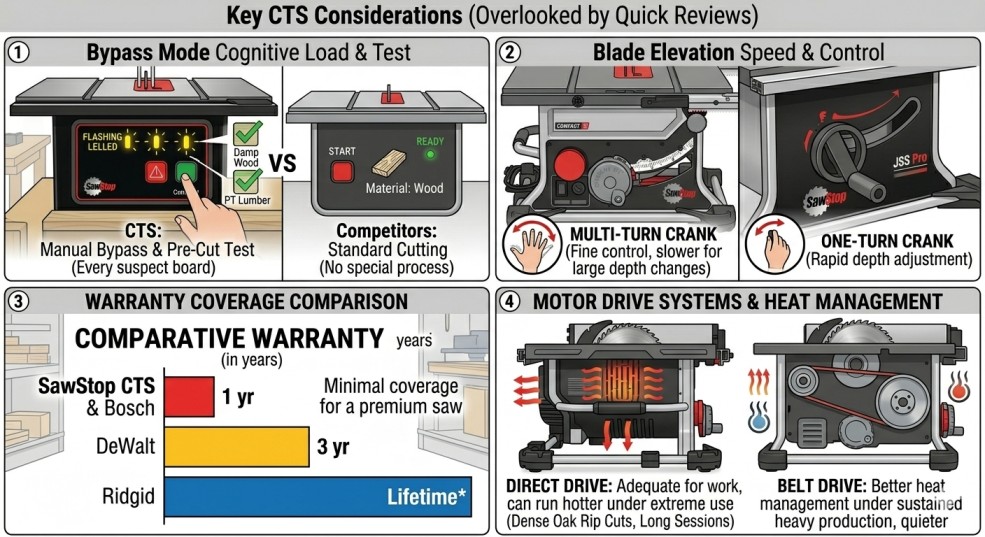
The bypass mode cognitive load. Covered above but worth repeating: if you work with varied materials — green lumber, PT lumber, high-moisture boards — bypass mode isn’t an occasional nuisance. It’s part of every session. The test function (which tells you before a cut whether a board would trigger a false positive) helps, but it’s still a step most competing saws don’t require at all.
The multi-turn blade elevation. The CTS uses a multi-turn elevation wheel to raise and lower the blade. The Jobsite Saw Pro has a one-turn system. Multi-turn means finer control but slower adjustment when moving through a big range. Minor in isolation, but if you’re making repeated depth changes across a session it adds up to a few extra seconds per adjustment.
The 1-year warranty. The CTS comes with a 1-year limited warranty — the same as Bosch’s jobsite saws. No lifetime service agreement like Ridgid, no 3-year coverage like DeWalt. For a saw this expensive, that’s a short warranty. SawStop’s broader reputation for customer service and parts availability is good, but the formal warranty coverage is minimal.
Direct drive vs. belt drive motor. The CTS’s direct drive motor is adequate for the work it’s designed for. Under hard sustained use — heavy repeated rips through dense oak, long production sessions — some owners note the motor runs hotter than a belt-drive equivalent. The belt-drive on the JSS Pro manages heat better under those conditions. For intermittent hobby use or normal contractor work this isn’t an issue. Worth knowing if you’re planning extended heavy production sessions.
Spec Comparison at a Glance
| SawStop CTS | DeWalt DWE7491RS | Ridgid R4514 | SawStop JSS Pro | |
|---|---|---|---|---|
| Price (2026) | $974 | $649 | $549 | $1,899 |
| Safety brake | ✅ Yes | ❌ No | ❌ No | ✅ Yes |
| Rip capacity | 24.5″ | 32.5″ | 30″ | 25.5″ |
| Dado capable | ❌ No | ✅ Yes | ✅ Yes | ✅ Yes |
| Fence type | Rack & pinion | Rack & pinion | Front/rear clamp | T-style ergo |
| Motor type | Direct drive | Direct drive | Direct drive | Belt drive |
| Weight (saw) | 68 lbs | 110 lbs | 52 lbs | 84 lbs |
| Warranty | 1 year | 3 years | Lifetime (LSA) | 1 year |
| Stand included | No (+$139) | Yes | Yes | Yes (mobile cart) |
Prices current as of mid-2026. Verify before purchase.
The Honest Verdict
The SawStop CTS is genuinely the safest compact table saw you can buy. The brake system works. The fence is excellent for the class. Build quality is noticeably tighter than comparably priced jobsite saws. And the fact that SawStop has documented hundreds of activations — real flesh-contact events that would have been serious injuries on any other saw — is not nothing.
What the CTS is not: the obvious choice for every woodworker at $974. The no-dado limitation rules it out for anyone who uses dado stacks regularly. The bypass mode requirement adds friction for contractors cutting mixed materials. The 1-year warranty is thin for the price. And the rip capacity, at 24.5 inches, is tighter than both the DeWalt and Ridgid competitors despite costing more.
Maybe I’m in the minority here, but I think the “is SawStop worth it” question gets framed wrong in most articles. The frame is usually cost vs. safety. The better frame is: what is your actual injury risk given how you work? A furniture maker doing deliberate, methodical cuts with quality technique on dry hardwood in a well-lit shop has genuinely different risk exposure than a contractor pushing production cuts through varied materials at speed. The safety premium is more defensible for the second person than the first.
If you work in a situation where the brake is likely to matter — high volume, varied materials, distractions, others in the workspace, or simply a healthy acknowledgment that you’re fallible — the CTS at $974 fully equipped to ~$1,200 is a price worth paying. If you’re a careful, methodical hobby woodworker working clean hardwoods with proper technique in a controlled environment, the honest answer is that the DeWalt’s better rip capacity and 3-year warranty might serve you better for $300 less.
The saw doesn’t make that decision for you. But at least now you’re making it with the right information.

Finlay Connolly is a woodworking enthusiast and power tool specialist with over a decade of hands-on experience in the workshop. As the founder and lead writer at ProTableSawReviews.com, Finlay combines expert knowledge with real-world testing to help woodworkers, DIYers, and professionals choose the best tools for the job. With a sharp eye for detail and a passion for precision, Finlay is committed to providing trustworthy, practical advice backed by years of experience and research in the field. Whether you’re cutting dados or comparing fence systems, you can count on Finlay for honest, reliable reviews that make your next cut your best one.